
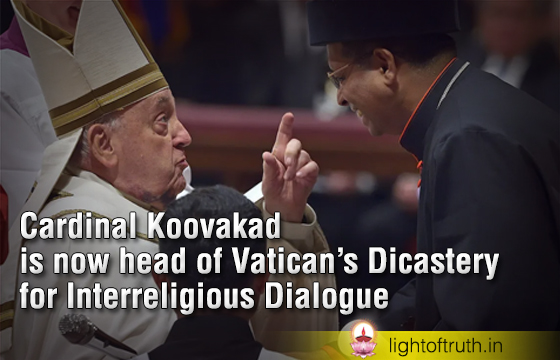
The Major Archbishop of the Syro Malabar Church has lauded the Vatican for appointing Cardi-nal George J. Koovakad as the new prefect of the Dicastery for Interreligious Dialogue. The Jan. 24 appointment of Koovakad is “a matter of great pride for his mother Church and the Indian Church,” said Major Archbishop Raphael Thattil. Koovakad becomes the second Indian cardinal to head a Vatican office after Cardinal Ivan Dias, who was Prefect of the Congregation for the Evangelization of Peoples from 2006 to 2011. Dias died in 2017. In his message, Thattil, said, “Koovakad will be able to promote harmony between different religions and accelerate dialogues for peace.” The dicastery is responsible for nurturing dialogue with Muslims, Buddhists, Hindus, Sikhs, and members of other world religions.
Daily Archives: January 31, 2025
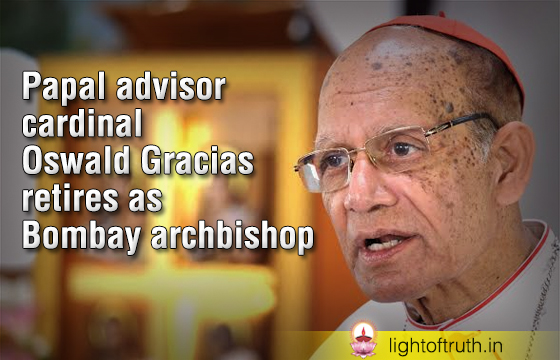
Papal advisor cardinal Oswald Gracias retires as Bombay archbishop
Pope Francis accepted the resignation of Cardinal Oswald Gracias as the Archbishop of Bombay on Jan 25 and elevated Coadjutor Bishop John Rodrigues as his successor in India’s largest diocese. Although retired from the archbishop’s office, Gracias continues serving on the Council of Cardinal Advisers. Gracias joined the Council of Cardinal Advisers in 2013 when Pope Francis established it and handpicked Gracias to be part of the nine-member team to advise him on revising the Roman Curia. Gracias “was a giant of a man, and now as his successor, I have mighty big shoes to fill,” Rodrigues, 57, said in a Jan. 25 statement. He thanked “Gracias for his dedicated service” to the archdiocese, the Church in India, and the Universal Church,” adding that they are proud of him. Rodrigues also urged his bishops, priests, religious men and women, and the Catholic community to work with the authorities and citizens “to further unity and true development in society.” Pope Francis appointed Rodrigues as coadjutor bishop on Nov. 30, and his installation took place only last week on Jan.23. Gracias said in a video message on Jan. 25 that Pope Francis “has accepted my resignation as the Archbishop of Bombay.” He said he submitted his resignation five years ago, when he turned 75, the canonical retirement age. However, the Vatican did not accept it then. He “reminded Rome about it recently,” Gracias said. His successor “comes with great knowledge, competence, experience and holiness of life,” he added.
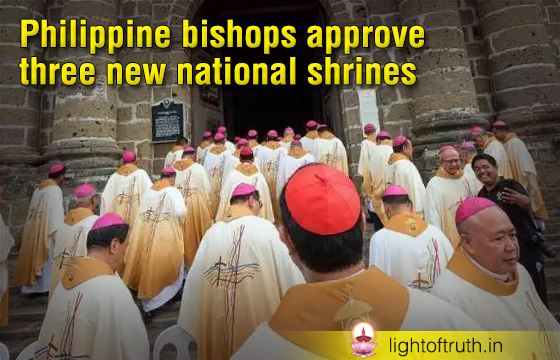
Philippine bishops approve three new national shrines
The Catholic Bishops’ Conference of the Philippines (CBCP) has designated three churches as national shrines, says a report. The Mary Queen of Peace Shrine, popularly known as the EDSA Shrine, the Our Lady of Loreto Shrine, both in the Manila Archdio-cese, and the Shrine of Our Lady of Aranzazu, from the Diocese of Antipolo, were elevated to the status of national shrines. The bishops’ announcement came on the first day of their plenary assembly, CBCP News reported on Jan. 26. Some 70 bishops from across the country are attending Jan. 25-27 meeting. With the latest approvals, the Philippines has 33 national shrines.
The Catholic Church recognizes national shrines for their historical, spiritual, or cultural significance. Shrines are often linked to popular devotion, significant religious events, miracles, or apparitions. Before receiving the status of a national shrine, a church must first be designated as a diocesan shrine by the local bishop or archbishop. This requires the church to be a pilgrimage site for a specific piety, offering superior worship, Christian formation, and social services. Once these conditions are met, the parish can petition for canonical elevation.
Diocesan shrines can petition the national bishops’ conference for recognition as national shrines when devotion grows. The newly elevated shrines have a history, making them a hub of Catholic devotion in their locations.
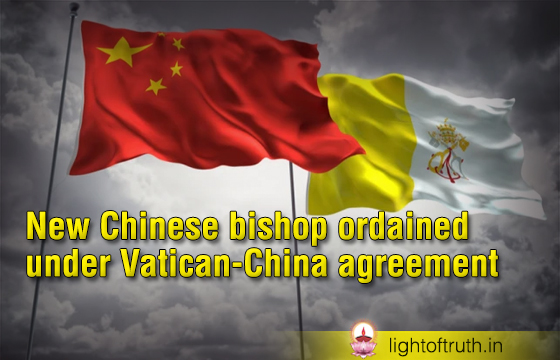
New Chinese bishop ordained under Vatican-China agreement
The Vatican announced that Pope Francis has erected a new diocese in China and appointed Father Anthony Ji Weizhong as its first bishop. The pope decided last October to suppress the Diocese of Fenyang in mainland China, which was originally erected in 1946 by Pope Pius XII, and at the same time erect the new Diocese of Lüliang.
Diocesan borders have been an area of dispute between the Vatican and China in the decades since the Chinese Communist Party came to power and started to redraw diocesan lines, seeking to bring them more in line with Chinese administrative boundaries.
Indeed, the territory of the newly-created Diocese of Lüliang conforms to the territory of the city of Lüliang, located about 400 miles southwest of Beijing in western Shanxi province. It will serve a total population of 3.3 million people, of whom approximately 20,000 are Catholics. A total of 51 priests and 26 religious sisters serve in the diocese.
Pope Francis appointed Weizhong as bishop of Lüliang on Oct. 28, 2024, having approved Weizhong in the context of the “Provisional Agreement,” better known as the Vatican-China deal, which appears to give the Chinese Communist Party (CCP) some ability to choose episcopal candidates.
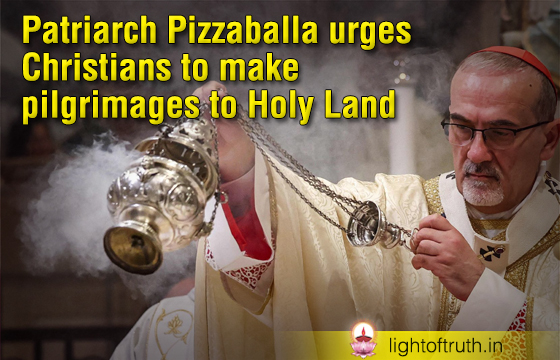
Patriarch Pizzaballa urges Christians to make pilgrimages to Holy Land
Cardinal Pierbattista Pizzaballa, the Latin Patriarch of Jerusalem, invites Christians to return to the Holy Land on pilgrimage, saying their presence makes residents feel part of the universal Church. “This ceasefire is a turning point that has been marked in the life of the Holy Land.” Patriarch Pierbattista Pizzaballa offered that assessment in a video message recorded from the Church of the Holy Sepulchre in Jerusalem.
The Latin Patriarch of Jerusalem was joined by the Custos of the Holy Land, Fr. Francesco Patton, in inviting Christians to make plans to visit the Holy Land on pilgrimage in the near future. “Last year was a difficult year,” said Patriarch Pizzaballa. “For this year, I want to express the appreciation we have for all the universal Church, for the support, for the prayer, or the unity and solidarity they expressed for the Holy Land.” He urged Christians worldwide to express their solidarity with the Holy Land, saying Jerusalem is safe, especially with the ceasefire between Israel and Hamas that went into effect on Jan. 19.
“The source and origin of hope is here at the Holy Sepulchre with Jesus, the Risen Lord,” he added. “So, it’s about time to take courage to come here. We are waiting for you.”
In the video, Fr. Patton agreed with Patriarch Pizzaballa, highlighting the importance of pilgrimage to the land where Jesus was born, died, and rose again.
Standing in front of the Holy Sepulchre, he said Christians are “waiting for you, because when you come as pilgrims to the Holy Land, our small Christian community feels that we are part of a great family, the great family of the Catholic Church and Christians living all around the world.” “Please, don’t fear,” concluded Fr. Patton. “Don’t be afraid. Come!”
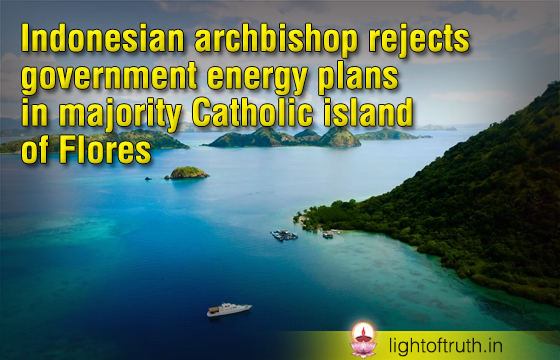
Indonesian archbishop rejects government energy plans in majority Catholic island of Flores
Indonesian Archbishop Paulus Budi Kleden, SVD, has spoken out against government-backed geothermal projects in Flores, the country’s most Catholic island located in East Nusa Tenggara.
According to UCA News, Indonesia’s Energy and Mineral Resources Ministry designated Flores a “geothermal spot” in 2017, identifying 16 project sites on the island in spite of strong opposition from local villagers.
“After hearing testimonies from several people, from Sokoria and Mataloko, and discussions with several priests, I have decided to reject geothermal projects in three vicariates,” Kleden said in a Jan. 10 video message.
Kleden, who became archbishop of Ende in August 2024, said residents have complained of the depletion of water springs in Sokoria and hot mud eruptions in Mataloko, UCA News reported.
Kleden is the first Indonesian archbishop to speak out publicly against the government’s energy plans in Flores, insisting that the projects have triggered a life-threatening “ecological disaster” on the island.
In addition to encouraging priests in the Ende Archdiocese to take a stand against the social and environmental harm caused by mining activities, Kleden said local residents should be encouraged to seek appropriate legal advice to protect their land.
Father Simon Suban Tukan, JPIC coordinator for the Society of the Divine Word in West Flores, told that the new law is important to protect the rights of environmental activists who feel threatened by a “government agenda that emphasizes investment.”
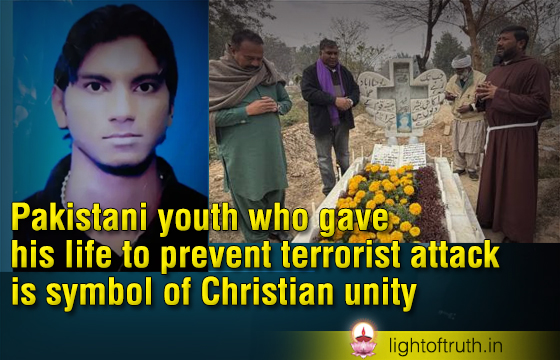
Pakistani youth who gave his life to prevent terrorist attack is symbol of Christian unity
During this year’s Week of Prayer for Christian Unity, a group of believers from different Christian denominations made a pilgrimage to the tomb of Akash Bashir, the young Pakistani Salesian who sacrificed his life in 2015 to prevent a terrorist attack at his church.
In Pakistan, a traditionally Islamic nation, everyone considers Servant of God Akash Bashir a martyr, according to the Vatican news agency Fides. His figure has become one “that unites Christians of all confessions.” Muslims also venerate him. “His sacrifice, giving his life to protect the innocent people praying in St. John Church in Lahore, transcends the boundaries of the Church and stands as a bridge for interreligious dialogue with the Muslim community,” Fides noted. As part of this year’s Week of Pra-yer for Christian Unity activities, an ecumenical prayer service took place at his burial place in which the participants “entrusted the lives of Christians in Pakistan to the intercession of this young man.”
Among them were a Catholic priest, Father Lazar Aslam, and two Protestant pastors, I.B. Rocky and Samuel Ashan Khokhar. The latter recalled that fateful day of March 15, 2015, when Bashir saved many lives by bravely confronting a terrorist who intended to blow himself up inside the church.
“I was in charge of receiving the bodies, placing them in the morgue and making a list of those who had tragically lost their lives. I remember in particular writing the name of Akash Bashir on one of the body bags,” Khokhar said.
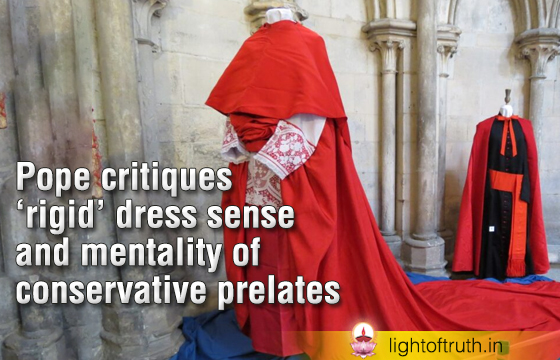
Pope critiques ‘rigid’ dress sense and mentality of conservative prelates
The Pope has taken conser-vative bishops and cardinals to task for the way they dress, suggesting their adherence to ostentatious styles reveals a “rigidity” of mind that in some cases may even reach a level of “mental instability” and “emotional deviation.”
The Pope made his criticism of the sartorial preferences of traditional-leaning prelates in his autobiography titled Hope, which was published on 14 January. Their “rigidity”, he writes, “is often accompanied by elegant and costly tailoring, lace, fancy trimmings, rochets”, which he described as amounting to “clerical ostentation.” The Pope then adds: “These ways of dressing up sometimes conceal mental imbalance, emotional deviation, behavioural difficulties, a personal problem that may be exploited.”
In his autobiography, Francis stresses how he avoided the tri-mmings and finery of papal tra-dition once he was elected in 2013. “They offered me a beautiful golden cross and I said: ‘I have this nickel silver one from my episcopal ordination, I’ve been carrying it for 20 years,’” he writes. He also notably turned down the papal red shoes favoured by his predecessor, Pope Benedict XVI. “The red shoes? No, I have orthopaedic shoes. I’m rather flat footed,” he said at the time, he recalls in his book. “Likewise, I didn’t want the velvet mozzetta, nor the linen rochet…They were not for me. Two days later they told me I would have to change my trousers, wear white ones. They made me laugh. ‘I don’t want to be an ice-cream seller,’ I said. And I kept my own,” he writes.
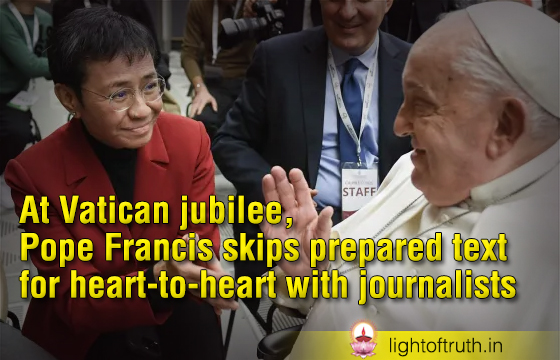
At Vatican jubilee, Pope Francis skips prepared text for heart-to-heart with journalists
“Communication means stepping outside ourselves a bit to give something of myself to another,” Pope Francis told hundreds of communications professionals on Jan. 25, speaking spontaneously after setting aside his prepared remarks at the Vatican’s Jubilee of the World of Communications.
“In my hands, I have a nine-page speech,” the pope said with a smile to participants gathered in the Vatican’s Paul VI Hall. He announced to an applauding audience that he would have this document distributed but only speak briefly, given the hour and the fact that everyone was hungry.
“To know how to communicate is a great wisdom, and I am happy that this jubilee of communicators is taking place. Your work is one that builds. It builds society and it builds the Church,” the pope said, provided journa-lists are truthful and “real” in their interior life.
The Jan. 25 encounter with communicators was one of several Saturday jubilee audiences of 2025, following a first meeting with pilgrims. The event began with a dialogue featuring Nobel Peace Prize laureate Maria Ressa and author Colum McCann, moderated by veteran Italian journalist Mario Calabresi.
The pope’s prepared message, later shared with participants, addressed several pressing concerns facing modern communications. The text called attention to journalists who died covering conflicts in the past year, noting that more than 120 media professionals lost their lives in 2024. The written remarks also warned against what the pope termed “brain rot” caused by constant social media scrolling, calling for greater media literacy and critical thinking, especially among young people. “We need courageous entrepreneurs, courageous information engineers, so that the beauty of communication is not corrupted,” the prepared text stated.
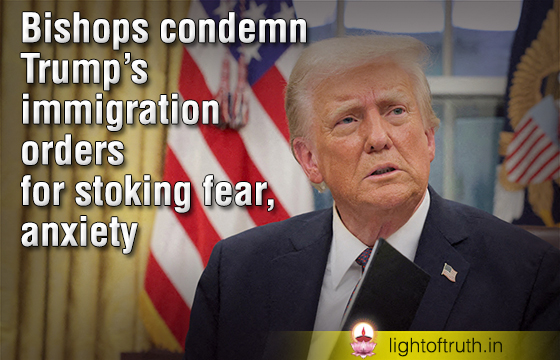
Bishops condemn Trump’s immigration orders for stoking fear, anxiety
Catholic advocacy groups, southern border dioceses and the U.S. Conference of Catholic Bi-shops are expressing deep concern after President Donald Trump signed a series of executive orders targeting immigration on his first week in the Oval Office.
Particularly troubling to these groups are his actions tied to the declaration of a national emer-gency at the southern border and his attempt to end birth right citizenship, a right long upheld under the 14th Amendment of the Constitution to anyone born on American soil, regardless of their parents’ immigration status.
Federal immigration autho-rities also will now be allowed to conduct enforcement actions in traditionally protected areas, including churches and schools, marking a sharp departure from previous policies, according to a Jan. 21 statement by the Depart-ment of Homeland Security, which said the move empowers agents to make arrests without restrictions tied to “so-called ‘sensitive’ areas.”
“Some provisions contained in the Executive Orders, such as those focused on the treatment of immigrants and refugees, foreign aid, expansion of the death penalty, and the environment, are deeply troubling and will have negative consequences, many of which will harm the most vulnerable among us,” said Abp Timothy Broglio, president of the U.S. bishops’ conference.