

India’s top court has ended a British-era practice of exempting Catholic priests, brothers, and nuns working in government-funded education institutions from paying taxes on their salaries. The Nov. 7 order of the three-judge bench of Chief Justice D. Y. Chandrachud, Justices J B Pardiwala, and Manoj Misra dismissed 93 appeals against a 2014 order of the Income Tax Department that asked them to pay taxes. The practice was introduced in 1944 during the British colonial era as part of an effort to promote education across the country. The Income Tax Department, which reports to the federal government, directed state governments in 2014 to deduct tax at source before paying salaries to priests, brothers, and nuns. The Church challenged the order in high courts of the southern states of Kerala and Tamil Nadu. The state courts upheld the tax department’s order, and appeals were filed before the Supreme Court. The counsels for the Church personnel argued that religious priests and nuns take a vow of poverty, and their salaries are transferred to their respective congregations’ accounts. Unlike other citizens, they do not individually own anything. The country’s top court, in an interim order, temporarily relieved Church personnel. However, in its final verdict, the court wondered how religious people’s vows of poverty or not owning personal property affected the taxability of their income. It asked the government to deduct tax at the source of paying salaries. The Supreme Court also stressed the need for a uniform application of law and held that any person employed and receiving a salary would be subject to taxation.
Daily Archives: November 16, 2024
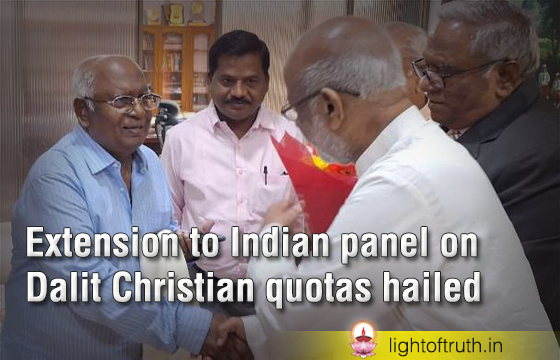
Extension to Indian panel on Dalit Christian quotas hailed
An Indian church leader has hailed the one-year extension gi-ven to the Justice K G Balakri-shnan commission to study whether socially poor Christians and Muslims are eligible for the nation’s affirmative action policy. “We welcome the extension gi-ven to the panel as it was unable to complete its work within the stipulated time,” said Father Antony Thumma, secretary of the Catholic Bishops’ Conference of India (CBCI) Office for Ecu-menism. Prime Minister Naren-dra Modi’s federal government appointed the commission in 2022 to study and recomm-end whether to extend the bene-fits of the affirmative action policy to Christians and Muslims who come from Dalit communi-ties that were once considered untouchable. The benefits of the policy include seats in educational institutions, government jobs, and electoral politics. However, these concessions are currently limited to Dalits who belong to Hinduism, Sikhism, and Buddh-ism. Balakrishnan, a former chief justice of India who headed the three-member panel, was given two years to submit the report. “The panel started its work late as it did not get an office, staff, and other amenities,” said Thu-mma. The priest has been actively involved in the struggles of Dalit Christians to gain benefits from the affirmative action policy. Thumma and a 15-member ecu-menical delegation met the com-mission on Oct. 12 in the national capital, New Delhi, to advocate for the cause of Dalit Christians, who make up more than 50% of India’s 25 million Christians.
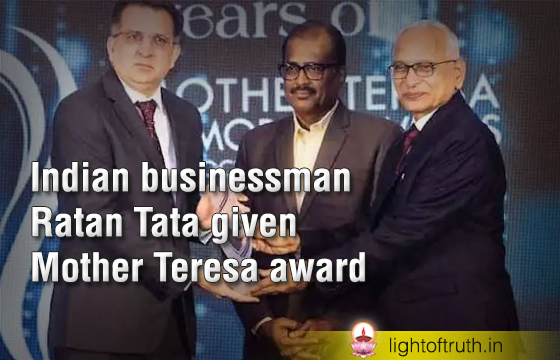
Indian businessman Ratan Tata given Mother Teresa award
An India-based voluntary agency has conferred its Mother Teresa Memorial Award for Social Justice on the late Indian business leader Ratan Tata for ‘his role beyond business’ and 11 others. “Ratan Tata has left a lasting legacy of service and social responsibility that conti-nues to inspire and uplift commu-nities,” said Abraham Mathai, founder-chairman of Harmony Foundation.
The Mumbai-based non-gov-ernmental organization instituted the annual award in memory of Saint Mother Teresa in 2005.The posthumous award to Tata was received by Siddharth Sharma, CEO of Tata Trusts, on Nov. 10 in Mumbai at a function. Tata, former chairman of the Tata Group, died on Oct. 9 in Mum-bai, aged 86. He is credited with putting the Indian conglomerate on the global map. Under his leadership, the group’s revenue rose from US$4 billion to US$100 billion between 1991 and 2012. Tata is known as an iconic business leader and a well-known philanthropist. Tata is also known for his social commitments and philanthropy. Through Tata Trusts, he impacted countless li-ves, fostering education, health-care, and social welfare initiatives across India, Mathai said. Polish activists Lena Grochowska and W³adys³aw Grochowski jointly won the award for their humani-tarian efforts to empower Ukrai-nian refugees in Poland. Their organization – Lena Grochowska Foundation – received the United Nations High Commissioner for Refugees’ Nansen Refugee Award last year.

Indian court order on Church properties worries Christians
Church leaders have expressed concern over a southern Indian court’s suggestion to bring Church properties under state control like in the case of Hindus and Muslims following graft allegations. Churches have vast properties and their funds “are drained to fuel a power struggle,” noted the Madurai bench of the Madras High Court in a recent ruling. The court on Oct. 23 served notices on the federal and the provincial Tamil Nadu governments, seeking their opinion on bringing Church properties under a statutory board like in the case of Hindus and Muslims. “We are aware of the court order,” said Father Robinson Rodrigues, spokesperson of the Catholic Bishops’ Conference of India (CBCI). “Our legal department is conducting a study on its implications,” Father Rodrigues told. The priest, however, refused to divulge details, saying “the matter is subjudice.” Like in the case of Hindu and Muslim charitable endowments, Christian institutions lack a comprehensive statutory body, the court observed. “Unlike the properties of the Hindu endowment or the Muslim Waqf [charity] Board, Church properties are purchased and not donated,” said Father A Santhanam, a Jesuit priest practicing law at the Madurai court. “Therefore, the findings of the court are not entirely correct,” Santhanam told.

Indian Church refuses to endorse political party in election
Bishop Marshall Kerketta of Ranchi, the moderator of Gossner Evangelical Lutheran (GEL) Church said that he has rejected the appeal from Anosh Ekka of Jharkhand Party to use the name of the Church for political purposes. Ekka, a tribal Oraon Christian and former minister in the provincial government, recently wrote to letter to Bp Kerketta, reque-sting him to support his party in the upcoming state elections to be held on Nov. 13-20.
The results of the election in 81 state constituencies are to be announced on Nov. 23. In a letter to Ekka, obtained by UCA News, Bishop Kerketta said the request was “not in accordance with the Constitution of the Church and its religious conduct.” The prelate also said that “it is a matter of great surprise that an experienced politician like you, an active and knowledgeable member of the Church has written the letter.” As per the Church rules, the Church cannot endorse any political party in the election, Kerketta said, adding that no one should use the Church’s name in the election campaign. Founded on Nov. 2, 1845, the GEL is a major Protestant Church in India with hundreds of thousands of members. The move from Ekka, the national president of his party and a member of the state legislature from 2005-2018, has triggered uproar in the state. Presently the state is run by the Jharkhand Mukti Morcha (JMM) party led by Chief Minister Hemant Soren. “I am not surprised by the favour sought by the political parties during the election as it is a common practice. But the Church and its intuitions are not politically affiliated entities so they cannot support any political party as per the Indian Constitution,” Ratan Tirkey, a former mem-ber of the state’s tribal advisory committee, told on Nov 8. Tirkey, the tribal Christian leader said that “any Christian members be it bishops, priests, nuns and laity are Indian citizens first and they exercise the voting right individually, all are free to vote any candidates according to their choice.” Mukti Prakash Tirkey, editor of New Delhi-based Hindi-language weekly Dalit Adivasi Duniya said that “not only the church but religious groups such as Hindus, Muslims and Sikh should refrain from supporting any political parties so that Indian constitution and secularism are upheld”.
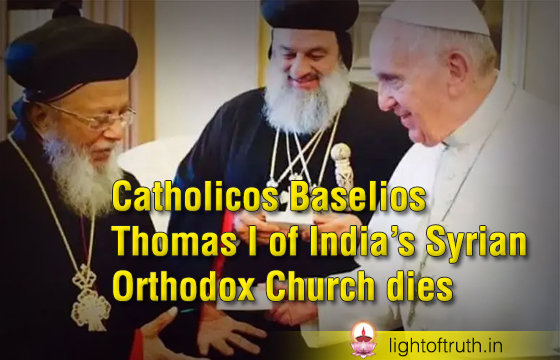
Catholicos Baselios Thomas I of India’s Syrian Orthodox Church dies
Catholicos Aboon Mor Baselios Thomas I, the spiritual head of the Syrian Orthodox Church’s Jacobite faction in India, died on Oct. 31. He was 95. The prelate passed away while undergoing treatment for age-related ailments in southern Kerala state, where the Damascus-based Church has more than 2 million followers. Thomas, affectionately called Bava, “was an ardent supporter of ecumenical unity,” said Major Archbishop Raphael Thattil, head of the Kerala-based Eastern rite Syro-Malabar Church. “He led the Church in the most challenging period” and served the Church “even at the cost of his life,” added Thattil. The Catholic Bishops’ Conference of India (CBCI) said his death “has left a void in the Christian community.” “He was an iconic figure in the Indian Christian community, having completed 50 years of dedicated Episcopal service,” the bishops said. Kerala Chief Minister Pinarayi Vijayan said the late prelate dedicated his life to the service of humanity. He made “unparalleled contributions to the growth of the Church,” Vijayan, the only serving communist chief minister in the country, said in his condolence message. Kerala Governor Arif Mohammed Khan said the prelate was known for his compassion and commitment to the community. The Syrian Orthodox Church of Antioch was based in Turkey. However, after World War I, the patriarchate was transferred to Homs in Syria in 1933. In 1959, it was shifted to Damascus. In 1911, the Church in India witnessed a spilt over its leadership, which led to a protracted dispute over Church properties. Thomas headed the Jacobite faction, which owed its allegiance to the Church’s head in Damascus. The rival Orthodox group’s supreme head is based at its headquarters in Kerala. In 2017, the Jacobite faction suffered a setback when, in a protracted legal battle, it lost almost all its temporal properties to the Orthodox faction.
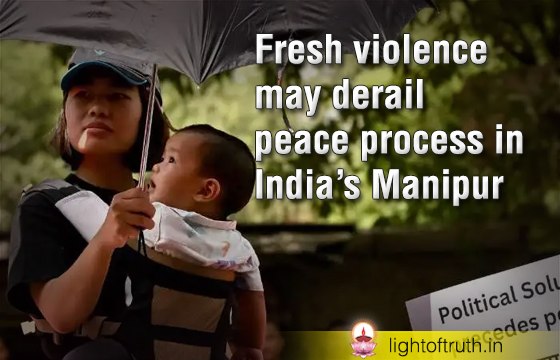
Fresh violence may derail peace process in India’s Manipur
A Church leader in India’s Manipur has expressed concern that the latest killings in a fierce gunfight between tribal Kuki militants and security forces may lead to “further escalation of violence” in the troubled northeastern state. At least 11 militants, who were described as “village volunteers” by their tribal body, were killed when security forces claimed to have “repulsed an attack on a police station” by them on Nov. 11. The fresh bout of violence will “increase animosities between rival groups” and “may jeopar-dize the federal government’s initiative to restore peace” in the state, the Church leader who did not want to be named due to security concerns told on Nov. 12.
Government sources said two personnel from the Central Reserve Police Force (CRPF) were injured as the militants in camouflage uniforms and arm-ed with sophisticated weapons fired indiscriminately at the Borobekra police station in Jiri-bam district. The Indigenous Tribal Leaders’ Forum (ITLF) condemned the killings of tribal men and denied the govern-ment’s claim that they were militants. The tribal body in a statement on Nov. 12 expressed deep sorrow over the “tragic loss of our 11 brave voluntee-rs.” The gunfight comes close after the burned corpse of a Kuki woman was found in the district last week. The woman was reportedly killed by Meitei gunmen in Zairawan village on Nov. 7. The ITLF claimed that “the CRPF personnel posted nearby refused to fire even one shot to help the villagers.”
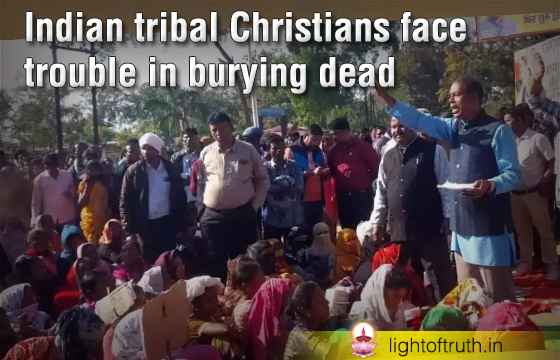
Indian tribal Christians face trouble in burying dead
Indigenous Christians face difficulties in burying their dead because of their faith in a central Indian state, according to Church leaders. “It is really painful to see villagers create obstacles in burying the dead,” said Protestant minister Jaldev Andhkury after he was released from jail for officiating the funeral service of one of his relatives in Bastar district in central Chhattisgarh state. The 42-year-old Andhkury was among the seven people, inclu-ding six pastors and a deacon, arrested after they joined the funeral service of Pastor Iswar Nag, his cousin, in his ancestral village in Chhindawada villa-ge. It is a custom among villa-gers in Chhattisgarh to bury their dead in ancestral villages even after their conversion to Christianity. Andhkury said their forefathers were buried in the village, but now villagers object to the burial of those who converted to Christianity. “The villagers opposed the burial on the plea that it would bring misfortune to the village and summoned the police. But, we still buried the body in the century-old graveyard,” Andh-kury told on Oct. 30, a week after being released from prison. The police summoned seven of us who prayed over the body and arrested us after accusing us of creating law and order problems, he said. They were released from prison on Oct. 22 after a local court accepted their bail pleas. The villagers, along with police, wanted us to exhume the body from the graveyard, but “we refused,” he added.
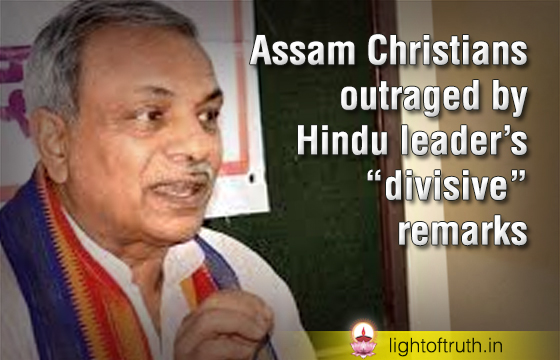
Assam Christians outraged by Hindu leader’s “divisive” remarks
Various Church groups in Assam have demanded action against a rightwing Hindu leader who allegedly maligned Christians and tried to undermine religious harmony in the northeastern Indian state. On Oct. 27, Surendra Kumar Jain, the international joint general secretary of the Vishwa Hindu Parishad (world Hindu council), stirred a controversy by accusing Churches of drug trafficking. He reportedly asserted that Churches were linked to drug trafficking that contributed to the degradation of youth in the region. He made the remarks at a function to honour Joya Thaosen (1925-1944), a revered freedom fighter who died fighting the British, at KK Hojai Chatrinivas Building, Haflong, Dima Hasao District. The United Christian Forum of Dimahasou, the United Christian Forum of Karbi Anglong, and the Assam Christian Forum (ACF) on November 5 expressed “deep shock and dismay” over Jain’s “divisive remarks.” “We believe that [Jain’s] baseless accusations against the Church and the Christian community are not only harmful but seem to be a deliberate attempt to malign an entire faith community. His statements undermine the invaluable contributions of the Christian community to this region,” stated the Assam Christian Forum, an ecumenical group. The Christian groups regretted that the Hindu leader used a significant event as a platform to condemn and divide communities on religious grounds. “Jain’s comments are perceived as a dishonour to the rich legacy of Thaosen, who stood for unity and secular values,” they added. They said all communities of Dima Hasao and the country at large cherished Thao-sen’s legacy. They noted that Christians have played “a transformative role” in northeastern India from the pre-Indepen-dence era. The community has worked in areas such as education, healthcare, social welfare, literature, media, relief, rehabi-litation, and sustainable development, they claimed.
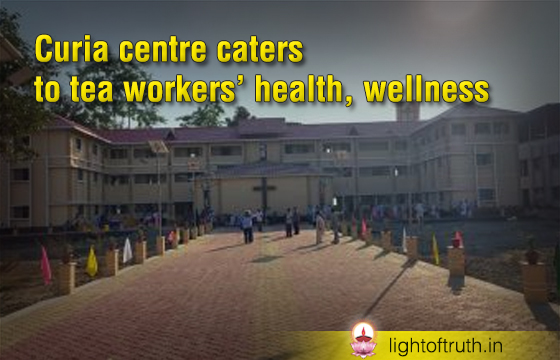
Curia centre caters to tea workers’ health, wellness
A newly inaugurated curia centre of Bagdogra diocese in Siliguri, serves health and wellness of local tea workers. The facility was blessed on November 9 by Archbishop Vincent Aind of Ranchi. “The building christened ‘Dishangan’ connotes direction, guidance, leading and nurturing; the kind of things which Jesus who is the ‘way and the truth’ came to do,” says Vicar General of Bagdogra diocese Fr Felix Pinto. Situated in Gulma area of Siliguri, the majority of the beneficiaries of the new facility are tea labourers surviving on meagre income from neighbouring tea gardens. “The focus of this centre is to improve the mental health of the community and to promote naturopathy, treatment with less of allopathy medicine and using more of traditional and non-intrusive health remedies,” adds Pinto. Through the Health & Counselling Centre housed in Dishangan, Fr. Anthres Toppo and Fr. Michael Kerketta are already giving counselling and reflexology treatment.