

Pope Francis on November 11 met with the Holy Synod of the Malankara Mar Thoma Syrian Church, marking an historic first visit to Rome and confirming the good relations of this ancient Oriental Indian Church.
Mar Thoma Syrian Church traces its origins back to the mission of the Apostle St. Thomas in South-Western India in the first century and consists today of about 1.5 million members most of whom reside in the Indian State of Kerala, where it is based.
The Church has communion with the Thozhiyoor (Anglican) Church and maintains an ecclesiastical relationship with the Old Catholic Church, Union of Utrecht, as well as the Church of South India (CSI).
In his address Pope Francis warmly welcomed the Holy Synod and extended his greetings to Metropolitan Theodosius Mar Thoma and the Malankara faith-ful, expressing gratitude for their ecumenical role, in bridging Eastern and Western Christianity. “Your Church,” he said, “rightly defines itself as a “bridge Church” between East and West.”
Daily Archives: November 16, 2024
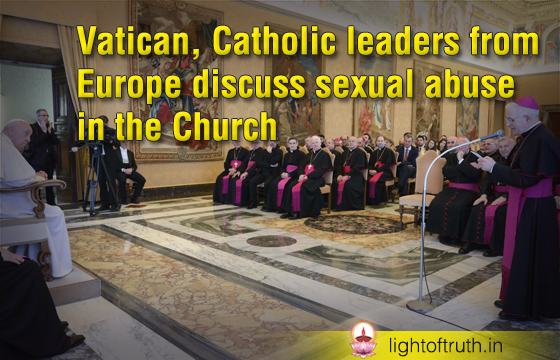
Vatican, Catholic leaders from Europe discuss sexual abuse in the Church
Catholic leaders from across Europe are in Rome this week to discuss how the Church can best protect children from sexual abuse and how to help those who have already been hurt by it. The Vatican’s Pontifical Commission for the Protection of Minors (PCPM) is hosting a conference on safeguarding in the Catholic Church in Europe from November 13–15.
The gathering, taking place in the centre of Rome at the head-quarters of the PCPM, includes participants–bishops, priests, re-ligious, and laymen and lay-women – from 25 countries in Europe. Safeguarding practices and strategies, how Church law and civil law interact, how to better help victims, and how to develop safeguarding networks are some of the topics the con-ference will address.
Vatican leaders and repre-sentatives from the European bishops’ conferences commission (COMECE) are also attending the meeting, which will include a keynote address Nov. 14 from Archbishop John J. Kennedy, secretary of the Vatican’s office responsible for the discipline of priests guilty of abuse.
In a message to conference participants Nov. 13, Pope Fran-cis said attendees’ “commitment to this cause [of safeguarding against abuse] is a sign of the Church’s continuing efforts to protect the most vulnerable in our midst.” The pontiff wrote that he is praying for the conference, which he hopes will be “a source of fruitful insights” and that their exchanges “will contribute to a safer and more compassionate Church” and a “deeper commitment to safe-guarding children and vulnerable adults within the Church.”
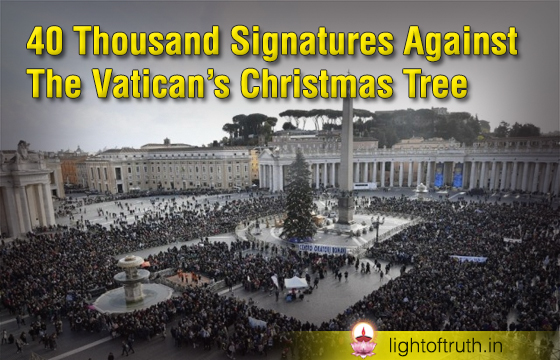
40 Thousand Signatures Against The Vatican’s Christmas Tree
In Italy’s Valley of Ledro, nestled near the old Austro-Hungarian border just kilo-meters from Lake Garda, locals are rallying to save a 200-year-old fir tree, famously known as the Green Giant. Towering at thirty meters and standing for centuries, this maje-stic tree has weathered wars, snowstorms, and survived the ax of carpenters. Now, it faces a new threat: being cut down and transported to Vatican City as the Christmas tree for St. Peter’s Square.
Residents of Ledro, who see the fir as more than just a tree, have written directly to Pope Francis in hopes of preventing what they deem an anachronistic massacre. They also launched a petition on Change.org, which has garnered 40,000 signatures so far, and secured legal counsel to help block the tree’s removal. Local environmental advocates and community associations argue that cutting down a tree for a holiday display contradicts efforts to combat climate change. Talking about protecting the environment means challenging outdated traditions like these,” they noted in a statement, emphasizing the contradiction of celebrating Christmas by sacrificing a tree that symbolizes nature itself. They propose decorating the fir where it stands in Passo Nota, allowing it to continue shading hikers who stop there after long climbs.
Residents further invoked Pope Francis’ own words on environmental stewardship, referencing his encyclicals calling for respect for nature. “We ask His Holiness to prevent this felling and instead come visit the Valley to experience its natural beauty firsthand,” the letter implores.
Beyond the emotional and environmental reasons, residents also have financial con-cerns. Lorenzo Vescovi, a representative from the Forty-Three Million Committee (a name symbolizing the 40 trees donated by the Ledro Council to the Vatican and the estimated three million Christmas trees cut down annually in Italy), notes that the trans-port of the Green Giant to the Vatican comes with a staggering 60,000 price tag. Many argue that the funds could be better used to address pressing needs within the Ledro community, such as medical care, where shortages of general practitioners are impacting health services.
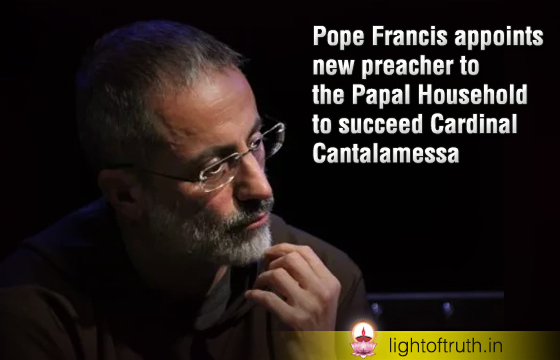
Pope Francis appoints new preacher to the Papal Household to succeed Cardinal Cantalamessa
Pope Francis on November 9 appointed Fr Roberto Pasolini, OFM Cap, as the new preacher of the Papal Household, replacing Cardinal Raniero Cantalamessa, 90, who held that position for 44 years. Cantalamessa, who was elevated to the College of Cardi-nals by Pope Francis in 2020, has been preacher of the Papal Household since 1980, when he was appointed by St. John Paul II. His successor is a professor of biblical exegesis at the Theological University of Northern Italy in Milan and is now tasked with giving the Friday meditations of Advent and Lent, among other tasks, as Cantala-messa did for years, serving three popes (John Paul II, Benedict XVI, and Francis) and the Vati-can Curia.
Pasolini was born on Nov. 5, 1971, in Milan and just turned 53. According to the Vatican Press Office, he made his perpetual vows in the Franciscan Order of Friars Minor Capuchin on Sept. 7, 2002, and was ordained a priest on Sept. 23, 2006.
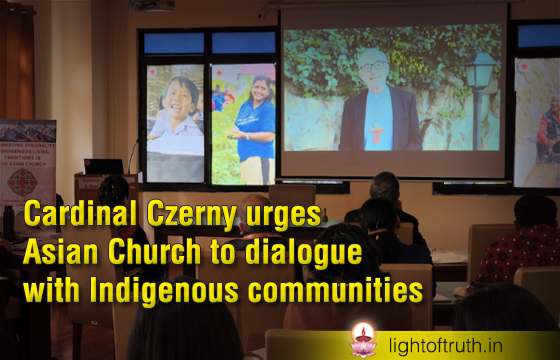
Cardinal Czerny urges Asian Church to dialogue with Indigenous communities
In a video message addressed to partici-pants at the Asian Forum on “Celebrating Synodality & Indigenous Living Tradition in the Asian Church” in Nepal, Cardinal Michael Czerny, Prefect of the Dicastery for Promoting Integral Human Development, emphasized the importance of recognizing and dialoguing with the Indigenous peoples. “For recognition and dialogue will be the best way to transform relationships whose history is marked by exclusion and discri-mination,” said Cardinal Czerny, underscor-ing the Church’s role in fostering inclusivity.
Speaking to an audience of bishops, Indigenous pastoral leaders, priests, nuns, lay leaders, and theologians from across Asia, he highlighted the significance of indigenous traditions, wisdom, and spiritual practices, encouraging the Church to embrace these as valuable contributions to synodality. “As members of the Church in Asia, you have the opportunity to deepen your engagement with the Indigenous peoples as principal dialogue partners with their chanters, healers, herbalists, midwives, shamans, wisdom keepers, and sharers,” Cardinal Czerny said.
The forum, organized by the faith-based group Circle of Sacred Rice, provided a platform for faith leaders to reflect on how the Church can incorporate Indigenous per-spectives while advancing social justice, environmental protection, and cultural pre-servation.
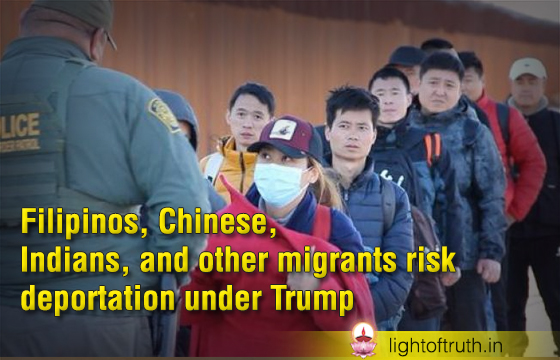
Filipinos, Chinese, Indians, and other migrants risk deportation under Trump
The Philippine Department of Migrant Workers (DMW) announced its readiness to assist 370,000 undocumented Filipinos living in the United States who might be deported following the election of Donald Trump. The DMW is set to help returning Filipinos with financial aid and job placement, but is also consi-dering the possibility of sending workers to other countries (in particular Croatia, Slovenia, Ger-many, Hungary, and Japan).
According to Rappler, a Phi-lippine online news website, to meet its commitment to 370,000 returnees, the Philippine govern-ment would have to find 18.5 billion pesos (over 5 million) to ensure proper assistance for all. Between 2014 and 2024, about 10,600 Filipinos were expelled from the US (a thousand per year on average), including some 3,500 during Trump’s first term in office (2017-2021).
The Philippine ambassador to the United States, Jose Manuel “Babe” Romualdez, issued an advisory telling undocumented Filipinos to leave the country voluntarily. Most Filipinos in the US are granted a regular work visa, but once it expires, many prefer to stay, often working illegally.
Irregular migrants in the United States do not come only from Latin America. The latest data (2022) indicates that about 1.7 million out of 11 million are from Asia. More than half are from India and China, followed by the Philippines, South Korea, Vietnam, Pakistan, Nepal, Thai-land, Afghanistan, and Bangla-desh. In 2023-2024, 1,100 In-dians were deported out of an estimated population at 725,000 unauthorised Indian immigra-nts in 2022.
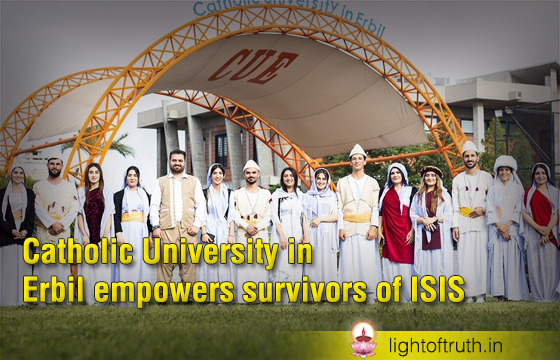
Catholic University in Erbil empowers survivors of ISIS
Founded in 2015, the Catholic University in Erbil, located in the Kurdistan region of northern Iraq, offers education, scholar-ships and support to the Iraqi minority groups that suffered under ISIS. In 2014, so-called Islamic State swept across nor-thern Iraq, capturing vast swathes of territory. The invasion led to mass displacement, particularly of minority groups such as Christians, Yazidis, Turkmen and Shabak. Many of these re-fugees fled to the Kurdish region of northeast Iraq, where – says Fr Karam Shahmasha, a priest of the local Chaldean Catholic Archdiocese – the local Church sought to provide them with housing, food, and medical care.
In time, Fr Shahmasha tells Vatican News, these charitable initiatives gave rise to an even bigger project: the founding of the Catholic University in Erbil, or CUE, which aimed to be a “beacon of light in the midst of chaos”. The goal was to welcome students of all backgrounds, particularly to those who had suffered the most from recent violence.
In a talk at Boston College in 2023, Archbishop Bashar Warda, CUE’s Chancellor and Chairman of the Board of Trustees, stressed that “We opened the doors of CUE to those most affected by ISIS: the forcibly displaced, the Christians, and the Yazidis … We are committed to being a strong voice for the hurt.”
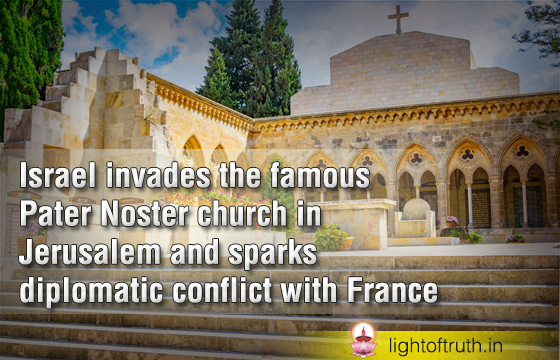
Israel invades the famous Pater Noster church in Jerusalem and sparks diplomatic conflict with France
On November 7, Israeli police entered the grounds of the Pater Noster Church on the Mount of Olives, briefly detaining two French security officers and igniting a diplomatic dispute. The site, managed by France for over 150 years, is one of four proper-ties in Jerusalem under French control, but this unprecedented breach has stirred deep concerns in Paris.
France’s Foreign Minister, Jean-Noel Barrot, had been set to visit the church complex–known as Eleona in French – but abruptly canceled after learning of the police intrusion, calling it “unacceptable.” France’s Mini-stry of Foreign Affairs responded swiftly, declaring it would summon Israel’s ambassador to address what it described as a violation of diplomatic protocol.
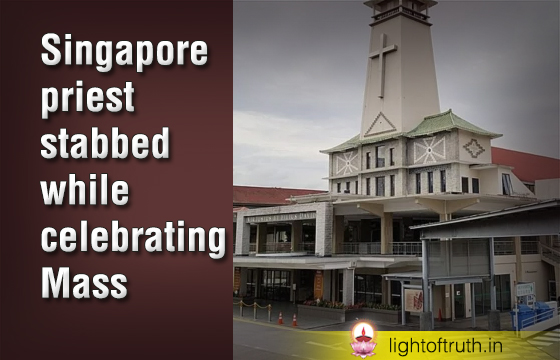
Singapore priest stabbed while celebrating Mass
The parish priest of St Joseph’s Church in Upper Bukit Timah, Singapore, was stabb-ed during Mass on Saturday evening, re-ported Channel News Asia. Father Christo-pher Lee, 57, whose stabbing occured dur-ing Communion, was taken to Singapore’s National University Hospital and is said to be in stable condition. The attacker, a 37-year-old Singaporean, has been arrested.
According to Singapore’s Police Force, he had been disar-med by members of the congre-gation, before later being arrested by police officers, the Singapore Police Force said in a statement, noting the assailant has past antecedents for serious hurt and misuse of drugs offences. “Based on the preliminary investigations, the man,” they noted, “is believed to have acted alone and the police do not suspect that this is an act of terrorism, for now.” “The public,” the po-lice urged, “is urged to remain calm and refrain from specula-tion as investigations are ongoing to ascertain the motive behind this incident.”
Cardinal William Goh, the head of the Catholic Church in Singapore, said he was “shocked and deeply saddened that violence has been committed against one of our beloved priests in the house of God while he was celebrating Mass.” “I am also very concern-ed,” he added, “about the psy-chological impact this incident may have had on our children and all who witnessed this attack.” “I ask,” Cardinal Goh urged, “the faithful to remain calm, not to speculate on the incident or pass judgment without knowing all the facts. We must allow the authorities to investigate the matter.”
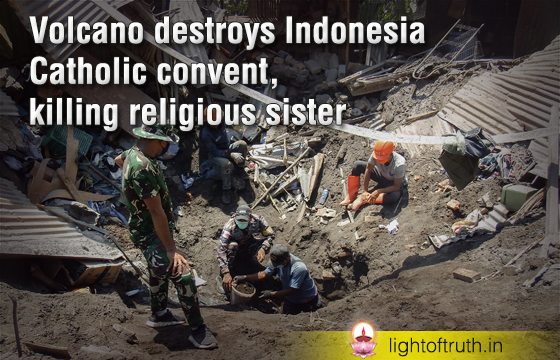
Volcano destroys Indonesia Catholic convent, killing religious sister
A volcanic eruption destroyed a monastery in Indonesia on Nov. 3, leaving at least 10 people dead, including a Catholic sister.
Just minutes before midnight on Sunday, Mount Lewotobi Laki-Laki on the Island of Flores erupted, spewing ash 6,500 feet high and destroying local villages, causing residents to evacuate. Locals did not receive alarms or warnings of the eruption, according to a report by Asia News. Sister Nikolin Padjo, head of a local monastery in Boru, Wulanggitang, died in the eruption, according to a report by Union of Catholic Asian News. Padjo was a Missionary Servant of the Holy Spirit (SSpS) and lived in the Hokeng Sisters Monastery. Another sister reportedly went missing as the sisters fled amid the volcanic ash, according to the Associated Press.