
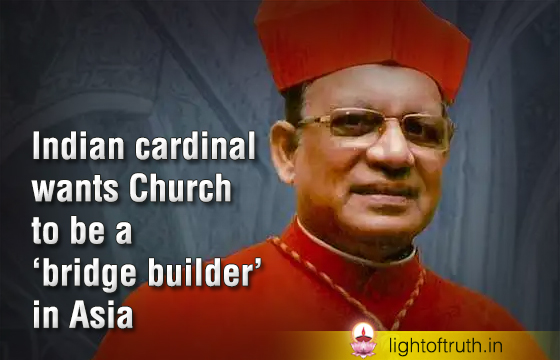
An Indian cardinal attending the Synod on Synodality at the Vatican says the Church in Asia emphasizes its role as a “bridge builder” by developing respect for other faiths. “We no longer refer to them as non-Christian religions or other religions,” said Card. Oswald Gracias of Bombay in an Oct. 7 press briefing, the news service of the Catholic Bishops’ Council of the Phili-ppines (CBCP) reported. “We begin to refer to them after the conference as ‘neighbour reli-gions,’” Gracias added. Gracias while referring to the outcome of the 2022 gathering of the Fe-deration of the Asian Bishops’ Conferences (FABC) in Bangkok said that a “certain closeness” has been created among the conference attendees. ”All of us working together, searching for God and feeling a bond among ourselves that has come out,” Gracias said, referring to the conference. Gracias is among the hundreds of other cardinals, bi-shops, priests, and laity attending the 16th Ordinary General Assembly of the Synod of Bi-shops, held from Oct. 2 to 27 in Vatican City. Gracias, who is among the top Asian voices representing the region’s Chri-stian minority, stressed Vatican II’s call for a greater under-standing of other religions and the need to inculturate the faith. “I feel there is a great richness in Asia, in India, in Korea, in Japan, all these countries. The local culture will help us,” Gracias said. “If we try to, not because we’re trying to convert, if we’re trying to build the kingdom of God also in Asia, we’ve got to take the values of Asia,” he emphasized.
Gracias also pointed out the impact of digital media, recalling a message by a youth representative during the 2022 Asian assembly that called upon bishops to come into the digital world. “A very, very powerful message and a challenging message to all of us who are resisting a bit but cannot resist anymore because that’s the world we are in,” he said. Gracias, also a member of Pope Francis’ Council of Cardinals, pointed out that the Asian delegates were comfortable with the synodal process given the experience of the 2022 Asian assembly. “What came out very strongly was we’ve got to work together, respecting lay people, respecting religions, respecting lay movements, respecting the baptismal consecration of each one, which has come out very strongly in the synod,” he said. The prelate also pointed out that the synod gathering displayed the “great fraternity, the great love for the Church, the great passion to do something to revitalize the Church that comes out very strongly.” “I feel that the synod should have an effect not only in transforming the Catholic Church, [but] the Christian churches and also the world,” Gracias emphasized.
Daily Archives: October 16, 2024
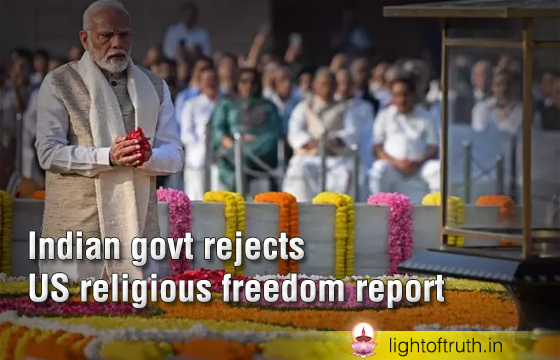
Indian govt rejects US religious freedom report
India’s Hindu right-wing government has rejected a United States Commission on International Religious Freedom (USCIRF) report on India, calling the US agency “biased” and the findings “malicious.” The USCIRF ”is a biased organization with a political agenda,” Indian foreign ministry spokesperson Randhir Jaiswal told reporters in the capital New Delhi. “We reject this malicious report, which only serves to discredit the USCIRF further,” he added on Oct. 3.The US independent bipartisan agency in its Oct. 2 report on India’s religious freedom said, “Individuals have been killed, beaten, and lynched by vigilante groups, religious leaders have been arbitrarily arrested, and homes and places of worship have been demolished.” These events “constitute particularly severe violations of religious freedom,” the commission said and asked the US State Department to designate India as a “Country of Particular Concern.” This is the fifth time the commission has asked the US administration to declare India a “Country of Particular Concern (CPC)” which is the designation for a country responsible for particularly severe violations of religious freedom under the International Religious Freedom Act of 1998. India is ruled by the Bharatiya Janata Party (BJP). The pro-Hindu party is against the missionary activities of the Indian Church.
Since Modi came to power in 2014, violence against Christians has increased, but India’s prime minister enjoys cordial ties with the US administration. The USCIRF annually releases policy recommendations to the State Department on international religious freedom. USCIRF’s report on India said, “The government, led by Bharatiya Janata Party (BJP), reinforced discriminatory nationalist policies, perpetuated hateful rhetoric and failed to address communal violence. “The ministry spokesperson called on the USCIRF to “desist from such agenda-driven efforts” and asked it to focus on addressing human rights issues within the United States. “It is sad that the Indian government is sweeping the report under the carpet, terming it “biased,” said A C Michael, National Coordinator of the United Christian Forum (UCF), an ecumenical body that records persecution against Christians in the country. The government should take necessary steps to protect the religious rights of minorities, Michael, a former member of the Delhi minority commission, told UCA News on Oct. 4.”At least two Christians are attacked every day in the country for their faith.” According to the UCF, India has recorded “447 incidents of violence against Christians this year from January to Aug. 10.” The ecumenical body recorded 731 incidents of violence in the country in 2023, excluding strife-torn Manipur where over 230 people have been killed, 60,000 others displaced and over 360 churches destroyed during 16 months of sectarian strife. According to Church leaders, the Uttar Pradesh government, the most populous state in the country with 200 million people and ruled by the pro-Hindu party, has registered 835 cases against Christians and Muslims under a sweeping anti-conversion law since it was enacted in 2020. Nearly 1,682 people have been arrested on conversion charges as of July 31, 2024. These cases are “closely monitored by senior officials,” said the state’s director general of police Prashant Kumar while briefing the media. Eleven states, most of them ruled by the BJP, have enacted a draconian anti-conversion law. This year’s USCIRF report recommended that 12 nations designated in 2023 by the State Department to be of “particular concern” be named again, including Russia and China.
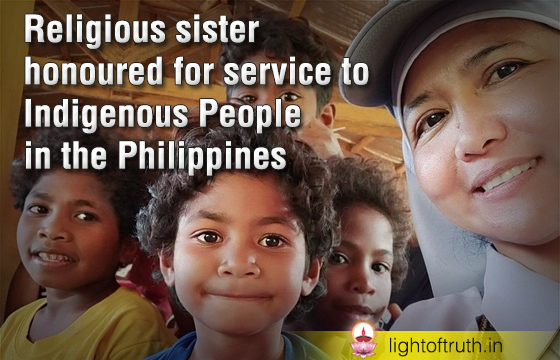
Religious sister honoured for service to Indigenous People in the Philippines
Sr. Minerva Caampued of the Franciscan Apostolic Sisters was recognized for her dedi-cated service to the Indigenous people of Sta. Ana town, where she has worked to preserve their heritage while promoting edu-cation and sustainable liveli-hoods. The award, established in 1983 by the AY Foundation, the philanthropic arm of the Yuchen-gco Group of Companies, and the Manila Jaycees, celebrates outstanding individuals whose selfless service reflects the charitable legacy of Mother Teresa. Sr. Minerva was honoured during a cere-mony on October 4, a significant date as the count-ry marks Indigenous Peoples’ Month.
The awarding organizations praised Sr. Minerva’s comprehensive efforts in uplifting Agta’s quality of life through various initiatives, according to a report by CBCP News. ”She remains a shining example of compassion, inspiring hope, and trans-formation–elevating lives through selfless service,” the organization said. Her programs encompass education, environmental protection, hea-lthcare, and feeding initiatives, with the goal of addressing the marginalization faced by the Indigenous community.
In her message, Sr. Minerva shared her gratitude, dedicating the recognition to the Agta people. “I am not called to be successful, but to be faithful,” she said.
“I dedicate it to the Agta communities, who continue to face the challenges of defending their ancestral domain, asserting their rights, and preserving their rich cultural heritage amidst marginalization,” she said. “Their strength and resilience are a constant source of inspiration to me. This award is not mine alone, but a tribute to their unwavering spirit,” the sister added.
Sr. Minerva emphasized the persistent challenges that indigenous communities in the Philippines encounter, particularly the struggle to protect their ancestral lands from external threats.
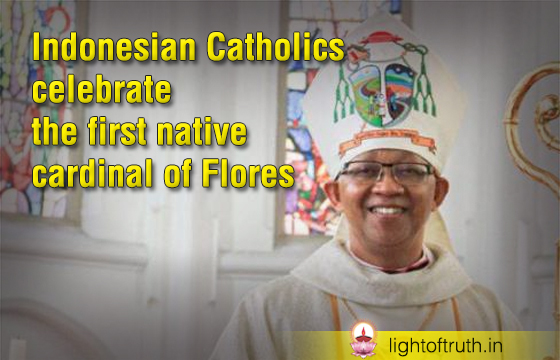
Indonesian Catholics celebrate the first native cardinal of Flores
In the appointment of 21 new cardinals announced by Pope Francis on October 6, there is also an absolute novelty for Indonesia, the world’s most populous Muslim nation, and one that has caused great ‘surprise’ among the faithful and within the local Church: after the three cardinals originally from the province of Central Java and all linked to the diocese of Semarang, in fact, the pontiff has chosen the bishop of the diocese of Bogor (in the province of West Java) Msgr. Paskalis Bruno Syukur (Ofm), a Franciscan from Flores Island, historically the heart of the Catholic presence in Indonesia.
In the aftermath of the appoint-ment, mixed reactions emerged among Indonesian Catholics: surprise and joy for the archipelago’s new cardinal, but also a certain ‘concern’ because there is a strong fear in Bogor that he might be transferred to another post after the purple.
‘I am personally ‘shocked’ to learn the news that our bishop will become a new cardinal next December, as there had not been any ‘hint’ previously,’ an elderly priest from Bogor points out to AsiaNews. ‘I hope that my bishop will not be transferred to another diocese that is still vacant,’ adds a former seminarian from the area.
To date, Indonesia has had four cardinals, three of them from the Central Java province and of Javanese ethnicity, with deep ties to Semarang: they are the late First Cardinal Justinus Darmojuwono, a priest of the Semarang archdiocese; Card. Julius Darmaatmadja, a Jesuit and head of the order’s Indonesian province before being chosen as bishop of Semarang in 1993 and later transferred to Jakarta; a similar story for Card. Ignatius Suharyo Hardjoatmodjo, archbishop of Semarang, later called to lead the archdiocese of Jakarta. Unlike his predecessors, as mentioned above, the new cardinal is originally from the island of Flores and from the local ethnic group.
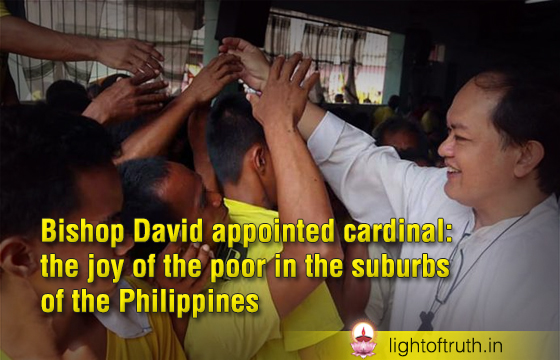
Bishop David appointed cardinal: the joy of the poor in the suburbs of the Philippines
The news of the appointment as Cardinal of Bishop Pablo Virgilio David of Kalookan, one of the smallest dioceses in the Philippines, was greeted with great joy by lay people, priests and bishops. As announced yesterday after the Marian Angelus prayer, Msgr. David – who is 65 years old and has been the president of the Philippine Bishops’ Conference since 2021 – will receive the purple on 8 December, together with 20 other new cardinals.
A priest since 1983 for the diocese of San Fernando, of which he was also auxiliary bishop, and since 2015 at the head of the diocese of Kalookan in the immense metropolitan area of Manila, Msgr David is a highly respected voice in the Philippine Church, for his courageous stance against social injustice, but he is also known outside the country holding the position of vice-president of the Fabc, the Federation of Asian Bishops’ Conferences.
A staunch advocate of human rights, ‘Bishop Ambo’ – as people affectionately call him – has worked tirelessly with the poor and marginalised, particularly in addressing the pressing issues of poverty and inequality in the Philippines. His pastoral leadership has made him a central figure in upholding the dignity of those who are most vulnerable in society.
Agnes Brazal, theologian and lecturer, comments: ‘David is a good theologian and administrator, as well as a courageous voice for the victims of extrajudicial killings during former President Rodrigo Duterte’s war on drugs. Indeed, Kalookan was one of the areas most affected by the Philippine government’s bloody anti-drug campaign. During those years, Bishop David courageously used his position to speak out against acts of violence, upholding the rights of the weak and the sanctity of life. ‘Lord, my life is in your hands,’ Bishop David often repeats in his prayer, and it is the attitude with which he is also preparing to begin this new service to the universal Church. As of 8 December, he will become the tenth cardinal in the history of the Catholic Church in the Philippines, joining two other current Philippine cardinal electors: Pro-Prefect of the Department of Evangelisation Luis Antonio Tagle and Archbishop of Manila Jose Advincula.
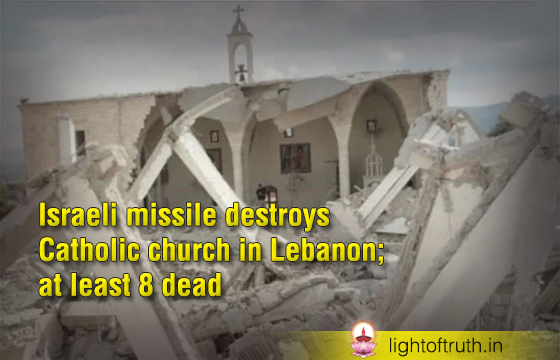
Israeli missile destroys Catholic church in Lebanon; at least 8 dead
A church of the Melkite Greek Catholic Eparchy of Tyre, Lebanon, was hit by a missile from Israeli airstrikes in the country’s south Oct. 9, killing at least eight people, the British branch of the pontifical foundation Aid to the Church in Need (ACN) has reported.
Local sources told ACN that the church, located in the town of Derdghaya, was sheltering people displaced by the conflict. A priest’s house and a three-story building housing parish offices were also completely destroyed by another missile.
Pope Francis called for peace in the Middle East on X, stating that “all nations have the right to exist in peace and security: Their territories must not be attacked, their sovereignty must be respected and guaranteed through dialogue and peace.” In an additional post on Oct. 11, the pontiff said: “I call for an immediate cease-fire on all fronts of the war in the Middle East, including Lebanon. Let us pray together for the Lebanese, especially for the inhabitants of the south forced to leave their villages, so that they can return as soon as possible and live in peace.”
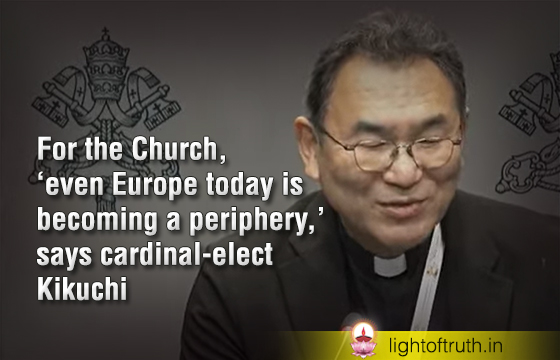
For the Church, ‘even Europe today is becoming a periphery,’ says cardinal-elect Kikuchi
“The mission today is an exchange of gifts between Churches, between those who have and those who have not,” the prelate said in his address. “Before, it was from West to East, now many countries in Asia and Africa give missionaries to the world. The very concept of periphery is changing, and even Europe today is becoming a periphery” said Archbishop Tarcisius Isao Kikuchi of Tokyo on October 8th briefing on the work of the Synod underway in the Vatican. In addition to the Archdiocese of Tokyo, the 65-year-old Kikuchi has chaired Caritas Internationalis since last year.
Pope Francis “has just come to our continent where he has visited many countries,” he said, stressing how the pontiff looks with particular attention to Asia. “He has chosen three more bishops from Asian dioceses among the new cardinals. More generally, the centre of the Church’s mission is moving towards the Global South.” On the experience of synodality, the prelate explained that the Japanese Church is focusing “more on its foundations than on the rush to build.” “We met with priests, religious and lay people for the National Congress of our 15 dioceses. We practised together the method of conversation in the Spirit. We also need a common understanding of synodality,” which “is not basing everything on consensus. Common discernment must indicate the direction, then someone has the task of making decisions.”
Archbishop Kikuchi had already written on his appointment as a cardinal in a message sent to his diocese and to all his friends. “This appointment is not just a personal honour for me, but a great honour for the Church in Japan, and especially for the Tokyo Archdiocese, and also for Caritas Inter-nationalis,” he said.
“I was surprised. It had been a long time since I was so shocked from the bottom of my heart. And I was confused. When I think about the fact that being a cardinal is not just an honorary position, but that there are many roles to play as an advisor to the Pope, I can only see my own shortcomings.”
Finally, the archbishop of Tokyo, who is also secretary general of the Federation of Asian Bishops’ Conferences (FABC), mentioned the presence of Philippine Bishop Pablo David among the new cardinals. He “will be the next FABC vice president (in January 2025 alongside the new president, Card Felipe Neri Ferrao, archbishop of Goa). I believe this appointment will have great significance for the FABC.”

Synod an opportunity ‘to overcome walls’ between Christians
The Pope presided over a candlelight vigil on October 11, the anniversary of the opening of the Second Vatican Council in 1962, and texts from council documents introduced the prayers of praise and the prayers of petition.
The Synod participants at the prayer service included the 16 “fraternal delegates” representing Orthodox, Anglican and Protestant churches, as well as the Rome-based representatives of the Anglican, Methodist and Reformed churches to the Holy See and other Christian ministers and faithful in the city.
Pope Francis did not read the meditation he prepared for the service, although it was distributed and published on the Vatican website.
Halfway through the Synod of Bishops, Pope Francis wrote, participants wanted to “express our shame at the scandal of division among Christians, the scandal of our failure to bear common witness to the Lord Jesus”.
“This Synod is an opportunity to do better, to overcome the walls that still exist between us,” the Pope wrote.
The vigil took place in the Square of the Roman Protomartyrs, just south of St Peter’s Basilica, which is the site where St Peter and other Christians were martyred in the first century under the Emperor Nero.
Noting the anniversary of Vatican II, he said the council “marked the official entry of the Catholic Church into the ecumenical movement,” which was begun by mainline Protestant churches out of a conviction that the lack of unity among Christians was harming their ability to preach the Gospel.
The goal of the work for Christian unity is the same as the goal for the Synod on Synodality, Pope Francis wrote. Both are focused on the mission Jesus gave to all his disciples to share the good news of salvation with everyone.
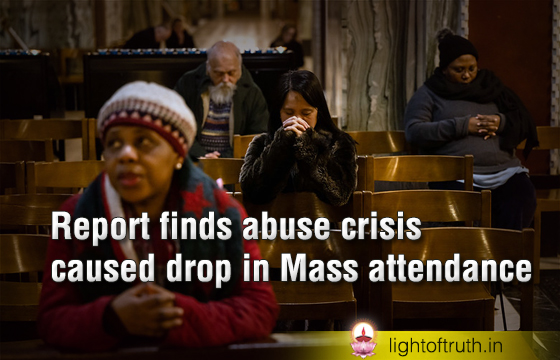
Report finds abuse crisis caused drop in Mass attendance
One in three Catholics who previously went to Mass have reduced their attendance or stopped going altogether as a result of the child sexual abuse crisis in the Catholic Church, according to a new report by Durham University. There has also been a corresponding fall in the number of financial donations, with a third of Catholics who previously donated no longer giving money to the Church. The YouGov survey was commissioned by the Centre for Catholic Studies at Durham University as part of a wider research project, “Boun-dary Breaking”, where research-ers are looking at the implications of the abuse crisis for the Catholic community.
More than 3,000 adults who identify as Catholic responded to the questionnaire, with 79 per cent saying that the Church needs to change “a great deal” to prevent further cases of child sexual abuse.
The sample was representative of the Catholic population in England and Wales. It included regular Mass-goers attending at least once a month and people attending less than once a month, as well as people who do not go to Mass but identify as Catholics.
According to the survey, the scandal of abuse has been a direct cause of distancing from the Church. However, it also shows that regular churchgoers have a more positive attitude towards the Church than non-attenders.
Nearly a third of those attending Mass regularly were more likely to consider child abuse in the Church to be a thing of the past compared to those who never attend Mass. Nearly half of regular Mass-goers were more likely to view the abuse as being about the same at other institutions that work with children.
Dr Marcus Pound from the Centre for Catholic Studies, who co-authored the study, said: “Overall, our analysis of the data shows that the Catholic community feels abuse is not a uniquely Catholic or clerical problem. However, there is also a conviction that the Church needs to make changes to prevent such abuse happening in the future.”

Jubilee 2025: Italian police seize more than 100,000 counterfeit items
As preparations intensify for the upcoming Jubilee Year in Rome, Italian authorities have cracked down on counterfeit religious merchandise flooding the city’s souvenir market. In a large-scale operation conducted by Italy’s financial police, more than 100,000 fake items bearing the official logo of Jubilee 2025 were seized from shops in the historic center of the capital.
The contraband haul, which included rosaries, medallions, bracelets, and pendants, was adorned with religious symbols, such as the image of Pope Francis and the emblem of the Papal Tiara, as well as the Jubilee slo-gan, “Pilgrims of Hope.” How-ever, these items failed to meet European Union safety standards, with several reportedly contain-ing harmful metals that pose health risks.
According to the Guardia di Finanza, the police force respon-sible for economic and financial crimes, four individuals of Chi-nese origin have been arrested in connection with the illegal trade. These suspects are accused of importing and selling counter-feit goods, as well as marketing items that contain substances banned under EU regulations. The authorities confirmed that these charges could lead to seri-ous legal consequences.
The discovery comes at a critical time, as Rome braces for the arrival of millions of pilgrims for the Jubilee Year, set to co-mmence on December 24, 2024. This Holy Year, an ancient Catholic tradition held roughly every 25 years, is expected to draw over 30 million faithful from around the world, who will visit the city’s major basilicas and sacred sites. With Rome already welcoming about 50 mi-llion tourists annually, the surge in visitors for the Jubilee poses additional challenges, including ensuring the safety and authenti-city of religious souvenirs.
Counterfeit religious items are a growing problem in Rome, especially around significant events like the Jubilee, when demand for holy symbols and memorabilia skyrockets. Not only do fake goods undermine the local economy and tarnish the sanctity of the event, but they also often fail to comply with safety regulations, posing a threat to consumers.
Authorities are stepping up efforts to prevent the circulation of counterfeit Jubilee items as the Holy Year approaches. In a statement, police stressed the importance of protecting consumers and the integrity of the event, warning that further raids and controls will be carried out across the city in the coming months.
With the official launch of the Jubilee Year fast approaching, both local authorities and the Vatican are keen to ensure a smooth and safe experience for pilgrims. Organizers are working closely with the Italian government to manage the anticipated influx of visitors and maintain order during this momentous religious event. As the countdown to Jubilee 2025 begins, the seizure of these counterfeit items serves as a reminder of the complex challenges that accompany major global religious celebrations in a city as iconic as Rome.