
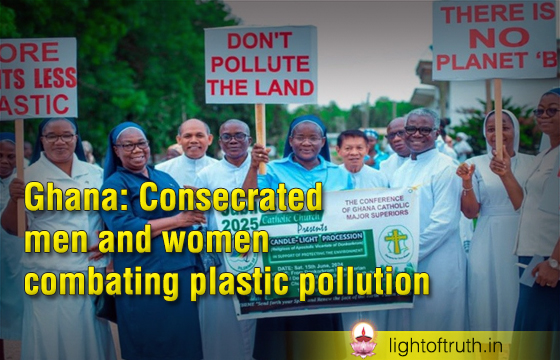
Consecrated religious in Ghana make time alongside their numerous other activities to help the wider community recognise the need to protect Creation, focusing especially on plastic pollution, which has become a major problem especially in suburban areas near cities.
Pollution is easily spotted in Donkorkrom, in the Eastern Region of Ghana, West Africa. Taking a leisure walk in Donkorkrom, from the doorstep through the streets to the markets, plastic bags can be seen lying on the ground.
Residents of Donkorkrom are frequently in the habit of drinking sachet water, and often as soon after consuming the water, the plastic is thrown anywhere on the ground. It is not unusual to see plastics littered on school or Church grounds, despite numerous pleas by priests and religious to take more care.
The indiscriminate dumping of plastics on the ground has serious effects on the environment. For instance, the rain collects the plastic from the ground and incorporates it into the land, which is often only discovered when one goes to plough the land for planting, and finds a dead land on which nothing can germinate as a result of plastic pollution.
Another problem with plastic pollution is that when the plastics get choked in the gutters, and it rains, the water is not able to move, resulting to spillage and floods, causing enhanced damage to the community.
Plastic pollution is not only detrimental to the soil but to animals as well, which are part of God’s Creation. Some of the plastics carried by the rain or floods hang on the grass, and if by any mistake any of the animals happen to swallow them, they die.
Consecrated religious have taken it upon themselves to sensitize the community on the need to protect the environment. They are doing this by engaging the community in talks and other activities on the subject, but mostly by their own lived realities. They undertake to take the lead so that others will follow.
Their goal is to continue to practice environmental care in their religious communities and parishes, so that when members of the local community visit their homes, they will see, become conscious, and follow suit.
The religious also believe that for this fight to be successful, there must be some kind of replacement to take care of the plastic pollution. In that light, they plan to produce shopping bags using fibre or material that can be disposed of, which they can consciously use for shopping instead of carrying numerous plastics from the shop, which only contributes to more pollution.
They believe that if the community sees them making this move, it will definitely effect a positive change in them, and they will become more conscious of preserving the earth.
Daily Archives: October 16, 2024
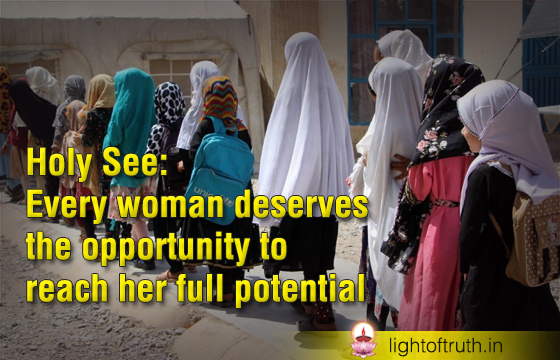
Holy See: Every woman deserves the opportunity to reach her full potential
“For a just society to thrive, it is essential to advance and recognize women’s capacities by combating all harmful stereotypes that deny them opportunities,” said the Holy See’s Permanent Observer to the United Nations addressing a Session dedicated to the Advancement of Women.
Archbishop Gabriele Caccia delivered his speech on October 09 during the Third Committee of the 79th Session of the United Nations General Assembly. Quoting from Pope Francis, the Archbishop described domestic violence as “a poisonous weed that plagues our society and must be pulled up from its roots,” and he called for a collaborative response to address domestic violence, which frequently, he noted, occurs behind closed doors.
The Archbishop emphasized that addressing root causes such as poverty and lack of proper education would ultimately reduce the abuse of women and girls, trafficking for sexual exploitation, and eliminate various forms of inhuman and degrading treatment towards women, particularly those characterized by violence, coercion, and drug abuse.
“The advancement of women cannot be fully achieved without respecting women’s unique capacities,” he said.
A renewed commitment, he continued, is essential to reduce maternal mortality and adequately equip clinics, particularly in regions where women are facing poverty.
“It would be a misleading assertion to claim that the advancement of women is being promoted or advanced when the pressing issues of poverty and abuse are not addressed,” he added.
Archbishop Caccia addressed surrogacy as a concerning form of exploitation, asserting that it leads to the “unacceptable commercialization of women’s unique capacity for motherhood.” He expressed his belief that this practice constitutes a serious violation of the dignity of both women and children and called for the prohibition and universal ban of surrogacy.
In concluding his speech, Archbishop Caccia stressed the importance of education as a crucial factor in empowering women and girls to develop their talents and realize their potential in society. “Changing both attitudes and practices to support women and men in their roles within the family and society is essential,” he said.

Bernini’s baldacchino to be unveiled on October 27
October 27 marks a significant day in the Vatican. Both the Synod and the work on the baldacchino covering the main altar in St. Peter’s Basilica will end. The Archpriest of the Basilica, Cardinal Mauro Gambetti, announced that Pope Francis will celebrate Mass and officially unveil the newly refurbished baldacchino.
“This is a significant date for many reasons,” the Cardinal explained. “October 27 will mark the conclusion of the Synod and Pope Francis will hold the concluding Eucharistic celebration. However, Oct. 27 is also a date of peace because it recalls the interreligious meeting desired by St. John Paul II in 1986 in Assisi.” Pope Francis has seen the progress on the baldacchino and, Cardinal Gambetti, said, he “appreciated it very much.”
The baldacchino was designed by Gian Lorenzo Bernini between 1624 and 1635 for Pope Urban VIII. It is an important structure in St. Peter’s Basilica because it stands above the tomb of the first Pope. Towering nearly 29 meters tall, the last refurbishment dates back to 1758. The Fabric of St. Peter described the work as “a challenging and necessary restoration” especially ahead of the Jubilee of 2025.
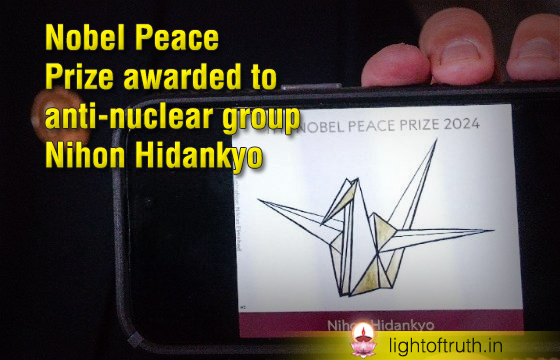
Nobel Peace Prize awarded to anti-nuclear group Nihon Hidankyo
The Nobel Peace Prize was awarded on October 11 to Nihon Hidankyo, a Japanese organiza-tion of survivors of the U.S. ato-mic bombings of Hiroshima and Nagasaki, for its “efforts to achi-eve a world free of nuclear wea-pons.”
Jørgen Watne Frydnes, chair of the Norwegian Nobel Commi-ttee, said the award was assigned to the grassroot organization as the “taboo against the use of nuclear weapons is under pre-ssure.” He said the Committee “wishes to honour all survivors who, despite physical suffering and painful memories, have cho-sen to use their costly experience to cultivate hope and engagement for peace.” Efforts to eradicate nuclear weapons have been ho-noured in the past by the Nobel Committee.
The International Campaign to Abolish Nuclear Weapons won the peace prize in 2017, and in 1995 Joseph Rotblat and the Pugwash Conferences on Science and World Affairs won for “their efforts to diminish the part played by nuclear arms in international politics and, in the longer run, to eliminate such arms.” This year’s prize was awarded agai-nst a backdrop of devastating conflicts raging in the world, notably in the Middle East, Ukraine and Sudan. “It is very clear that threats of using nuclear weapons are putting pressure on the important international norm, the taboo of using nuclear weapons,” Watne Frydnes said.
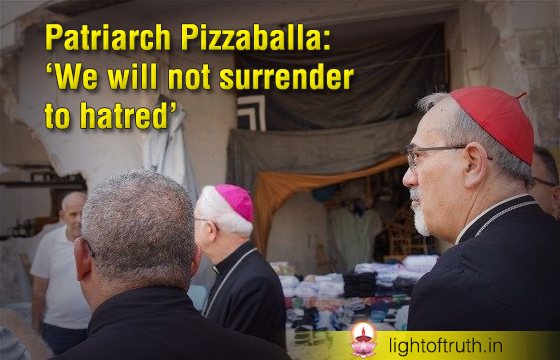
Patriarch Pizzaballa: ‘We will not surrender to hatred’
Cardinal Pierbattista Pizzaballa, the Latin Patriarch of Jerusalem, has sent a letter to Pope Francis to convey the “most sincere gratitude” of Catholic leaders and all the Christian faithful in the Middle East for his closeness and compassion.
On the Day of prayer for world peace and fasting to mark the anniversary of Hamas’ ma-ssacre in Israel and the devasta-ting war that has ensued, the Pope also addressed a letter to the Catholics of the region expressing his closeness to the “small, de-fenceless flock” in the Holy Land “thirsting for peace.”
In his letter, published on Friday by the Vatican’s “L’Oss-ervatore Romano” newspaper, Cardinal Pizzaballa thanks the Pope for this “beautiful gesture of closeness and affection” and also for being “the only world leader” who acknowledges the human “suffering of all” remin-ding us of the need “not to lose our humanity”, even in these tragic circumstances.
Referring to the Day of prayer for peace joined by the Catholic communities in the Holy Land and across the world, the Latin Patriarch of Jerusalem noted that these “weapons of love” are the Church’s response “to the mis-trust that seems to be spreading more and more. “In this context of deeply rooted hatred,” he said, “there is a need for empathy, for gestures and words of love that, even if they don’t change the course of events, bring comfort and consolation.”
Cardinal Pizzaballa recalled that in the past twelve months of war priests, religious men, and women along with volunteers have remained steadfast in serving those in distress, to provide relief and comfort, even at the risk of their lives.
He reiterated the Church’s firm commitment to rebuilding broken relationships and trust between communities and to resist the “logic of evil” that seeks to divide.
“We will not surrender to events that seem to drive us apart, but we will always seek to be thirsty builders of peace and justice,” he said, recalling the example of men and women of all faiths who, even though personally affected by the violence, have had the inner strength to forgive and not to give in “to the logic of hatred.” He expressed his hope that this “small remnant” might provide the starting point for rebuilding relationships.
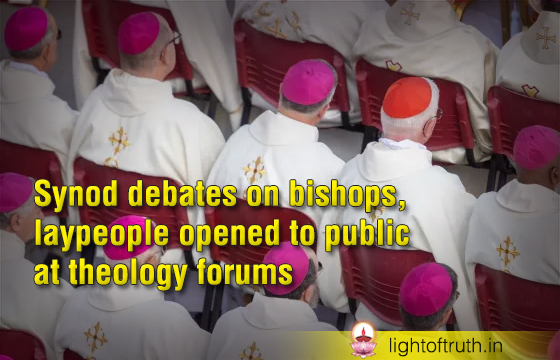
Synod debates on bishops, laypeople opened to public at theology forums
Synod on Synodality events open to the public gave a glimpse into the private debates happening among delegates and theological experts on the issues of a bishop’s authority and his relationship to the laity in light of synodality.
At the Oct. 9 forum on ”The Role and Authority of the Bishop in a Synodal Church,” hosted in a conference hall near the Vatican, four theologians and a canon lawyer gave presentations on finding and following the correct interpretation of the Se-cond Vatican Council’s teaching on episcopal authority, with frequent citations of the council’s dogmatic constitution Lumen Gentium. Speakers claimed an important part of synodality is implementing the proper under-standing of a bishop’s authority in his diocese, which demands cooperation with laypeople.
Italian canonist Father Matteo Visioli pointed out that ”What power of governance can be en-trusted to laymen and women?” is one of the questions being asked by the synod that, he said, still needs further theological explo-ration. “The problem is, which offices require the sacred orders and which don’t?” he asked in response to a question about changes Pope Francis has made to permit laypeople to hold posi-tions formerly reserved to priests or bishops. The canonist noted that while Pope Francis has drawn practical lines in the sand in some instances, including in the newest constitution governing the Roman Curia, Praedicate Evangelium, ”if he entered into the theoretical line, he would have gotten stuck.”
In his remarks, Italian theo-logian Roberto Repole, arch-bishop of Turin and bishop of Susa, cited paragraphs 38-39 of the 2024 Instrumentum Laboris, which says that a bishop’s powers and ministry do ”not imply his separation from the portion of the people of God entrusted to him” and ”is not the justification for an episcopal ministry that is ‘monarchical…’”
In light of what is written in the Instrumentum Laboris, Repole, who will be made a cardinal in December, said there are different ways to interpret Lumen Gentium’s teaching that bishops have the fullness of the sacrament of holy orders. He argued that a ”synodal” interpretation of the bishop’s ministry — one in which he serves in full cooperation with priests and laypeople — could ”dissolve” some of the isolation and stress faced by bishops around the world and prevent a ”monarchical”-style rule.
A prominent theologian from Argentina, Father Carlos María Galli, argued in his lecture that the bishop is the servant of the Lord, not a ”lord” of the Church, and said a ”novelty” of Vatican II was viewing the people of God as equal in dignity to the Church’s hierarchy. The second chapter of Lumen Gentium, on the people of God, was a ”big revolution” in Church ecclesiology, he said. “These theological foundations should move us to a change of mentality, of mindset.”
In his contribution, Father Gilles Routhier, a French Canadian and theological consultant to the general secretariat of the Synod of Bishops, described the bishop’s relationship to the laity using imagery from the Mass. Just as the celebration of the Mass includes the organic participation of all the parts (priest and laity), so, too, the bishop should view his communion and cooperation in running a diocese, he said. Routhier also criticized the Church’s use of the prepositions ”of,” “for,” or ”at” to describe a bishop instead of the words “in” and ”within.” As written in Lumen Gentium, the priest and bishops, he said, are part of and within the same assembly of the people of God. “We can’t speak of the autonomy of the pastor from the rest of the assembly,” the theologian and Vatican II expert claimed.
Sister Gloria Liliana Franco Echeverri, ODN, addressed bishops directly in her contribution to the forum, exhorting them to be servant leaders and to combat abuse.
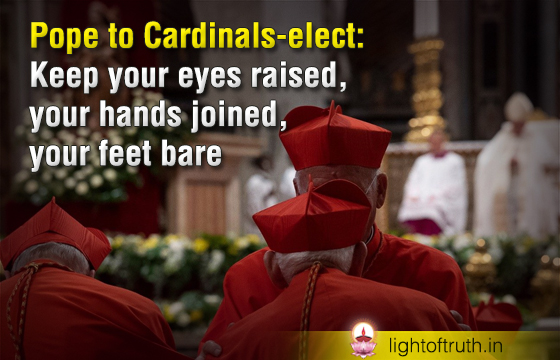
Pope to Cardinals-elect: Keep your eyes raised, your hands joined, your feet bare
Pope Francis has written a personal letter to the 21 men – bishops and priests from around the world – whom he will raise to the Cardinalate at a consistory set for December 8, the Solemnity of the Immaculate Conception of the Blessed Virgin Mary.
Noting that their elevation to the College of Cardinals will associate them with the Roman Clergy, the Bishop of Rome reminds them that membership in the College “is an expression of the Church’s unity and of the bond that unites all the Churches with this Church of Rome.”
In his letter, the Pope Francis invites the Cardinals-elect “to embody the three attitudes with which an Argentinian poet (Francisco Luis Bernárdez) once characterized Saint John of the Cross, and which are also applicable to us: ‘eyes raised, hands joined, feet bare.’” Explaining these three attitudes, the Holy Father tells the soon-to-be Cardinals that their new service within the Church will require them to “lengthen your gaze and broaden your heart” to see further and love more fervently.
They must keep their hands joined in prayer to enable them “to shepherd well the flock of Christ,” the Pope said, adding that prayer is “the realm of discernment” that helps discern God’s will and follow it.
Finally, the Pope said, they must keep their feet bare “because they touch the harsh realities of all those parts of the world overwhelmed by pain and suffering,” which will demand from the new Cardinals “great compassion and mercy.”
Concluding his letter, Pope Francis thanked the Cardinals-elect for their generosity and assured them of his prayers “that the title of ‘servant’ (deacon) will increasingly eclipse that of ‘eminence.’”