
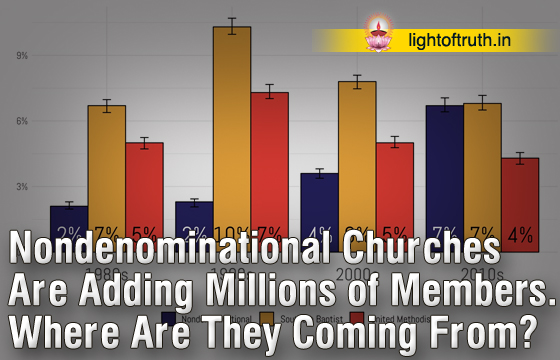
Over the last decade Baptists, Methodists, Lutherans, Presbyterians, and every other Protestant family has declined except for those who say they are nondenominational.
The 2020 US Religion Census, due out later this year, tallied 4,000 more nondenominational churches than in 2010, and nondenominational church attendance rose by 6.5 million during that time. At the same time, mainline Protestant Christianity is collapsing following five decades of declines. In the mid-1970s, nearly a third of Americans were affiliated with denominations like the United Methodist Church, the United Church of Christ, and the Episcopal Church. But now, just one in ten Americans are part of the mainline tradition.
In 2021, nondenominational Protestants in the United States outnumbered mainline Protestants. But what is causing this tremendous shift in the church landscape?
Daily Archives: August 13, 2022

Raising banner, protesters raise questions about ‘Doctrine of Discovery’
In a brief protest at a papal Mass in Canada, Indigenous women unfurled a banner that said, “Rescind the Doctrine.”
The protest July 28 was a momentary but graphic reminder of how, when representatives of Canada’s First Nations, Métis and Inuit communities met Pope Francis at the Vatican in March and April, they asked him specifically for a formal repudiation of the so-called “Doctrine of Discovery.”
The phrase describes a collection of papal teachings, beginning in the 14th century, that blessed the efforts of explorers to colonize and claim the lands of any people who were not Christian, placing both the land and the people under the sovereignty of European Christian rulers.
The loss of the land, language, culture and spirituality of the Indigenous peoples of Canada and the foundation of the residential school system all can be traced to the doctrine, Indigenous leaders told reporters after their meetings with the Pope.
Asked July 20 if the Pope was expected to say something about the “Doctrine of Disco-very” while in Canada July 24-29, Matteo Bruni, director of the Vatican press office, said, “a reflection is underway in the Holy See on the Doctrine of Disco-very,” and the study is nearing its conclusion. However, he said he was not certain that a statement would be completed before the papal trip ends or if the Pope would speak about it while in Canada.
Sarain Fox, an activist and member of the Batchewana First Nation near Sault Ste. Marie, Ontario, told Canada’s CBC News that she was one of the people holding the banner as Mass began in the National Shrine of Sainte-Anne-de-Beaupré.
“It’s important for us to be recognized as human beings, so it’s not enough just to apologize. You need to talk about the root of everything,” which is the Doctrine of Discovery, Fox told.
The Canadian Conference of Catholic Bishops, in a 2016 statement on the Doctrine of Disco-very, acknowledged the connect-ion between it and the government’s residential school policy, which forcibly removed Indigenous children from their homes and sent them to schools where their language, cultures and spiritualities were suppressed.
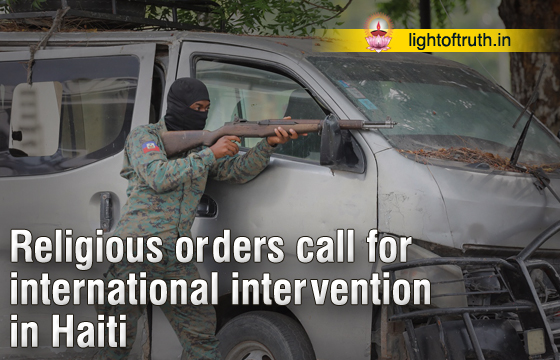
Religious orders call for international intervention in Haiti
Religious orders working in Haiti have called on the inter-national community to directly intervene to address the reign of terror of armed gangs they described as “diabolical, frightening and unacceptable.”
The same gangs are responsible for nearly four kidnappings a day in 2022 and violence that killed more than 200 and forced 3,000 to flee their homes during July alone.
In an Aug. 4 open letter to Najat Maalla M’jid, U.N. special rapporteur on violence against children, the Justice Coalition of Religious — made up of 20 religious orders — urged the inter-national community “to respond swiftly and effectively to the atrocities occurring in Haiti.”
In a document of testimonies published by the coalition, Passionist Father Rick Frechette, a doctor in Port-au-Prince, said “99% of people on the street want a foreign military force to save them.” He described the situation on the streets of Port-au-Prince as “Somalia-type battles.”
The coalition letter noted that the “Haitian state has failed in its sovereign obligation to protect the population.” It diverged from a July 29 statement from the Haitian bishops’ conference, which said state authority must be restored and that the government must take immediate action to “disarm the gangs, to allow the police to tackle violent crime and create a climate of serenity and confidence.” The bishops’ message stopped short of calling for action from the international community.
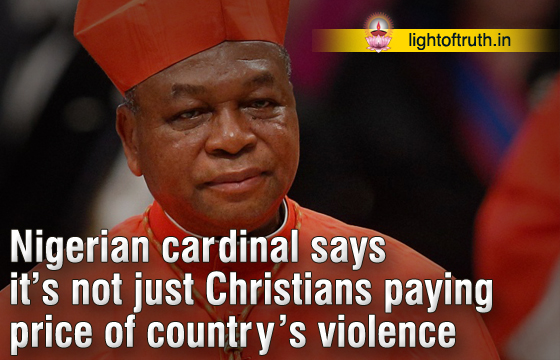
Nigerian cardinal says it’s not just Christians paying price of country’s violence
According to the former top Catholic official of Nigeria’s capital city, the violence in the country is “getting out of hand.” It’s not only Christians paying the price, he said. None of the country’s 200 million people are safe. “There is great insecurity throughout the country, people are being killed every day; bandits and terrorists seem to have a free hand,” said Cardinal John Onaiyekan, archbishop emeritus of Abuja. “We don’t know where the security forces are.”
“No one is safe, not just Christians. It is as if the government has lost control.” The country has presidential and parliamentary elections scheduled for February and March 2023.
According to the prelate, both Christians and Muslims are victims of violence, perpetrated by criminals who “go around illegally killing innocent people.”
Speaking on the occasion of the XIX Plenary Assembly of the Symposium of the Bishops’ Conference of Africa and Madagascar (SECAM), which ended on July 31 in Accra, Ghana, Onaiyekan said his country has been experiencing “indiscriminate” violence since the rise of Boko Haram in 2009.
The insurgency group is one of the largest Islamic terrorist organizations, and their stated goal is to turn Nigeria into an Islamic state, much like ISIS tried to do in Iraq.

Pope Francis on birth control: Can the teaching of the Church on contraception change?
Can the Church’s teaching on birth control change? During Pope Francis’ return flight from Canada, a journalist asked him about the possibility of a development in the Church’s teaching on contraception.
“This is very timely. But know that dog-ma, morality, is always in a path of development, but development in the same direct-ion,” Pope Francis responded on July 30.
The pope went on to say that he thinks that the development of Catholic moral doctrine, in general, is fine but recommended in particular that it follows the rules outlined by the 5th-century theologian St. Vincent of Lérins.
Pope Francis explained that St. Vincent of Lérins taught “that true doctrine in order to go forward, to develop, must not be quiet, it develops ut annis consolidetur, dilatetur tempore, sublimetur aetate.”
“That is, it consolidates with time, it expands and consolidates, and becomes more steady, but is always ‘progressing.’ That is why the duty of theologians is research, theological reflection. You cannot do theology with a ‘no’ in front of it … the magisterium will be the one to say no,” the pope added.
Francis also addressed the recent controversy over a book published by the Vatican’s publishing house, which discussed “the possible legitimacy of contraception in certain cases.”
The book “Theological Ethics of Life: Scripture, Tradition, and Practical Challenges” was a 528-page synthesis of a theological seminar sponsored by the Pontifical Academy for Life in 2021.
Pope Francis said: “On the issue of contraception, I know there is a publication out on this issue and other marriage issues.”
“These are the proceedings of a congress and in a congress there are hypotheses, then they discuss among themselves and make proposals. We have to be clear: those who made this congress did their duty because they tried to move forward in doctrine, but in an ecclesial sense, not out, as I said with that rule of St. Vincent of Lerins.”
On the subject of birth control, the Catechism of the Catholic Church states that “legitimate intentions on the part of the spouses do not justify recourse to morally unacceptable means (for example, direct sterilization or contraception).”
St. Paul VI issued Humanae Vitae, the landmark encyclical reaffirming Church teaching against contraception, on July 25, 1968.
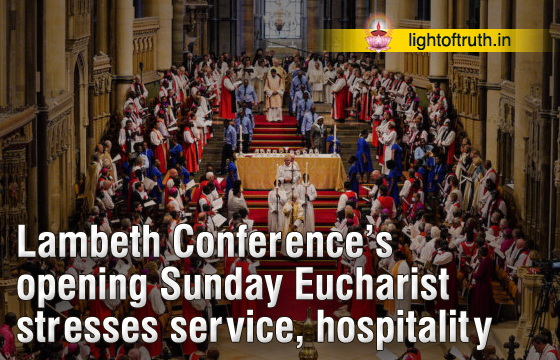
Lambeth Conference’s opening Sunday Eucharist stresses service, hospitality
Episcopal and Anglican bishops and their spouses filled Canterbury Cathedral on July 31 for the opening Sunday Eucharist of the Lambeth Conference.
The service spanned several hours and was marked by prayer and pageantry in a worship space with more than 1,400 years of history that was described in a welcoming message as “the heart of our communion.”
More than 600 bishops representing an estimated 165 countries are attending the July 26-Aug. 8 conference.
Archbishop of Canterbury Justin Welby, head of the Anglican Church, convened the Lambeth Conference of Anglican bishops. Standing just inside the cathedral door, Archbishop Welby offered an opening prayer, seeking unity among bishops in their shared faith despite individual differences.
“Let us pray earnestly for God’s blessing upon those who are gathered here,” the archbishop said, “that through our discussions and our walking together we may grow into a deeper understanding of one another and a deeper love for the world Jesus Christ came to save.”
The Lambeth Conference is a decennial assembly of bishops of the Anglican Communion convened by the Archbishop of Canterbury. The first such conference took place at Lambeth in 1867.
As the Anglican Communion is an international association of autonomous national and regional churches and is not a governing body, the Lambeth Conferences serve a collaborative and consultative function, expressing “the mind of the communion” on issues of the day.
Lambeth is a riverside area home to Lambeth Palace, the residence of the Arch-bishop of Canterbury.
This is the 15th Lambeth Conference and the first in 14 years, after past conferences typically were held once a decade. Welby initially postponed calling his first Lambeth Conference by two years due to theological divisions between some of the provinces, and his plans to hold the conference in 2020 were delayed by another two years because of the Covid-19 pandemic.
The last Lambeth Conference was in 2008.
The bishops displayed a broad spectrum of colour, nationality and dress, reflecting the diversity of the Anglican Communion’s 42 provinces – four more provinces than existed in 2008.

Cardinal Müller: ‘The German Synodal Way was over before it even started’
Cardinal Gerhard Ludwig Müller, prefect emeritus of the Congregation for the Doctrine of the Faith, has sharply criticized the Synodal Way in Germany.
In an interview, the 74-year-old cardinal said that the Synodal Way, declared a “reform process” by its initiators, is “over” and was on an “anti-Catholic, wrong track.”
The Holy See issued a statement June 21 noting that the Synodal Way was “not authorized” to “oblige the bishops and the faithful to adopt new forms of governance and new orientations of doctrine and morals.” It was “necessary” to clarify this in order to “safeguard the freedom of the people of God and the exercise of the episcopal ministry.”
The Synodal Presidium – consisting of the German Bishops’ Conference and the Central Committee of German Catholics (ZdK) – then accused the Vatican of a lack of willingness to communicate. It stated: “Unfortunately, the synodal presidium has not been invited to a conversation until today. That this direct communication does not take place so far, we regret irritated. Synodal church goes after our under-standing differently! This also applies to the way of today’s communication, which astonishes us. It does not testify to a good style of communication within the Church when statements are published that are not signed by name.”
It was the “birth defect of this body” to set itself up as a vanguard of the Church, he said.
Baby Blues: How to Face the Church’s Growing Fertility Crisis
Data from the National Survey of Family Growth (NSFG) from 1982 to 2019, along with data from four waves of the Demographic Intelligence Family Survey (DIFS) from 2020 to 2022, point to a widening gap in fertility rates between more religious and less religious Americans.
In recent years, the fertility gap by religion has widened to unprecedented levels. But while this difference may comfort some of the faithful who hope higher fertility rates will ultimately yield stable membership in churches and synagogues, these hopes may be in vain. Rates of conversion into unfaith are too high, and fertility rates too low, to yield stable religious populations.
As a result, data from over 70,000 women surveyed from 1982 to as recently as 2019 can be used to estimate fertility rates for three broad groups of women: those without any religious affiliation, those with religious affiliation but less than weekly attendance, and those with at least weekly attendance.
It’s evident that birth rates among Americans who attend weekly have never dropped much below 2 children per woman, and as recently as 2008 were around 2.4 children each. Fertility among religious people did decline after the 2008 recession, but by 2017–2019, it was rising again.
Finally, fertility among non-religious women rose considerably from 1982 to 2005, then again from 2008 to 2012, showing a very different pattern than the one we see for religious women.
From 2010 to 2013, non-religious women had about the same birth rates as women who attended religious services less than weekly, before their fertility slumped through 2019.