

The trial for the 90-year-old cardinal and four others detained under China’s national security law will take place Sept. 19-23
At a pre-trial hearing in Hong Kong, a judge set a five-day trial for Cardinal Joseph Zen Ze-kiun and four other defendants who face charges of failing to properly register a now-defunct fund to help anti-government protesters.
According to an Aug. 9 report by the Hong Kong Free Press news agency, Magi-strate Ada Yim announced that the trial will take place Sept. 19-23 after asking prosecutors and the defendants’ lawyers if five days would be sufficient for the court to hear the case. Both sides agreed.
The 90-year-old cardinal was detained May 11 under China’s national security law. However, he and the four others were charged with failing to properly register the 612 Humanitarian Relief Fund, set up to offer financial assistance to those involved in anti-government protests in 2019. It was disbanded last year after coming under scrutiny by authorities.
Lawyers for both sides will argue whether the 612 Humanitarian Relief Fund fell under Hong Kong’s Societies Ordinance, which regulates registered and exempted associations.
The Hong Kong Free Press reported that prosecutors and defines lawyers also will argue whether the defendants held any positions of authority within the relief fund.
The national security law made participating in or supporting the pro-democracy movement crimes of subversion and collusion with foreign organizations and allowed for those remanded to be extradited to mainland China. Punishment ranges between a minimum of three years and a maximum of life imprisonment.
All five defendants pleaded not guilty. If convicted of the improper registration, each defendant could incur a fine of about $1,300.
Daily Archives: August 13, 2022

Police hunt for Sri Lankan priest deplored
Rights defenders and church officials in Sri Lanka have deplored the police raid on a remote parish church allegedly to search for a Catholic priest who has been a key figure in anti-government protests in the crisis-hit nation.
Police raided the church at Ratnapura in Sabaragamuwa Province of south-central Sri Lanka on July 27 and searched for Father Amila Jeewantha Peiris, media reports said.
The raid came two days after a Sri Lanka court slapped a travel ban on the 45-year-old priest and five others for their alleged participation in “unlawful assembly and damage to public property” during a protest rally in June.
Father Peiris has been at the forefront of the months-long anti-government pro-test at Galle Face Green in the capital Colombo that effectively ousted the long-reigning Rajapaksa family dynasty blamed for the nation’s worst economic crisis.
The huge protests forced President Gotabaya Rajapaksa to flee the country and resign. Last week, parliament elected former prime minister Ranil Wickreme-singhe as the new president. However, protests have continued demanding the resignation of Wickremesinghe, who is known as a loyalist of the Rajapaksa dynasty.
Prominent rights activist Ruki Fernando said police actions against Father Peiris are absolutely unacceptable, noting that he is among the few Sinhalese Catholic priests who have spent years serving communities in minority Tamil-dominant North and East that were ravaged by decades of civil war in the ethnically-divided Sri Lanka.
The priest is loved by the Tamil clergy, religious and laity, said Fernando, a consultant to the Justice, Peace and Integrity of Creation Commission of the Conference of Major Religious Superiors.
“He faces reprisals for his unwavering commitment to the struggle of people. I hope church leaders and all others will come forward to support and protect him, as he had done for others,” he told.

Preserving a vanishing culture in Pakistan
Goan vibes were in full swing, complete with melodious tunes in the Konkani language and traditional music, at Goa Fest 2022 held on the grounds of St. Patrick’s Cathedral in the southern port city of Karachi recently.
Among the beautiful damsels and stylish men turned out in their best outfits was Saphrina Bella Coelho, a banker who regaled the colorful gathering with a Konkani ‘masala medley.’
“Good things should never end,” she told. “We are Pakistani Catholics with a Goan ancestry; hence we prefer being called Goans.”
Coelho is part of a small community of some 5,000 people in Karachi, descendants of Catholics who arrived in Pakistan from Goa, a former Portuguese colony in western India.
During the British colonial days, their ability to handle English and Western lifestyle helped them get employment in government services such as the judiciary, port, police, railways, post and telegraph, and healthcare.
The partition of British India in 1947, at the end of colonial rule, gained them Pakistani citizenship, making their return to Goa almost impossible.

Indian Christians stage first ‘National March for Life’
Marchers seek to raise awareness in a country that records more than 15 million abortions each year. Pro-life activists and Christians gathered to observe the first National March for Life in New Delhi on Aug. 10.
The day also marked the 51st anniversary of the passing of the Medical Termination of Pregnancy Act which legalized abortion.
Some 100 people from across the country assembled at Jantar Mantar, a place allotted by the government to hold protest marches, holding placards against abortion, singing Christian hymns and reciting prayers to end abortion.
The protesters including a bishop, priests, nuns and laity observed a “Day of Mourning” in memory of the millions of aborted fetuses across the world.
The protest was organized by the Catholic Charismatic Renewal Services in India and the Delhi Catholic Charismatic Service of Communion to raise awareness about abortion.
The march was followed by prayers and a Life Gala at Sacred Heart Cathedral hosted by the Archdiocese of Delhi.
“Being a Christian, at least we can try in our capacities to help stop this practice in our country”
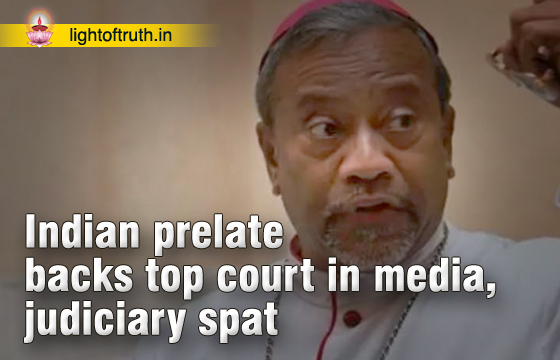
Indian prelate backs top court in media, judiciary spat
A Catholic archbishop has condemned media re-ports saying India’s top court was delaying the hearing of a case seeking an end to violence against Christians.
“I am extremely distressed about articles in news-papers that the honorable Supreme Court, India’s top court, is not taking up the matter of attacks against Christians. There is no merit in the allegation. I strongly condemn it,” said Archbishop Peter Machado of Bangalore in southern Karnataka province, on July 30.
The prelate’s statement came a couple of days after Supreme Court Justice D.Y. Chandrachud criticized a section of the media for carrying news items hinting that the top court was not very keen on hearing the petition.
“You get it published in newspapers that the Supreme Court is delaying the hearing. Look, there is a limit to which you can target the judges. Who supplies all this news,” asked Justice Chandrachud on July 27 while clarifying the last hearing was postponed as he was down with Covid.
Archbishop Machado was concerned as there was a possibility of a misunderstanding that the petitioners including himself, the National Solidarity Forum and the Evangelical Fellowship of India, could have briefed the media against the top court.
Affirming his complete faith in the judiciary, the archbishop in his statement said: “The Christian community wishes to place on record its immense faith in the judiciary. We would never imagine or doubt that the Supreme Court would delay or hesitate to take up important issues that affect human rights or religious freedom.” The prelate also reiterated that attacks continue against Christians, especially in states where anti-conversion laws were enacted, and hoped the Supreme Court would bring justice for the victims of violence.

Surviving India’s chronic poverty by faith alone
For Maria Yuliana Farida keeping her faith alive and fighting for her rights is now part of her daily routine.
For Gabriella Minj, a tribal Catholic mother living on the outskirts of India’s capital New Delhi, survival is a daily bur-den and hope is a luxury afford-ed only by faith.
The 44-year lives with her two teenage children and husband in a two-room house in the densely populated Khora colony in the eastern part of the city. The rooms take different shapes as a bedroom, study, sitting room, and kitchen at different times of day and night.
“We are lucky to have this place,” she said alluding to the millions of people, many of them tribal people like her from central India, who live in Delhi’s slums.
Minj comes from Chhattisgarh, which has the ignominious distinction of being India’s poorest state where around 40 percent of people live below the poverty line.
“What you see or hear, you will forget. But what you experience can never be forgotten. It will remain with you forever,” says the slightly built woman while narrating how extreme poverty forced her to migrate from her village.
She arrived in the national capital two decades ago looking for a job to support herself and her large family back home comprising 10 members. Years of hard work and strong faith have helped her develop a steely resolve to ensure a better future for her children.
“I have great faith in Mother Mary. Whenever I feel sad and lonely I pray the rosary and every time my prayers are answered,” she says.

Mangaluru churches organize special prayers for communal harmony
The Catholic churches in Mangaluru have organized special prayers for communal harmony as sectarian tension prevails in the southern Indian coastal city.
Two Muslim and one Hindu youth were killed in separate incidents of targeted violence by extremist groups from both the communities in the last week of July in Mangaluru suburbs forcing police to impose 144 section in the region until August 5.
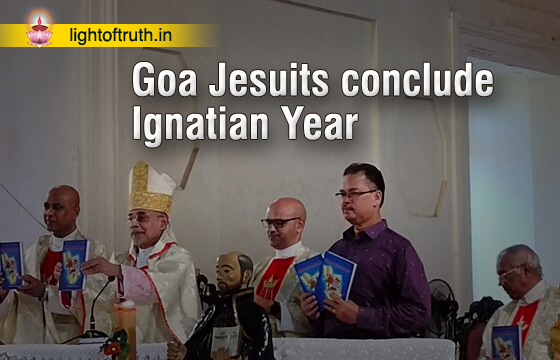
Goa Jesuits conclude Ignatian Year
Cardinal-elect Filipe Neri Ferrao, Archbishop of Goa and Daman, has urged Jesuits and their collaborators to listen, discern and respond to God’s call and become true followers of Christ. The cardinal-elect was speaking during a solemn Mass July 31 at Bom Jesu Basilica in Old Goa that concluded the Ignatian Year celebrations of the Jesuits of the Goa province.

Pakistani Christians suffer heavy losses in deadly July floods
The unusually heavy rains and flash floods that hit Pakistan’s Balochistan province in July have left a trail of devastation for Christians and Church-run institutions.
“At first we didn’t think much of the rain. However, after a week of continuous downpour, the white paint started to come off the old walls. Then the cement started crumbling and the ceiling started to swell,” recalled Father Samson Shakir as he narrated the damage sustained by a free tuition center attached to St. John Vianney Church in the provincial capital city of Quetta.

Nobel-laureate witch-hunt tarnishes Bangladesh’s image
Muhammad Yunus, Bangladesh’s only Nobel laureate, renowned economist, and microfinance pioneer is hailed globally for his efforts to eradicate poverty.
But at home, he is battling to save his reputation from a host of challenges stemming from a politically connected conflict with the ruling Awami League regime.