
A Mexican parish will remember the victims of violence in the country with 130,000 candles to be lit the night of July 30, as part of the Day of Prayer for Peace called by the Mexican Bi-shops’ Conference.
In a video message, Father Alberto Medel, pastor of Our Father Parish in the Diocese of Xochimilco, south of Mexico City, recalled the Bishops’ conference’s invitation to pray especially on July 31 “for the perpetrators and the civil authorities, so they may open their hearts to this situation of unleashed violence that we are experiencing and that has claimed so many lives and that has caused so much pain.”
In response, the Mexican priest said, his parish seeks to prepare itself to observe that day “with a prayer vigil in which we want to light 130,000 candles” in order to “remember all those who have died in such a violent way and at the same time in such a pointless way.”
The vigil will be held July 30 at 8 p.m. Central time and will be broadcast on the YouTube channels and Facebook pages of Medel, the Diocese of Xochi-milco, the Archdiocese of Mexico, and the archdiocese’s weekly publication Desde la Fe.
According to the local press, in the three and a half years of President Andrés Manuel López Obrador’s administration, nearly 130,000 people have been murdered in Mexico. When the president completes his six-year term, it could be the most violent administration in the history of Mexico. In this same period, seven Catholic priests have been murdered.
According to official figures, from Jan. 1 to July 24 of this year, 14,943 homicides have been committed in Mexico.
Daily Archives: July 31, 2022
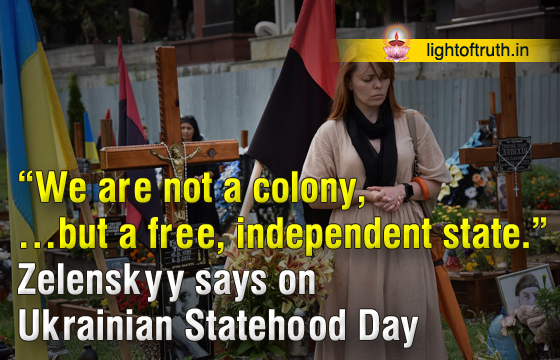
“We are not a colony, …but a free, independent state.” Zelenskyy says on Ukrainian Statehood Day
Ukrainians will fight for their statehood to the last and will not stop until they liberate the last meter of Ukrainian land, President Volodymyr Zelenskyy said in a video address for Ukrainian Statehood Day July 28.
The day marks the 988 baptism of “Kyivan Rus,” the origin of Christianity in the region, but this is the first year Ukrainians marked Statehood Day, reported Religious Information Service of Ukraine.
Zelenskyy stressed that Ukrainians need neither fireworks nor pomp to show the importance of statehood for the Ukrainian people.
“Today we defend (Ukraine) with weapons in hands. For 155 days in a row,” he said, referring to the Feb. 24 Russian invasion. “We can say that for us, State-hood Day is every day. Every day we fight so that everyone on the planet finally understands: We are not a colony, not an enclave, not a protectorate …not a province, but a free, independent, sovereign, indivisible and independent state.”
Zelenskyy outlined the main historic events that laid the basis for Ukraine’s statehood and noted: “All stages of the history of Ukraine’s statehood, its defense and struggle for it can be described in one sentence: We existed, exist and will exist. We will exist, because our state has incredible sons and daughters who have stood up for its de-fence.”
The United Nations reported July 25 more than 5,200 civilians had been killed and more than 7,000 injured in Ukraine since the war began.
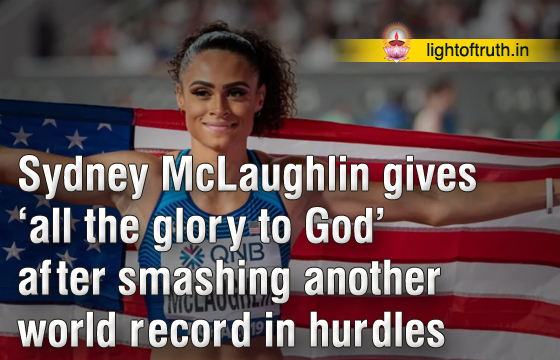
Sydney McLaughlin gives ‘all the glory to God’ after smashing another world record in hurdles
Olympic track and field gold medalist Sydney McLaughlin, who broke her own world record in the 400-meter hurdles at the World Athletics Championships on July 23 in Oregon, is using her time in the limelight to share her Christian faith.
After smashing her previous record set a month ago, she gave all credit to God in a social media post that has since gone viral with over 400,000 likes.
Her 50.68-second finish was the fourth time this year that the 22-year-old New Jersey resident broke the world record in the event.
In an Instagram post following the win, McLaughlin quoted Hebrews 4:16, which describes God’s generosity in giving his people what they need: “So let us come BOLDLY to the throne of our gracious God. There we will receive His mercy, and we will find grace to help us when we need it most.”
In her Instagram caption, McLaughlin added that prayer and hard work “divinely culminated in 50.68 seconds.”
In an NBC Sports interview following her latest victory, McLaughlin was asked how she accomplished her goal. She said, “I’ll have to start off by saying all the glory to God.” She continued by saying that God gave her the strength to achieve this milestone.
McLaughlin is not Catholic, but she grew up in a devout Christian household and attended Union Catholic Regional High School in Scotch Plains, N.J.

Six years after grisly murder, France remembers Father Jacques Hamel
Six years after Father Jacques Hamel was murdered by knife-wielding terrorists while celebrating Mass at his parish church in northern France, locals gathered to commemorate his life and to pray.
“We enter into prayer where Jacques fell, victim of the madness of men,” Archbishop Dominique Lebrun of Rouen said at the suburban Rouen church of Saint-Étienne-du-Rouvray. An eyewitness said the 85-year-old priest twice told the attackers “Begone, Satan!” before they slit his throat.
Three nuns and several parishioners were present when the attack took place. One elderly parishioner was severely hurt when the attackers tried to take him hostage. The two attackers, both 19 years old, were killed by police as they exited the church.
Hamel’s death shocked France and much of the world. Pope Francis offered a Mass for the priest shortly after the attack, calling Hamel a martyr.
In March, four men were convicted of terrorist conspiracy after a three-week long trial. Three of the men convicted received between 8 and 13 years in prison.

“I am sorry”: Canadian Indigenous react to papal apology
The words “I am sorry” are powerful.
For Tammy Ward of the Samson First Nation, those words from Pope Francis brought tears as she listened on the Muskwa, or Bear Park, Powwow Grounds.
“It’s just very powerful,” Ward told The Catholic Register, Toronto-based newspaper, after Pope Francis finished delivering his historic apology on Indigenous land for the Catholic Church’s role in residential schools and other wrongs done on the church’s behalf. “For me, it’s the healing.”
Ward leaned into her 21-year-old daughter, Aleea Foureyes, for comfort as Pope Francis confessed the sins Catholics committed against Indigenous Canadians in residential schools.
“In the face of this deplorable evil, the church kneels before God and implores His forgiveness for the sins of her children,” Pope Francis said, invoking St. John Paul II’s 1998 bull, “Incarnationis Mysterium.” “I myself wish to reaffirm this, with shame and unambiguously. I humbly beg forgiveness for the evil committed by so many Christians against the Indigenous peoples.”
Pope Francis delivered his apology on the treaty land of the Ermineskin and Samson Cree Nations, the Louis Bull Tribe and the Montana First Nation, as part of his “penitential pilgrimage” to Canada. The site was near one of Canada’s largest residential schools. For 49-year-old Ward, it brought memories of her relationship with her parents.
“I always thought my parents didn’t love me. I was always wondering why they were silent,” she said. Years later she understood how a childhood spent institutionalized in residential schools had left her parents unprepared for family life.
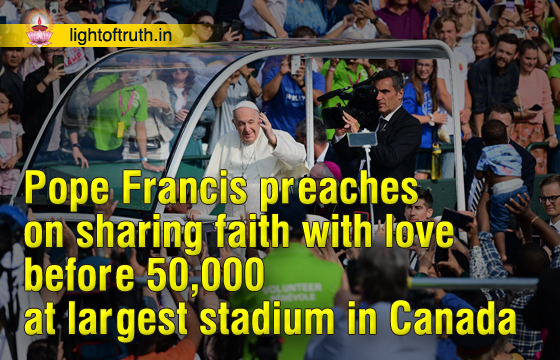
Pope Francis preaches on sharing faith with love before 50,000 at largest stadium in Canada
Preaching at a Mass celebrated in Canada’s largest stadium, Pope Francis reflected on the elderly, who he said should be honoured, and who serve as an example to the Church on how to pass on faith in a loving way.
“In addition to being children of a history that needs to be preserved, we are authors of a history yet to be written,” the Holy Father said.
“The grandparents who went before, the elderly who had dreams and hopes for us, and made great sacrifices for us, ask us an essential question: what kind of a society do you want to build?”
Developing a theme he introduced Monday in his speech at Sacred Heart parish, the pope reflected on the importance of presenting the faith to others in a loving way, rather than with proselytism.
“From our grandparents we learned that love is never forced; it never deprives others of their interior freedom. That is the way Joachim and Anne loved Mary; and that is how Mary loved Jesus, with a love that never smothered him or held him back, but accompanied him in embracing the mission for which he had come into the world,” Pope Francis said.
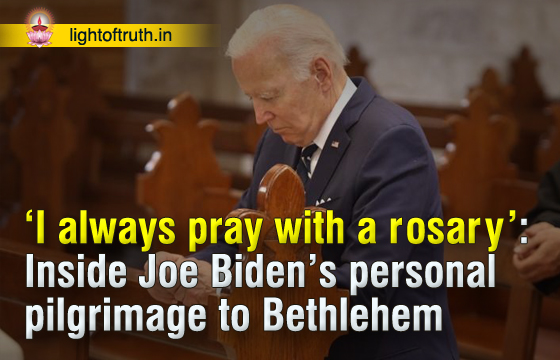
‘I always pray with a rosary’: Inside Joe Biden’s personal pilgrimage to Bethlehem
One part of President Joe Biden’s ultra-publicized trip to the Middle East took place in private, away from the eyes of any of the journalists who accompanied him on the five-day visit.
The president was accompanied only by a single Secret Service agent when, after meeting with Palestinian President Mahmoud Abbas in Bethlehem on July 15, he went on a personal pilgrimage to the complex containing the Basilica of the Nativity and the Church of Saint Catherine to pray.
Ibrahim Faltas, a Franciscan priest with the Custody of the Holy Land, first met Him, at the Jerusalem ceremony in which Israeli President Isaac Herzog awarded the U.S. president Israel’s highest civilian distinction, the Presidential Medal of Honour. Saint Catherine’s, adjacent to the basilica, is where the Latin Patriarch of Jerusalem traditionally holds the crowded midnight Mass on Christmas Eve. Last Friday, anticipating Mr. Biden’s visit, it was empty.
“After going to the grotto he came to Saint Catherine’s Church, where I received him,” Father Faltas said, in an exclusive interview with America. “He arrived with the Custos and only one Secret Service agent.”
“He took a rosary out of his pocket, saying, ‘I always pray with a rosary,’ and remembered his son Beau. He cried. He was very emotional,” Father Faltas said, about the moment in which Mr. Biden kneeled alone in a wooden pew, the rosary in his hands, and prayed.
Who are the women appointed to the Vatican’s Dicastery for Bishops?
Pope Francis named three women as members of the Vatican’s Dicastery for Bishops on July 13.
The appointments, which the pope previewed in an interview last week, mark the first time that women have served as members of the Vatican department responsible for the world’s episcopal appointments.
Who are the pioneering trio? María Lía Zervino is the Argentine president general of the World Union of Catholic Women’s Organizations (WUCWO). The umbrella body representing almost 100 groups worldwide was founded in 1910 and represents an estimated eight million Catholic women.
She is a member of an Argentine institute of consecrated life, the Servidoras, founded by Fr. Luis María Boneo.
She wrote: “I dream of a Church that has suitable women as judges in all the courts in which matrimonial cases are processed, in the formation teams of each seminary, and for exer-cising ministries such as listening, spiritual direction, pastoral health care, care for the planet, defence of human rights, etc., for which, by our nature, women are equally or sometimes better prepared than men. Not only consecrated women, but how many lay women in all regions of the globe are ready to serve!”
Sister Raffaella Petrini was born in Rome on Jan. 15, 1969, Petrini studied political science at the Luiss Guido Carli, a prestigious private university in the Italian capital, before pursuing a doctorate in social sciences at the Pontifical University of St. Thomas Aquinas (Angelicum). She earned a master’s degree in organizational behavior from the University of Hartford in Conn-ecticut in 2001.
Sister Yvonne Reungoat is T 77-year-old Salesian Sister of Don Bosco has been a member of the Congregation for Institutes of Consecrated Life and Societies of Apostolic Life since 2019, when she became one of the first women appointed to the body.
In 1990, she began serving as delegate of the institute’s provinces of Spain and France for West Africa. In 1991, she was elected superior of the African province of Mother of God, based in Lomé, Togo. In a 2012 interview, she said: “My time as a missionary in Africa enriched my vocation, which then developed in a surprising way with my election as visiting councillor, vicar general, and finally superior general.”
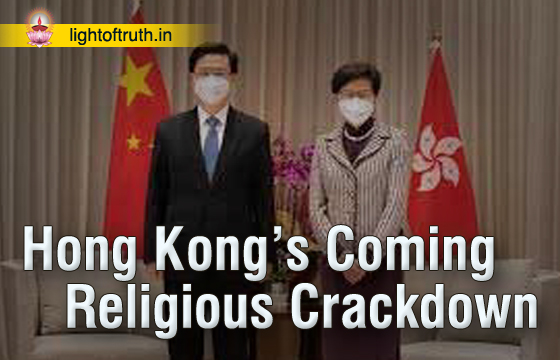
Hong Kong’s Coming Religious Crackdown
Freedom of speech, assembly and the press are gone in Hong Kong, and there’s good reason to fear religious liberty will be the next target.
That was the warning from Monsignor Javier Herrera-Corona, the Vatican’s unofficial envoy in Hong Kong, as he prepared to leave the city this spring after six years. Reuters reports that in four private meetings he encouraged some 50 Catholic missions in the city to safeguard their property, files and funds in anticipation of more mainland Chinese control.
“Change is coming, and you’d better be prepared,” Monsignor Herrera-Corona warned the missionaries, according to Reuters, which quoted an attendee as summarizing the monsignor’s message: “Hong Kong is not the great Catholic beachhead it was.”
Hong Kong’s Basic Law guarantees freedom of religion, and diverse faiths have flourished there. The city has also long been a haven for mainland Christians, who traveled to Hong Kong to study. Father Laszlo Ladany, a Hungarian Jesuit based in Hong Kong, famously reported on Chinese political and legal developments during the Mao Zedong era. Yet China has violated other liberties it swore to respect under the Sino-British Joint Declaration, and there’s no reason to believe religious freedom will be an exception.