

Hypocrisy has been the name of the game when it comes to alcohol in India, particularly in Gujarat, the home state of Prime Minister Narendra Modi and the father of the Indian nation, Mahatma Gandhi.
Any number of human deaths will not stop politicians and even the state’s denizens from swearing by the Gandhian way of being teetotalers and continuing to keep Gujarat a dry state, where the law bans storing, selling and transporting alcohol. And yet, 42 people died and 50 others remain in hospital in critical condition after consuming spurious liquor in Gujarat earlier this week.
The terrible human tragedy reported in Botad district — a repeat of the 2009 hooch tragedy in Ahmedabad in which 159 people died in similar circumstances — has yet again brought into focus the debate on prohibition.
Gujarat, since its foundation in 1960, adopted the policy of being a dry state as a mark of respect and tribute to Mahatma Gandhi.
Gandhi’s idea was influenced by his Hindu morals and Islamic scriptures that described liquor as evil. He regarded alcohol as a social evil, capable of adversely impacting the lives of humans of all classes. “Let’s not fool ourselves. It is time to come out of denial mode and accept the fact that Gujarat is not as dry as it claims to be”
Despite more than six decades of policing, the state has failed to stop a thriving bootlegging industry. Time and again it has been proved that Gujarat’s prohibition policy has been a sham, a farcical exercise.
The tragedy in Botad prompted former chief minister Shankersinh Vaghela to question the futility of prohibiting liquor. Does banning alcohol really benefit people? No, said Vaghela who wants the prohibition policy to be reviewed as early as possible. He wants to relax restrictions and legalize sales and distribution to reduce illicit supplies.
Vaghela also suggested this could provide economic opportunities for the state’s tribal people for whom liquor is not taboo, unlike mainstream society. “Let’s not fool ourselves. It is time to come out of denial mode and accept the fact that Gujarat is not as dry as it claims to be,” he said.
Daily Archives: July 31, 2022

Ranchi St Anne congregation completes 125 years
The first indigenous women religious congregation in eastern India has concluded its 125 years of founding through various programs at Ranchi, capital of the Jharkhand state.
Jesuit Archbishop Felix Toppo of Ranchi July 23 presided over the jubilee Mass at St. Mary’s Cathedral in Ranchi, capital of Jharkhand state.
He was assisted by Bishops Vincent Barwa of Simdega, Binay Kandulna of Khunti, Anand Jojo of Hazaribag, Julius Marandi of Dumka, Fulge-nce Aloysius Tigga, Antonis Bara of Ambikapur concelebrated along with Father Linus Pingal Ekka, apostolic administrator of Gumla.
The Mass was also attended by 75 priests from various parts of India and some 800 members of the congregation representing all four provinces and the delegations of Andaman and Europe.
In his homily Archbishop Toppo commended the vigor and zeal of the Daughters of St Anne in serving God’s people. The jubilee theme was “Celebrating God’s Graciousness: Committed to Renewed Mission.”
“Today is the apt time to raise our hearts and minds in praise of God for all his merciful acts that we have benefited for last 125 long years,” the prelate said.

Stella Maris chaplain receives major anti-trafficking hero award
A Stella Maris port chap-lain in Thailand has been recognized by the US Department of State for her dedicated and untiring work supporting trafficked seafarers and fishers.
Apinya Tajit, Stella Maris Deputy Director in Chanthaburi diocese received the US Department of State 2022 Trafficking in Persons Report Hero Award from Secretary of State Antony J Blinken at a ceremony in Washington DC on July 19.
She has helped hundreds of workers in the fishing sector from various countries, including Thailand, Indonesia, Cambodia, Burma and Bangladesh and has also played an active role in raising awareness of child trafficking, visiting schools throughout Thailand to educate more than 10,000 students each year.
Apinya has worked with global maritime network Stella Maris since 2005 and has for the past seven years dedicated her energies towards combatting human trafficking.
“This Award is completely unexpected to me, and I feel honoured to receive it. Stella Maris works closely with law enforcement agencies in Thailand to support trafficked fishers and seafarers. We assist by way of helping identify victims, rescuing them, helping them reintegrate into society,” she said.
We provide training, access to legal advice, and funding to help them rebuild their lives,”

Faith sustains Catholic mother amid hard times in Myanmar
Mary Song Thi May ‘is a special gift from God bringing His love to her people’ in Mai Yen Parish in Mai Son district.
For more than a decade now, Benedette Marang Ji Grawng has been living in a crowd-ed camp for displaced people in conflict-torn Myanmar.
With each passing day, simple life becomes even more difficult to endure with increasing challenges and hardships, but that hasn’t diminished her faith, says Ji Grawng, a Catholic mother.
“The more difficulties I face, the deeper and stronger my faith becomes. I believe in God who fulfils all our prayers,” says the slightly built 43-year-old Kachin mother of three.
In the midst of her busy daily schedule involving cleaning, cooking, sewing clothes and taking care of a three-year-old child, the devout Catholic finds time to share teachings from the Bible with her two teenage children, aged 16 and 18. “I also send my children to catechism and Bible classes,” Ji Grawng told. “My children are obedient and I am proud to be their mother.”
She lives with her three children and husband, Paul Magi Seng Awng, in a tiny 81 square foot (7.5 sq meter) room in the Catholic Church-run St. Paul Ja Maing Kaung camp for internally displaced persons (IDPs).
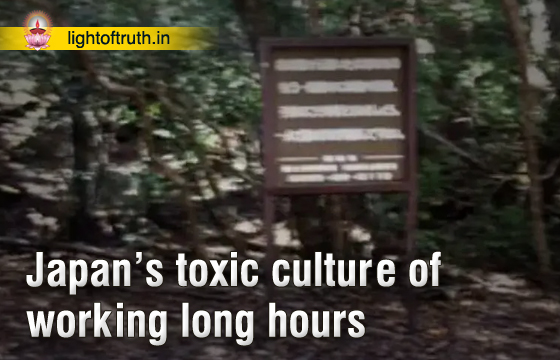
Japan’s toxic culture of working long hours
A suicide warning at the entrance to Aokigahara Forest, known as Suicide Forest, in Japan’s Yamanashi prefe-cture. It reads: “Life is a precious thing that you have from your parents. Try to calmly think about your parents, brothers and sisters, your children. Please do not keep things to yourself. Talk to someone.”
A television commercial for an energy drink in 1990s Japan told viewers they could work 24 hours straight without feeling tired. The claim, if made today, would be seen as an invitation to karoshi or death caused by overwork.
The most attractive start-ups today are those that offer the possibility of arriving late at work and working from home at least one day a week.
Yet in 2019, there were 29,169 suicides out of which 1,949 or 9.7% were cases of karoshi. The precise causes are to be found in the inability to give up a commitment even if all psycho-physiological sensors tell the body it cannot take this anymore.
This is what happened to Yui (not her real name), a 23-year-old who recently graduated from university. She found a job in Japan’s notorious broadcasting network, NHK. Her aspiration was to make documentaries on social issues.
“It was last year, April 2021. I just graduated from University and was super excited to go work for them. But it was unusual from the beginning,” she recalled.
“After days of hard work, I suddenly realized my body was feeling strange. I felt incredibly tired. And the tiredness wouldn’t go away. That’s when I realized I had been working for 22 days straight,” Yui said.

New Krishnagar bishop seeks blessings from faithful
Krishnagar, July 23, 2022: More than 4,000 people July 23 attended the episcopal ordination of Salesian Bishop Nirmol Vincent Gomes of Krishnagar in West Bengal state.
After the ordination at Cathedral of the Holy Redeemer in Krishnagar, the new bishop asked the gathering to bless him as he takes charge of the diocese. The congregation, – 22 bi-shops, 200 priests and 500 Sisters and some 4,000 faithful – responded extending their right hand in prayerful blessing as the newly ordained Bishop bowed his head in prayer.

Prelate launches Indian edition of ‘Desiderio Desideravi’
Cardinal-Elect Filipe Neri Ferrao of Goa and Daman in the western Indian state of Goa launched the Indian edition of Desiderio Desideravi, Pope Francis’ apostolic letter on the liturgical formation of lay people on July 9. Archbishop Ferrao, president of the Conference of Catholic Bishops of India (CCBI), released the book urging Catholics to celebrate the liturgy in a proper, effective and relevant manner.
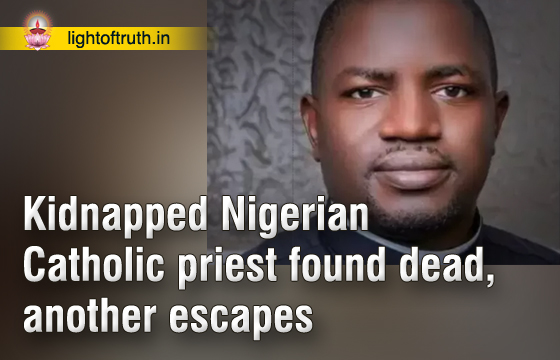
Kidnapped Nigerian Catholic priest found dead, another escapes
A Nigerian Catholic priest abducted last week was found murdered while his colleague managed to escape from his captors in the northern state of Kaduna, the local diocese said.
Fathers John Mark Cheitnum and Donatus Cleophas were seized in the town of Lere when attending a parish function at Christ the King Catholic Church, Yadin Garu last Friday.
On July 19, the body of Cheitnum was found, the Kafanchan diocese said in a statement, adding that he was “brutally killed on the same day of his abduction.”
No one has claimed responsibility for the abduction.
About a dozen priests have been kidnapped this year across Nigeria by gunmen who demand ransom payments. Nigerian security forces, who are stretched fighting an Islamist insurgency in the northeast, often fail to stop the attacks.

Vatican asks Indian archbishop to resign over liturgical dispute
An archbishop of Eastern Rite Syro-Malabar Church re-signed following the Vatican’s directions. No reason were given. It may be part of the programme Vatican initiates dealing with land sale issue as well as liurgial difference of view.
Archbishop Antony Kariyil, the vicar of the major arch-bishop of Ernakulam-Angamaly archdiocese in southern Kerala state resigned on July 26, six days after he was summoned to the Vatican nunciature in New Delhi.
The nuncio issued a letter asking him to immediately tender his resignation, said archdiocesan officials from the eastern rite Syro-Malabar Church.
Archbishop Kariyil initially refused as no valid reason was cited for his resignation. He handed over a letter to the nuncio seeking to apprise Pope Francis about the developments, officials added.
The resignation comes after Archbishop Leopoldo Girelli, the nuncio to India, arrived at the Arch-bishop’s House on July 26 and held a discussion with Archbishop Kariyil.
As the news spread, a section of the archdiocesan priests held an emergency meeting at the Archbishop’s House and passed a resolution recording their opposition to the Vatican emissary forcefully demanding the resignation of Archbishop Kariyil.
“The Archeparchy showed tremendous unity, Christian witness and progress during the tenure of Mar Kariyil compared to the past many years. He is a true pastor who knows the hearts and minds of his flock,” the resolution by the priests stated.
Archbishop Kariyil, it said, was a bishop who was fully committed to Jesus, the Word of God and the Roman Pontiff and never violated any canon or civil laws.
“Any attempt to jeopardize his bishopric will prove detrimental to Catholic communion and harmony,” they warned.
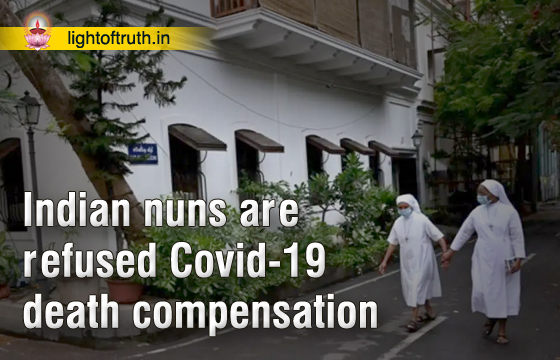
Indian nuns are refused Covid-19 death compensation
Church officials in the southern Indian state of Kerala are upset with the provincial government for refusing to pay financial compensation to Catholic nuns who died of Covid-19.
Authorities declined to pay the Covid-19 death compensation of Rs 50,000 (US$625) each to four nuns belonging to the indigenous order of Sisters of the Destitute (SD).
“I moved the claims for compensation,” Sister Kiran Mandoth, SD, told on July 22. “The officials at the village and district made me run from pillar to post to gather nearly a dozen documents including death certifi-cates. I was made to wait for over a year only to be told that nuns were not eligible for compensation.”
Sister Mandoth said the officials cited no reason for the denial of compensation. “It is not about the money. But are nuns not citizens of India,” she asked.
Father Jacob Palakkappilly, the spokesman of the Kerala Catholic Bishops Council (KCBC), said the provincial government has no right to block humanitarian services to anyone including Catholic nuns, priests or seers, regardless of their religion.
“This is injustice and discrimination against the nuns who are citizens of India,” he said.
The provincial governments were ordered to pay exgratia compensation to families of persons who died of Covid-19 by the Supreme Court of India in October 2021.