

Some young Christians have burnt the effigy of a Hindu law maker in the central Indian state of Madhya Pradesh to protest against his unsavoury statement against Christians and Muslims.
Rameshwar Sharma, a legislator belonging to the ruling pro-Hindu Bharatiya Janata Party, urged Hindus at a religious gathering “to stay away from Father (referring to Christians) and Chadar (referring to Muslims) and Peer Baba (a Sufi Muslim saint).”
The law maker cautioned Hindus that the company of company of Christians and Muslims “will destroy you.”
The legislator’s communal remarks provoked some Christians, who on October 18 burnt his effigy at Lilly Talkies Square in the state capital of Bhopal.
“This time we burnt Sharma’s effigy at a public place to caution him,” Jerry Paul, the national president of the Sarva Isai Mahasabha (grand council of all Christians), told Matters India, October 22.
“If the legislator repeats the same, we will not hesitate to burn his effigy in front of his house and lodge police case against him for creating communal discord among people on religious lines,” Paul warned.
Sharma believed to have made the remarks at a Dussehra celebration on October 15 in Bhopal. It came to light through a video clipping on social media two-days later.
The legislator further urged Hindus to stop using “good morning” (apparently referring to European culture and Christianity) and instead use “Jai Shree Ram” (hail Lord Ram) to greet people.
Meanwhile Archbishop Leo Cornelio of Bhopal condemned the legislator’s divisive remarks. “An MLA representing the people of a state should have a sense of what to speak and what not to speak in public forum,” the prelate said.
Daily Archives: October 31, 2021

Indian pastor injured after mob barges into church
A pastor of a Protestant church was held by the police after a mob of pro-Hindu activists barged into a church in the Indian state of Karnataka and began singing bhajans or Hindu devotionals as a protest against alleged forced religious conversions.
A video clip of the incident reported from Hubbali town on Oct. 17 showed activists of the Vishwa Hindu Parishad (World Hindu Council) and its youth wing, the Bajrang Dal, forcibly entering Bairidevarkoppa Church and singing devotionals.
Pastor Somu Avaradhi and some of his associates reportedly sustained minor injuries in a scuffle but Arvind Bellad, a local member of the legislative assembly belonging to the ruling Bharatiya Janata Party (BJP), blocked a highway along with his supporters demanding their arrest.
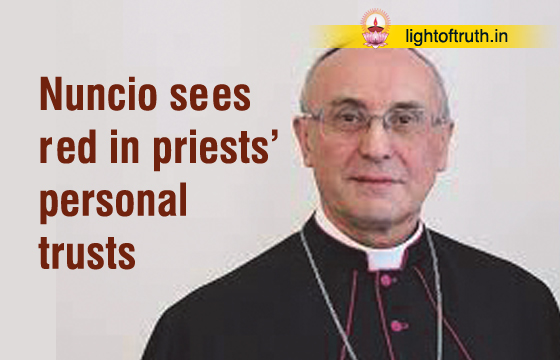
Nuncio sees red in priests’ personal trusts
Apostolic Nuncio to India Archbishop Leopoldo Girelli has pulled up Tamil Nadu bishops for “a tendency” among priests to set up and manage independent trusts violating the canon law. The nuncio says the existence of such trusts in Tamil Nadu came to his attention during his recent visit to the diocese of Kottar in the southernmost tip of India.
“Even if the aim of such trusts may appear to be praiseworthy, all too often those trusts become financial and political power bases for the priests involved,” says the nuncio’s October 8 letter addressed to the Catholic bishops of Tamil Nadu.
The letter, shared widely in social media platforms, quotes various sections of the canon law to urge bishops of dioceses with such trusts to regulate them guided by the bishops’ conference.
“Priests and religious should not be directly associated with any independent or standalone trusts or societies or For/Not-for-profit companies, unless their involvement has specifically been approved by” the local bishop, the nuncio asserts.
The Vatican representative wants bishops to follow the canon law to punish the offenders according “to the gravity of their offence.”
He has recommended the Tamil Nadu bishops’ conference to formulate “clear guidelines on the subject,” if they are non-existent.
He wants every bishop to ascertain the details of the personal trusts held by any of his priests and instruct holders of existing personal trusts to close them immediately. He also wants the bishops to ensure that no new trust is opened by his priests.
The nuncio wants the diocesan trust or the diocesan social services trust to bring under its control personal trusts of priests that “are of genuine benefit to the life and mission of the diocese.”
The Vatican official urges the bishops to resolve that no trust is set up under “the sole control of a single member of the clergy.”
The nuncio concludes the letter saying his recommendations are for the well-being of the Church in Tamil Nadu. In response to the nuncio’s letter, Bishop Thomas Aquinas of Coimbatore, one of the 18 dioceses in Tamil Nadu, wrote to his priests on October 16 that he is aware of “a couple of priests” who have trusts.
Afghan Muslims Are Asking Questions on Christianity
Mike Christian and his wife lead a small congregation called the Afghan-American Church of the Bay Area. But their main ministry is not gathering with a dozen or so Afghan believers during the week. It is engaging with the tens of thousands of Afghan seekers from around the world who reach out through messaging apps, social media, and online outlets.
Mike, who was born in Afghanistan and worked alongside the US military there, adopted the name “Mike Christian” after his conversion. It was a signal to fellow Afghans that they could speak with him if they were curious about Christianity. His popular Facebook page shares Bible verses and Christian messages in Dari alongside an invitation to get in touch.
The recent Taliban takeover has created a unique opportunity for some Afghan Muslims to rethink their faith, just as a massive influx of Afghan evacuees are fleeing to the United States for resettlement. It ’s the younger generation, and especially the women, Mike says, who are most dis-enchanted with Islam, and most open to learning about the God of Christianity.
“We receive tons of text messages, emails, WhatsApp, and phone calls from Afghanistan,” Mike told in an interview. “They ’re saying, ‘We don ’t like Islam. We don ’t want that kind of religion. We want to become a Christian. Please help us. Show us how we become a follower of Jesus.’”
“I just keep praying,” he says, “‘Lord, you have the power to change Afghan people—to join your church, to seek you and believe in you, to pray and repent.’’”
The couple fields hundreds of questions a day from curious Afghans, describing the good news to them and connecting new believers to nearby house churches. But they are also part of the global network of believers with Afghan connections, helping create resources for churches to better serve their Afghan neighbors—both here and abroad.
“I’m engaged with 30,000 Afghans now,” said Mike. “I don ’t remember the Lord tell-ing me to stop. The Lord ’s mission is never stopped, so let ’s keep going.”
When Mike was working with the military during the War in Afghanistan, he found himself in a dark place and struggling after a deadly mission. He had a series of dreams about Jesus, who called him by name to share the gospel with his people. After joining the underground house church movement, Mike endured intense persecution, multiple imprisonments, and brutal torture for his evangelism efforts before he was able to escape Afghanistan and make his way to the United States.
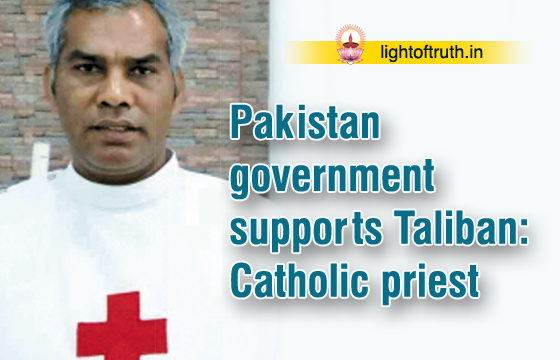
Pakistan government supports Taliban: Catholic priest
The government in Pakistan celebrated the Taliban’s rise to power in Afghanistan, a senior priest has said, stressing that “the brotherhood of the two countries” means they are prejudiced against Christians and other non-Muslims.
Speaking to Aid to the Church in Need (ACN), Father Mushtaq Anjum, the only Pakistani priest of the Order of St Camillus, explained that, following the Taliban’s victory, Christians are under serious threat.
He said: “The threat against them (Christians) has increased, since our government supports the victory of the Taliban in Afghanistan. Both Afghanistan and Pakistan consider the United States as an enemy. There is a deep-seated hatred of western countries where Christians compose a sizeable proportion of the population.
“The brotherhood of the countries is based on Surah Al-Ma’idah 5:51 of the Qur’an, which warns believers against becoming allies of Jews and Christians. It is largely because of the Taliban that religious minorities in Pakistan and Afghanistan live a subdued life.”
Pakistan’s Ministry of Reli-gious Affairs and Interfaith Harmony last month rejected a bill which sought to prohibit forced conversion of any indi-vidual of a religious minority, particularly underage girls, on the grounds that it “clashes with Islamic Shari’a.”
Father Anjum said: “We have always complained of mob rule and about the controversial blasphemy law which has been grossly abused, with many people making false accusations to settle personal scores, to obtain the victim’s property, or to attack the person’s faith. We have always demanded that the majo-rity of Muslims should respect and accept religious diversity in Pakistan…
The soaring cost of justice for minorities in Pakistan
Costs and lack of helpful resources are the most prominent barriers for religious minorities in accessing justice in Pakistan, according to a survey by a legal group.
“Religious minorities were less confident about attaining a fair trial compared to their Mu-slim counterparts. They foremost identified themselves as not aff-luent and powerful, and therefore not possessing the law to seek protection within its ambit, nor the law taking ownership of them. Consequently, they seldom approach the judicial system to seek justice,” found the Legal Needs Assessment Survey laun-ched on Oct. 20 in Islamabad.
“They repeatedly referenced poverty, and not religious dis-crimination, as their biggest problem. They identified their minority status as exacerbates of their poverty. Instead, a dearth of opportunities, corruption and administrative incompetence were the primary suspects.
“These problems are a direct result of poverty and dire living conditions. Structural discrimi-nation, including absence of employment opportunities and lack of provision of legal identities, creates and traps these communities in a problem loop by limiting avenues for awareness and information and thus altering legal behaviours.
“The majority of our res-pondents were unaware that their problems are legal issues with a predetermined solution. Majority versus minority rhetoric has made our respondents believe that this country is for Muslims and so is the law. The discrimi-nation faced by these marginali-zed communities is not only external but is also fuelled by ca-steism and socioeconomic dispa-rity within these communities.”
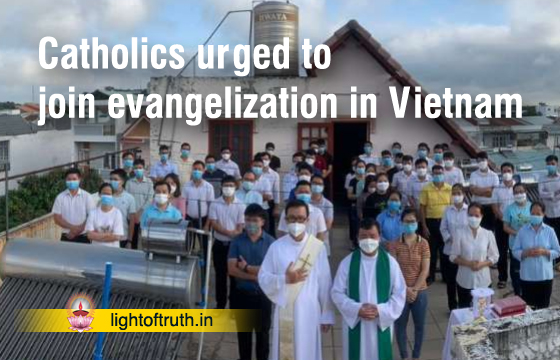
Catholics urged to join evangelization in Vietnam
Catholics in Vietnam are urged to celebrate the coming World Mission Sunday by praying the Our Father and reaching out to people in need. Bishop Matheus Nguyen Van Khoi of Qui Nhon said October is chosen as the Mission Month, starting with the feast of St. Therese of the Child Jesus, patroness of mission lands, including Vietnam. Bishop Khoi said the height of Mission Month is World Mission Sunday falling on Oct. 24 this year. The entire Church unites in prayer and sacrifices for the work of evangelization worldwide and locally.
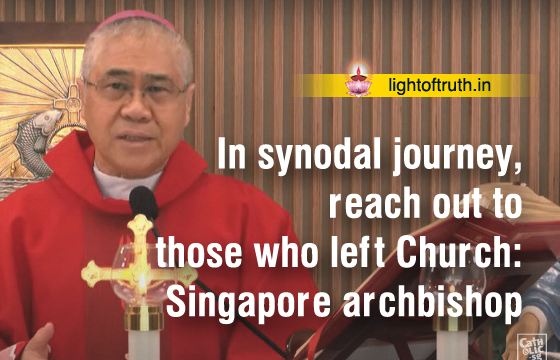
In synodal journey, reach out to those who left Church: Singapore archbishop
For too long, the Church hierarchy has held consultations between bishops and priests, and between Bishops and the pope, without involving the laity seriously. However, unless the hierarchy identifies with the pains of the people, it would not be able to come up with solutions that are effective, practical and uplifting.
Archbishop William Goh of Singapore made this point during his homily at an online Mass on October 17 to launch the synodal process in the Southeast Asian archdiocese. This process of Church consultation, launched simultaneously by dioceses around the world, is part of a two-year process leading to the Synod of Bishops in Rome in 2023. The event has the theme: “For a Synodal Church: Communion, Participation, and Mission.”
“The Church is not just simply constituted of the hierarchy,” stressed Archbishop Goh in his homily. “The Church is the People of God including the bishops and the priests. And so it is very important that this synodal process must begin by including everyone.”
He noted that many Catholics had left the Church “because they feel that the Church lacks compassion, the Church did not listen to them,” he said. “They have been hurt, they are angry.”
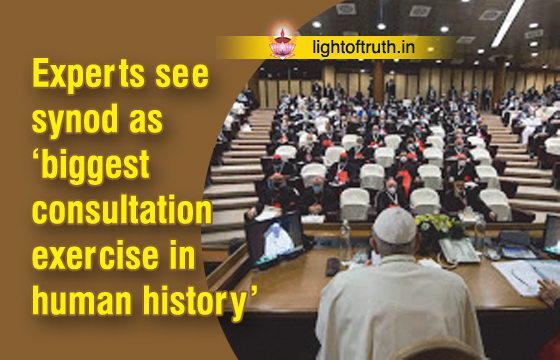
Experts see synod as ‘biggest consultation exercise in human history’
Though probably unbeknownst to most Catholics around the world, on October 9 Pope Francis officially opened a two-year global consultation process, all part of a Synod of Bishops on Synodality, which participants hope will help radically change the way the Catholic Church takes decisions.
“My expectation is that a new way of doing things, which will allow us to see synodality being lived at every level of the Church, is now underway,” Spaniard Carmen Peña Garcia, a synod participant, told Crux.
“The Synod should not be reduced to this moment, these two years, because synodality is a call for co-responsibility and co-participation of the entire people of God in the life and mission of the Church, with baptism being the entry card,” she said.
During the next year, a consultation will be launched at a parish level, with the faithful being invited to join in dialogue sessions. In March, there will be time for a diocesan and national gathering, followed by a continental one, with the process, in principle, concluding in Oct. 2023, with a general assembly of the Synod of Bishops, set to take place in Rome in October.
On Saturday, the people on hand were mostly laity, priests and religious, with some countries not even having Bishops in the Synod Hall. This was so because the Vatican’s Synod office had requested continents to send representatives, not each country individually, among other reasons due to COVID-19 restrictions on travel.
Some participants had to embark on a months-long process to get a greenlight from their governments to fly to Rome, as was the case of lay woman Susan Pascoe from Australia. All of the Bishops from Down Under are currently taking part in a national-level Plenary Council, the first session of which is being held this week, so none came. Upon her return home, Pascoe will have to isolate in a hotel for two weeks.
A member of the Synod’s Commission on Methodology who has worked both for the Australian Church and the Australian government, she told Crux she values “the authenticity of the process. I see hope in this process, and I trust in it. So, I hope other Catholics will answer the invitation issued by the Pope for them to participate.”
An invitation for all the baptized to take part, Peña Garcia said, has been issued, but it not only applies to them, because “the Church wants to be in dialogue with the world too. I think we have to encourage people to take part, so that you don’t only get the voices of the usual suspects, but well, there’s also the matter of free will!”
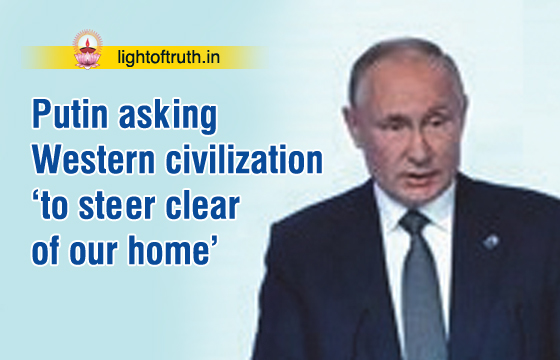
Putin asking Western civilization ‘to steer clear of our home’
The Western civilization has the right to choose its own values, but at the same time it should not force them on other countries, including Russia, President Vladimir Putin said.
“We are watching with asto-nishment the processes taking place in the countries that used to considering themselves flag-ships of progress. Of course, the sociocultural disturbances that are taking place in the States, in Western Europe are none of our business, we are not getting into that. Some people in Western countries believe that the aggre-ssive deletion of whole pages of their own history, reverse discri-mination against the majority in the interests of minorities or a demand to give up basic things such as mother, father, family or gender differe-nces constitute movement towards public renewal.”
“Adepts of so-called social progress believe they are bring-ing some new, better knowledge to humanity,” he said. “So, God willing. Let them go ahead with it. Only the recipes they are offer-ing are not new at all, we have done all that in Russia,” Putin said.