
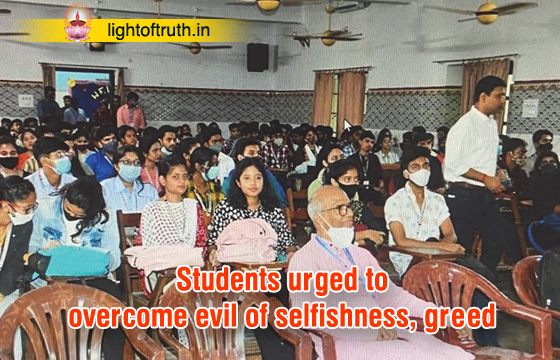
Swami Sachidananda Bharathi, a peace activist, has urged students to work for an India free of hunger, caste discrimination and corruption by overcoming the evil of selfishness and greed. One should overcome the “evil of selfishness, greed and pride” with love and sharing, caring and giving, focus and progress, trust and entrust, grow and help grow, risk and rise and report and response, said the former Indian Air Force officer who has become a seeker of truth and promoter of peace.
Daily Archives: October 31, 2021
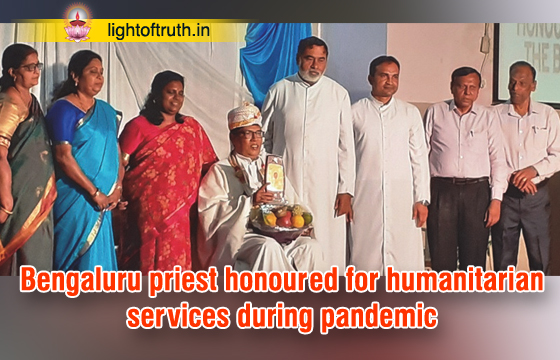
Bengaluru priest honoured for humanitarian services during pandemic
The women of a Catholic parish in Bengaluru have felicitated their parish priest for being the “front line hero” during the pandemic period.
Salesian Father Aloysius Santiago, rector and parish priest of Don Bosco Shrine in Lingarajpuram was honoured October 24 at a function in the parish church.

China forces removal of Bible and Quran apps
American tech giant Apple has removed a Bible app and a Quran app from its App Store in China following requests from officials, triggering conde-mnation from rights groups over a further violation of religious freedom by the communist state.
Apple confirmed to the BBC that the apps, Quran Majeed and Bible App by Olive Tree, have been taken down. Chin-ese officials complained that the apps violated laws by hosting religious texts illegally. “We are required to comply with local laws, and at times there are complex issues about which we may disagree with governments and other stakeholders on the right path forward,” Apple reportedly told BBC, explaining its human rights policy.
Quran Majeed has over 5 million downloads on the Google Play Store, while Bible App by Olive Tree has just over 1 million downloads, according to Business Insider.
Quran Majeed is produced by Pakistan Data Management Services. The company says it has over 35 million users globally including 1 million users in China. It said Apple informed it that “the app has been removed from the China App Store because it includes content that requires additional documentation from Chinese authorities.”
Olive Tree Bible Software, founded in 2000 in Spokane, Washington, creates biblical software and mobile apps. It is an electronic publisher of Bible versions, study tools, Bible study tools and Christian eBooks for mobile, tablet and desktop devices. Another American tech giant, Microsoft, recently announced it was closing its career-focused site LinkedIn in China as Chinese laws pose extreme difficulties. LinkedIn faced criticism recently for closing the accounts of some journalists following complaints from Chinese authorities.
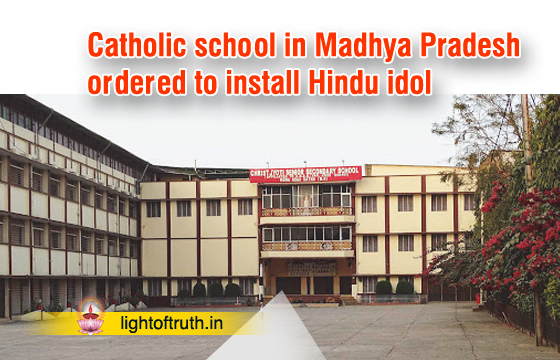
Catholic school in Madhya Pradesh ordered to install Hindu idol
Right-wing Hindu activists on October 25 served a 15-day ultimatum to Catholic school in the central Indian state Madhya Pradesh state to install in the campus an idol of Saraswati, the goddess of know-ledge. A 30-member delega-tion of the Vishwa Hindu Parishad and Bajrang Dal met Father Augustine Chittupara-mbil, manager of Christ Jyoti Senior Secondary School in Satna district headquarters, to make the demand through a memo-randum. The memora-ndum they gave the priest 15 days to comply with their demand or face protests in front of the school.
“The Hindu activists came to our school and wanted us to install an idol of goddess Saraswati in the campus,” Father Chittuparambil told. The radicals forced the priest to give in writing that he had received their memorandum that he accepted at the school’s main gate.
The Hindu activists left the place with a warning to come back in case the school failed to comply with their demand.
“They claim that the school was built at a place where the idol of goddess Saraswati had existed,” the priest explained.
He pointed out that the school was built 49 years ago and no one had made such a claim until now. The Syro-Malabar diocese of Satna manages the school. Satna town is some 455 km northeast of Bhopal, the state capital.
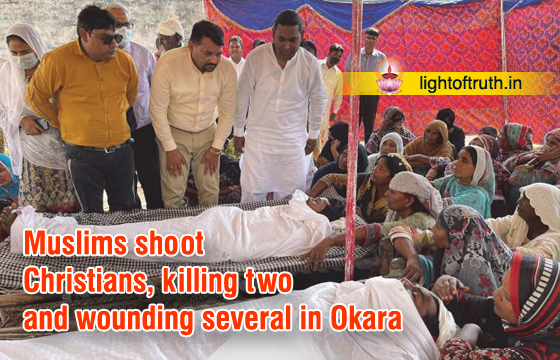
Muslims shoot Christians, killing two and wounding several in Okara
More than 20 Muslims have attacked a Christian commu-nity in Punjab. The violence followed a row between two families over the irrigation of some fields in the Okara area.
When a group of young Christians went back to water their fields, Muslims opened fire with guns and rifles.
Two young Christians, Yaqub Mukhtar and Haroon Mukhtar, died on the spot, whi-le half a dozen other Christians had to be hospitalised in critical conditions. A First Information Report (FIR) was drawn up against a group of Muslims, said Indrias Mukhtar, a witness to the incident.
Those named in the FIR include Muhammad Abbas, Babar, Mustafa, Shafqat, Gulzar, Qadir Gulzar, Nasar-Ullah, Noor, Abbas Ahmad, Hassan Ahmad, Azhar Taj.
In all, police registered a case against 18 people, but only two have been arrested so far.
Asif Munawar, a human rights activist and member of the Jhang District Committee, visited the site of the shooting and attended the funerals. He offered his condolences to the families of the dead.
In this case the violence was unleashed by a disagree-ment between three young Christians who were cleaning the entrance of their church and a Muslim passing by.

Indian Dalit Christians demand separate Catholic rite
Dalit Christian organiza-tions in the southern Indian state of Tamil Nadu have demanded a separate rite for Dalit Catholics as a solution to caste-based discrimination in the Indian Church. Dalit Chri-stians have long wanted an end to caste-based discrimination in the Church and have in the past urged Pope Francis to create a Catholic rite like the Kerala-based Syro-Malabar and Syro-Malankara churches.
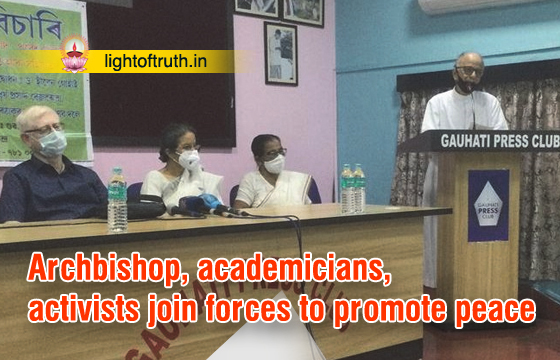
Archbishop, academicians, activists join forces to promote peace
A group of academicians and social activists came together under the leadership of Archbishop emeritus of Guwahati to promote peace at a time when the whole of Brahmaputra Valley is “in search of peace.”
The occasion was the re-lease of an Assamese langua-ge book entitled Hanti Bisari (In Search of Peace) written by Archbishop Thomas Mena-mparampil. The original work in English language was tran-slated into Assamese by a civil society leader, Paresh Mala-kar.
The book-release on Octo-ber 22 turned out to be a social-discussion session in which the need for mutual understanding between communities was emphasized. A reputed intelle-ctual of Assam, Hiren Gohain released the book at Guwahati Press Club.
Archbishop Thomas says, “Professor Satyakam Bortha-kur of the University of Dibrugarh had helped in the compi-lation of texts from original Assamese authors. So, the book turns out the product many hands, coming out precisely at a time when the whole of Brahmaputra Valley is ‘in search of peace’.”

From Mumbai to Jerusalem, the synodal path begins in Asia
The Churches of Asia, in communion with Catholic communities around the world, yesterday marked the start of the two-year synodal path announced by Pope Francis centred on the theme “For a Synodal Church: Communion, Participation and Mission”.
The first phase, which entails listening to the whole people of God, will see individual dioceses take the lead.
To this end, Card Oswald Gracias, president of the Catholic Bishops’ Conference of India (CBCI), led a solemn Mass in the Cathedral of the Holy Name of Jesus in Mumbai.
Due to COVID-19 restrictions, only 122 people representing various groups attended the service, while thousands more people followed the service via online streaming.
In a show of the willingness to listen to everyone, women were given a prominent place in the liturgical readings. A migrant woman from Jharkhand proclaimed the first reading in Hindi (the national language), while a second woman performed the second reading in Marathi (the local language). Prayers were also recited in Tamil and Konkani.
In his homily, Card Gracias said, “the Synodal process [is] meant to reform the church, by discerning what ails the Church, which means even listening to those who have left the Church and those who are thinking of leaving the Church, [for] they have a story to tell, which might make us reflect.”

India records spike in anti-Christian violence this year
India has witnessed a significant rise in violence against Christians this year with 305 incidents recorded across 21 states during the past nine months. Surprisingly, official cognizance of the targeted violence was lax with only 30 complaints registered by police so far.
September had the highest number of incidents with 69, followed by 50 in August, 37 in January, 33 in July, 27 each in March, April and June, 20 in February and 15 in May. These figures were published in a fact-finding report by the Association for the Protection of Civil Rights (APCR) and United Against Hate and United Christian Forum (UCF) and released at a press conference in New Delhi on Oct. 21
Christian Prio Sadhana Lanse and her daughters Pearl and Eva from Roorkee presented horrific details of the attack they suffered.
Eva recalled how an armed mob of around 200 shouting slogans like “Jai Shri Ram” (Hail Lord Ram) and “Vande Mataram” (I bow to thee, motherland) barged in, vandalized a prayer house and manhandled the Christian faithful on Oct. 3.
“We feel unsafe there and fear for our lives,” she said, adding that police made no arrests despite naming the main attackers in their complaints with evidence of the violence and destruction they caused.
Uttar Pradesh in northern India ruled by the pro-Hindu Bharatiya Janata Party (BJP) topped the list with 66 incidents of attacks this year, followed by Congress-ruled Chhattisgarh (47), tribal people’s Jharkhand Mukti Morcha-ruled Jharkhand (30) and BJP-ruled Madhya Pradesh (26).
Karnataka in the south, also ruled by the BJP, witnessed a spurt in violence against Christians with 32 incidents.
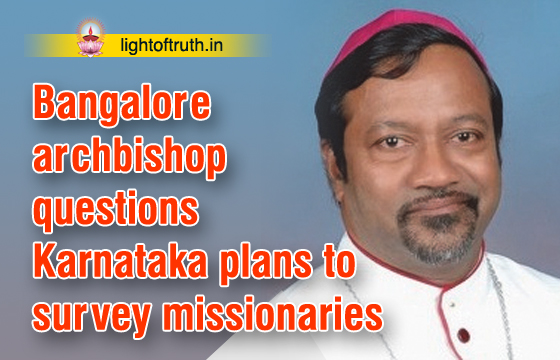
Bangalore archbishop questions Karnataka plans to survey missionaries
Archbishop Peter Machado of Bangalore has condemned the continuous harassment on the Christian Missionaries in the state and questioned the wisdom behind conducting a survey on their presence and activities in Karnataka.
The Backward Classes and Minorities Welfare Department in Karnataka has ordered the officers to conduct a survey of both official and non-official Christian missionaries in the southern Indian state, following a discussion on Christian conversions in the state on October 13.
“Why is the government interested in making survey of the religious personnel and places of worship only of Christian community?” asked the Bishop in a statement issued October 15.
Instead, “let the government take the count of education institutions and health centers run by the Christian missionaries, which will give a fare idea of the service that is rendered by the Christian community to the nation building and how many people are converted in these places and institutions,” he challenged.
“We consider this exercise as futile and unnecessary. There is no good that will come out of it,” stated the archbishop. In fact, in the background of the conversion boggy and anti-religious feelings that are being whipped up, it is dangerous to make such surveys, he added.