

Police have launched an investigation into the marriage of a Protestant couple after Hindu activists claimed the bride was a Hindu converted to Christianity in the central Indian state of Madhya Pradesh.
Hindu extremists barged into the marriage reception in Indore town on Sept. 29 evening and disrupted the function.
Even though the families of both bride and groom denied the allegations, the ruckus led to the police being summoned.
“The couple and their family members were taken to the police station. The allegations of the Hindu activists were found to be false and they were let off,” Pastor Patras Savil, who is based in Indore, told on Sept. 30.
“The newly wedded couple are Christians and their marriage reception was disturbed based on a false allegation of religious conversion.”
No one from either family spoke to the media about the incident, apparently out of shock and fear. Police have started a probe into the marriage based on a complaint from an office bearer of Vishwa Hindu Parishad and Bajarang Dal, right-wing Hindu organizations opposed to Christians and their charitable work.
Daily Archives: October 17, 2021
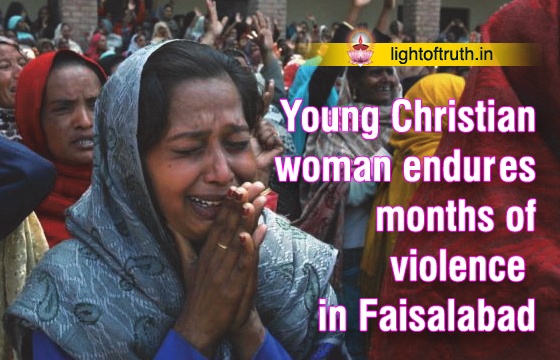
Young Christian woman endures months of violence in Faisalabad
After months of threats and attempted kidnappings, Arushma Ejaz, a young woman from Rabbani Colony, turned to Human Rights Focus Pakistan (HRFP) late last month for help after her complaints to the police proved useless. A man named Ghulam Jelani has been stalking her for a while, going so far as to try to kidnap her back in mid-July in order to convert her to Islam and force her to marry him.
To this end, Jelani broke into Arushma’s home, armed, forced to leave only after neighbours intervened. In this incident, the police arrived too late.
In the following days, Jelani continued to follow the young woman in an attempt to kidnap her.
He threatened to kill the young woman’s brothers if she refused to marry him, and then attempted to intimidate her family by saying that he would accuse them of violating the blasphemy law.
At this point, Arushma’s mother contacted HRFP, which immediately brought the case to the Faisalabad District Court. However, the human rights organisation was able to file a First Information Report with police only on 2 September.
Under maximum security, Arushma and her mother testified before the court 10 days later.
For HRFP President Naveed Walter, “kidnappings, forced conversions and forced marriages are not yet considered a serious matter by the state. The government sometimes talks about high-profile single issues, but never addresses the underlying causes, much less tries to eliminate them.”
A big problem continues to be police reluctance to get involved in such cases. In Jelani’s, he was held in custody for a while, then released without trial.
“From the first call to the police to actual action, 47 days passed,” Walter pointed out.
The HRFP told that it was concerned by how free and fair trials involving girls from religious minorities are, given the fact that “often political and religious figures publicly support the culprits.”
“Muslims who convert [to other religions] would be called murtads (apostates), so that only non-Muslims can convert,” the organisation added.
For the HRFP, the authorities must stop “protecting kidnappers and rapists who hide behind forced conversions and marriages to save themselves from punishment.”
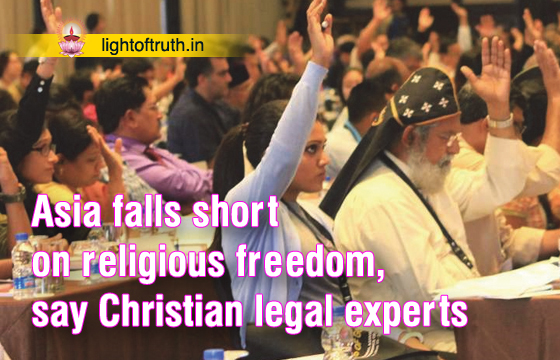
Asia falls short on religious freedom, say Christian legal experts
Asian nations are failing to effectively interpret and imple-ment freedom of religion and belief for their citizens despite having constitutional provisions and guarantees, Christian legal experts said during a regional consultation.
“Although a majority of Asian countries have strong constitutional provisions and guarantees to secure their citi-zens’ freedom of religion and belief, there are severe short-comings in interpretation and implementation, or in upholding such principles in practice,” observed two legal experts during the Asia Regional Consultation on “Freedom of Religion, Rights of Religious Minorities and Constitutional Guarantees in Asia” organized by the Christian Conference of Asia (CCA).
The five-day consultation from Oct. 3-5 drew 50 partici-pants from various Asian nations.
“In order for freedom of religion and belief to be secure, enhanced and applicable to all human beings, we must comply with constitutional provisions and be consistent with international declarations,” said Eugene Yapp, senior fellow of the Religious Freedom Institute’s Southeast Asia team. “If constitutional guarantees are to be meaningful, there is a need for more context-ualized or localized approaches based on ground realities – such as cultural particularities and contingencies of a local nature.”
Yapp, former secretary-gen-eral of the Evangelical Alliance of Malaysia, also emphasized the role of churches and missionaries in Asia, stating that churches must seek concrete expression for the flourishing of “diversity of cultures in social engagement and creative dialogue for the well-being of everyone for the common good.”
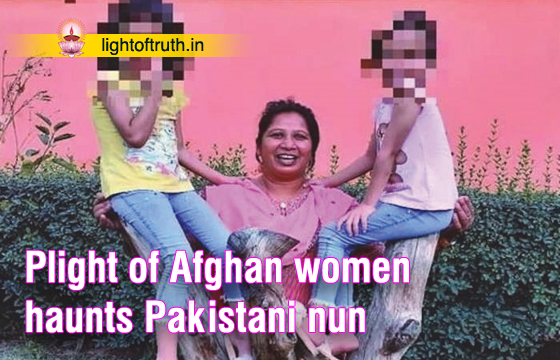
Plight of Afghan women haunts Pakistani nun
A Pakistan-born Catholic nun who worked in Afghanistan until the Taliban takeover says the plight and lack of freedom of women in the country still trou-ble her. Women are considered inconsequential in Afghanistan, said Sister Shahnaz Bhatti from the Sisters of Charity of St. Jeanne-Antide Thouret, who fled the troubled Central Asian country following the Taliban victory on Aug. 15.
Young women are forced against their will to marry men selected by the patriarch of the family, said Sister Bhatti, who served in Afghanistan as part of the pontifical mission set up by Pope John Paul II in May 2002.
“The most trying thing was not being able to move about freely because, as women, we always had to be accompanied by a man,” Sister Bhatti said in an interview with papal charity Aid to the Church in Need (ACN) on Sept. 22.
The congregation, founded by St. Jeanne-Antide Thouret in 1797 in France, ran a school for children with intellectual disa-bilities and Down’s syndrome in the capital Kabul. Sister Bhatti served in the school along with Sister Teresia of the Sisters of Maria Bambina (Sisters of Holy Child Mary) and Sister Irene of the Missionary Sisters of Consolata.
“It was my job to complete all the necessary paperwork at the banks or other government agencies, but I always had to be accompanied by a local man,” she added.
Women religious had to dress like the local women and were constantly being monitored, Sister Bhatti said, recalling her experience in Afghanistan, where US-led forces were engaged in a 20-year war and humanitarian assistance.
Afghans consider all foreigners to be Christians, she added.
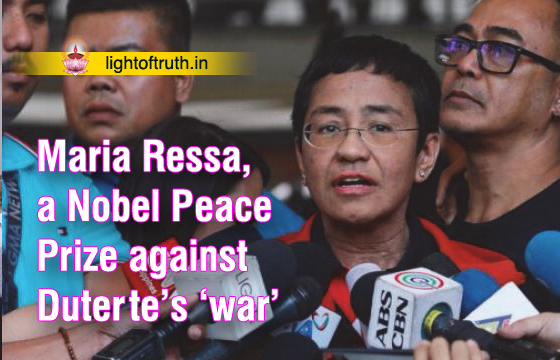
Maria Ressa, a Nobel Peace Prize against Duterte’s ‘war’
The Nobel Peace Prize was awarded to Philippine journalist Maria Ressa, founder of the news website Rappler, and Russian journalist Dmitry Muratov.
In announcing the award, the Nobel committee chair, Berit Reiss-Andersen, said: “Free, independent and fact-based journalism serves to protect against abuse of power, lies and war propaganda.
“Without freedom of expression and freedom of the press, it will be difficult to successfully promote fraternity between nations, disarmament and a better world order to succeed in our time,” she added.
Maria Ressa, the first Filipino to receive a Nobel Peace Prize. She founded Rappler in 2012, an online news website that “has focused critical attention on [President Rodrigo] Duterte regime’s controversial, murderous anti-drug campaign,” the committee writes.
What is more, Ressa and Rappler ”have also documented how social media is being used to spread fake news, harass opponents and manipulate public discourse,” it added.
In recent years, the journalist has been the target of a series of attacks. For her cover of Duterte’s ruthless “war on drugs”, she ended up in jail twice.
Her tenth arrest warrant for cyber libel in less than two years shows “definitely a pattern of harassment,” Ressa, a former CNN correspondent, laments.
Despite the risks, Maria Ressa, whose book “How to stand up to a dictator” will be released in April 2022, has decided to stay in her country.
“I don’t think this is me, I think this is Rappler. I have – we have – all along said this since 2016, that that we are fighting for facts,” the journalist said upon hearing about the award.
If the news becomes debatable, she warns “then journalism becomes activism”, a “battle for facts”. For her, “the Nobel peace prize committee realised that a world without facts means a world without truth and trust.”
The Philippines is ranked the seventh most dangerous country in the world for journalists. As a sign of things to come, when he took office in 2016, President Duterte said that “Freedom of expression cannot help you if you have done something wrong.”

Good News for Iraq’s Christians: More Autonomy
This week, the Christian enclave of Ankawa in Erbil, the capital city of Iraqi Kurdistan, was designated by the autonomous region’s prime minister as an official district with administrative autonomy. Starting next week, Christians will directly elect their own mayor and be in charge of security, among other matters.
Prime Minister Masrour Barzani called Ankawa a home for “religious and social coexistence, and a place for peace.”
Archbishop Bashar Warda, the Chaldean Catholic archbishop of Erbil, called it an “important” and “strategic” decision.
“Our confidence in the future of Kurdistan makes us encourage Christians not only to stay,” he told Kurdistan 24, “but also to invest in this region.”
Ordained a priest in 1993, Warda was consecrated in his current position in 2010. With Iraq’s haemorrhaging of Christians since the 2003 US invasion, Warda’s bishopric in the autonomous Kurdish region soon became a providential band-aid.
Beginning in 2014, ISIS drove Christians from Mosul and their traditional homeland in the Nineveh Plains, and thousands took refuge in Erbil and other cities in the secure northeast. From 1.5 million Christians in 2003, the Chaldean Catholic church now estimates a population of fewer than 275,000 Christians.
Warda has long been investing to turn the tide. In 2015, he established the Catholic University of Erbil, and has coordinated relief aid from governments and charities alike. The situation stabilized following ISIS’s defeat in 2017.
But freedom does not come from politics alone. Two years ago, Christians endorsed widespread popular uprisings against the political class. Violently suppressed, the movement’s main celebrated achievement was early elections under a new law designed to promote better local and small-party representation.
Polls open on October 10, and a quota gives Christians five of 329 seats in parliament. However, Warda’s Baghdad-based patriarch has called for a Christian boycott, fearing fraud.
Warda wants a Christian revival. Buoyed by the March visit of Pope Francis, he believes that ISIS broke the fundamental religious and cultural underpinnings of Islamic superiority. Christians no longer are seen as second-class citizens.
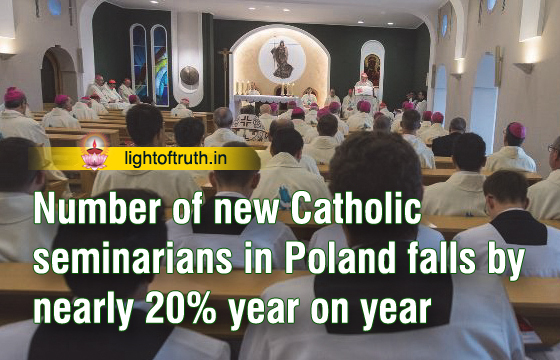
Number of new Catholic seminarians in Poland falls by nearly 20% year on year
Nearly 20% fewer candidates for the Catholic priesthood have enrolled in Poland’s seminaries this year, compared to 2020.
Fr. Piotr Kot, chairman of the Conference of Rectors of Major Seminaries, told the Polish Catholic news agency KAI on October 12 that 356 seminarians began their studies in 2021.
Last year, he said, there were 441 candidates, meaning that “the number is lower by approxi-mately 20%.”
He explained that of the 356 candidates, 242 were training for the diocesan priesthood and 114 for religious orders.
There were 47 fewer semi-narians in diocesan seminaries and 38 fewer candidates for religious orders compared with the previous year, he said.
The Polish Catholic weekly GoϾ Niedzielny noted that priestly vocations had declined sharply in Poland in recent years.
In 2012, it said, 828 candidates enrolled in the first year of seminary. There were 498 in 2019 and 441 in 2020.
In March this year, Poland’s bishops made their final adjust-ments to a decree, called “The Way of Formation of Priests in Poland” (Ratio institutionis sa-cerdotalis pro Polonia), setting out new rules for priestly for-mation.

Pope Francis greets Colombian nun freed 4 years after kidnapping by Islamists in Mali
Pope Francis greeted a Colombian nun on October 10, shortly after she was freed four years after being kidnapped by Islamists in Mali.
The Pope blessed Sr. Gloria Cecilia Narváez Argoti before a Mass in Saint Peter’s Basilica launching a worldwide synodal process. Sr. Gloria, a member of the Congregation of the Franciscan Sisters of Mary Imma-culate, was kidnapped in southern Mali in 2017.
The Malian presidency announced that she was released on Oct. 9 after “four years and eight months of combined efforts of several intelligence services.”
It posted photographs on social media of her meeting with interim president Col. Assimi Goïta, accompanied by Cardinal Jean Zerbo of Bamako.
“We prayed a lot for her release. I thank the Malian authorities and other good people who made this release possible,” the cardinal told.
Armed men kidnapped Sr. Gloria in Karangasso, about 90 miles south of the town of San, near the border with Burkina Faso, on Feb. 7, 2017.
The men forced her to hand over the keys to the community’s ambulance. The vehicle was later found abandoned. Three other sisters were present at their house but escaped.
The kidnappers were going to take the youngest nun, but Sr. Gloria reportedly volunteered to take her place.

Science Closes In on Covid’s Origins
Where did Covid-19 come from? The answer can be found in the SARS-CoV-2 virus itself. To get to the truth, we need only unleash the power of science. Based on experience with SARS-1 in 2003 and MERS in 2012, we know that many people are infected by a host animal long before a co-ronavirus mutates to the point where it can jump from human to human. An extensive data set from late 2019—more than 9,000 hospital samples—is available of people exhibiting flulike (thus Covid-like) symptoms in China’s Hubei and Shaanxi provinces before the epidemic started. Based on SARS-1 and MERS, the natural zoonotic theory predicts 100 to 400 Covid infections would be found in those samples. The lab-leak hypothesis, of course, predicts zero. If the novel coronavirus were engineered by scientists pursuing gain-of-function research, there would be no instances of community infection until it escaped from the laboratory. The World Health Organization investigation analysed those stored samples and found zero pre-pandemic infections. This is powerful evidence favouring the lab-leak theory.
Within months of the SARS-1 and MERS outbreaks, scientists found animals that had hosted the viruses before they made the jump to humans. More than 80% of the animals in affected markets were infected with a coro-navirus. In an influential March 2020 paper in Nature Medicine, Kristian Ander-sen and co-authors implied that a host animal for SARS-CoV-2 would soon be found. If the virus had been cooked up in a lab, of course, there would be no host animal to find.
The WHO team searched for a host in early 2020, testing more than 80,000 animals from 209 species, including wild, domesticated and market animals. Not a single animal infected with SARS-CoV-2 was found. This finding strongly favours the lab-leak theory. We can only wonder if the results would have been different if the animals tested had included the humanized mice kept at the Wuhan Institute of Virology.
In their Nature Medicine paper, Mr. Andersen and colleagues pointed to what they considered the poor design of SARS-CoV-2 as evidence of zoonotic origin. But a team of American scientists mutated the stem of the coronavirus genome in nearly 4,000 different ways and tested each variation. In the process they actually stumbled on the Delta variant.
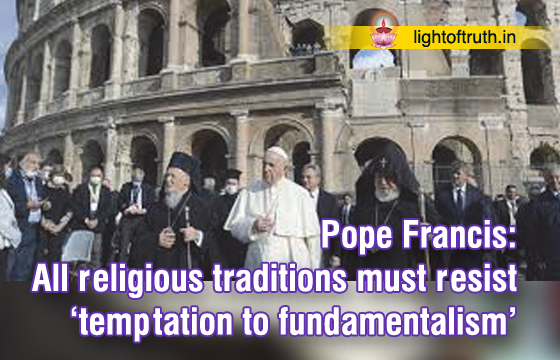
Pope Francis: All religious traditions must resist ‘temptation to fundamentalism’
Pope Francis asked leaders of world religions to resist “the temptation to fundamentalism” for the sake of peace at an interreligious gathering Thursday in front of the Colosseum. Peace “summons us to serve the truth and declare what is evil when it is evil, without fear or pretence, even and especially when it is committed by those who profess to follow the same creed as us,” the pope said Oct. 7. “For the sake of peace, please, in every religious tradition let us defuse the temptation to fundamentalism and every tendency to view a brother or sister as an enemy.” Speaking on a stage together with Muslim, Jewish, Buddhist, and Hindu representatives, Pope Francis appealed for peace amid the world’s current conflicts. “Dear brothers and sisters, as believers it is our responsibility to help eradicate hatred from human hearts and to condemn every form of violence. Let us unambiguously urge that arms be set aside and military spending reduced, in order to provide for humanitarian needs, and that instruments of death be turned into instruments of life,” the Pope commented.
“Fewer arms and more food, less hypo-crisy and more transparency, more vaccines distributed fairly and fewer weapons marketed indiscriminately,” he said.
The Islamic scholar, who signed the landmark Document on Human Fraternity with Pope Francis in 2019, criticized the uneven distribution of COVID-19 vaccines throughout the world.
He said that “the world has suffered a setback despite the efforts made by religious institutions, their representatives and leadership, to foster a collaborative approach and exchange of goods, giving precedence to the public interest over private interests.” The Pope was speaking at the live-streamed closing ceremony of “Peoples as Brothers, Future Earth. Religions and Cultures in Dialogue,” the 35th event promoted by the Sant’ Egidio Community in the “spirit of Assisi,” the interreligious gathering convened in St Francis’ birthplace by Pope John Paul II in 1986.