

Leaders of various religious communities and social organizations have started a journey in the southern Indian state of Kerala to promote communal harmony and national integration.
The journey named ‘Sarva Dharma Sadbhavana Yatra’ (Journey to foster goodwill among all religions, is an initiative of the Dharmabharathi mo-vement and promoted by a 16-member team. The journey was flagged off October 8 from Ananda Ashram, a Hindu centre, in Kasargod, Kerala’s northernmost town. It will end October 14 at Thiruvananthapuram, the state capital in the south.
Daily Archives: October 17, 2021
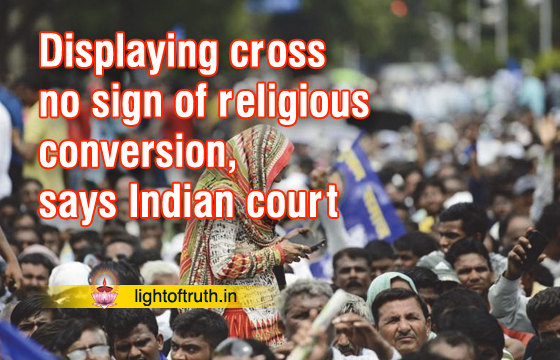
Displaying cross no sign of religious conversion, says Indian court
A top court in the southern Indian state of Tamil Nadu has ruled that a Dalit Hindu woman marrying a Christian or displaying religious symbols such as the cross cannot be cited as reasons to revoke her scheduled caste (SC) community certification. The Madurai bench of Madras High Court held that hanging the cross on a wall or going to church does not necessarily mean one has altogether abandoned the original faith to which one was born and cannot be the basis for cancelling an SC certificate.
The bench was hearing the case of Dr. P. Muneeswari, who belongs to the Hindu Pallan community. Her SC certificate was cancelled by district officials in Ramana-thapuram in 2013 on grounds that she was married to a Christian man and their child-ren were also being brought up in the Christian faith. The officials had reached the decision after finding a cross hanging on the wall of her clinic and concluded that she had converted to Christianity and hence was not liable to continue as a member of her Hindu SC community.
Members of the Hindu Dalit or former untouchable communities in India are often discriminated against under the centuries-old caste system. In legal and constitutional terms, they are now listed as scheduled castes enabling them to access the government’s affirmative action policies and programs.
Dalits who converted to Christianity and Islam are excluded from India’s affirmative action plan that includes reservations in educational institutions and government jobs among other social welfare schemes.
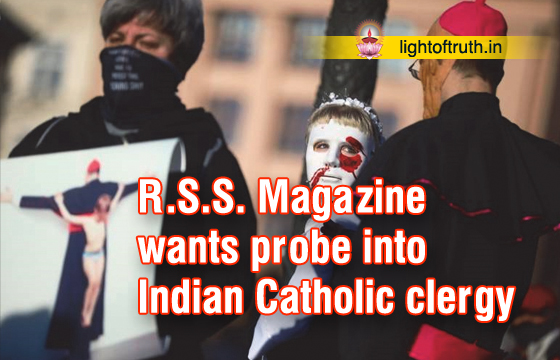
R.S.S. Magazine wants probe into Indian Catholic clergy
Panchjanya, a weekly ma-gazine linked to the Rashtriya Swayamsevak Sangh (RSS), has sought an inquiry into the Indian Catholic Church and its clergy while citing the recent expose of child sexual abuse within the French Church.
In its latest issue, which will hit the stands on Oct. 17, the magazine has reportedly published a cover story on the sexual exploitation of children and nuns by priests across the world.
Panchjanya, published in Hindi to uphold Hindu patri-otism in keeping with the objectives of the nationalist RSS, has claimed that incidents of sexual exploitation of children and nuns are on the rise in India too.
Referring to the reported incidents of rape of a woman in a missionary college in Che-nnai and a nun from Kerala, the magazine has said the people of the country wanted a probe against the Church and its priests.
Detailing the inquiry that unearthed the scale of abuse within the French Church, the magazine termed the earlier apology by Pope Francis in 2019 for such incidents a “formality under pressure.”
It went on to question and blame the style of functioning of the Church for the declining number of religious nuns acro-ss the globe. A similar trend was witnessed in the southern Indian state of Kerala and so the Church was targeting girls from poor families in under-developed states such as Chha-ttisgarh, Jharkhand, Himachal Pradesh and Odisha, the maga-zine alleged.
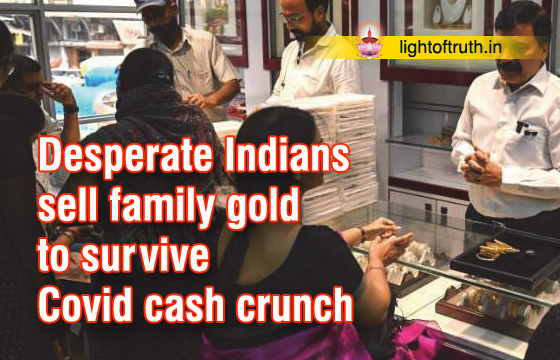
Desperate Indians sell family gold to survive Covid cash crunch
In Mumbai’s jewellery bazaar, Kavita Jogani gingerly places her wedding bangles on the shopkeeper’s scales, one of the thousands of Indians parting with their most cherished asset – gold.
It was not an easy decision – Jogani was desperate after her garment business took a severe hit in the past year and a half with multiple corona-virus lockdowns, making it difficult to pay shop bills and the salaries of her 15 emplo-yees.
The headline growth numbers suggest Asia’s third-largest economy is rebounding from the economic crisis un-leashed by Covid-19, but there is no end yet to the financial pain for many Indians.
“I don’t have any other option than selling the gold,” said Jogani as she waited nervously for the shop owner to make her an offer.
“I bought these bangles before my wedding 23 years ago,” the 45-year-old told.
Business closures and job losses pushed more than 230 million Indians into poverty in the past year, according to a study by Azim Premji University, leaving many struggling to pay rent, school fees and hospital bills.
Their difficulties have been compounded in recent weeks by soaring prices for electricity, fuel and other items.
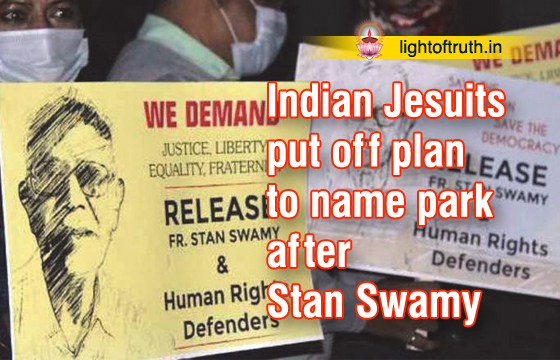
Indian Jesuits put off plan to name park after Stan Swamy
The opposition from Hindu nationalists’ organiza-tions has compelled a Jesuit-run institution in the southern Indian state of Karnataka to postpone the naming of a park inside its campus after late Jesuit priest and tribal rights activist Father Stan Swamy.
The 140-year-old St. Aloy-sius College in Mangaluru had decided to hold the naming ceremony on Oct. 7 but post-poned it citing President Ra-manath Kovind’s two-day offi-cial visit to the city.
Vishwa Hindu Parishad, its youth wing Bajrang Dal and Akhil Bharatiya Vidyarthi Pa-rishad, the students’ wing of the ruling BJP, had threatened to stage a protest if the college went ahead with the plan. The park is located on the college’s Beeri campus on the outskirts of the coastal city but VHP said it would be an insult to name it after someone accused of terror activities.
“It is unfair to oppose the naming of the park in the name of Father Stan and to brand him as a Maoist because it is not yet proven in court,” Father Denzil Fernandes told.
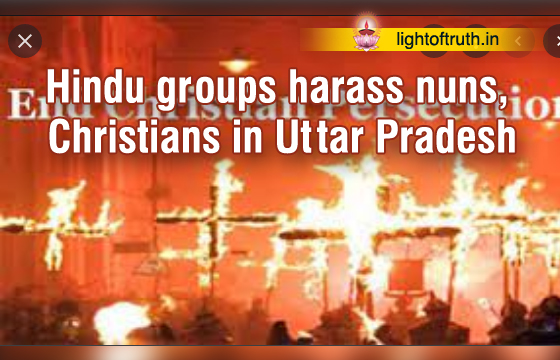
Hindu groups harass nuns, Christians in Uttar Pradesh
Some 50 Christ devotees attending Sunday service were attacked by Hindu radicals in the Mau district of the northern Indian state of Uttar Pradesh. The activists of Bajrang Dal (party of the stout and strong) and Hindu Yuva Vahini, a youth group, paraded the Christians to the nearby police station where they were detained until late night on October 10.
Seven of them, including three women and a pastor, were sent to jail for attempting forced religious conversion and other allegations.
Meanwhile two Ursuline Franciscan nuns, who had come to the city bus stand, were forcibly taken to the police station and kept there from 12:30 pm to 6 p.m. They were released under pressure from high ranking police officials from Lucknow, the state capital.
Sister Gracy Monteiro, working in Mirpur Catholic mission, told Matters India that she had gone to the bus stand to help her companion Sister Roshni Minj to board a bus to Varanasi.
Sister Minj was going home to visit her ailing father in the eastern Indian state of Jharkhand. As Minj went to ask about the bus, some Hindu radicals attacked the driver and forced the nuns to walk to the police station, where the Sunday worshipers were already detained..
Sister Monteiro said she was under terrible shock for almost an hour as she and Sister Minj were accused of being part of the Sunday worshippers who were allegedly attempting to forcibly converting the people.
Vijendra Rajbhar, the leader of the Christ devotees, told the police and the journalists that the Catholic nuns were not part of the prayer meeting. The Hindu radicals insisted that the nuns are part of the conversion gang.
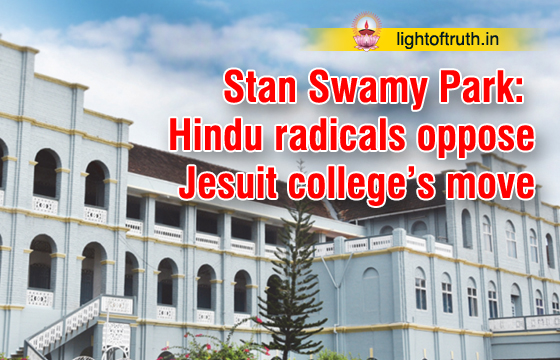
Stan Swamy Park: Hindu radicals oppose Jesuit college’s move
Some right wing Hindu groups in the southern Indian state of Karnataka have objected to naming a private park after Jesuit Father Stan Swamy, who died in judicial custody three months ago.
The park is situated inside the campus of 140-year-old St Aloysius College in Manga-luru, a port city in the state.
The college is part of a network of educational institutions administered by the Society of Jesus in India.
The Mangalore college recently decided to name their park after Father Swamy, who is revered by many for sacrificing his life for the poor tribal communities in Jharkhand, eastern India.
However, Hindu groups on October 6 condemned the college’s decision threatened to protest if the management goes ahead with its plan.
The opposing groups are the Akhil Bharatiya Vidyarthi Parishad, the students wing of the Bharatiya Janata Party (BJP) that heads the federal and several state govern-ments, including Karnataka, Vishwa Hindu Parishad (World Hindu Council) and Bajrang Dal (the party of the strong and stout).
Sharan Pumbwell, VHP zonal secretary, told reporters that Father Swamy was arrested under India’s anti-terror law — the Unlawful Activities(Prevention) Act – as he had faced serious allegations like promoting terrorism and Maoism.
“It is an insult to society if the park is named after him,” he added. He also said the Hindu groups would protest if the management goes ahead with its plan. The groups have also submitted a memorandum to the deputy commissioner in this regard.
The ABVP secretary suggested that the college could name the park after renowned politicians and college’s alumni such as Oscar Fernandes or George Fernandes, who, he said had contributed to society.
Oscar died September 13 this year, aged 80, while George passed away on January 29, 2019, when he was 88.
Some Catholic leaders say the controversy is unnecessary and urge groups to keep away from the internal matters of private institution.
“The political groups have no rights to interfere with the internal matters of St. Aloysius College,” asserts Jesuit Father Joe Xavier, the director of the Indian Social Institute, Bengaluru, where Father Swamy had served as a trainer and director for years.
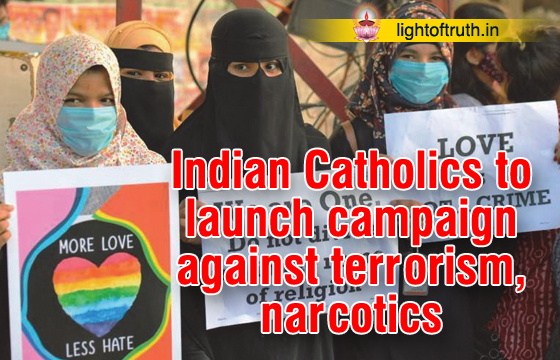
Indian Catholics to launch campaign against Terrorism, Narcotics
The laity council of the Catholic Bishops’ Conference of India (CBCI) will launch a nationwide awareness campaign against terrorism and the use of narcotics on Oct. 1.
The Save the People camp-aign will see students and youths, religious, political organizations and sociocultural movements participate in a “conscientization process” over a period of three months, said V.C. Sebastian, the laity council secretary, in a press release issued on Sept. 24.
Programs through social media against narcotics and te-rrorism, seminars, discussions, family visits, and formation of local solidarity groups will be part of the campaign, the press release said.
Sebastian said the campaign “will rouse the general consci-ence against the glaring threats of narcotism and terrorism getting worse across the nation and making the common man increasingly worried.”
The anxiety shared by certain political parties about the fast spread of a terrorist agenda to the higher education sector is to be viewed seriously, he said.
The CBCI is the apex decision-making body of the Indian Church. The 14 regions of its laity council, 174 Catholic dioceses, various churches and lay organizations will collaborate in the campaign, ensuring the in-volvement of different religious denominations, people’s representatives and sociocultural leaders.
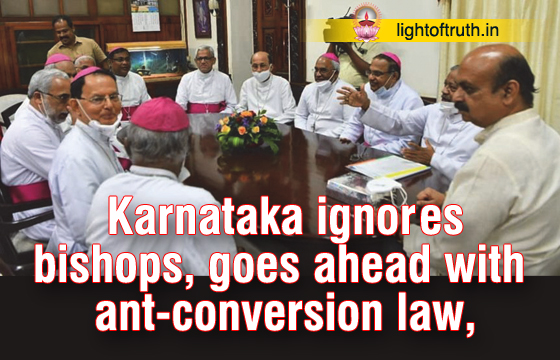
Karnataka ignores bishops, goes ahead with ant-conversion law,
The government in Karnataka has issued an order to check “forced conversions” in the southern Indian state.
State Chief Minister Basa-varaj Bommai on September 28 instructed the district deputy commissioners to become vigi-lant about the conversions in their respective jurisdiction and puni-sh those violating the rule.
The order came five days after the Catholic bishops in the state governor to express their concern about the proposed Anti-Conversion Law in the state.
Bommai said he has received complaints about the forced conversions during his recent visits to various districts and that such activities cannot be tolerated. He reiterated the government plan to bring in a legislative ban on conversions in the state.
Father Faustine Lobo, the director of the regional Pastoral Centre in Bangalore, says the Catholic Church does not involve in any forcible conversions, although it cares to more than 30% of the population with schools and hospitals.
“If we really wanted to con-vert people through our schools or hospitals, we could have done it easily,” the priest told Matters India September 29. He also challenged the government to prov4e if any such incidents had been reported.
However, he expressed concern that an anti-conversion law might result in people taking law into their hands and harassing “Christian workers and our institutions.”
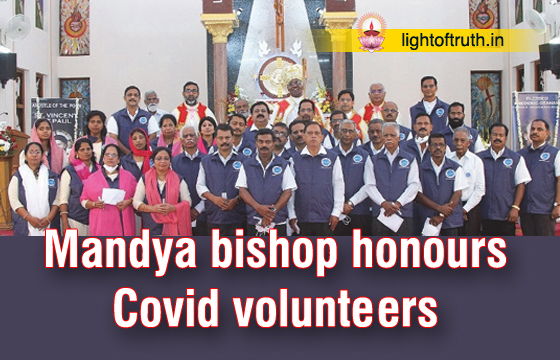
Mandya bishop honours Covid volunteers
Bishop Sebastian Adyanthra-th of Mandya has hailed the Covid volunteers for their exceptional service to mankind during the coronavirus pandemic.
“Covid posed a serious crisis in Bengaluru and the Catholic laity under the Vincent De Paul Society have played a remarkable role as frontline warriors,” the Syro-Malabar prelate said.
Bengaluru is the capital of Karnataka where Covid19 claim-ed more than 8,500 lives.
The bishop was speaking at the silver jubilee celebrations of the St. Vincent De Paul Society at St. Thomas Church, Jalahalli in Benglauru, capital of Karna-taka. The parish unit of the St. Thomas Church that celebrated the jubilee on September 27 decided to build five houses for the Covid-19 victims as jubilee gifts.
The bishop called upon the society members to imbibe the Vincentian spirituality and increase charity activities in all the parishes of Mandya diocese.
Tom Thomas, a pioneering member of the unit, said his most gratifying moments in life came when he reached out to the needy.
The parish unit of the Vincent De Paul Society worked round the clock to transported Covid patients to hospitals in their ve-hicles, supported their treatment and provide food to their fami-lies. The main tasks included reaching food and medicines to the affected families, help orga-nize hospital admission for those requiring hospital care, assist in swab collection from people with symptoms, provide oxygen cyli-nders, oximeter, masks, gloves, sanitizer and other items irres-pective of people’s cast or creed.
“For us, the work was wor-ship and we experienced the Christian life more meaning-fully,” said Tom Thomas, who has led the lay movement in the parish for more than two decades as the founder president.