
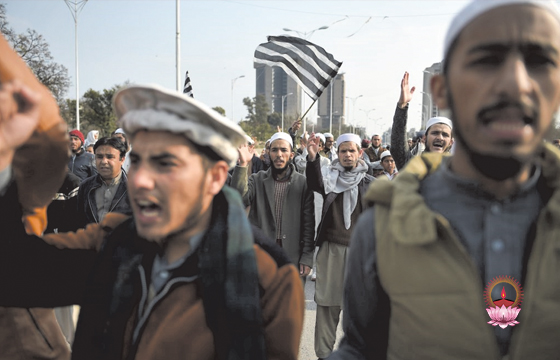
A 25-year-old Pakistani Christian was arrested and charged with violating the country’s blasphemy laws after sharing a social media post critical of Islam in December. Pastor Raja Warris, a Christian pastor, was charged for posting on Facebook on Dec. 22 a message that reportedly hurt the religious sentiments of his Muslim neighbours.
On Dec. 26, hundreds of people gathered in Warris’ Charar neighbourhood in the city of Lahore and threatened to behead the pastor and to set fire to Christian homes unless police took action.
“The situation turned dangerous when someone found out the Muslims were planning to set fire to the houses of Christians,” said Saleem Khokhar, one of those displaced by the incident.
“This forced the Christians to flee the neighbourhood,” he told the group International Christian Concern (ICC).
Hundreds of anti-riot policemen were deployed to Charar while leaders of the Christian community met with authorities to resolve the situation.
“The police said they could not guarantee the safety of our people if the accused was not presented for arrest,” said Rev. Ayub Gujjar, vice moderator of the Raiwind Diocese of the Church of Pakistan. “We reluctantly agreed to bring Warris but demanded that he be kept at an undisclosed location due to the serious threat to his life,” the church leader told local media.
On Dec. 27, police charged Warris with committing blasphemy. He also apologized for the social media post.
William Stark, regional manager of ICC, said called on Pakistani authorities “to continue to protect the homes of Charar’s Christians” although Warris has already been charged.
He said “there is still the potential for mob violence against the Christians of Charar.”
“No one should be forced to flee their home because of a social media post,” said Stark, adding that Pakistan’s blasphemy laws “must not be misused to justify mob violence.”
Daily Archives: January 17, 2021
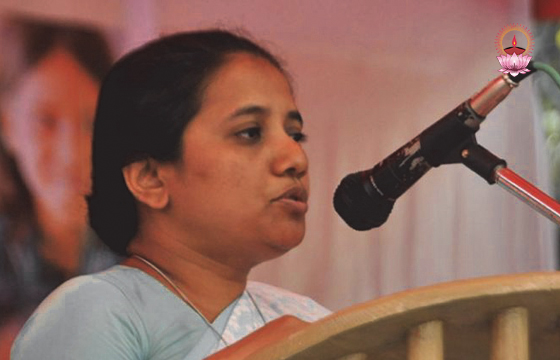
Advocate for India’s domestic workers
Sister Christin Mary is a member of the Missionary Sisters of the Im-maculate Heart of Mary, also known as ICM Sisters.
Based in the western Indian city of Mumbai, Mary coordinates the National Domestic Workers’ Movement, which has been championing the rights of domestic workers, children in domestic work, and migrant domestic workers since 1985. Today, its work is spread across 17 states of India, engaging nearly 200,000 domestic workers in major cities, towns and villages.
The movement was set up by Belgian Sister Jeanne Devos, also of the ICM Sisters, who spent several years as a missionary in India. She was concerned about the plight of Indian domestic workers who were exploited and whose work was undervalued.
Mary shared with Global Sisters Report about her work with the movement. She said the movement has emerged as a ray of hope for thousands of children who were deprived of their childhood and education, rehabilitating and educating them to enter mainstream society. The movement, she said, has set the tone for “breaking the slavery of silence.”
“Our journey is a road less trave-led,” the 47-year-old nun said. She expressed some of major hardships “Slow response from the govern-ments to protect the rights of workers and the exclusion of workers from the purview of labour laws even after constant lobbying efforts are some of them. Failure of the government to allocate a budget for the welfare board has created difficulties for the domestic workers to avail the social protection schemes on time. Domestic workers also report unfair dismissal when they ask for better wages and working conditions.” About her mitivations she said:
“When I was a student in a convent school in the southern Indian State of Tamil Nadu, I saw religious sisters helping the poor children who couldn’t afford to pay their fees and buy books. In my student days, I heard about the plights of child workers who were forced to sacrifice their childhoods to support their starving families. I used to be disturbed about those children, whose dreams were nipped in the bud. My desire to serve the underprivileged children and women motivated me to become a nun in 2001.”
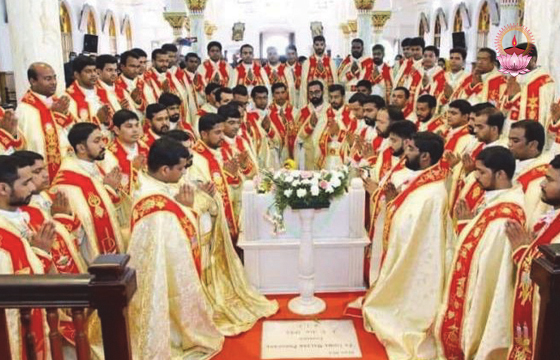
56 new Carmelite priests celebrate Mass at founder’s tomb
As many as 56 newly ordained priests of the Carmelites of Mary Immaculate Congregation (CMI) on January 4 celebrated thanksgiving Mass at St Joseph’s Monastery Church in Mannanam in Kerala’s Kottayam district where their founder’s remains are kept.
Father Mathew Chandrankunnel, a member of the congregation and a professor of theology, said the young men were ordained priests recently for their 15 provinces. All are from Kerala but belong to various provinces of southern and northern India.
Father Chandrankunnel said the new priests had undergone training that lasted from 10 to 15 years. They will now serve God and wider humanity all over the world, he told Matters India. The Kerala-based congregation works in various parts of India and abroad. It had 2,597 members, including 1,900 priests in 2016.
The first indigenous Catholic religious congregation in India was founded in 1831 by Fathers Thomas Palackal and Thomas Porukara, along with Saint Kuriakose Chavara – all members of the Syro-Malabar Church.
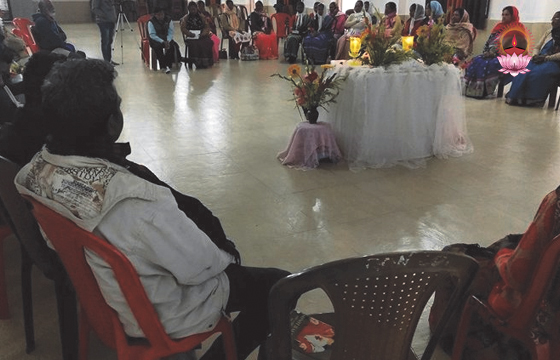
Lockdown deepened faith, Christin life: Dumka SCCs
The Small Christian Community (SCCs) members from Dumka diocese in Jharkhand shared unanimously that their faith in Christ was deepened during the lockdown.
Representatives from two parishes of 13 SCC units of St Joseph’s Parish, Guhiajori village, about 10 km from Dumka town and Sacred Hear Parish in Dumka shared their experience of Christian life during an animation session on January 13.
During the Lockdown when the churches were closed and the Mass was not celebrated, we had family prayer together both morning and evening, said Esther Murmu, an SCC animator. As our children were not going to school I led the prayers in the house and read the Bible, which we hardly did earlier, added Mrs. Murmu, a school teacher sharing her experience. This united us in our family, she shared.

Christ Varsity Student employs 21 youth during lockdown
A postgraduate girl student at Christ University Bangalore staying home during Covid 19 lockdown in Kochi found employment for herself and 21 other youth thanks to her language skills.
From being a mere translator, she was promoted to the post of Kerala Technical Head and Coordinator and had a team of 21 technicians assisted by her former batch mate.
After resigning from her job as Head of Operations for entire Kerala State, Reshmi Rose Tom of Kakkanad spoke to mattersindia.com before leaving for airport to catch a flight back to Bangalore.
Stating reason for resignation she says, “As my MA degree classes are resuming and I need to continue with my research work, I would not get time to wholeheartedly continue this work and hence I have asked the company to relieve me.”
It all started with lockdown induced rage for fitness machines in Kerala.
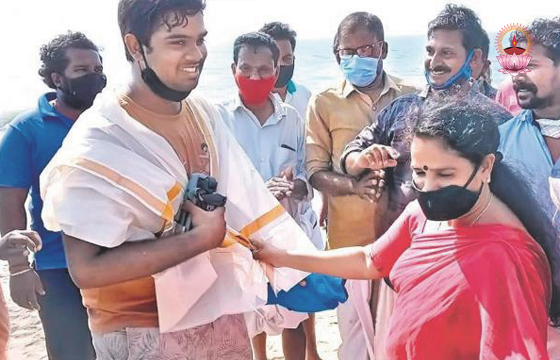
Christ University student helps rescue 4 from sea
An 18-year-old student of Bengaluru’s Christ University used his drone to save four fishermen who floated in the sea for hours after their boat capsized. Devang Subil, a student Bachelor of Technology, had come to his home in Kerala after the corona-virus forced closure of his college.
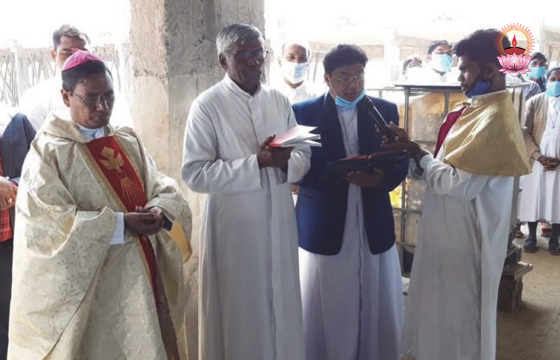
Odisha Church’s largest holistic laity centre opened
The diocese of Berhampur in Odisha has opened the largest holistic laity centre in the eastern Indian state.
Bishop Sarat Chandra Nayak of Berhampur inaugurated the “Anugraha Peetho”(centre of grace) on December 27 at Mohana in the Gajapati district. In his address at the inaugural function, Bishop Nayak thanked the Almighty for fulfilling a “long-awaited dream” of the Odisha Church.
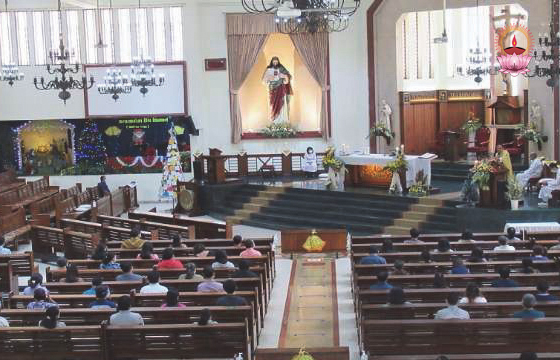
Pandemic puts squeeze on Jakarta’s parishes
The Covid-19 pandemic has greatly affected parish life, particularly in Jakarta Archdiocese, with the Indonesian capital recording the highest number of virus cases in the country. This, however, has forced the archdiocese’s parishes to be more creative. Indonesia has been hit hard by the Covid-19 pandemic which first hit the country in March last year. As of Jan. 4, the country had recorded 772,103 cases and 22,911 deaths. As of Jan. 3, Jakarta ranked first, with 189,243 cases and 3,316 deaths.
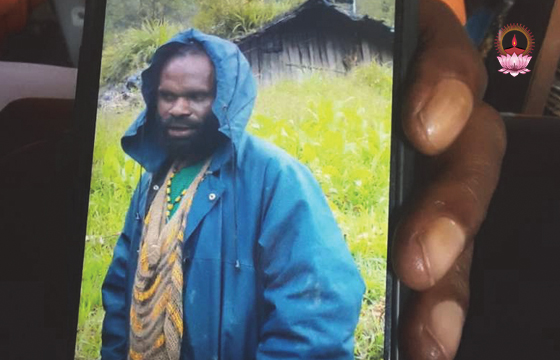
Worsening situation in Papua sparks church tensions
Intending to visit activists arrested for treason, Fr Pius Cornelius Manu, a priest in Papua’s Merauke Archdiocese, was shouted at by police, in-terrogated and had his bag searched. “I was shocked because I had often visited, arrested activists. Previously, I was not treated that way because many policemen knew me,” said the priest, talking about an incident last November when he went to visit 55 Papuans at Merauke district police station.

Bishops welcome India’s top court suspending controversial farm laws
The Supreme Court of India has ordered Prime Minister Narendra Modi’s government to suspend three controversial farm laws that stirred up nationwide protests by farmers.
The top court on Jan. 12 ordered the formation of a committee of experts to hold talks with the federal government and farmers to end the stalemate as the main protest on New Delhi’s outskirts entered its 48th day.
“The Supreme Court order gives some hope to the farmers who are protesting in very adverse conditions,” said Bishop Alex Vadakumthala, chairman of the Indian bishops’ office of labour.
“The government should find an amicable solution and end the protest as it is not good for any country to let their farmers struggle in the open for their genuine demands,” the prelate told.
Thousands of farmers from Punjab and Haryana states marched to New Delhi on Nov. 29 demanding the government repeal laws that they say work against their interests. When authorities blocked their entry to the capital, they sat on the highways to block major entry and exit points to New Delhi.
They want the Modi government to withdraw three laws passed last September — the Farmers’ Produce Trade and Commerce (Promotion and Facilitation) Act, 2020, the Farmers (Empowerment and Protection) Agreement of Price Assurance and Farm Services Act, 2020, and the Essential Commodities (Amendment) Act, 2020. The government, led by the pro-Hindu Bharatiya Janata Party (BJP), disregarded opposition to pass the bills, saying they are necessary to reform the farm sector and help farmers have the freedom to sell their products in an open competitive market and gain maximum profit.
Farmers’ unions say the laws take away the minimum support price (MSP) or the government guarantee for their products besides giving private businesses unrestricted opportunities to purchase and store produce.
Critics say the laws were designed to help multinational companies and would lead to the collapse of government-controlled markets and leave farmers at the mercy of big business houses. Government lawyers told the court that the new laws were drafted and implemented based on two decades of studies and disagreed with the farmers’ demand for their repeal.