Church joins to oppose coal mine auction in Jharkhand

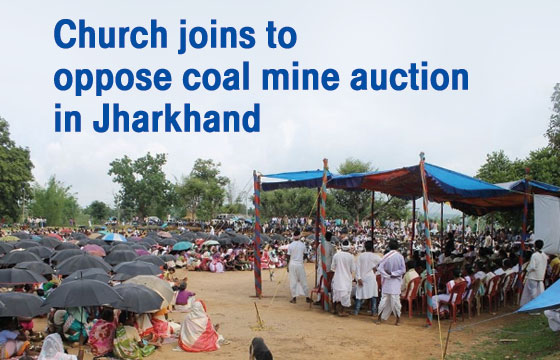
Church leaders and activists have joined political leaders in opposing the federal government’s decision to auction coal blocks for commercial mining in the eastern Indian State of Jharkhand, which they say will disturb biodiversity and cause displacement.

Hearing the case on July 15, the Supreme Court asked the federal government’s opinion on Jharkhand State government challenging the federal decision to go ahead with the auction of coal blocks.

“Tribals in the state dependent on farming and forestry, so allotting land for mining will destroy vast areas of the forest as well as the farmland resulting displacement and migration,” said Father Vincent Ekka. He heads the department of tribal studies at the Jesuit-run Indian Social Institute in New Delhi.

“I even doubt the central government’s claim of job opportunities for locals. Mining goes on in several states for decades without concern about its impact. If it provides job for locals, why there is a mass migration from these states,” Father Ekka said.

“There are other ways for the government to generate income and stabilize the nation’s economic condition without disturbing the livelihood of tribal people, who are the protectors of the environment,” the Jesuit priest added.
Telangana Christians want church inside state secretariat

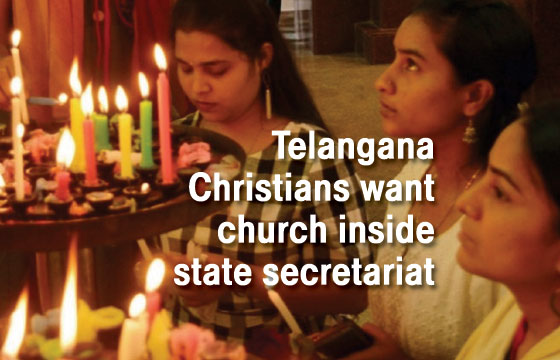
A body representing prominent churches in the southern Indian State of Telangana has urged the state government to build a church along with a temple and a mosque in the new secretariat.

The Federation of Telugu Churches, a body of churches in the state, also reminded their Chief Minister K. Chandrashekar Rao about a regular prayer previously conducted in the old secretariat building.

“Christian workshops were conducted every Wednesday during the lunch break,” in the old secretariat, according to Father Anthoniraj Thumma, executive secretary of the Federation.

Father Thumma said in a press note on July 13 that “this time we have requested a different church building, which the mosque and temple had. “On previous occasions, we have requested the government for the allotment of land in the secretariat. This is a long-pending request.”

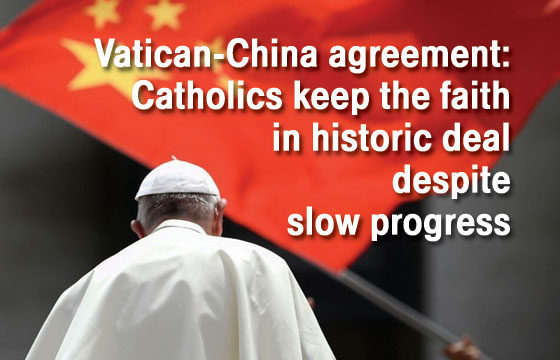
Vatican-China agreement: Catholics keep the faith in historic deal despite slow progress

This is the last in a three-part series examining the role of the Roman Catholic Church in China and how the difficult and complex relationship between the Vatican and Beijing has shifted and evolved since the Communist Party broke diplomatic ties in 1951. This instalment looks at how Catholics continue to be persecuted despite a landmark deal being signed between the Vatican and Beijing in 2018.

If James Su Zhimin is still alive, he would have turned 88. While he has not been seen for 17 years, Su is still listed by the Holy See, the worldwide govern-ment of the Catholic Church, as the Bishop of Baoding in China’s Hebei province.

Between 1956 – five years after the Vatican and Beijing  broke off diplomatic relations – and 1997, Su was arrested at least eight times, spending more than 30 years in prisons and labour reform facilities for refusing to switch allegiance from the Pope to China’s state-sanctioned Catholic Church.

He was last seen in 2003, when he was in hospital. Since then, no one has had any news about him and the authorities have been silent about his whereabouts and status. Many fear he might already be dead. Hopes rose that the Chinese government might be more willing to share information about so-called underground bishops like Su.

Lankan birth certificates to omit parents’ race, religion

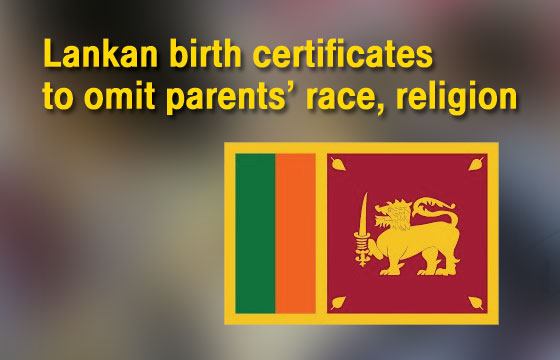
Sri Lankan authorities on July 22 announced that birth certificates for new born children in future will not mention their parents’ race, religion or the marital status. Registrar General of the Registrar General’s Department, N.C. Vithanage told local media that all details pertaining to marriage, ethnic group and religion will be removed from the application form for the registration of a birth in Sri Lanka although this was mandatory earlier.

Local media reports said that the decision was taken after many children in the country were reportedly facing issues due to the details of the marriage of parents, especially when enrolling a child in school. Under the new system, a 12-digit serial number is to be issued for all new birth certificates and this number can be used to obtain a national identity card when a child completes 15 years of age, Vithanage said.

Low birth rate in South Korea could destroy the economy in 80 years

If current trends are not reversed, the South Korean popu-lation will be halved in 80 years. At the same time, the “Asian tiger” will see its GDP drop to 20th place, this according to a study by the prestigious medical journal Lancet.

The birth rate is hot issue in the Asian country, beset by wage discrimination against women and an unfettered capitalism that leads young couples not to have children in order not to have career problems.

At present, the total popula-tion is around 53 million. It should peak in 2031 at 54.29 million, before plunging to 26.78 million by 2100. At the same time, the economy is likely to take huge steps backwards.

According to Lancet, fewer people “might reduce innovation in economies and fewer workers in general might reduce domestic markets for consumer goods, because many retirees are less likely to purchase consumer durables than middle-aged and young adults.”

Experts estimate that high-income countries with low fertility rates will be forced to adopt more liberal immigration policies and prepare their socie-ties to assimilate newcomers. Otherwise, they can expect economic, fiscal and geopolitical collapse.

China Orders Christians To Destroy Crosses, Jesus Images

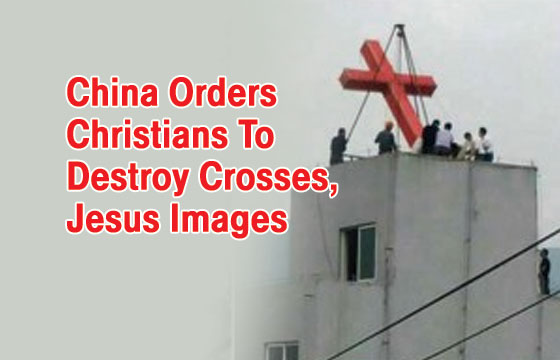
In continuation with its religious repression, Chinese authorities have reportedly ordered Christians to renounce their faith and replace the crosses, images of Jesus in churches with portraits of Chairman Mao and President Xi Jinping or risk losing welfare benefits. According to a report published in Daily Mail, a concerted attempt is being made by the Chinese officials to suppress the manifestation of religion in the country. In what appears to be state-sanctioned persecution against the Christian minorities, Chinese officials have recently demolished religious symbols by force in churches in multiple provinces, including Anhui, Jiangsu, Hebei and Zhejiang.

The report claims that when the Chinese officials arrived at the location to dismantle the cross, they faced stiff resistance from dozens of believers, who had gathered to stop the authorities from knocking down the cross.

Minority rights recognised only on paper in Pakistan

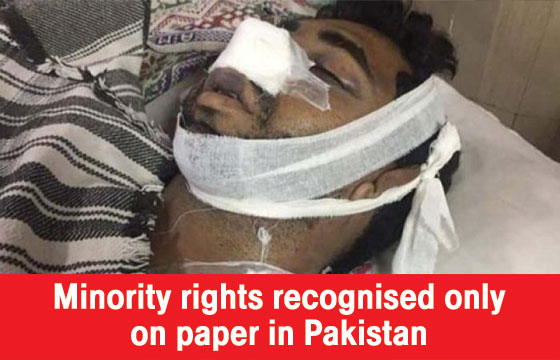
“I saw my son bleed, bruis-ed, unconscious. I shouted his name, splashed water on his face and gently slapped him to wake him up, but he no longer moved,” said Ghafoor Masih, a Christian, father of Saleem Masih, who was beaten to death in Baguyana village on 25 February.

The 24-year-old was punished for bathing in a tube-well pool used by Muslims. His father spoke about the incident that led to his son’s death in an interview with the British Pakistani Christian Association, a non-profit organisation.

Pakistan broke away from India for the sake of religious freedom, but it is now the home of many Ghafoor Masihs, who seek justice for their loved ones; all religious minorities are discriminated against in the country, not only Christians.

Why are minorities in Pakistan the victims of repression? Was the country founded only for Muslims? Of course not. Its founder, Quaid-e-Azam (Great Leader) Muha-mmad Ali Jinnah paid great attention to religious freedom.

“You are free;” Jinnah said, “you are free to go to your temples, you are free to go to your mosques or to any other place of worship in this State of Pakistan. You may belong to any religion or caste or creed that has nothing to do with the business of the State.”

For not following Jinnah’s words, Pakistan has become the 7th most dangerous place in the world for religious minorities, according to Human Rights Watch.

The problem goes way back. Discrimination began in 1949, right after the Constituent Assembly approved the Objectives, Resolution whereby all laws must conform with Islamic precepts.

Filipino bishops: Like Hong Kong, we too are sliding towards dictatorship

A few days ago, we received a letter from His Eminence, Charles Cardinal Maung Bo, Archbishop of Yangon, Myanmar and President of the Federation of Asian Bishops’ Conferences. It was an ardent request for prayers for Hong kong, on account of the signing into law of a new National Security Act. He explained in his letter how this new law poses a threat to the basic freedoms and human rights of the people of Hong kong, and how it potentially undermines especially their freedom of expression.

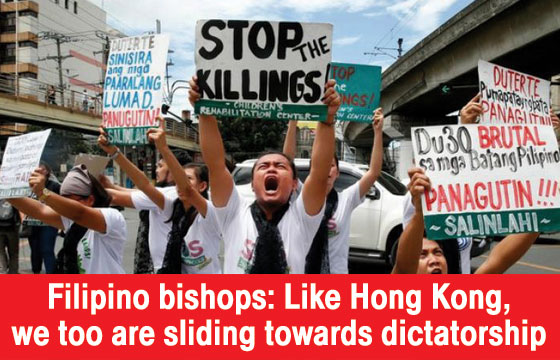
Apparently, the Chinese government assures the people of Hong kong that they have nothing to be afraid of, as long as “they don’t get involved in any activity that threatens national security.” Why does this sound eerily familiar to us Filipinos? Because we are in a similar situation. And so, while we responded with an assurance to His Eminence, Cardinal Bo, that we would join him in praying for the people of Hong kong, we also asked him to pray for the Philippines and explained why we are as seriously in need of prayers as the people of Hong kong. Like them, we are also alarmed about the recent signing into law of the Anti-Terror Act of 2020.

We are still in disbelief about the manner in which the contentious Anti-Terror Bill was fast-tracked and approved in both Houses of Congress while the whole country’s attention was focused on the Covid-19 pandemic. They did not even seem to care that many of the people they represent were against it—lawyers’ associations, the academe, the business sector, labour groups, youth organizations, NGO’s, political movements, faith-based communities, and even the Bangsamoro government.

The dissenting voices were strong but they remained unheeded. None of the serious concerns that they expressed about this legislative measure seemed to be of any consequence to them.

At least 9 Catholic bishops have died from the coronavirus

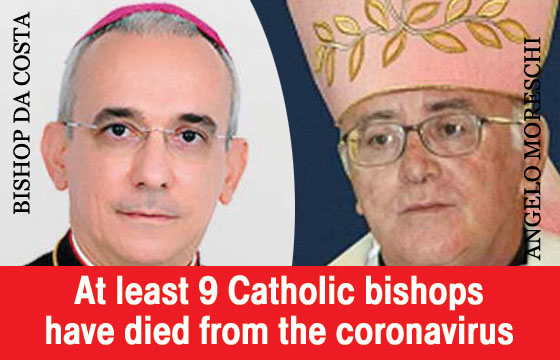
At least nine Catholic bishops have died from the coronavirus worldwide as the pandemic continues to spread across the Americas. Bishop Henrique Soares da Costa of Palmares, Brazil, became the latest bishop to die of COVID-19 on July 18. He died at the age of 57. Archbishop Emeritus Pedro Ercílio Simon of Passo Fundo died at the age of 78 on June 1 of COVID-19, and Archbishop Emeritus Aldo Pagotto of Paraiba, who was already suffering from cancer, died of respiratory failure on April 14 in an intensive care unit for coronavirus patients at the age of 70.
Sixty-six-year-old Bishop Eugenio Scarpellini of El Alto, Bolivia, died on July 15 after contracting the coronavirus. In the United States, Boston auxiliary Bishop Emilio Allue died on April 26 at the age of 85 of complications from COVID-19. At least two African bishops have died from the coronavirus. Bishop emeritus Gérard Mulumba Kalemba of Mweka, in the Democratic Republic of the Congo, died on April 15 at the age of 82 in a clinic in Kinshasa.

UAE criticises the decision to turn Saint Sophia into mosque, stresses its universal heritage

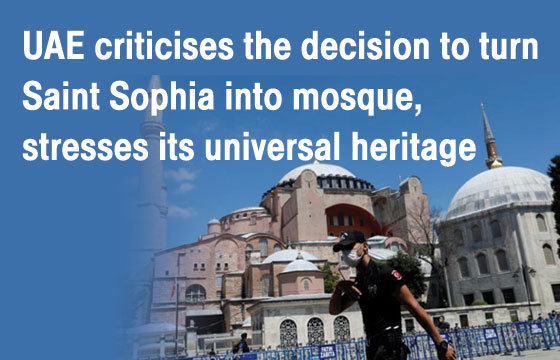
Humanity’s cultural land- marks should be preserved for their value and function, and must “neither be misused nor altered” for personal purposes, said Noura Al Kaabi, the United Arab Emi-rates (UAE) Minister of Culture and Youth.

For Al Kaabi, the decision of Turkish President Recep Tayyip Erdoðan to turn the Basilica of Saint Sophia, now a museum, into a mosque deeply “touches the human essence” because the Unesco heritage site has “exce-ptional international value” for “all peoples and cultures.”

The UAE’s reaction is one of the most critical in the Arab world. UAE leaders committed their country to the document on human brotherhood signed by Pope Francis and Grand Imam of al-Azhar Ahmad al-Tayyeb.

With respect to Saint Sophia, the UAE Minister for Culture slams the change in status, regardless of its historical and human value, noting how it served “as a bridge connecting different peoples and cementing their bonds.” Saint Sophia, she explained, “is a unique witness to the interaction between Asia and Europe across centuries. It is a symbol of dialogue.”