Burning Cathedrals, Burning Questions About Religious Freedom

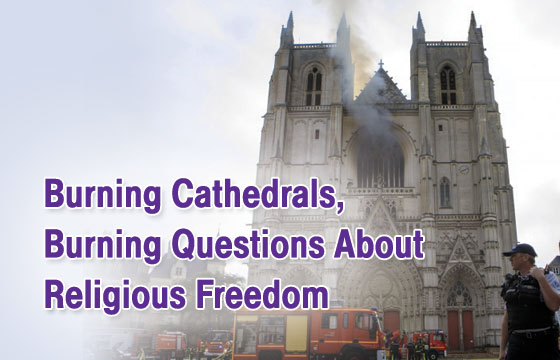
Nantes’ 600-year-old Gothic Church, the Cathedral of St Peter and St Paul, one of France’s most cherished landmarks, was intention-ally set ablaze by arsonists on July 18. During the conflagration, some 16th century stained glass windows were blown out and shattered, while a priceless 17th century church organ was entirely consumed in the inferno. Repairs to the structure will take several years. In the meantime, myriad questions have been reignited concerning religious persecution against France’s Christian and Jewish communities. A spate of thefts and vandalism in French churches has led to calls for the government to act.

France’s 475,000 Jews represent less than 1 percent of the country’s population. Yet …according to the French Interior Ministry, 51 percent of all racist attacks targeted Jews.

Anne-Elisabeth Moutet also noted, “Since the 1990s, as satellite Arab channels and later the internet, started spreading the anti-Semitic propaganda that’s the norm in the Middle East, the French State was slow in acknowledging the existence of a problem, and even slower in responding.”

Communist progressives, neo-Nazis and gilets jaunes can be violent. But most vicious of all are Islamist radicals who rage in their hatred for Jews and Israel. And as for Christians? ISIS has made its intentions clear: “The Christian community …will not have safety, even in your dreams, until you embrace Islam. We will conquer your Rome, break your crosses, and enslave your women.”

Ecocide, ethnocide, terricide worse than Coronavirus: Amazon Assembly

The first Global Assembly for the Amazon closed with a final declaration which states that ecocide, ethnocide and terricide are worse than the Coronavirus.
The assembly was held on July 18-19 and was promoted by the Coordination of indigenous organizations of the Amazon Basin (Coica), the Pan-American Social Forum (Fospa) and the Pan-American Church Network (REPAM).

The event took place virtually because of the pandemic and included several countries: Ecua-dor, Colombia, Peru, Bolivia, Chile, Paraguay, Guyana, Vene-zuela, Brazil, French Guiana and Suriname. “Ecocide, ethnocide and terricide” are “worse than the virus,” because they carry “a colonial and capitalist system which does not understand life care.” “There is no more time,” the document continues, “we must unite in the diversity of peoples’ knowledge and in the culture of care.” “Amazonize yourselves,” is, therefore, the invitation of the assembly: “Now or never.”

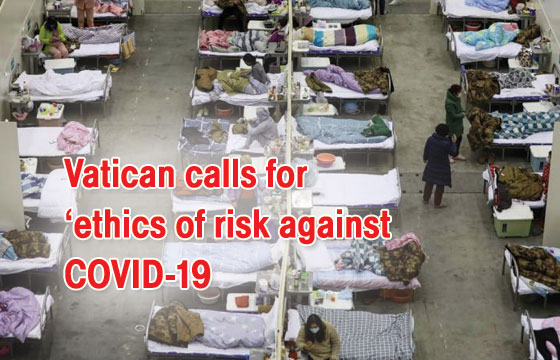
Vatican calls for ‘ethics of risk against COVID-19

The Pontifical Academy for Life released a paper on the eff-ects of the pandemic. Titled Hu-mana Communitas in the age of pandemic: untimely meditations on life’s rebirth, it starts from the realisation that human “fragility” has been made worse by the pandemic.

The document notes that “all of us may succumb to the wounds of disease, the killing of wars, the overwhelming threats of disasters.” However, there are “very specific ethical and poli-tical responsibilities toward the vulnerability of individuals who are at greater risk for their health, their life, their dignity.”

For the Academy, this calls for a “conversion” towards a sense of responsibility and inter-national solidarity, regardless of borders and political systems. specifically, “COVID-19 is the most recent manifestation of globalization,” and sparing no one, it “has made us all equally vulnerable, all equally exposed. Such a realization has come at a high cost.”

The “lesson of fragility” touches everyone, especially hospital patients, prison inmates, and refugees. “COVID-19 is not just the result of natural occu-rrences. What happens in nature is already the result of a complex intermediation with the human world of economical choices and models of development.”

The pandemic “is the result, more than the cause, of financial greed, the self-indulgence of life styles defined by consumption indulgence and excess.”

Vatican: In rare cases, lay faithful can lead marriage rite

The Vatican said on July 20 that in very exceptional circum-stances and with special permission, lay Catholics can be allowed to perform marriage rites.

In a document issued by the Holy See office for clergy, the Vatican said that could only happen if there are no priests or deacons available, the nation’s bishops sign off on the exception and the Holy See OKs it too.

The same document stresses that lay faithful can preach at liturgy services, but never can give homilies at Masses.

The Vatican document said that the local bishop, using his “prudent judgment,” may entrust to lay faithful in “exceptional circumstances” such duties including celebrating funeral rites, administering baptism, assisting at marriages – with the Holy See”s permission – and preaching in a church in case of need.

It noted that “where there is a lack of priests and deacons, the diocesan bishop can delegate lay persons to assist at marriages” after the nation’s bishops conference signs off on the decision and the Vatican gives its permission, too.

“Under no circumstances, however, may lay people give the homily during the celebration of the Eucharist,” said the Congregation for the Clergy.

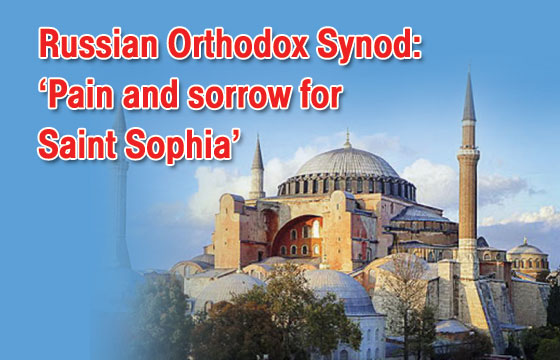
Russian Orthodox Synod: ‘Pain and sorrow for Saint Sophia’

The Holy Synod of the Ru-ssian Orthodox Church “expre-sses its profound regret over the decision of the state leader-ship of Turkey to revoke the museum status of Hagia Sophia and to give it to the Muslim community for public worship.” The Orthodox clergy of Mos-cow wrote in a statement approved after a session of the Synod, which took place between 16 and 17 July. The decision, reads the text, “was taken with no regard for the petitions and explicit position of the Primates and hierarchs of the Orthodox Local Churches, representatives of foreign states, numer-ous international non-governmental and human rights organisations, and clerics of various confe-ssions and religious traditions.”

This choice, it continues, “has hurt religious feelings of millions of Christians all over the world, which can cause disturbance of interfaith balance and impair mutual understand-ing between Christians and Muslims both in and beyond Turkey.” “The Greek Orthodox Archdiocese of America is inviting all Christians and people of goodwill to join in a Day of Mourning on July 24 for Hagia Sophia,” the US Conference of Catholic Bishops tweeted. “They have asked that every Church toll its bells, every flag be raised to half-mast and that the Akathist Hymn is chanted or the rosary recited in the evening.”

Churches burned, people beheaded in Mozambique’s escalating extremist violence

A Catholic bishop has deplored the world’s indifference to escalating extremist violence in northern Mozambique, where multiple churches have been burnt, people beheaded, young girls kidnapped, and hundreds of thousands of people displaced by the violence.

Bishop Luiz Fernando Lisboa of Mozam-bique’s Pemba diocese has been an outspoken advocate for the needs of the more than 200,000 people who have been displaced by the violent insurgency.

In June there were reports that insurgents had beheaded 15 people in a week. Yet the bishop said that the crisis in Mozambique has largely been met with “indifference” from the rest of the world.  “The world has no idea yet what is happening because of indifference,” Bishop Lisboa said in an interview with Portuguese media on June 21.

“We do not yet have the solidarity that there should be,” he told LUSA news agency.

During Holy Week this year insurgents perpetrated attacks on seven towns and villages in Cabo Delgado province, burning down a church on Good Friday, and killing 52 young people who refused to join the terrorist group, the bishop told Aid to the Church in Need. More than 1,000 people have been killed in attacks in northern Mozambique since 2017, according to the Centre for Strategic and International Studies. Some of these attacks have been claimed by the Islamic State, while others have been carried out by the homegrown Ahlu Sunna Wal extremist militant group, which has been kidnapping men and women.

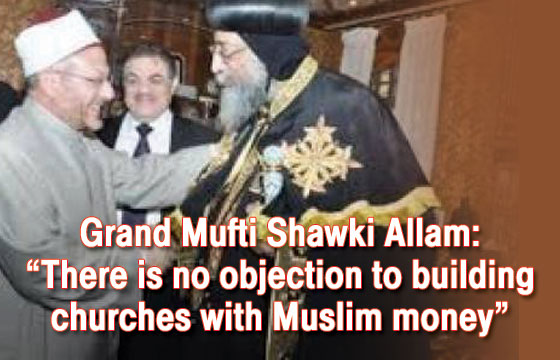
Grand Mufti Shawki Allam: “There is no objection to building churches with Muslim money”

Islamic law does not contain any legal objection to the possi-bility of building churches using money belonging to Muslims. This relevant observation, full of possible applications with respect to situations of potential sectarian conflict in many coun-tries with a Muslim majority, also deserves attention for the authoritativeness of the source: this is what Sheikh Shawki Ibra-him Abdel-Karim Allam, current Gran Mufti of Egypt, said during his speech on a television pro-gram conducted by the journalist Hamdi Rizk.

The Egyptian Grand Mufti, in his speech, indicated Egypt as the Country with a Muslim majo-rity where more public resources are used in the construction of Christian places of worship, indi-cating this figure as a manifesta-tion of strong national social cohesion. Shawki Allam (in the photo together with Coptic Orthodox Patriarch Tawadros) referred to the teachings of Mohammad who, even when he justifies military self-defense campaigns, commands not to destroy places of worship and not to kill monks. The Egyptian Grand Mufti also intervened on the reconversion of the ancient Hagia Sofia Basilica in Istanbul ordered by Turkish authorities. In this regard, Sheikh Shawki Allam said it was illegal to convert a church into a mosque, declaring that in the history of Egypt no Christian place of worship has been transformed into a Muslim place of worship.

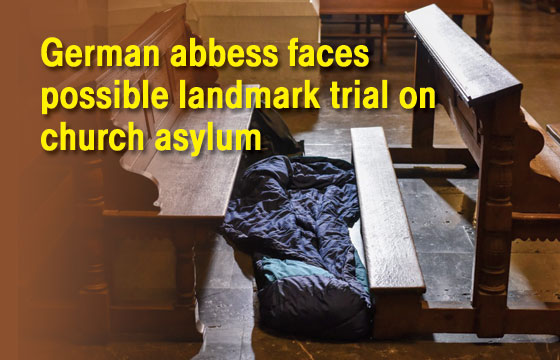
German abbess faces possible landmark trial on church asylum

A Benedictine abbess who granted refuge to female asylum-seekers faces trial for refusing to pay a fine, reported the German Catholic news agency KNA. It could become a land-mark case by determining whe-ther granting church asylum amounts to the punishable offen-se of “aiding and abetting illegal residents,” as state prosecutors often interpret it. There is no supreme court ruling on this issue yet, KNA reported.

Mother Mechthild Thurmer granted refuge to female asylum-seekers in her monastery in the Bavarian town of Kirchschletten more than 30 times. The main hearing at the Bamberg district court was cancelled in mid-July because the judge wanted to wait for a possible further charges against her, a court spokesman told KNA.

“I acted out of Christian spirit,” the 62-year-old abbess said. “To give concrete help to a person in need can’t be a crime.”

Up to now, authorities in Bavaria have mostly dropped proceedings against people granting church asylum and imposed no penalties. In a few cases, they offered to close cases in exchange for a fine. If the accused agreed, the matter was over, although this did not amount to an acquittal. Franz Bethauser, the lawyer for Mother Mechthild, has long been hoping for a fundamental clarification of the issue by the justice system in order to give people legal certainty.

KNA said the hearing in Bamberg would not be just about Mother Mechthild. It’s also about whether the 2015 agreement between the churches and the government on church asylum still stands. Under that agreement, authorities tolerate asylum while the asylum-seeker’s individual application is exa-mined, provided that he or she is not hidden.

The Freising district court ruled in 2018 that as long as the state does not enforce an asylum-seeker’s obligation to leave the country, church asylum cannot be punishable.

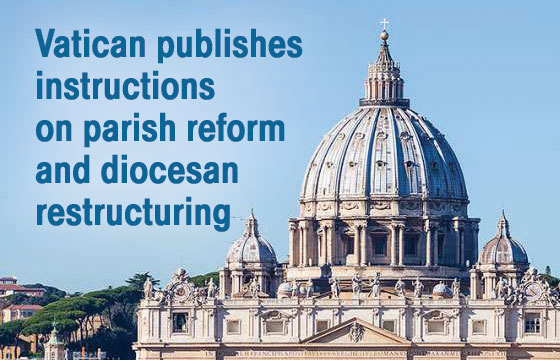
Vatican publishes instructions on parish reform and diocesan restructuring

The Vatican’s Congregation for Clergy has published instructions on reforming parishes and restructuring dioceses to better serve their “singular mission of evangeli-zation.”

The 24-page document is called “The pastoral conversion of the parish community in the service of the evangelizing mission of the Church” and seeks to “foster a greater co-responsibility and collaboration among all the baptised,” according to Msgr Andrea Ripa, the under-secretary of the Congregation for the Clergy.

The under-secretary described the in-structional document as an “instrument with which to support and accompany the various projects of parish reform and diocesan restructuring.”

“One could say that the essence of the present Instruction is to recall that in the Church ‘there is a place for all and all can find their place,’ with respect to each one’s vocation,” Ripa said in an introduction to the document on July 20. The instruction, which does not introduce anything new to Church law, sets out provisions of the existing law and guidelines to preserve “the faithful from certain possible extremes, such as the cleri-calization of the laity and the secularization of the clergy, or from regarding permanent deacons as ‘half-priests’ or a ‘super laymen,’” the under-secretary wrote.

Signed by Pope Francis on June 29, the Solemnity of Saints Peter and Paul, the instru-ction promotes greater cooperation among different parish communities, emphasizing the need for the parish to be inclusive, evange-lizing, and attentive to the poor.

The document builds on the 2002 instruction from the Congregation of Clergy, “The Priest, Pastor and Leader of the Parish Community,” and the Vatican interdicasterial instruction “Ecclesia de Mysterio,” on the collaboration of laity in the ministry of priests.

It includes instructions on the suppression or merging of parishes, ways of assigning pastoral ministry within the parish, the pastoral council, the sacraments, and the renewal or “conversion” of parish and diocesan structures.