Tribals, Dalits protest against CAA in New Delhi

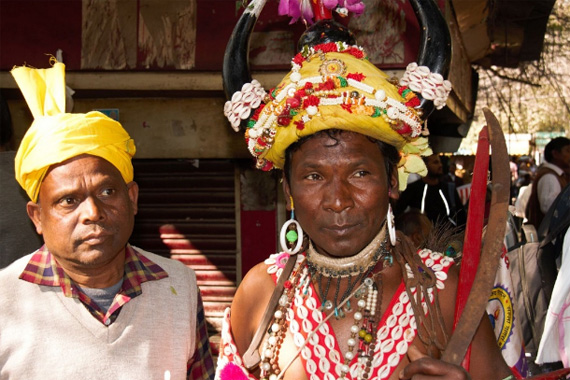
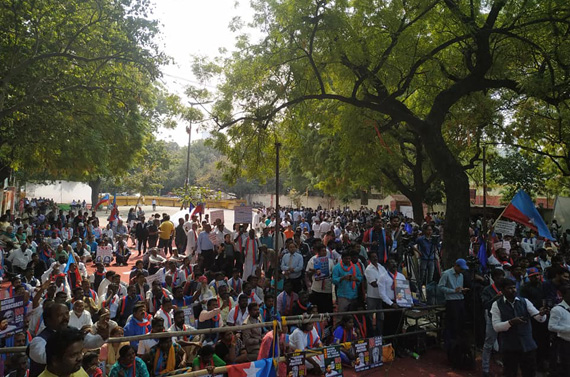
Hundreds of Dalits, Tribals, Muslims and Christians from various parts of India gathered in New Delhi to protest against the implementation the Citizenship (Amendment) Act (CAA), the proposed National Register of Citizens (NRC) and the National Population Register (NPR).

The March 4 protest at Jantar Mantar, near the Parliament building, was organized by Save Nation Save Constitution Committee, a civil rights group.

“The unleashing of violence by anti social elements under the political backing on the citizens of the nation, particularly women from marginalized religious and caste communities around the country has led to a state of unprecedented insecurity among people,” says a statement issued by the organizers.

The protesters expressed deep anxiety against CAA which is to be used as a ploy to divide the society based on the religious identity.

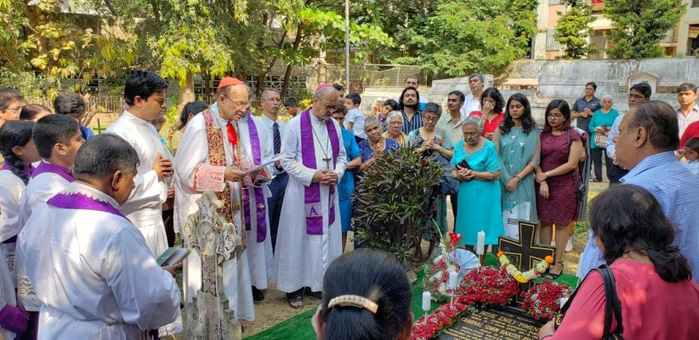
Archdiocese of Bombay dedicates pastoral centre to late Cardinal Pimenta

Cardinal Oswald Gracias of Bombay celebrated a special memorial Mass at St John the Evangelist Church in Marol on March 1 in honor of his predecessor, who died 2013 at the age of 93. The parish was the home parish of the late cardinal, and was the place where he was buried after his death. Marol, a suburb of Bombay, was once under Portuguese control and considered a Catholic heart of the city. St John the Evangelist parish was founded in 1579.

Pimenta served as Arch-bishop of Bombay from 1978-1996 and was created a cardinal in 1988 by St John Paul II.

“I wanted to give Cardinal Pimenta a fitting memorial to mark his birth centenary,” Gracias told Crux.

“I worked very closely with Pimenta, and was his close advisor, and we have to honor Pimenta’s pioneering initiative in Raighad. When Pimenta was appointed Archbishop of Bombay, the Catholic Church had no presence in Raighad,” the cardinal said.

Nun, hospital employee charged with conversion in India

Ucanews.com reported the charges came after Hindu activists barged into Sanjo Hospital in Mandya district and beat up its public relations officer, Solomon George, said Father Josekutty Kalayil, who is helping the hospital deal with the case.

George and Sister Nirmal Jose, hospital administer, were accused of denigrating Hindu gods and attempting to convert Hindus, Kalayil told ucanews. com on March 4.

George was granted bail March 3, two days after he was arrested, but the case continues in court, said the priest, who is helping the hospital deal with the case.

Kalayil told ucanews.com the case started with an elderly man being admitted to the hospital with a complaint of high blood pressure on March 1. The next day, he sought to leave the hospital against medical advice.

Overcoming the cycle of poverty

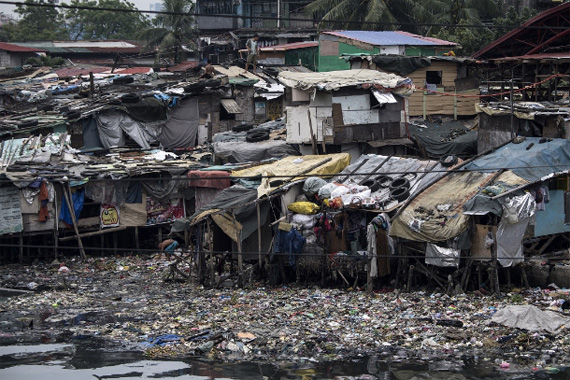
There is extreme poverty in the world. One percent of rich people have more money and wealth than the combined wealth of 4.6 billion people who have almost nothing. World-wide there are about 735 million people in extreme poverty.

In the Philippines, there are an estimated six million people in extreme poverty. Why is there so much inequality in the world?

Can the power of goodness bring social justice and overcome the devastating harm done by powerful greedy, selfish people? They must be challenged, opposed and resisted by those dedicated and committed to doing well.

Humanity develops when there is sharing, cooperation, justice, freedom and equality among people. When these values pervade daily life, they bring peace, harmony and well-being. People have to change peacefully the political and economic forces that allow them such a life.

Each of us can help our neighbors and find ways to open the cage of poverty and let them fly free. Everyone needs a job and a just wage to support their family. The following is a true story, one that is repeated many times over.

Luisito was a boy from a hungry, homeless family. They lived in poverty under sacks at the edge of a beach. His father was a simple fisherman but when international fishing companies were given commercial fishing permits in Philippine waters by corrupt officials, the fish disappeared.

Thousands of Filipinos were thrown into the pit of poverty. Luisito, then 15, collected, junk, plastic bottles, anything he could sell for a few handfuls of rice. That’s all they had but it wasn’t enough. Sickness took his father.

Awakening: A missionary responsibility seminar held

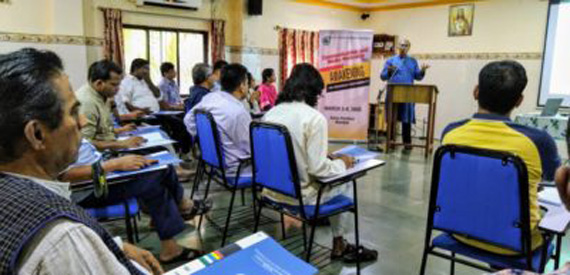
A two-day communication and media workshop on the theme “Awakening: A Missionary Responsibility” was organized by the Society of Divine Word (SVD) Mumbai province on March 3-4 at Atma Darshan, Andheri, Mumbai. As many as 30 SVD priests and two Holy Spirit sisters (SSpS) from all over India participated in the workshop. Seeing the need to preach the Gospel through social media is the need of the time as the modern techno-logy has become a handy thing.

Delhi riots 2020: A milestone on the march to a Hindu nation

The Delhi riots of Feb. 23-27 provide harrowingly detailed narratives of the horrors of what Hindu sectarian politics has done to India, the world’s largest democracy, over the last seven decades.

After the riots in individual pockets of the capital, one could find Hindus and Muslims sharing food, echoing sentiments of brotherhood and harmony. But as one steps into northeast Delhi, the hub of the riots, the ugly face of the Hindu-Muslim divide is palpable.

Even on Feb. 29, when police said the riots were over, mobs were still shouting “Hinduon ka Hindustan” (India belongs to Hindus). In a violence-hit area, a Hindu shopkeeper was more vocal. “They have seen Hindus are not meek,” he said.

The riots provided a new but controversial slogan: “Desh ke gaddaro ko, Goli Maro salon ko” (Shoot down the traitors of the nation). The word “traitor” has somehow become synonymous with people who publicly oppose the idea of a Hindu nation and policies geared to that end. By extension, it came to mean Muslims. The slogan, publicly and brazenly, is a call to shoot down Muslims.

The Delhi riots have some ironic links to the February 2002 riots in Gujarat which killed some 2,000 people, mostly Muslims. Comparatively, the 46 deaths in Delhi could be regarded as insignificant, but the recent violence shows the definitive and advancing march toward a Hindu nation, a journey that began to take graphic shape 18 years ago in Gujarat.

Archbishop asks Indian state government to return Christ statue to cemetery

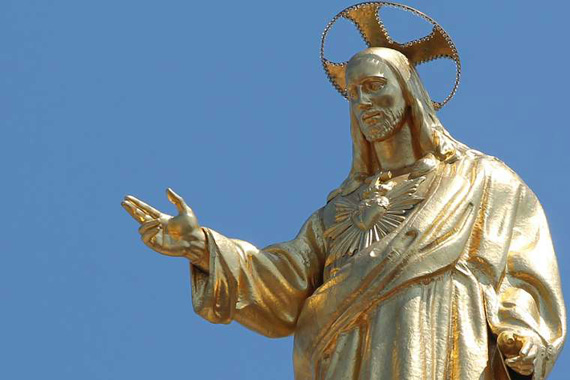
The Archbishop of Bangalore decried on March 4 the removal of a statue of Christ from a Christian cemetery. The statue was taken down after complaints from non-local Hindus.

“It is very sad, unfortunate and regrettable that the police, bowing to the pressure of a few outsiders, have forcefully removed the statue of Lord Jesus,” Archbishop Peter Machado wrote on March 4 at AsiaNews.

“It is a blow to the communal harmony of the people in our villages and also violation of the religious freedom guaranteed to us by the Indian Constitution.”

The 12 foot tall statue was taken down on March 3 from Mahima Betta cemetery in Doddasagarahalli, more than 30 miles north of Bangalore in India’s Karnataka State.

India’s ruling political party, the Hindu nationalist Bharatiya Janata Party, has been increasingly hostile to religious freedom for minorities. The BJP also controls the government of Karnataka.

According to Archbishop Machado, Christians have been making devotions at the cemetery “for the last 30 to 40 years with-out any difficulty,” and “there is absolutely no problem from local people to our burials, nor our prayers and devotions on the hill.”

He noted that for the past week or so “some people from outside have been creating tens-ions by spreading wrong rumors that the place is used for con-version, which is completely far from the truth.”

“The local villagers have publicly said that the presence of Christians and their prayers are absolutely no problem for them and, this being the case, why should some outsiders come and disturb the harmony of the village,” the archbishop asked.

Women petition Cardinal Gracias for more decision-making roles

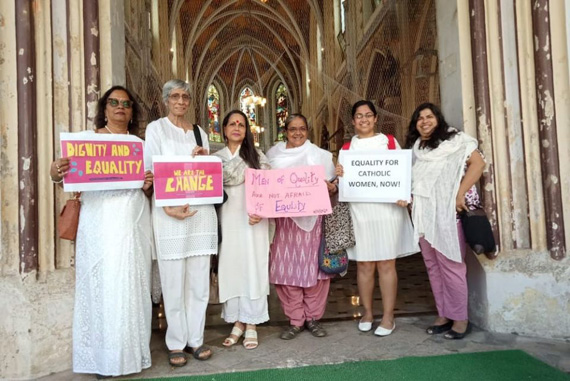
About 150 Catholic women in India have delivered a petition to Cardinal Oswald Gracias, asking that he take concrete steps to better include women in decision-making roles in the global church.

The women are partly responding with Gracias, in which the cardinal acknowledged a bias among the members of the Catholic Church’s all-male hierarchy against giving women more leadership roles. In that interview, he also said he and his peers must “shed this prejudice.”

The three-page memorandum praises Gracias’ words in the interview, but asks for “changes in the policies, practices and structures of the Church so that women can participate fully in … leadership.”

Support independent Catholic news. Gracias is the archbishop of Mumbai, president of the Catholic Bishops’ Conference of India and one of six members of Pope Francis’ Council of Cardinals. The petition was partly drafted by Astrid Lobo Gajiwala, a medical doctor and scientist who has served as a consultor to the bishops’ conference and helped draft the organization’s gender policy.

Some of the strongest language in the petition refers to that policy, passed in 2010 and the first of its kind in the global church. The policy said the Indian Church “rejects all types of discrimination against women as being contrary to God’s intent and purpose,” according to the memo.

Catholic groups team up to help Delhi riot victims

Various groups of Catholics in Delhi have decided to pool their resources and personnel for relief and rehabilitation works among the victims of sectarian violence in the national capital.

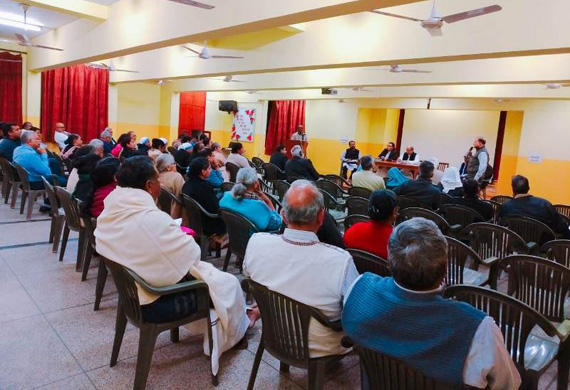
They met on March 10 under the leadership of Archbishop Anil Couto of Delhi and decided to work under the banner of the archdiocese and witness Christian services of love and compassion.

Presentation Sister Anastasia Gill, a member of the Delhi Minority Commission and among the first Christians to reach out to the riot victims in northeastern Delhi, narrated her painful experience in Shiv Vihar, a worst affected area.

She suggested the CRI members to join the local parish priest and heads of various institutions to send volunteers to help in distribution of relief material and to counsel women and children traumatized by the riots.

A legal team led by Jesuit Father Arun will help file First Information Reports and monitor people’s security requirements.