National Geographic honours Kerala’s “rebel” nuns

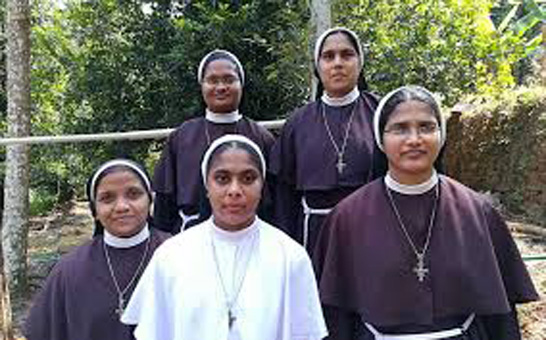
The US-based National Geographic magazine has honoured Kerala’s five “rebel” nuns by featuring them in its November issue.

The 131-year-old magazine has hailed the endurance of Missionaries of Jesus Sisters Alphy Pallasseril, Ancitta Urumbil, Anupama Kelamangalathuveli, Josephine Villoonnickal, and Neena Rose in their demand for justice for one of their companions, who was allegedly raped by Bishop Franco Mulakkal of Jalandhar.

Indians less charitable than Asian counterparts

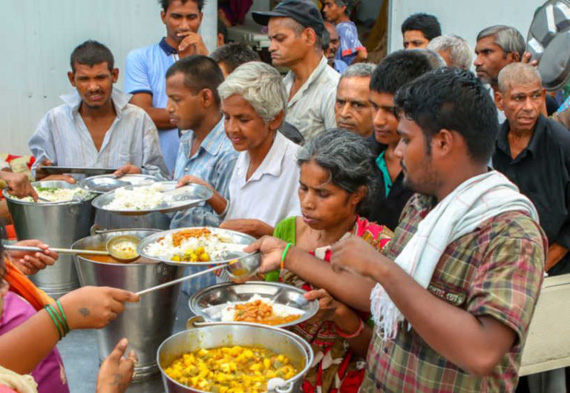
India ranked 82nd among 128 countries for generosity over the last 10 years, according to the tenth World Giving Index (WGI).

Up to a third of Indians helped a stranger, one in four donated money, and one in five gave their time volunteering, the report said, attributing India’s low ranking to its strong culture of unorganized and informal giving to family, community and religion.

It recommended more formal mechanisms of donating to charity.

The report, published on-line in October, was based on surveys of 1.3 million people in 128 countries during 2009-2018. It asked interviewees if they had helped a stranger, donated money to charity or volunteered their time in the past month.

The surveys used Gallup World Poll data and were commissioned by Charities Aid Foundation (CAF), a UK charity that provides services and assistance to international charities and their donors.

India’s rank on the Index has yoyoed vastly, the lowest being 134th in 2010 and the highest being 81st last year. This year’s report aggregated data for each country for the last 10 years. India’s overall WGI score this year was 26 percent.

Of the top 10 countries, seven are among the wealthiest in the world. Yet, global generosity is on the decline, stated the report, highlighting that individual giving is now lower in countries with long histories of philanthropy such as the United States, Canada and the United Kingdom.

CCBI Women’s Commission to revive role of mothers in Church

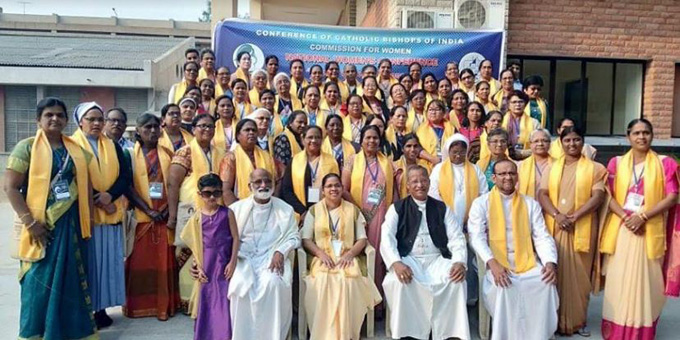
The Conference of Catholic Bi-shops’ of India (CCBI) – Women’s Commission held a workshop in New Delhi to revitalize the role of mothers in the Church.

“The purpose of the seminar was to build a strong and united Church through faith-filled families by mothers in each diocese in India,” Sister Lidwin Fernandes, executive secretaries of CCBI Women’s Commission, told Matters India. The other aim of the event was to revisit the Mission, Vision and Objectives for the commission.

The 18-21 November programme was held at Navinta Retreat House, New Delhi. As many as 70 participants from 50 Latin dioceses of India attended it.

Participants resolved to draft the bye-laws and guidelines for Women’s Commissions at national, regional and diocesan levels, said Ursuline Franciscan Sister Fernandes.

Inaugurating the event that the theme “Chosen to be a missionary month.”

Syro-Malabar church to issue its ‘Aadhaar’ for parishes

In an ambitious attempt to move with the times and make its services, religious and otherwise, available at the ‘fingertips’ of believers, the Syro-Malabar Church is launching an app for each of its roughly 3,500 parishes – the church has already come out with custom made apps for more than 700 parishes.

The apps are meant for religious, administrative and practical needs of every parish, and the vicar’s office will serve as the admin for each app. The church is also set to provide a Unique Identification Number, similar to Aadhaar, to every parishioner through the app.

9 states witnessed increased incidents of communal violence

India has witnessed more communal violence cases this year than the previous year, revealed the latest data culled by intelligence agencies.

Nine states reported increased number of incidents of communal violence. Uttar Pradesh topped the list with 457 communal incidents in 2019 between January 1 and October 30, as compared to 396 incidents last year during the same period.

The second state was Rajasthan (165 incidents this year, compared to 116 communal incidents last year), followed by West Bengal (79 incidents as compared to 57 last year), Gujarat (40 incidents against 26 last year), Assam (20 communal incidents against 17 such incidents last year), Kerala, Tripura, Delhi and Odisha (five incidents against none last year).

Commenting on the latest report on the communal violence in the country, A C Michael, former member of Delhi Minorities Commission, told Matters India, “It is really sad to note our country that is known for being the largest democracy in the world is today going through a phase of continuous communal violence.”

“I would like to blame the politicians for this menace as their vote-bank politics have pitted the citizens of India against each other based on religion,” said Michael, national coordinator of United Christian Forum.

“The present government has made no bones about their strategy of following majoritarian appeasement policy. Till the time the young generation which is being claimed to be on the ruling party side understands the politics of appeasement, I do not foresee any solution to this problem,” he added.

Indian Evangelical churches call on Christians to pray for persecuted Church

The Evangelical Fellowship of India (EFI) and the National Alliance and Central Network of Evangelicals in India called on the Christian community to observe the Nov 24 as the International Day of Prayer for the Persecuted Church (IDOP). “An estimated 100 million Christians face persecution daily in the world today. In India according to the database kept by the Religious Liberty Commission of EFI, this year itself, over 250 instances of hate crimes and violence have taken place against Christians till the last October,” said Reverend Vijayesh Lal, EFI general secretary.

“Let us stand in solidarity and prayer with our persecuted family. Let us join our sisters and brothers worldwide in praying together,” he said. India, rich in its diversity of religions, languages and cultures, faces several incidences of persecution. Reverend David Fernandes from Commission Church Mumbai, said, “Pray that the Lord will comfort, protect and guide persecuted Christians and others and the Church would remain strong even amid all the persecution and opposition. That there will be a decrease in anti-Christian and anti-minority violence in India and we will respond in love towards our persecutors. Pray that the constitutional guarantees will remain.”

Kerala Church to encourage young widows’ remarriage

The Family Commission of Kerala Catholic Bishops Council (KCBC) will create a matrimonial website, with a separate option for the widows to register.

“We want to bring in a change in the overall outlook to widows in our community. Even today society prescribes dress code for them and forces them to behave in a certain manner in social gatherings. They are humans and in no way they should be discriminated in society,” explained Father Paul Madassery, KCBC Family Commission Secretary.

The Church official pointed out that the remarriage of widows, even very young one, has become a rarity. He claimed the new website would give Christian widows hope for a new life, especially those under 40 years.

This Japanese painter found the faith through sacred art

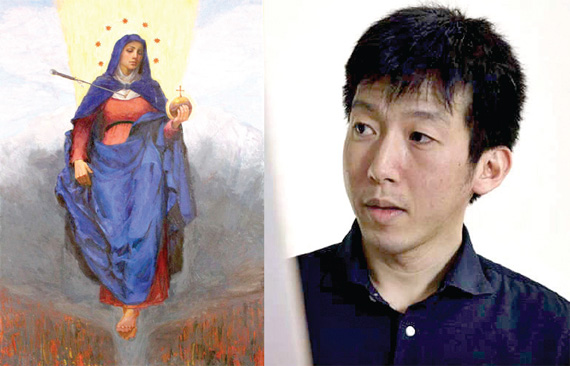
Osamu Giovanni Micico had never read the Bible, knew nothing of the stories of Christ in the gospels, and had never heard of the apostles, when his experience studying sacred art in Italy brought him to the Catholic faith. “When I came to Italy, painting was the only street for me as far as my profession goes. Thank God, that is also where God gave me my spiritual rebirth,” Micico told CNA.

Catholicism “transformed my life. The way I relate to others, the way I view the world. And the direction I’m taking in my life. The meaning of suffering. It all changed. My conversion gave life to death.”

From his childhood and adolescence in Tokyo, Micico was interested in drawing and painting, but he originally pursued a science-based career to please his parents.

During university, however, he encountered an artist who inspired him to pursue his passion for painting.

The 37-year-old artist moved to Florence in 2008 to study the paintings of the Old Masters, such as Michelangelo and Leonardo da Vinci. He told CNA that at the time he mostly painted landscapes or portraits, except when he copied the great masterpieces to learn from them. But he did not know what he was looking at.

“I was with my Catholic friend, asking my friend, who are those fishermen?” the artist said. In a way, he noted, he encountered the gospel the same way it was encountered by people in the Middle Ages who could not read, through the symbols of art.

“I was ‘reading’ those paintings before I knew the gospel. I didn’t know what stories they represented,” he explained.

“I think like music, those paintings spoke to me with harmony and it animated my soul. It was not just technique – that they made a realistic painting – but there was something else that was very holy there.”

Another personal encounter was influential in Micico’s conversion: his friendship with Irish religious artist and Catholic Dany MacManus, who was then living in Florence. While Micico still knew nothing about the Bible, MacManus invited him to a lecture he was giving on St John Paul II’s Theology of the Body. “That left an impression,” Micico said.

MacManus became Micico’s godfather at his baptism in 2010. “Art was the entrance. I think that even without words, like with the music of Bach, one can intuit the beauty of a creator,” he said. “Ultimately, God the merciful was represented in the painting … That’s what spoke to me.”
Micico now creates sacred art himself.

Pope praises Thailand’s commitment to peace

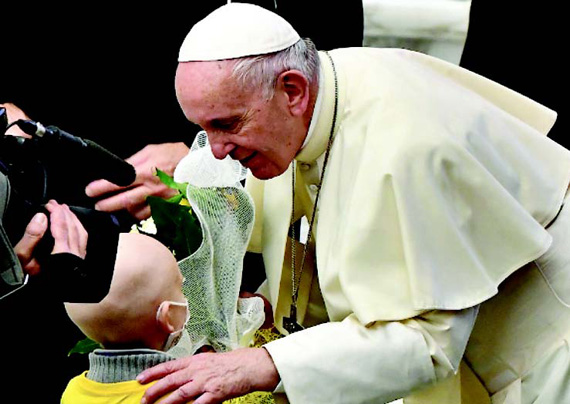
Pope Francis has praised Thailand for promoting harmony and peace in a video message ahead of his visit to the kingdom that begined on Nov. 20.

“In this world that too frequently experiences discord, division and exclusion,” Thailand has shown commitment to work hard “to promote harmony and a peaceful coexistence,” he says.

This commitment, he says, “can serve as an inspiration” for all the people around the world who are working to “promote a great, true development of our human family in solidarity, in justice and in living in peace,” Vatican News reported.

Pope Francis visited Thailand on his 32nd Apostolic Journey from Nov. 20-23 before heading to Japan.

In his message, he said he will have the opportunity to meet and “encourage” the Catholic community of Thailand “in their faith and in the contribution they make to the whole of society.”

He is hoping to “strengthen the bonds of friendship that we share with many Buddhist brothers and sisters.”

“I trust that my visit will help to highlight the importance of interreligious dialogue, mutual understanding and fraternal coope-ration,” says the Pope.

He thanked the people of Thailand “from the bottom of” his heart for all the preparation that is being made for his visit.

This is the first papal visit to Thailand in nearly four decades following the journey made by Pope John Paul II in 1984.

Pope’s Asia visit ‘shows concern for marginalized’

Pope Francis’ visits to Thai-land and Japan show his love for marginalized communities, says Cardinal Charles Bo of Yangon, president of the Federation of Asian Bishops’ Conferences. In his fourth visit to Asia, Pope Francis is scheduled to arrive in Bangkok on Nov. 20. Three days later, he leaves for Tokyo and nuclear-bombed Hiroshima and Nagasaki before returning to Rome on Nov. 26.

Pope Francis has “chosen countries where the Catholic community is a minority. His concern for communities on the margins has amplified their presence,” Cardinal Bo said in a statement.

Two years ago, “he chose to visit two countries where the Christian presence is so small. Christianity was in Myanmar for 500 years. His visit made this small flock to be known to the world,” said the cardinal.

In his 2017 Asia visit, Pope Francis covered Muslim-dominated Bangladesh and Buddhist-majority Myanmar, the base of 71-year-old Cardinal Bo.

Pope Francis became the first Pope to visit Myanmar, where Christians form just 6 percent of a population of some 54 million people. Catholics make up about one percent or some 750,000.