Amazon synod: Pope fires up ‘daring prudence’ of the spirit

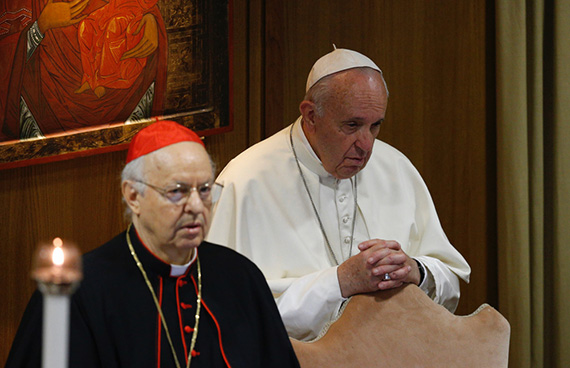
The Church’s mission risks being reduced to ashes unless bishops become open to the “daring prudence” of the spirit and make changes to the status quo, Pope Francis said.

Opening the Synod of Bishops assembly on the Pan-Amazon region, he warned against a mentality where “everything continues as it was” and those groups who want to “make everyone and everything uniform”.

The Pope was speaking during a Mass in St Peter’s at the start of the 6-27 October gathering which was attended by the 185 synod fathers, the majority of them bishops serving in the Amazon. Some 260 participants will take part in the gathering including outside experts and representatives from indigenous groups. During the Mass the indigenous sat in the front row of the basilica, and brought up the offertory gifts to the Pope.

In his homily, the Pope told the congregation that Christian perseverance requires being able to rekindle the gift of faith, a gift which he said was “a fire, a burning love for God and for our brothers and sisters”. If the fire is not fed, he added, it “turns into ashes” and dies.

“If everything continues as it was, if we spend our days content that ‘this is the way things have always been done,’ then the gift vanishes, smothered by the ashes of fear and concern for defending the status quo,” he told cardinals of the Roman Curia and  bishops from across nine countries in Latin America. “Jesus did not come to bring a gentle evening breeze, but to light a fire on the earth.”

The Jesuit Pope argued that the virtue of prudence is not “timidity or fear” but requires a daring attitude and the willingness to take decisions.

“Prudence is not indecision, it is not a defensive attitude,” he said. “It is the virtue of the pastor who, in order to serve with wisdom, is able to discern, to be receptive to the newness of the Spirit. Rekindling our gift in the fire of the Spirit is the opposite of letting things take their course without doing anything.”

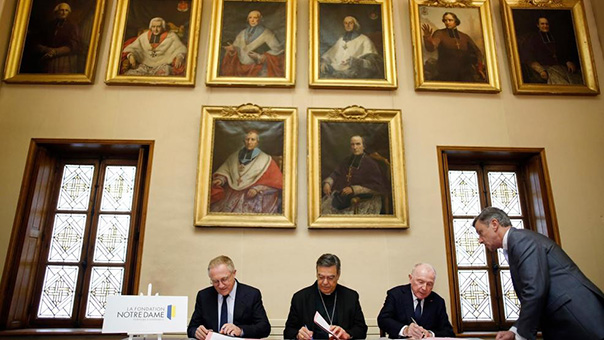
French billionaire gives $109 million to rebuild Notre Dame

French billionaire Francois Pinault and son Francois-Henri Pinault have officially signed documents setting aside $109 million toward rebuilding Notre Dame Cathedral, following months of delay that left officials largely reliant on small charity donations to fund the first phase of repairs.

Surrounded by portraits of former cardinals, the Pinaults signed the donation agreement at the Archdiocese of Paris on Tuesday. The money will give the Notre Dame Foundation a much-awaited financial boost as authorities draw up plans for the cathedral’s reconstruction, following the devastating fire on April 15. Paris Archbishop Michel Aupetit says “everyone gives what he can according to his needs, but the big donors give us breathing room.”

Francois Pinault, whose international luxury group Kering owns Gucci and Saint Laurent, pledged the money directly after the fire.

Amazon communities want married priests, cardinal tells synod

Pope Francis is urging bishops taking part in the Amazon synod not to chase the Holy Spirit away from their discussions, as he launched the first full working day of a summit designed to bolster the Church’s evangelising presence in the region.

Speaking to the 268 participants in the Paul VI Hall this morning, the Pope warned against a “homogenising centralism” in the Church, driven by ideology and which fails to respect local cultures.

Francis told the 185 synod fathers he was “saddened” to hear a “sarcastic” remark about an indigenous man who had brought up the offertory gifts at the Mass in St Peter’s Basilica yesterday wearing a feathered headdress.

“What difference is having feathers on your head and the three cornered hat worn by some officials of our dicasteries?” the pope said to applause, referring to a priest’s biretta.

Before getting to work, the synod participants gathered in St Peter’s Basilica gathered in a circle around to sing prayers in Spanish and native languages.

The Pope then joined them, the choir sang the Veni Creator Spiritus–Come Holy Spirit–and Francis, bishops and barefooted indigenous representatives processed from the basilica to the synod hall. The crowd carried an indigenous image of Mary in a canoe, a multi-coloured fishing net and held up placards with images of missionaries killed in the Amazon and St Oscar Romero.

Benedict XVI alumni express concerns about married priesthood

Just days before the Amazon synod of bishops is to convene in Rome, a symposium of students of Pope Emeritus Benedict XVI published a statement of concern regarding the possibility of married priests, a controversial topic of discussion at the upcoming synod. “The vocation as well as the existence of the priest are solely dependent upon the will of Jesus Christ alone and are not derived from either human considerations or Church regulations. In Him and with Him the Priest becomes the ‘proclaimer of the Word and the servant of joy,’” the students said in a public statement September 28.

“As the priest only exists from his relationship with Christ, a participation in the lifestyle of Christ would seem to be appropriate for those who are to act his person,” the statements added.

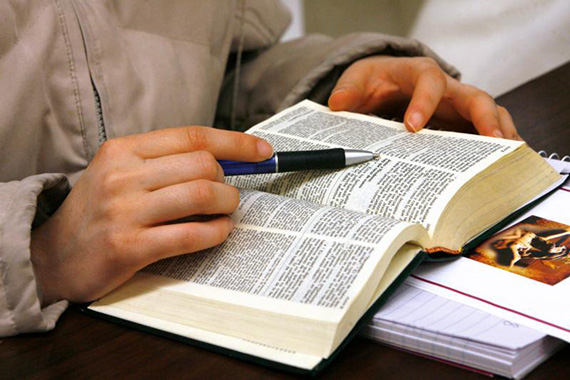
Pope declares special Sunday each year dedicated to word of God

To help the Church grow in love and faithful witness to God, Pope Francis has declared the third Sunday in Ordinary Time to be dedicated to the word of God.

Salvation, faith, unity and mercy all depend on knowing Christ and sacred Scripture, he said in a new document.

Devoting a special day “to the celebration, study and dissemination of the word of God” will help the Church “experience anew how the risen Lord opens up for us the treasury of his word and enables us to proclaim its unfathomable riches before the world,” the pope said.

The declaration to have a “Sunday of the Word of God” was made in a new document, given motuproprio, on the pope’s own initiative. Its title, AperuitIllis, is based on a verse from the Gospel of St. Luke, “Then he opened their minds to understand the Scriptures.”

“The relationship between the risen Lord, the community of believers and sacred Scripture is essential to our identity as Christians,” the pope said in the apostolic letter, released by the Vatican Sept. 30, the feast of St. Jerome, patron saint of biblical scholars.

“The Bible cannot be just the heritage of some, much less a collection of books for the benefit of a privileged few. It belongs above all to those called to hear its message and to recognize themselves in its words,” the pope wrote.

“The Bible is the book of the Lord’s people, who, in listening to it, move from dispersion and division toward unity” as well as come to understand God’s love and become inspired to share it with others, he added.

Without the Lord who opens people’s minds to his word, it is impossible to understand the Scriptures in depth, yet “without the Scriptures, the events of the mission of Jesus and of his church in this world would remain incomprehensible,” he wrote.

Archbishop RinoFisichella, president of the Pontifical Council for Promoting New Evangelization, told Vatican News Sept. 30 that added emphasis on the importance of the word of God is needed because “the overwhelming majority” of Catholics are not familiar with sacred Scripture. For many, the only time they hear the word of God is when they attend Mass, he added.

“The Bible is the most widely distributed book, but it also perhaps the one most covered in dust because it is not held in our hands,” the archbishop said.

Sister at Amazon synod calls for women religious to be granted vote

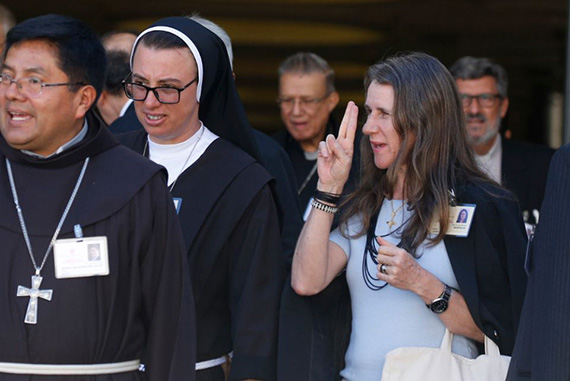
One of the Catholic sisters taking part in the Vatican’s Synod of Bishops for the Amazon has called for women religious attending the gathering to be granted the right to vote, saying their status as non-voting participants has been a “strong topic” of discussion.

Medical Mission Sr. Birgit Weiler, one of 20 sisters participating in the synod, noted that while a lay brother was appointed to attend as a voting member, the sisters were not.

“Pope Francis already made it possible, saying it’s not necessary to receive ordination to priesthood to be able to vote when you have participated fully in the whole process of sharing faith, of discerning together,” said Weiler, a Peruvian theologian.

“We hope very much that something can happen there,” she said during an Oct. 11 press briefing. “There is no real reason why not, because when the brethren can vote, women religious are equal.”

The issue of women’s voting has emerged as an issue in the past three Synods of Bishops, as Francis each time appointed one or two lay brothers as a voting member, but appointed the sisters attending as non-voting auditors or experts.

According to the Catholic Church’s theology, brothers and sisters have analogous roles. They are each non ordained, professed members of religious orders.

Several groups have organized petitions and hosted demonstrations in Rome to call attention to the issue.

Weiler, who is part of the Peruvian bishops’ commission for social action, said the topic had come up in past days in the small working group she was assigned to participate in during the synod. Those groups are known by the Italian term circoliminori (“small circles”). “In our circle, it has been a topic and a strong topic and has been cited by several bishops,” she said.

Cardinal calls for Newman to be made ‘Doctor of the Church’

John Henry Newman should be considered a Doctor of the Church who ranks alongside early Christianity’s great thinkers, a senior cardinal has argued.

In a powerfully argued speech ahead of Newman’s canonisation, Cardinal Marc Ouellet, Prefect of the Congregation for Bishops and a respected theologian, said the new English saint was eligible thanks to his contribution to the development of Christian teaching. Doctors of the Church are saints who have helped deepen understanding of the faith. Just 36 men and women have been elevated to the position in Christian history.

“It seems to me that the English master ranks among such Doctors of the Faith as Athanasius and Augustine, whose lives were confessions of faith at the cost of great sacrifice, and who provided decisive insights on either its content or its act,” the 75-year-old Canadian cardinal said during a speech at the Casino Pio IV, in the Vatican gardens.

Newman was canonised in a ceremony in St Peter’s Square on 13th October, along with four others. To mark the event the British Embassy to the Holy See hosted an event to celebrate his life.

Kindly lights in gloomy world: Pope declares five new saints

Saints are people who recognized their need for God’s help, who took risks to discover God’s will and to help others and who nurtured a habit of thanksgiving, Pope Francis said.

“The culmination of the journey of faith is to live a life of continual thanksgiving. Let us ask ourselves: Do we, as people of faith, live each day as a burden, or as an act of praise?” the pope said in his homily Oct. 13 after formally declaring five new saints for the Catholic Church.

Those canonized at the Mass were: St. John Henry Newman, the British theologian, poet and cardinal who died in 1890; Brazilian St Maria Rita Lopes Pontes, popularly known as Sister Dulce, who died in 1992; Indian St Mariam Thresia Chiramel Mankidiyan, founder of the Congregation of the Holy Family, who died in 1926; St Marguerite Bays, a Swiss laywoman and mystic, who died in 1879; and St Josephine Vannini, the Italian co-founder of the Daughters of St Camillus, who died in 1911.

“Three of them were religious women,” the pope noted in his homily. “They show us that the consecrated life is a journey of love at the existential peripheries of the world.”

“St Marguerite Bays, on the other hand, was a seamstress; she speaks to us of the power of simple prayer, enduring patience and silent self-giving,” he said.

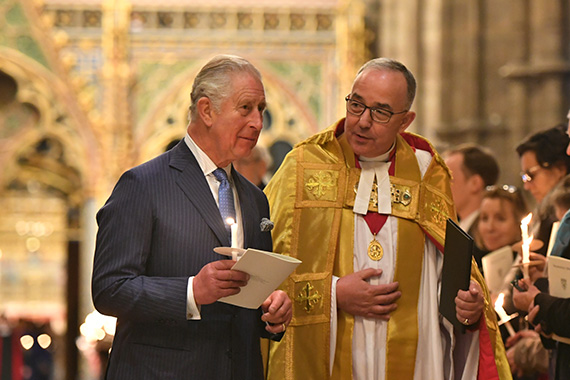
Prince of Wales pays personal tribute to Newman the reconciler

The Prince of Wales has commended Cardinal John Henry Newman as a saint for our times, suggesting in an article that his example as a harmoniser of differences, of inclusivity and respect, “is needed more than ever.” Writing ahead of his visit to Rome, where he will attend Newman’s canonisation as the head of the British delegation, Prince Charles says Newman stood “for the life of the spirit” and against forces that debase human dignity and destiny.

“In the age in which he attains sainthood, his example is needed more than ever – for the manner in which, at his best, he could advocate without accusation, could disagree without disrespect and, perhaps most of all, could see differences as places of encounter rather than exclusion,” says the Prince. The article, which appears also today in Italian in L’Osservatore Romano, reveals a deep familiarity with and respect for Newman, who tomorrow will become the first English saint of modern times. It will be published in full in the print edition of The Tablet next week.

Recalling the climax of Newman’s famous spiritual poem The Dream of Gerontius, when the soul glimpses the harmony of the divine vision, Prince Charles writes: “Harmony requires difference. The concept rests at the very heart of Christian theology in the concept of the Trinity.” This revelation of the Trinity, the Prince says, shows that “difference is not to be feared.”

He goes on to write: “In the image of divine harmony which Newman expressed so eloquently, we can see how, ultimately, as we follow with sincerity and courage the different paths to which conscience calls us, all our divisions can lead to a greater understanding and all our ways can find a common home.”

Describing Newman as “a great Briton,” Prince Charles notes in particular his significance for “those who seek the divine in what can seem like an increasingly hostile intellectual environment find in him a powerful ally who championed the individual conscience against an overwhelming relativism.” Elsewhere in the article Prince Charles pays tribute to the contribution of the Catholic community to British society, something he describes as being “immeasurably valuable.”

Christians in India are “living in fear,” says Catholic bishop

Christians across India are “living in fear” because of acts of state-led violence and oppression, says the bishop of a region still recovering from one of the country’s worst outbreaks of persecution. Speaking to leading Catholic charity Aid to the Church in Need, Bishop Kishore Kumar Kujur of Rourkela described how the government in India is “causing problems” – with support from “right-wing” groups hostile to Christians and other minorities.

He said: “Christians are living mostly in fear at present – much more in the north, where they are a minority.”

Underlining the severity of the threat, the bishop said his safety would be put at risk if he released key details about the oppression and persecution suffered by Christians and other minorities.

Bishop Kujur’s diocese covers part of Odisha state (formerly Orissa), where an anti-Christian pogrom in 2008 left 100 or more dead, 50,000 homeless, with attacks on 4,500 houses and 250 churches.