Being elected pope doesn’t wash away one’s sins, pope says

While his responsibilities are greater and his prayer list longer, Pope Francis said he’s basically the same person he was before and he was elected in 2013, so he still goes to confession every two weeks. “The mere fact that I now dress all in white has not made me any less sinful or holier than before,” he told Jesuits in Mozambique on September 5th, according to a transcript of the meeting published on September 26th by La Civilta Cattolica.

Often on trips abroad, Pope Francis spends time with local Jesuit communities and holds a question-and-answer session with them. Weeks later, a transcript of the exchange is published by La Civilta Cattolica, a Jesuit journal in Rome.

In Mozambique, a Jesuit had asked the Pope how his experience of God has changed since he was elected Pope.

“I guess my experience of God hasn’t fundamentally changed,” he responded. “I speak to the Lord as before. I feel God gives me the grace I need for the present time. But the Lord gave it to me before. And I commit the same sins as before.”

“I am and I remain a sinner,” he told his fellow Jesuits. “That’s why I confess every two weeks.”
Justice mission claimed 56 Jesuits in 50 years

As many as 56 Jesuits have lost their lives since their congregation made a commitment to promote a “faith that does justice” and foster reconciliation in society 50 years ago, says an official of the Society of Jesus.

“If we want to stand for justice, we have to pay the price. We have sacrificed many Jesuits and their collaborators as our forefathers worked hard to bring justice and reconciliation in the world,” said Father Xavier Jeyaraj, director of Jesuits’ Rome-based Social Justice and Ecology Secretariat.

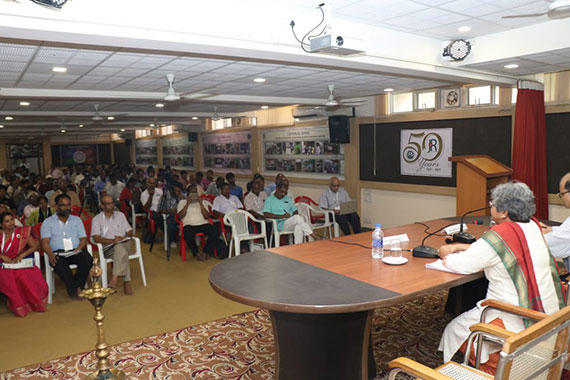
Father Jeyaraj, a member of the Calcutta Jesuit province, was addressing around 220 conferrers and their associates in South Asia who have gathered in Delhi to celebrate the golden jubilee of their congregation’s commitment to justice.

“If we want to commit for future, be ready to pay the price,” he told the opening session of the September 26-27 program at Navjeevan Renewal Centre in Old Delhi.

Father Jeyaraj, who went to Rome in 2017 after four years of service as the secretary of Jesuits in Social Action in South Asia, said similar celebrations have taken place in various continents and all of them were occasions to review their ways, re-strengthen themselves to recommit to justice.

The bald and mustachioed diminutive Jesuit, who took up social justice seriously after a shock experience of witnessing the demolition of shanties in Mumbai in 1985, pointed out that the golden jubilee celebration takes place at a time when several crises that grip the world hinder the mission of justice and reconciliation.

“There is a crisis of democracy and leadership, a crisis rising from the growth of religious fundamentalism that destroys unity and harmony and a crisis of environment,” he explained.

He said many people in India cutting across religious and ideologies have paid the price for standing for truth and justice.

Belagavi: Church-cum-mutt a rare example of religious harmony

On Sunday mornings, when they are not working in the fields that surround Deshnur, around 200 of the village’s 12,000 people go to Snanika Arulappanavara Virakta Mutt, a shrine where they attend mass that a Catholic priest holds in Kannada.

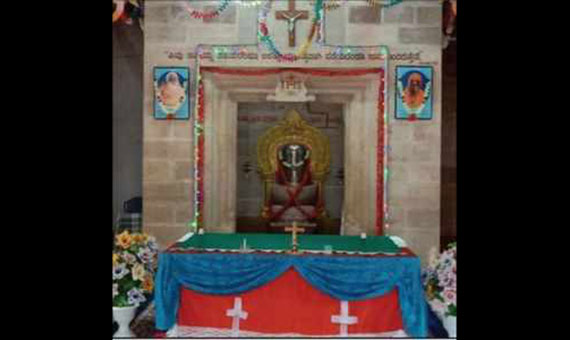
Yet, not a single inhabitant of the village is Christian. Within the imposing building of large stone blocks, also known as the Church of St John the Baptist, is a tabernacle in the form of a Shiva linga – a reminder that it once was a Lingayat mutt.

The Jesuit priest who conducts mass and runs the church, Menino Gonsalves, introduces himself as Sri Menino Swamy. He wears saffron robes and a rudraksha mala as his congregation worships Jesus and Mary in Lingayat style, burning camphor and agarbatties and with vibhuti smeared on their foreheads.

Since its establishment as a church in 1947, five Christian priests have served in the shrine, said Sri Menino. “We all adopted Hindu names,” he said. “Our founding father, Armado Alvares, called him-self Sri Animananda Swamy. Father Sebastien became Swami Arulananda.”

All the Jesuit priests who have served at the church became vegetarians and wore rudrakshamalas, he said. Sri Menino sees no incongruity in the mingling of Hindu and Christian elements in the mutt. It is an experiment in social integration, Sri Menino said. Prelates of the Catholic Church described the shrine as an example of assimilation of local culture.

Sri Menino, who has been in charge of the church for 11 years, dismissed as an “unnecessary controversy” the uproar on social media about alleged conversions at the shrine, triggered by photographs of Belgaum Bishop Derek Fernandes wearing saffron robes and with a tilak on his forehead during a recent visit to the village.

Marian pilgrimage boosts business in Pakistani village

Nasreen was depressed after a stroke left her husband paralyzed on his right side three years ago. Her youngest son took up his father’s job as a mason in the Catholic village of Mariamabad in Pakistan’s Punjab province.

“Suddenly our sole breadwinner became bedridden. The loans kept climbing. I felt helpless as an unskilled housewife,” the 46-year-old mother of five told ucanews.com.

That was until Lahore Arch-diocese announced that the 70th annual pilgrimage to the National Marian Shrine in Mariamabad would be held from Sept. 13-15 under the theme “St Mary: The woman of dialogue.”

More than a million devotees and young people from all over Pakistan travelled to the shrine on foot, by bicycle or in vehicles to pray and intercede with the Blessed Mother for special favours. They lit candles and incense sticks and covered the statue of the Blessed Mother with colourful embroidered dupattas (long scarves).

In keeping with tradition, thousands of Muslims also expressed their personal devotion to Mary, whom the Quran honours as the mother of Jesus, considered a prophet. The non-stop processions head toward a grotto that is a replica of the one in Lourdes, France.

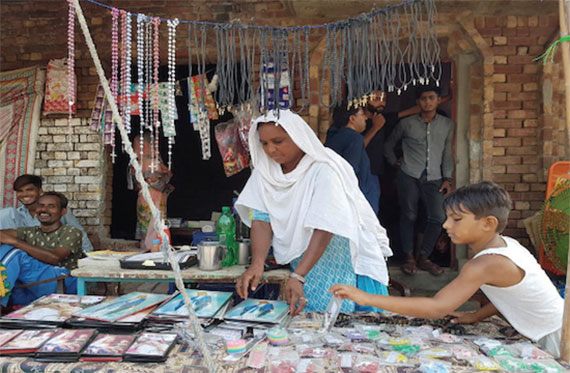
An area in front of the Church of St Mary and St Joseph was allocated for a weekend market. The selection of goods and services included Christian gifts, souvenirs, gospel CDs, toys, clothing, food, beverages and even tattoo parlours.