Draft of new constitution for Curia reform ready for consultation

A draft of the proposed apostolic constitution for reforming and governing the Roman Curia will soon be sent out to leaders of the world’s bishops’ conferences, religious orders and some pontifical universities for their observations and suggestions.

The draft, which has been approved by Pope Francis’ Council of Cardinals, will be subjected to this “consultative step” before it is once more amended and then given to the Pope for his consideration, Alessandro Gisotti, interim director of the Vatican press office, told reporters on April 10.

The proposed apostolic constitution, provisionally titled “Praedicate Evangelium” (“Preach the Gospel”) also will be sent to the Synods of the Eastern Catholic Churches, the dicasteries of the Roman Curia, the conferences of major superiors of men and women religious and some pontifical universities. They will be asked to send observations and suggestions to the Council of Cardinals so that changes or additions can be made and a final draft be given to the Pope by the end of 2019, Gisotti said.

The Council of Cardinals, which has been advising the Pope on the reform of the Curia and church governance in general, met at the Vatican on April 8-10.

Solutions need to be found with the whole Church, not just Rome

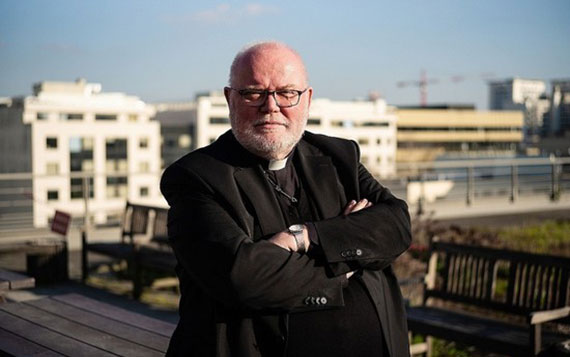
At a visit to La Croix during a Paris conference organized by the German, Swiss and French bishops’ conferences on “The common good in Europe,” Cardinal Reinhard Marx of Munich, a member of Pope Francis’ advisory council of cardinals, reflects on the crisis that the Church is currently experiencing.

“Since Vatican II, we have asked ourselves how the Church should situate itself within a modern, pluralist society where people are free to believe or not that Jesus was raised from the dead and that they can actually meet him.

What we need to imagine is not ‘a new Church’ but a Church that situates itself ‘in another way.’ Catholics themselves have said they want change.

However, this is a slow and painful process. Raising awareness does not occur at the same pace everywhere and some prefer to seek security in the past.

This is reinforced today by a loss of credibility resulting from the revelations of sexual abuse, as well as from a lack of financial transparency and a culture of secrecy.

Pope and Moroccoan King make joint appeal to protect Jerusalem status quo

Pope Francis has signed a joint appeal with Morocco’s King Mohammed VI to protect the status quo of Jerusalem as a place of worship for the followers of the monotheistic faiths. The Holy See has long supported a two-state solution in the Middle East, and supports the international community’s position that Jerusalem is a city of religious and political importance that transcends any one state.

“We consider it important to preserve the Holy City of Jerusalem/Al-Quds Acharif as the common patrimony of humanity and especially the followers of the three monotheistic religions as a place of encounter and as a symbol of peaceful coexistence,” Pope Francis and King Mohammed wrote in their appeal signed in Rabat, 30 March, during Francis’ visit to Morocco.

“To this end, the specific multi-religious character, the spiritual dimension and the particular cultural identity of Jerusalem/Al-Quds Acharif must be protected and promoted.”

The appeal implicitly recognises the international concern about the status of Jerusalem following the President of the United States’ unilateral decision to recognise the city as Israel’s capital, a sore topic for Palestinians who want East Jerusalem as the capital for their future independent state.

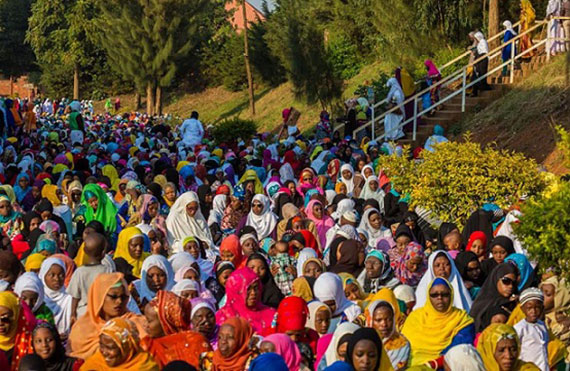
From the ashes of genocide, Islam rises in Rwanda

A handful of Muslims took a stand during the hundred days of slaughter. Their stance inspired thousands of Rwandans to become Muslim in what was once called Africa’s most Catholic country. “I was a Catholic pastor before genocide,” Matabaro Sulaiman told TRT World on a chilly in Kigali, dressed in a flashy purple jilbab – a long loose-fit dress worn by Muslim men.

When the genocide in Rwanda began in 1994, the 49-year-old, suffered a crisis of faith watching the churches, in which he preached peace and unity became slaughter houses.

“Christians were killing people in the church,” Sulaiman said.

“The [victims] went to churches thinking they will find peace but instead, they were killed. “Meanwhile, I saw Muslims take people inside the mosque.” Since the advent of European colonialism in the country in 1884, Roman Catholicism has been the dominant religion in Rwanda. But in the last 25 years, Islam has become an alternative for thousands of Rwandans who lost their faith in Christianity during the genocide.

Muslims made up one percent of the population before the genocide. Although no census has been conducted, today “12% to 15% of the total population is Muslim,” according to Salim Habimana, a former Mufti of the country. The 1994 genocide began after a decade-long systematic dehumanisation campaign against the Tutsis turned into full ethnic cleansing. The hatred was so deeply implanted in ordinary society that neighbour turned on neighbour, friend against friend, as people joined the slaughter of those closest to them.

Many went to churches as a last resort to seek refuge but death eventually found them, even in what they hoped were houses of God.

Thousands were killed inside churches across the country, including Rwanda’s largest Catholic Church, Sainte Famille.

More than 2,000 people who sought shelter were killed after Pastor Wenceslas Munyeshyaka collaborated with the attackers instead of protecting those in need.

Archbishop of Canterbury to lead a spiritual retreat at the Vatican

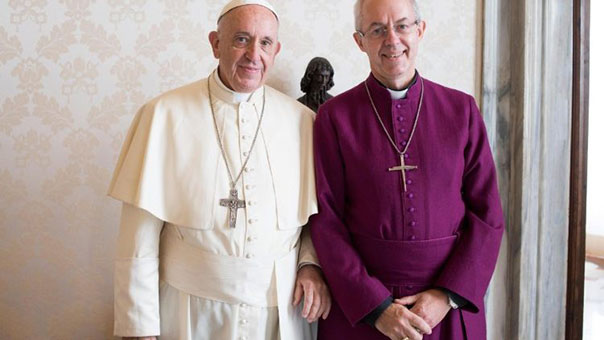
The Archbishop of Canterbury, Justin Welby, was in the Vatican to lead a retreat for civil and ecclesiastical authorities of South Sudan.

Pope Francis has approved the proposal presented by the Archbishop of Canterbury, His Grace Justin Welby, to organise a spiritual retreat to take place in the Vatican, within the Domus Sanctae Marthae, from the 10-11 of this month of April, in which the highest civil and ecclesiastical authorities of South Sudan will participate.

This event, both ecumenical and diplomatic at the same time, was organised by mutual agreement between the Secretariat of State and the Office of the Arch-bishop of Canterbury.

Analysis: Pope Francis’ new exhortation ‘Christus Vivit’

Laphidil Oppong Twumasi, a youth leader from Ghana, reads Pope Francis’ apostolic exhortation, “Christus Vivit” (Christ Lives), during a news conference for its presentation at the Vatican on April 2, 2019

As a young Jesuit, Jorge Bergoglio taught literature to a group of rowdy, hormonal teenage boys at a private school in Argentina who, according to one of them, “had no desire to study.”

Faced with the chaos of the classroom, the 28-year-old Bergoglio refused to adopt a dictatorial path of control but instead engaged his pupils by posing them challenges. He demonstrated his passion for a range of writers, even managing to get one of Spanish literature’s greats, Jorge Borges to come and talk to the class.

Recalling those days Jorge Milia, who is now a writer, said the future Pope always urged his students to analyse, break down arguments and not be “hood winked.”

Decades later, and now sitting in the Chair of St Peter, Pope Francis is adopting a similar teaching method when it comes to how the Church can better connect with young people.

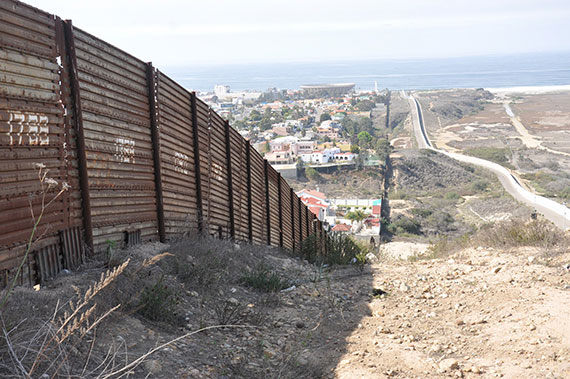
Trump’s border wall will make US a “prisoner” of isolation, pope says

President Donald Trump’s decision to build an anti-immigrant wall will leave the United States alone and a “prisoner” of its own isolation, according to Pope Francis in his latest wide-ranging interview, this time with a Spanish journalist.

“He who raises a wall ends up a prisoner of the wall he erected,” the Pope said. “That’s a universal law in the social order and in the personal one. If you raise a wall between people, you end up a prisoner of that wall that you raised.”

“Yes, I defend my autonomy, yes,” Francis said, “but you’re left alone like a mushroom.”

Francis’s words came in a pre-recorded interview, which took place before he departed for an overnight trip to Morocco. Speaking to Spanish journalist Jordi Evole of La Sexta, Francis said countries that traffic in arms “have no right to talk about peace.”

“Are they fomenting war in another country and then want peace in their own?” Francis asked. “That theory will boomerang. Life charges them, one way or another. If you arm the war there, you will have [the war in] your house whether you want it or not.”

Asked about victims of clerical sexual abuse and whether they should go to the police to denounce a crime, Francis said “of course” and insisted such a standard was the outcome of a recent summit on abuse he convened.

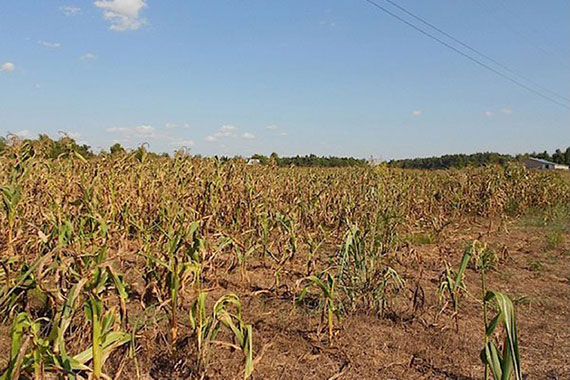
German bishops publish ‘10 theses on climate protection’

The German Bishops’ Conference on April 3, 2019 has published a contribution to climate policy discussion as a central social challenge in the field of the creation of creation. The expert text “Ten theses on climate protection. A discussion contribution “is based on socio-ethical, economic, natural and juris prudential considerations and contains solutions.

Based on Pope Francis ‘Encyclical Laudatosi,’ the text clarifies the need for climate protection from a socio-ethical perspective. The task of counteracting dangerous climate change is described as a requirement of justice. The text is committed to the goal of achieving greenhouse gas neutrality as early as possible, but by 2050 at the latest. Specific implementation steps will be identified, including taking a pioneering role in Europe and the world, the phasing out of fossil fuels Frame-work for the transformation of the energy system, the involvement of consumers and producers and the promotion of sustainable lifestyles. Reflections on the model function of the church complete the text.

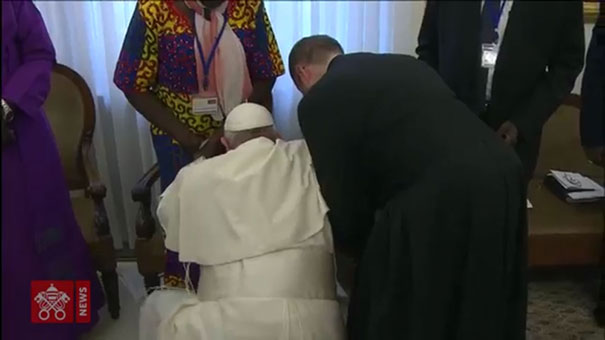
In extraordinary peace gesture Pope kisses feet of South Sudan’s leaders

For five years they were at war with each other in a bloody conflict that has killed 400,000, left six million starving, four million displaced from their homes and a devastated economy.

On 11 April 2019, the President of South Sudan, SalvaKiir, and his former vice-president Riek Machar sat together on a sofa in the Casa Santa Marta in the Vatican as Pope Francis appealed for them to persevere with their fragile peace agreement and “remain in peace.” After finishing his talk the Pope stood up from behind his desk, walked over to the warring leaders of the world’s youngest state and knelt down and kissed both of their feet. Machar, who was taken aback by the gesture, appeared to try to stop the Pope from bending down in front of him. Francis told him: “let me.”

Along with Kiir and Machar, the 82-year-old Pope also bent down to kiss the feet of the other political leaders gathered in the room including Rebecca Nyandeng, the widow of John Garang, the man who helped bring about an independent South Sudan. Nyandeng was in tears during the encounter, which is likely to go down as one of the most dramatic peace gestures of the Francis pontificate.

The Archbishop of Canterbury, Justin Welby, choking up with emotion after witnessing the scene said: “We have heard the prophetic call of Christ. We now commission you as ambassadors of peace.” He handed each of the leaders a Bible with the following message: “seek that which unites. Overcome that which divides.”

By any worldly measure, South Sudan’s problems seem insurmountable and might be best left to the intercession of St Jude, the patron of saint of hopeless causes.

Abp Barwa to the Christians of Orissa: We are gathering evidence on the Kandhamal martyrs

“We are gathering information on the Kandhmal martyrs:” announced Msgr John Barwa, archbishop of Cuttack-Bhubaneswar, to Christians in Orissa during a meeting with clergy and religious. The prelate started the formal process to have the Christians killed during the pogroms unleashed by the Hindu radicals in 2008 known as “martyrs of the faith.”

The meeting took place at the Kandhamal pastoral centre on 3 March, where over 60 diocesan priests and leaders presented various reports on financial aspects and land issues. The archbishop expressed the desire to strengthen the laity through education, both religious and secular, and to improve the socio-economic conditions of the district’s population. He said, “people are disadvantaged due to lack of higher education and professional training. We must encourage and strengthen them.”

Msgr Barwa participated in a retreat for the clergy, in which “the preacher emphasized that the Eucharist is at the heart of priestly spirituality, and invited prelates to devote more time to Eucharistic adoration and prayer.”

“I told our clergy and religious – he concludes – that it is our task to gather all the evidence and material, so that I can advocate [the cause] in the Vatican, in the first phase of the beatification process. Everyone – lay faithful, consecrated and priests – must share the documents in their possession. It is a joy for us.”