Remember our faults when correcting others: Pope

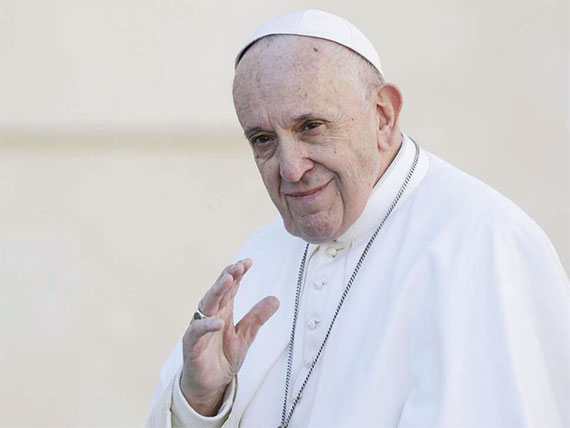
To be effective teachers of the faith, Catholics must be cognizant of their own sins and shortcomings when giving correction and guide to others, Pope Francis said on March 3.

“So many times, we all know, it is easier or more convenient to discern and condemn the defects and sins of others, without being able to see our own with just as much clarity,” the Pope said before the Angelus on 3rd March. People want to hide their own defects and even themselves, he said. “The temptation is to be indulgent with one’s self … and hard with others.”

This teaching is illustrated in Scripture, Francis said, when Jesus says: “how can you say to your brother, ‘Brother, let me remove that splinter in your eye,’ when you do not even notice the wooden beam in your own eye?’”

He explained that it is good to give counsel to a neighbour, but to do so while imagining one’s self to be faultless is wrong.

“If I believe I do not have [defects], I cannot condemn or correct others,” the Pope said. “We all have flaws: everyone.” To correct others with credibility, and “with humility, witnessing to charity,” requires looking inside one’s self and acknowledging personal sin and failure.

The line about the splinter and the beam, and others from the day’s Gospel, are short parables Jesus tells in order to teach His followers “not to be presumptuous and hypocritical,” Pope Francis said.

Further illustrating the point, Jesus asks His disciples: “Can a blind person guide a blind person?”

The Pope explained that “Jesus wants to point out to His disciples the way to go in order to live wisely. He wants to underline that a guide cannot be blind, but must see well, that is, he must possess wisdom, to guide wisely, otherwise he risks causing damage to people who rely on him.”

This is especially true, He continued, for those who have educational and leadership responsibilities, like priests, politicians, teachers, and parents. These people need the gift of wisdom in order to be good guides and to discern “the right path on which to lead people,” he said.

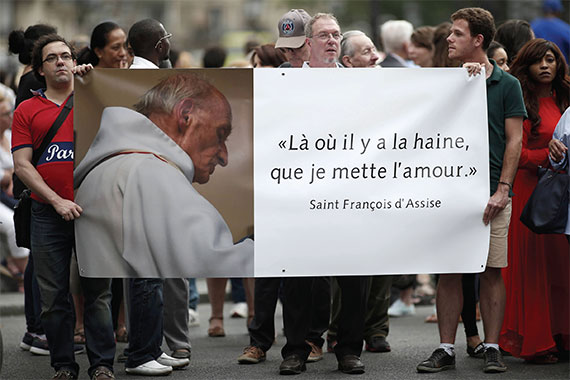
Anti-Catholic climate worsens in France

French monitoring groups have cited an increase in attacks on churches and religious sites, with a record 47 documented in February, despite appeals for better protection from the country’s Catholic bishops.

The groups’ report said 15 vandalism attacks had been registered nationwide during the month, along with 15 robberies, 10 acts of profanation and one torching incident. It added that the worst had occurred at the gothic cathedral of Saint-Denis, near Paris, the historic burial place of French monarchs, which assailants had entered by smashing a historic stained-glass window, before wrecking the organ and choir-stalls.

The report follows growing concern over anti-clerical incidents in France, where Catholics nominally make up around 54% of the population of 67 million, according to surveys, but with only a small proportion attending Mass.

In February, Archbishop Roland Minnerath of Dijon held a Mass of reparation at his city’s Notre Dame Church, two days after its tabernacle was forced open and consecrated hosts scattered.

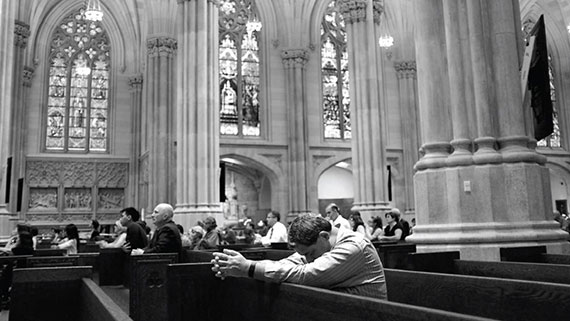
Many U.S. Catholics Question Their Membership Amid Scandal

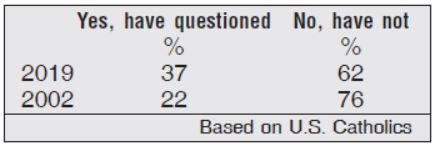
As the Catholic Church responds to more allegations of sexual abuse of young people by priests, an increasing percentage of Catho-lics are re-examining their commitment to the religion. 37% of U.S. Catholics, up from 22% in 2002, say news of the abuse has led them to question whether they would remain in the church.

As a result of the recent news about sexual abuse of young people by priests, have you, personally, questioned whether you would remain in the Catholic Church, or not?

These results are based on interviews with 581 U.S. Catholics who participated in Gallup polls Jan. 21-27 and Feb. 12-28. While the polling was being conducted, Pope Francis met with Catholic leaders from around the world at the Vatican to respond to a new wave of sex abuse allegations in numerous countries. The church dealt with a similar crisis in the U.S. in 2002, the last time Gallup polled about this. That polling came after The Boston Globe reported on wide-spread abuse by Catholic priests in the Boston area and church leaders’ efforts to prevent the abuse from becoming public knowledge.

Gallup’s latest findings show that the current scandal is affecting U.S. Catholics more than the one in 2002 did, in terms of their feelings about the church. However, it is unclear whether Catholics who are questioning their church membership will actually decide to leave the church. Many Catholics may consider leaving the church but ultimately decide not to do so, or they may have no intention of leaving but simply be responding to this question as a way to express their frustration with the way the church has handled the problem.

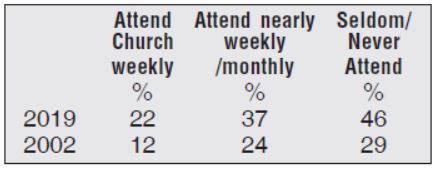
Substantial minorities of both practicing and nonpracticing Catholics say they are questioning their commitment to the church — but, as might be expected, those less committed to their religion are more likely to be questioning it. Whereas 46% of Catho-lics who seldom or never attend church say they have questioned whether they would remain in the faith, 37% of those who attend church on a monthly basis and 22% who attend weekly say the same.

The same pattern existed in 2002, although both practicing and nonpracticing Catholics are more likely now than in 2002 to be questioning their place in the church. Seventeen years ago, only one in eight weekly churchgoers were re-examining their mem-bership, as were 24% of semi-regular church- goers and 29% of infrequent ones.

Practicing Catholics Less Likely to Question Their Membership in the Church

BJP moves to woo minorities with manifesto

India’s pro-Hindu Bharatiya Janata Party (BJP) has invited suggestions from minorities on how to adapt its election manifesto to making the nation more inclusive. Representatives of religious minorities, including Catholics, presented their suggestions at a March 7 meeting in the capital, New Delhi. The gathering was convened by federal Minority Affairs Mini-ster Mukhtar Abbas Naqvi and Social Justice and Empower-ment Minister Thaawar Chand Gehlot ahead of national elections in May. “We told the ministers that the minorities feel insecure in the country and need to be protected and that constitutional values need to be upheld,” said Father Joseph Manipadam, who led the Catholic representation at the meeting.

Married priests will be on agenda for the Amazon synod, theologian says

When the Synod of Bishops on the Amazon rolls around in October, the long-debated possi-bility of ordaining mature, marri-ed men to the priesthood in areas where there are priest shortages will be brought to the table, according to one Brazilian theolo-gian.

Speaking to Crux, Jesuit Father Francisco Taborda, a professor of theology at the Jesuit university in Belo Horizonte, Brazil and an author of numerous books on the sacraments, said one of the primary pastoral challenges in the Amazon region is access to Mass, especially for indigenous populations who often live in rural areas that are difficult to reach.

“The Eucharist is central in the Christian life,” Taborda said, and lamented the fact that many communities in the Amazon only receive the Eucharist at most four times a year, which is “a very big problem.”

“There is a shortage of priests,” he said adding that this can lead “to a re-thinking of how it can be done so that every community… can have the Sunday Eucharist.”

Asked if this “re-thinking” included the ordination of so-called viri probati, meaning mature, married men who are strong in their faith and who would usually be considered as candidates to be ordained dea-cons, Taborda said “that’s what this is about.” “In the final analysis, the solution that could be seen is this one,” he said, explaining that the topic will come up in the synod hall.

Vatican yearbook shows slight rise in Catholic population, drop in seminarians

The number of Catholics has increased at a faster rate than the rest of the population, newly released statistics by the Vatican reveal. Over the course of nine years, the number of Catholics worldwide has increased by 17.8%, compared to the global population, which increased by 17.3%. From 2005 to 2014, the number of Catholics grew from 1.12 billion to 1.27 billion. These and other statistics, released by the Vatican on Saturday, are contained within the 2016 Pontifical Yearbook and the 2014 Annuarium Statisticum Ecclesiae. These volumes, compiled by the Central Office of Church Statistics and edited by Vatican Typography, are set to be released in bookshops within days. The books also show changes in the Church’s life over the course of 2015, according to the March 5 statement.