Philippine church groups condemn ‘tyrannical’ Duterte

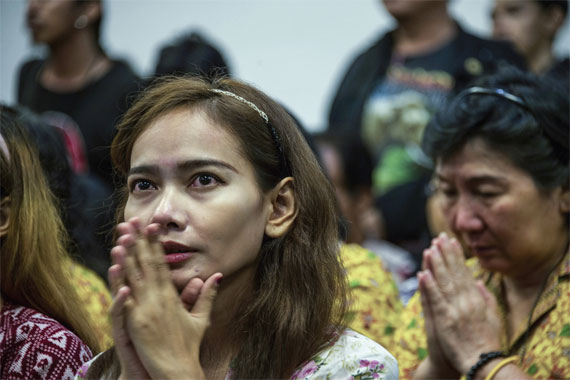
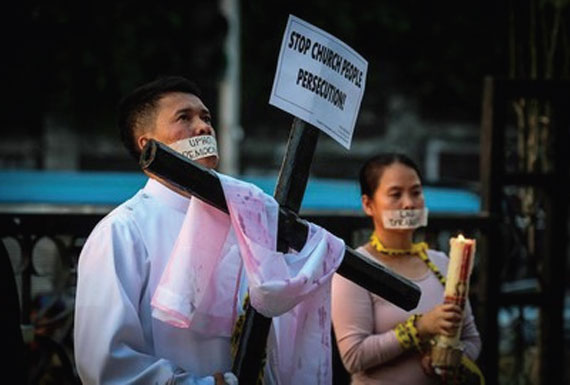
Priests, nuns, and seminarians staged a candle-lit prayer rally on May 17 to protest against what they called the “tyrannical tendencies” of Philippine President Rodrigo Duterte.

The protest came days after Cardinal Luis Antonio Tagle of Manila released a letter to parishes warning that the Philippines is “facing a crisis of truth.”

The Manila prelate noted that even Philippine legal experts have “given us conflicting interpretations on basic questions of law.” Cardinal Tagle issued the letter to priests and religious in his archdiocese days after the Philippine Supreme Court ousted the country’s chief justice.

The court decision has been widely criticized by various groups, including civil society organizations and Catholic Church leaders.

Bishop Arturo Bastes of Sorsogon said the removal of Chief Justice Maria Lourdes Sereno could be the start of “another dark period in the country’s history.”

“A real dictatorship of a strong man is emerging,” said the prelate, adding that “more controversial issues are surely coming.” He said the court decision “is the most shameful act in the history of the Philippine judiciary.”

Cardinal Tagle said the “crisis of truth” has already resulted in “suspicion, mistrust, and fragmentation.”

“Partisan politics has turned into political tribalization. The common good is one of the first casualties,” the Manila prelate said.

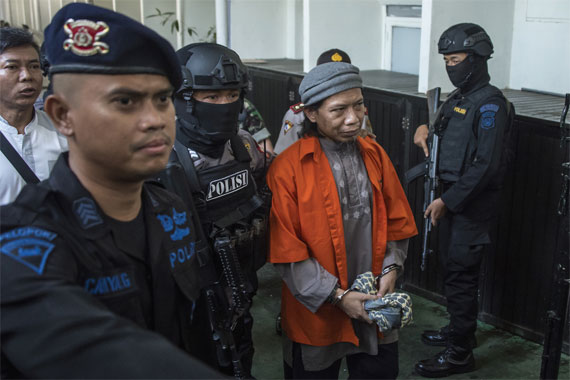
Indonesian Catholics want mercy for terrorist kingpin

Leading Catholics in terrorism-plagued Indonesia have criticized prosecutors who demanded the death sentence for the alleged mastermind behind a deadly spate of suicide bombings and attacks against police that have left many dead.

From a moral perspective and the view of the church, the death penalty is wrong no matter what the crime is, said Father Antonius Benny Susetyo, an adviser to a presidential unit that promotes communal tolerance and understanding. “The death penalty does not provide an effective deterrent against perpetrators of these sort of crimes,” he said.

He was responding to calls on May 18 from prosecutors demanding that judges impose the death sentence on Aman Abdurahman, alleged leader of an Islamic State-linked terror group, Jamaah Ansharut Daulah (JAD), who is standing trial on terrorism charges in a Jakarta court. Abdurahman, 46, is standing trial for allegedly masterminding a series of attacks that included a February 2016 bombing in Jakarta that killed eight people and an attack in November 2017 against the Batak Society Christian Church of Oikumene in Samarinda, East Kalimantan that killed four people.

Surabaya Christians uncowed by church bombings

Despite tight security and fears of further deadly attacks, defiant Christians in Surabaya flocked to services and Masses on May 20 – Pentecost Sunday – according to church officials.

Christians at the Santa Maria Catholic Church and Diponegoro Indonesian Christian Church held services in their church buildings which were attacked by suicide bombers on May 13. Meanwhile, members of the Surabaya Pentecostal Church, which suffered the most damage, held services in a large tent. Twelve Christians were killed during the attacks, committed by members of the same Muslim family.

Church officials told on May 20 that Christians prayed as usual, while fully-armed police and military personnel stood guard outside.

Those entering the churches were thoroughly searched and had to pass through a metal detector.

Father Alexius Kurdo Irianto, parish priest at the Santa Maria Church, said he did not see any decline in church attendance during Mass.

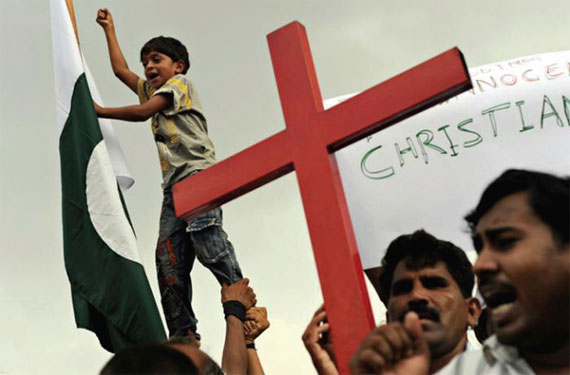
In Punjab, Christians who tried to retake their homes grabbed by Muslims suffer gunshot wounds

Two Christians have survived after they were fired upon by armed men who wanted to prevent them from regaining possession of their land.

The incident occurred on May 17 in the village of Sankhatra (Punjab province), where the Christian community blocked the streets to protest against the ille-gal occupation of their properties. For months they have been unable to go back into their homes because of a land dispute with a politician from the ruling party. The wounded are Shahbaz Masih Gill, 36, and Samina Tasneem, 28. Both suffered gunshot wounds to the legs and are currently in hospital.

The police took their statement and filed a case under the Pakistan Penal Code, sections 324 (Attempt to commit qatl-i-amd, i.e. murder), 148 (Rioting, armed with deadly weapon), and 149 (Every member of unlawful assembly guilty of offence committed in prosecution of common object).

“I was coming home after fixing an electric motor when armed men on a motorcycle stopped and attacked me with wooden sticks and punches,” Gill told.

“With my forehead bleeding, I joined the protest against the attack. We had gathered at 6:50 pm when they returned and shot five fires.” Despite this, “We did not panic and retaliated by throwing bricks at the attackers causing them to flee. That’s when I realised blood was dripping from my right leg.”

Archbishop of Jakarta decries jihad families as new form of violence

“Planning and implementing a suicide attack by taking their children with them is a new” form “of violence. It is a family tragedy,” decries Msgr. Ignatius Suharyo Hardjoatmodjo, Arch-bishop of Jakarta and President of the Indonesian Bishops’ Con-ference (Kwi).

He was commenting on the dynamics of the attacks that have hit three churches in Surabaya, capital of the province of East Java two days ago. Meanwhile, following the death of Nathanael, an eight-year-old Catholic child, the number of victims of the co-ordinated attack has risen to 12.

The terrorists belonged to a single terrorist family. The father, Dita Oeprianto, is the Pentecostal Church bomber (Gpps), while the two teenage sons carried out the attack on the Catholic Church of Saint Mary Immaculate (Smtb), aboard a motorcycle. The mother and her two small daughters, aged nine and 12, carried out the suicide attack at the Christian Church of Indonesia (Gki).

“I am convinced – says Msgr. Suharyo – that the two young daughters had no idea what would happen. This is incomprehensible and I think this kind of thing should never happen again, clouding our humanity.”

Christians in Nepal concerned over sudden attacks on churches

Christians in Nepal are alarmed after this month’s sudden series of arson and bomb attacks on four church buildings, and church leaders suspect authorities are lax in investigating.

At the same time, six Christians were arrested for evangelizing while suspected Hindu extremists launched attacks on three church buildings and bombed another. The attacks caused extensive property damage but no casualties. The Hebron Church building in the eastern hilly region was set on fire on May 9, Emmanuel Church’s building in western Nepal’s Doti District was burned on May 10, and the Kanchanpur Emmanuel Church building in the Midwest hilly region was set ablaze on May 11. Before midnight on May 12, the Mahima Church building in Dhangadhi, in western Nepal, was bombed. Neither government officials nor police have issued a formal statement on suspects, though police have attributed the attacks to the Nepal Communist Party, known as the Biplab Group. But Christian leaders in Nepal suspect a coordinated campaign by Hindu extremists.

Nationalists complain against Hindu temple in Tamil Nadu that let nuns visit the site

Leading members of the Hindu nationalist Bharatiya Janata Party (BJP) and other nationalist groups have filed a complaint against the administration of a Hindu temple in Tamil Nadu for allowing a group of Catholic nuns to visit the site, this according to The Hindu, one of India’s foremost daily newspapers. According to the plaintiffs, the presence of nuns in their religious attire in a Hindu place of worship hurt the religious feelings of Hindu believers and was meant to mock the temple’s sanctity.

The complaint was filed by Sethu Aravind, a member of the BJP state executive committee, and representatives of militant Hindu fundamentalist movements: Vishwa Hindu Parishad (VHP), Hindu Alaya Meetpu Iyakkam and Anaithu Hindu Iyakkam.

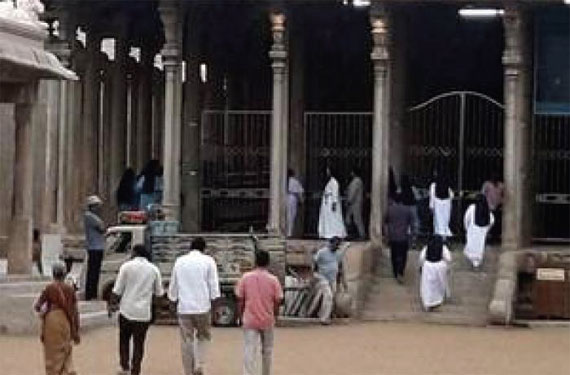
The incident occurred on 8 May at the Sri Ranganathaswamy Temple in Srirangam, an island in the city of Tiruchirappalli. The nuns were part of a group of tourists from Kerala. The visit sparked the fury of the radicals when their social media began spreading the rumour that the nuns had taken rosaries out of their pockets and started to pray inside the Hindu temple.

Pictures of the nuns were posted on online messaging platforms showing them walking near the Thousand Pillar Mandapam, a theatre like structure made from granite.

Following the publication of the images, some devotees criticised the temple administration and filed a complaint with the Srirangam police. “The temple of Srirangam in Tiruchirappalli is one of the temples which does not permit Christians to enter,” said Fr Sebastian Michael, adviser to the Pontifical Council for Interreligious Dialogue.

“Even today, in a globalised world, it is their right not to permit people from other religions. We cannot go against their belief,” he added.

“Despite this, we continue to believe in dialogue. There is a lot of good will and cooperation between religions. Many Hindu religious leaders invite us to their religious meetings and we do the same,” he noted.

Delhi archbishop’s prayer for nation triggers BJP rebuke

The archbishop of Delhi has called for a prayer campaign until the next general election in an unprecedented political inter-vention, citing a threat to the country’s secular fabric, trigger-ing angry reactions from the ruling Hindu nationalist party.

“We are witnessing a turbulent political atmosphere which poses a threat to the democratic principles enshrined in our Constitution and the secular fabric of our nation,” Archbishop Anil Couto wrote in a letter issued this month to all parish priests and religious institutions in the archdiocese of Delhi.

The letter became public, bringing to fore tensions between Christians and Hindu nationalist hardliners who form the bedrock of Modi’s Bharatiya Janata Party (BJP).

Christians constitute less than 3% of Hindu-majority India’s 1.3 billion people. India is officially secular, but four-fifths of its population profess the Hindu faith. The BJP said the letter was akin to calling people to vote along communal lines, and that it was unfortunate. The next election has to be held by next May.

The Evangelical Fellowship documented at least 351 cases of violence against Christians last year, mainly in states ruled by the BJP. Between 2014 and 2015, Couto and other Christians in the national capital region of Delhi told Singh how violence had picked up after Modi came to power, detailing at least five cases of attacks on churches in New Delhi following which extra police had been deployed to protect 240 churches in the capital. Responding to Delhi archbishop’s letter, home minister Rajnath Singh on said in India minorities are safe and no one is allowed to discriminate on the bases of caste and religion. “I have not seen are safe and no one is allowed to discriminate on the basis of caste and religion,” Singh said.

Indian state imposing patriotic slogan worries church leaders

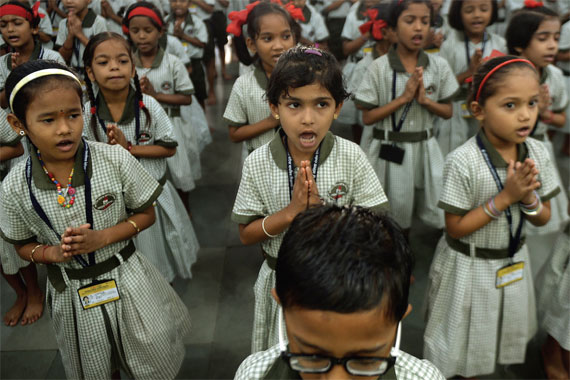
A directive for government school students in India’s Madhya Pradesh State to and with a patriotic slogan called ‘Jai Hind’ (hail India) during attendance roll calls has been criticized by Catholic Church leaders.

On May 15 the education department said the government had decided to make the slogan compulsory for government schools from the start of a new academic year in June.

“This is a misplaced idea of patriotism,” said Archbishop Leo Cornelio of Bhopal, head of the bishops’ council in the region.

The commonly used slogan Jai Hind emerged during India’s independence struggle and continues to be raised at the end of national anthem. However, Hind is a shortened form of Hindustan (land of Hindus) that excludes India’s religious minorities such as Christians and Muslims.

The central Indian state’s government, run by the pro-Hindu Bharatiya Janata Party (BJP), has exempted privately managed schools such as Church schools from the new practice.

But an official source seeking anonymity told the government exempted private schools fearing a backlash as state elections are due in December this year. The nine Catholic dioceses in the state run some 500 schools.

“But in this case, a particular ideology is promoted in the name of patriotism,” he said.

‘Honour’ killing in Catholic family shocks Indian state

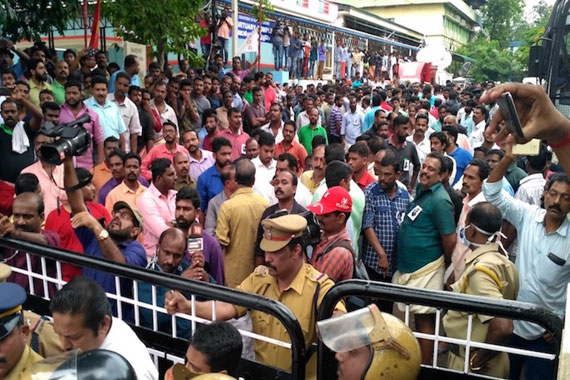
The victim’s father and wife told media that they had approached police soon after he was kidnapped but officers refused to entertain them, saying they were busy arranging security for a visit by Pinaryi Vijayan, the state’s chief minister.

Neenu named her brother Shanu Chacko and 11 people as responsible for the crime. Most gang members belong to the Democratic Youth Federation of India (DYFI), a youth wing associated with Kerala’s ruling communist alliance.

The crime comes amid allegations that Communist Party of India leaders use police to meet their ends.

However, police have arrested some DYFI members in connection with the murder.

The government is to suspend local police officers including Kottayam district police chief V.M. Mohammad Rafik.

Widespread protests have been held by Dalit Christian groups in the state recently against the discrimination they face from upper-caste Christians, commonly known as Syrian Christians because of their ancient link with the Syrian Church and its liturgy.

A Syrian Christian bishop recently rattled the community by saying that discrimination against Dalit Christians was due to the “myth” that their forefathers were upper-caste Brahmins.