Bishops warn of ‘growing genocide’ in Cameroon

“They are hunting us,” mur-murs a secondary school teacher, turning his back to the camera and asking not to be named. “The Cameroon government security forces were entering villages and killing unarmed people. Bodies have been found in forests, they used every method and means to kill. It’s a huge number of fatalities.”

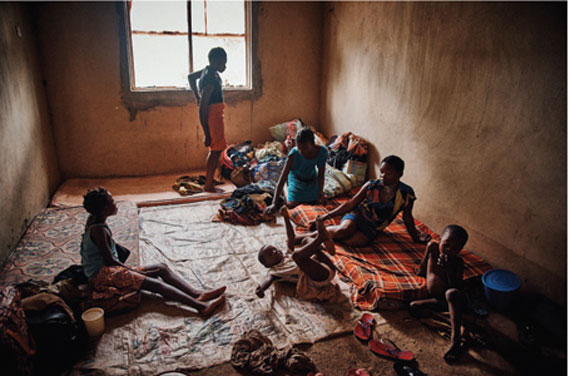
Nearly 26,000 people, four-fifths of them women and children, have fled into Nigeria from Southern Cameroon. The number has doubled since January, according to Caritas Internationalis and the UN High Commissioner for Refugees (UNHCR). More are arriving daily, while an estimated 40,000 people are displaced inside Cameroon. Political upheaval is provoking an under-reported humanitarian crisis in both countries, with refugees flooding into Nigeria’s border states carrying nothing but their children and the clothes on their backs. The refugees tell the same story over and again, of a brutal crackdown by the Cameroon military against anyone suspected of sympathising with the secessionist movement of the English-speaking minority. Known as the Anglophone crisis, Cameroon’s English-speaking Catholic bishops have described it as “a growing genocide,” although there are no reliable data on how many have died.

Mexican priest proposed as possible human rights chief

Andres Manuel Lopez Obrador will appoint Father Alejandro Solalinde as human rights director if he wins election.

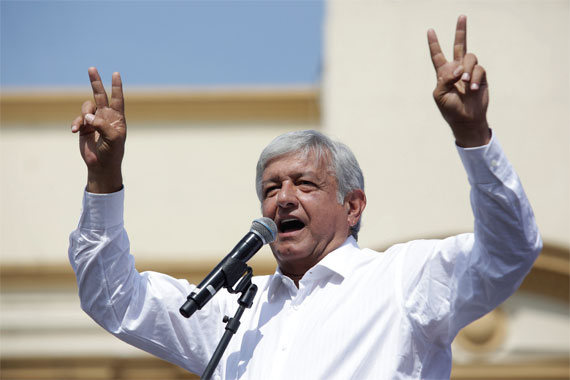
The front-runner in Mexico’s presidential election has said that if he wins on July 1, he will appoint an activist priest as his human rights director.

Andres Manuel Lopez Obrador told a gathering of victims of violence on May 8 that he would appoint to Father Alejandro Solalinde to the human rights position and name Catholic poet Javier Sicilia – whose son was kidnapped and killed in 2011 and later organised the families of those suffering atrocities – to form part of a commission for finding the thousands of disappeared people in Mexico.

Father Solalinde, who started a shelter in southern Oaxaca State for protecting Central American migrants traveling through Mexico, accepted the offer.
“Of course I will, because it’s for Mexico and provided it’s without a salary,” Father Solalin-de said. “I don’t need a salary. I’m a missionary. It would be an honour to serve Mexico in this manner.”

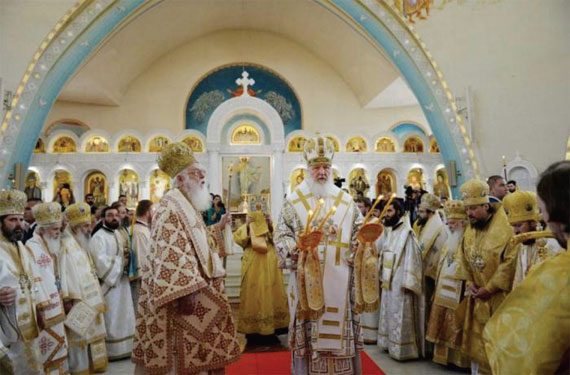
Patriarch Kirill: True faith defeats terrorism. Hilarion: Unity with Catholics impossible

The head of the Russian Orthodox Church, Patriarch Kirill (Gundjaev), went on an official visit to Albania from April 28 to 30, where he was welcomed by the Archbishop of Tirana Anastas (Janullatos), leader of the Orthodox in the Land of Falcons. Kirill and Anastas, who has long been an Orthodox missionary in Africa, have also been close friends for over 50 years, and the visit took place in a particularly relaxed atmosphere. The Russian Patriarch said he was “impressed” by the growth of the Church in Albania, which reaches about 7% of the population. The same April 29, in an interview with Russia 24 television, his main collaborator, Metropolitan Hilarion (Alfeev) said that unity with the Catholic Church, on the other hand, is practically impossible. “Although the foundations of our faith are the same, and the symbol of faith is almost identical, Catholics have another conception of the procession of the Holy Spirit,” said the prelate.

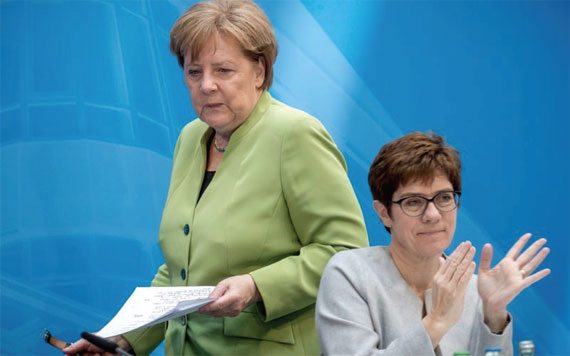
Catholic politician touted as Germany’s next leader says women should be ordained as priests

A Catholic politician who is being touted as Angela Merkel’s successor has said she hopes for the ordination of women to the priest-hood. Annegret Kramp-Karrenbauer, who was appointed general-secretary of the Christian Democratic Union (CDU), Germany’s ruling party, in February, said it was “perfectly clear” that it would be an “immense break” with tradition, but argued that “the Catholic Church would not perish.”

“I wish that the priestly ordination [of women] would come,” she told Christ & Welt, a supplement of Die Zeit, a German newspaper.

She said she could have imagined herself as a priest, but knew it was impossible. A more realistic goal, she suggested, was female deacons. “What do women not bring with them, except that they are women?” she said. “What are they missing, that they cannot receive this consecration? That they are not allowed to become deaconesses? Apart from the fact that they are women, nobody could answer me that positively! Kramp-Karrenbauer, who is a member of the Central Committee of German Catholics (ZdK), an influential lay group, stressed the importance of women in the Church, saying that if you “close your eyes and think away all the women,” it would leave “only a small remnant.” She suggested quotas for women in leadership positions. “Women determine the daily work in the church, which must also be reflected in offices,” she said. “Much of what we see today as a set of rules has evolved over the centuries, and was shaped by institutions, not by Jesus,” she said.

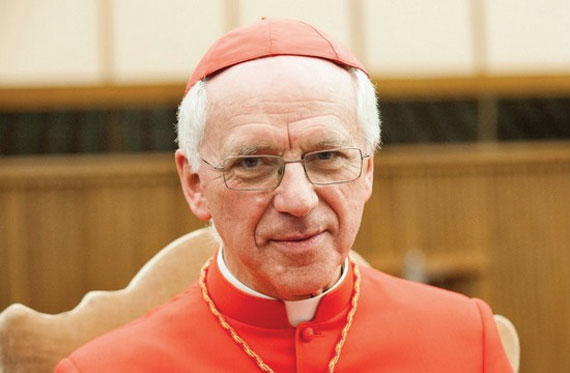
Cardinal Jozef De Kesel backs prayer ceremony for gay couples

Cardinal Jozef De Kesel, archbishop of Malines-Brussels and primate of the Catholic Church in Belgium, is open to reflecting on a ‘pray celebration’ for gay couples.

Cardinal Jozef De Kesel of Malines-Brussels met with a small delegation from a local gay working group which had requested an audience.

Following the meeting, Cardinal De Kesel “expressed his concern for their well-being and conveyed his respect to them,” Geert De Kerpel, the Dutch-speaking spokesperson for the Archdiocese of Malines-Brussels said on May 5.

In his effort to answer questions from the working group, “the cardinal also spoke of their relationships as couples, distinguishing these from Christian marriage between a man and a woman,” De Kerpel said.

“However, it does involve a personal encounter,” he said.

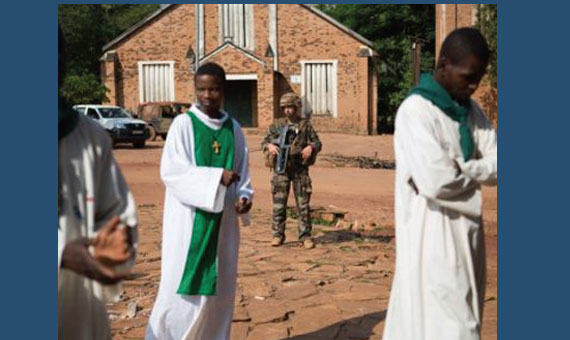
At least 15 people, including priest shot dead during Mass

At least 15 people including a priest were killed and scores wounded in Central African Republic’s capital Bangui on May 1 when unidentified gunmen attacked a church, a morgue official and rights groups said.

The attack occurred on the border of the predominantly Muslim PK 5 neighbourhood where 21 people were killed when a joint mission by U.N. peacekeepers and local security forces to disarm criminal gangs descended into open fighting. Nine dead bodies were taken to Bangui’s Community Hospital, a morgue official said, while aid agency Doctors Without Borders said six people had died and 60 were wounded at other hospitals where it operates.

It is not clear if they were all killed in the church attack itself or during skirmishes that occurred afterwards in the surrounding area. Retaliation killings followed by “anti-balaka” armed groups, drawn largely from Christian communities, and Muslim “self-defence” groups sprang up in PK 5, claiming to protect the Muslim civilians concentrated there against efforts to drive them out.

World’s best high jumper has low-profile meeting with pope

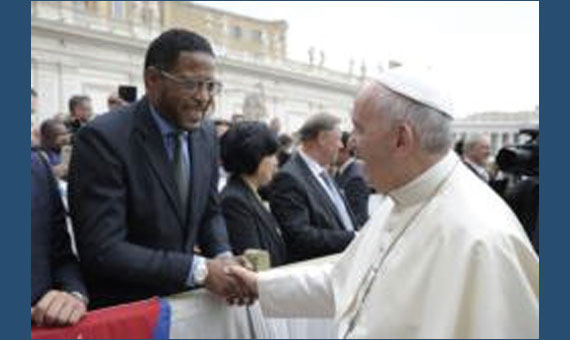
Despite holding the world record in the high jump, Javier Sotomayor kept his feet on the ground and didn’t try to clear the waist-high wooden barricade between him and Pope Francis. The now-retired 50-year old Cuban track-and-fielder was part of a small athletic delegation from Cuba greeting the Pope at the end of his May 2 general audience in St Peter’s Square.

The delegation included Luis Enrique Zayas, gold medalist at the World Under-20 Championships in the high jump in 2016, and coach Barbaro Diaz Castro.

Sotomayor is the only person to ever have cleared 8 feet in the high jump with his world record jump of 8 feet 1/2 inch (2.45 meters) set in 1993. Considered the best high jumper of all time, he has set many records and won numerous records throughout his nearly 20-year career. He took the gold medal in the 1992 Olympics and silver in 2000 before retiring the next year. Cuba boycotted the 1984 and 1988 Summer Olympic Games.

Ranchi, beheaded pastor was a tribal, a ‘peripheral’ being

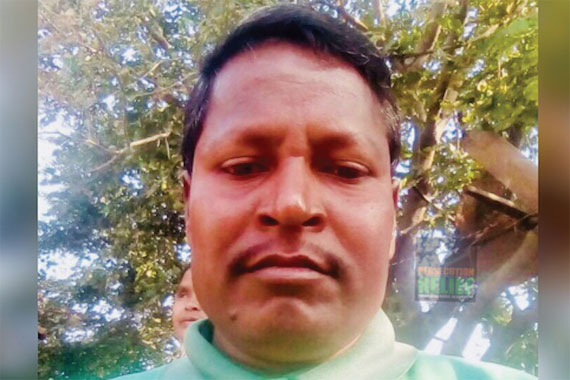
The Pentecostal Christian pastor beheaded near Ranchi, in Jharkhand, was a tribal, informs Msgr. Paschal Topno, Archbishop emeritus of Bhopal, in Madhya Pradesh. According to the prelate, the real reason for the reverend’s murder is to be found in his aboriginal origins. “Being a tribal Christian in India – he says – means being peripheral. Tribal Christians face the greatest challenges.” Meanwhile, police investigations continue to identify the perpetrators of the murder of the Rev. Abraham Tigga Topno, kidnapped on the night of May 1, beaten and beheaded.

Christians of Pakistan join Asia Bibi in fasting and praying

Christian Churches and groups in Pakistan have responded to the call of death row Christian woman, Asia Bibi, to join her in a special day of prayer and fasting for her release.

Her appeal was conveyed by her family that visited her recently and by the Renaissance Education Foundation in Lahore that supports her family and bears her legal costs.

In perhaps Pakistan’s most famous blasphemy case, Asia Bibi was sentenced to death in 2010 for insulting Muhammad, an allegation she denies. Pakistan’s Supreme Court adjourned her death sentence appeal on October 13, 2016, after one of the 3 judges recused himself from the case.

Asia Bibi’s hope revived after hearing her lawyer Saiful Malook declare that the Chief Justice of Pakistan Supreme Court Saqib Nisar would soon establish the date for the next hearing before the Supreme Court.

Cardinal Tauran in Riyadh speaks about the needed interreligious dialogue, education and concrete actions

Cardinal Jean-Louis Tau-ran, President of the Ponti-fical Council for Inter-religious Dialogue, visited Saudi Arabia (April 14-20), where he was received by King Salman. During his stay, the media described the visit as a “desire for rapprochement,” as a “stage in the opening of the Saudi kingdom to other religions,” as a “ripples of openness.” However, Tauran’s own words were the most emblematic. For him, “What is threatening all of us is not the clash of civilisations, but rather the clash of forms of ignorance and radicalism,” words that describe in a nutshell all the religious tensions that afflict the world.

The visit itself was the first by a high envoy of the Catholic Church to Saudi Arabia, cradle of Wahhabism, one of the most radical currents in Islam. During his stay, the prelate spoke about issues such as freedom of religion and equal rights for believers of all faiths. Even if he did not explicitly address the issue of allowing churches in the country or even letting Christians worship, the visit had.