Indonesians on remote Philippine island embrace Catholic faith

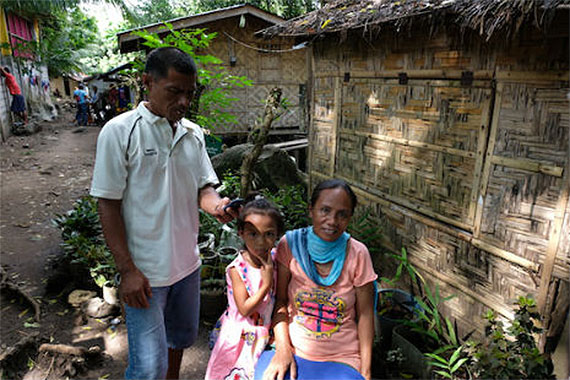
Her parents’ religion did not prevent Evangeline Musaling-Pacinabo to embrace the Catholic faith and help spread the Good News on a remote island in the southern Philippines.

Evangeline’s Muslim parents migrated from Indonesia to the small island of Balut in the southern province of Davao Occidental in the 1940s, during the height of World War II.

As years passed, some of the migrants and their children became Catholics with the blessing of their non-Catholic parents. “A catechist was instrumental in my embracing the faith,” said Evan-geline, who later married a Filipino, and became a catechist.

For the past 22 years, Evangeline has been going around the remote municipality and its nearby islets to share her experience with people and teach them about the faith.

Balut is the sleepy centre of the Sarangani island group that can only be reached after a nine-hour boat ride from General Santos City, the nearest urban centre in Mindanao. The 24,000 population of the island comprises of Muslims and members of the B’laan tribe who mostly rely on fishing and coconut farming to survive.

It is around the fringes of this municipality that Evangeline shares the teachings she learned from seminars and workshops she attended in the parish church.
Are we on the verge of another Reformation – 500 years later?

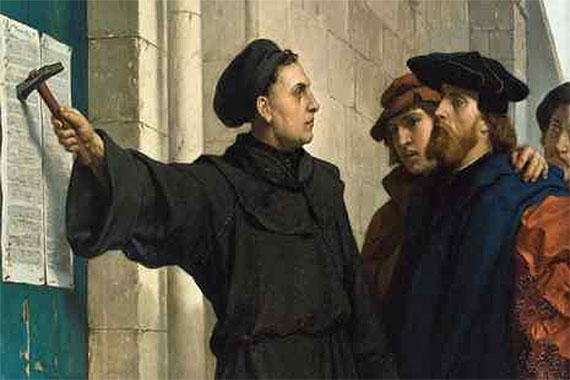
October 31 marks the quincentenary of a certain Augustinian monk nailing his ninety-five theses to a church door in Wittenberg, Germany – a perfect moment to consider having a repeat.

Pundits often claim that Islam needs its own Reformation. But maybe all of us Christian and non-Christian, believer and non-believer – would benefit from a New Reformation, one that changes our sense of what the word “religion” means. Present conditions indicate that we might be on the verge of another Reformation anyhow.

In some ways, Martin Luther’s world was not so different from ours. In 1517, old certainties were failing, and politics was in turmoil. New discoveries transformed understanding, and poisonous nationalisms emerged. Media technology altered how people received information.

And most crucially, a crisis of faith marked his world. We suffer from a similar malady, one that, ironically, was in part precipitated by that brave monk himself.

Depending on whom you ask, Luther is either to thank for liberal modernity or to blame for the doctrinaire, literalist form much of Christianity now takes. Scholars debate the details of the Reformation, concerning both timeline and implications, but maybe it’s still too early to know what Luther’s full influence will be.

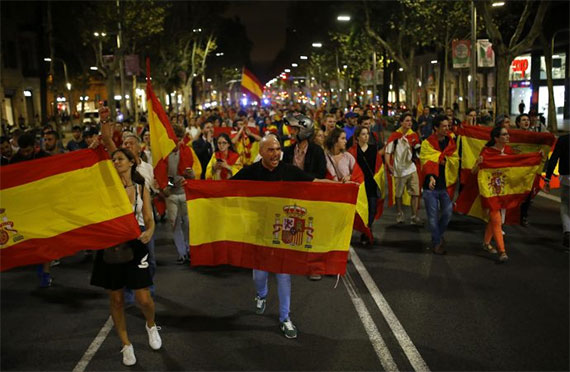
Pope Francis reportedly against the division of Spain

Pope Francis is against the secession of the Spanish region known as Catalonia that is threatening to declare its independence. This claim comes from the Spanish ambassador to the Vatican, who had a private meeting with the pontiff on October 2.

Ambassador Gerardo Bugallo, who was recently appointed to the position, was having his first official meeting with Francis, a day after a controversial independence referendum in Catalonia.
Before it took place, the national government and the federal courts declared the voting illegal, claiming it violated the constitution, and have since refused to acknowledge it.

According to the weekly Catholic magazine Vida Nueva, the Pope spoke to Bugallo about the “Holy See’s position against every self-determination process that is not justified by a process of decolonization.”

The piece was signed by Antonio Pelayo, the magazine’s correspondent in Rome, and ecclesial councilor of the embassy. He also wrote that the Pope “manifested the rejection by the Church to every attitude that is not rooted in respect to the constituted legality.”

POPE FRANCIS REAPPOINTS CARDINAL BURKE TO VATICAN’S TOP COURT

Pope Francis has named Cardinal Raymond Burke as a member of the Apostolic Signatura, the Church’s supreme court which the cardinal used to lead. The appointment came as a surprise given the cardinal has been a prominent critic of Francis who is threatening to issue the Pope with a “fraternal correction” over the papal family life document, “Amoris Laetitia.”

The Pope’s decision to give the cardinal a seat on the board of the Church’s top justice body will be read as a peace offering, and comes after the Holy See’s most senior diplomat, Cardinal Pietro Parolin, called for more dialogue in the Church.

It also has the effect of drawing Cardinal Burke closer into the Francis administration and therefore upping the stakes should the cardinal issue a correction. A correction by Burke would be divisive, yet the Pope’s move today signals the papacy wants reconciliation.

Poland: ‘The Rosary to the Borders,’ criticized as anti-Islamic

The Polish Episcopal Conference has issued the following statement:

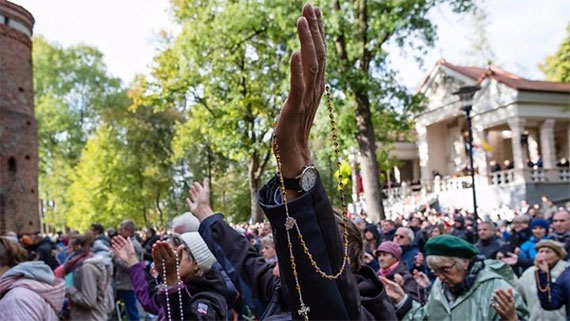
Several million Poles prayed the rosary at the same time throughout the country on October 7. This was the largest prayer event in Europe after the 2016 World Youth Day.

“The Rosary to the Borders” is the name of the prayer initiative, which took place on 7 October, the feast of Our Lady of the Rosary. On the 100th anniversary of the apparitions in Fatima, pilgrims went to the borders of Poland, where Holy Mass was celebrated simultaneously in 300 churches at 11am, with the Rosary prayed at 2pm.

Archbishop Marek Jedras-zewski of Krakow said during his sermon on the feast that people should pray for “Europe to remain Europe.

Rafal Pankowski, an expert on xenophobia and extremism, said the prayers were an expression of Islamophobia at a time of rising anti-Muslim sentiment in Poland, even though the country’s Muslim population is small.

“The whole concept of doing it on the borders reinforces the ethno religious, xenophobic model of national identity,” Pankowski, who heads the Never Again association in Warsaw, told the Associated Press.

German-speaking bishops move to take full control over liturgical translations

Catholic bishops in the German-speaking countries of Europe have been at odds with the Vatican for years over a controversial and never-implemented translation of the Missal, the Latin prototype for the celebration of the Roman Catholic liturgy.

Germany’s bishops never even mentioned the disputed translation last month in the final report of the national episcopal conference’s autumn plenary. Instead, they thanked Pope Francis at length for his recent “motu proprio.” Magnum principium, which gives such conferences greater authority over liturgical translations.

They also expressed gratitude that the Pope had once again underlined, as he did in his 2013 exhortation Evangelii gaudium, that the “genuine doctrinal authority” of episcopal conferences needs to be more fully elaborated (EG 32). And they said the liturgy commissions of all the various German-speaking conferences would now begin discussing Magnum principium and its consequences in detail.

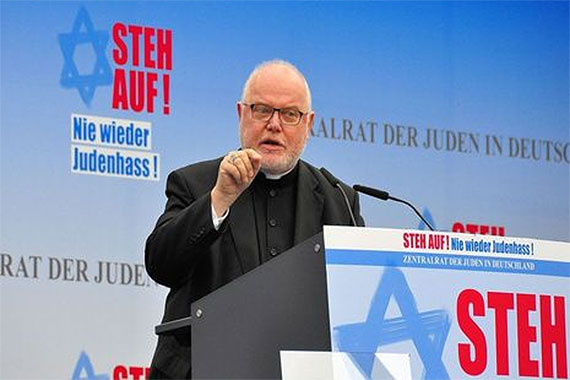
The German bishops’ president, Cardinal Rei-nhard Marx of Munich, said the first reaction he and his confreres had to the new “moto proprio” was a sense of “huge relief.”

During a press conference at the end of the September 25-28 plenary assembly, he said he believed the Congregation for Divine Worship (CDW) had taken too narrow a view on liturgical translations in the norms it issued in 2001 with the docu-ment, Liturgiam authenticam. The cardinal pointed to the long ordeal of producing the English translation of the Missal, saying he thought it was “altogether excessive” the way the Vatican had insisted on a strictly literal rendering of the Latin.

Cardinal Marx revealed that some of the English-speaking bishops had turned to him for help and that even he found it hard to pray some of the prayers in their Missal.
“The language is simply unacceptable,” he said.

Hilarion: Russia and European Christians for the Salvation of the Continent

On 22 September, Metropolitan Hilarion (Alfeev), the “Foreign Minister” of the Moscow Patriarchate, delivered an important speech at a conference organized by the Russian Embassy in London in front of diplomats, politicians, entrepreneurs and exponents of the major religious confessions.

The Metropolitan’s address developed the main theses that have marked the positions of the Russian Orthodox Church in recent years, especially Patriarch Kirill’s (Gundjaev), calls to Europe and the West. These are the positions which largely inspired President Putin’s policy, at least in terms of the ethical aspects of relations between Russia and the superpowers of the globalized world.

The speech focused on the future of Europe, and in particular on the conditions of Christianity in the old continent. According to Hilarion, who cited several recent statistics, Christianity today is the most persecuted religion in the world, and also faces new challenges that question the “moral foundations of people’s lives, their faith, and their values.”

AUSTRALIAN CHURCH FACING BIGGEST CRISIS IN ITS HISTORY, SAYS BRISBANE ARCHBISHOP

A leading Australian bishop says the Church in his country is facing the biggest crisis in its history after taking part in talks with the Vatican over how to address the problem.

The Archbishop of Brisbane, Mark Coleridge, who is Vice President of the Australian Bishops’ Conference, told The Tablet that he and fellow bishops were in Rome to discuss the fallout of the clerical sexual abuse crisis, and how the Church will adopt a new approach. This, he says, will look at how to include women in positions of “governance.”

High on the agenda at the Vatican summit was Australia’s Royal Commission inquiry into how institutions handled child sexual abuse. This has seen the Catholic Church facing unrelenting criticism for its response to the scandal. The problem has been magnified after the Australian police’s decision to charge Cardinal George Pell, the Vatican treasurer and former Archbishop of Sydney, with historic sexual offences.

The Royal Commission has already had a huge impact on the Church in Australia, and the Final Report will make the impact still greater. The Church has been shaken to the core, or as one well-informed voice has said, “It has broken the heart of the Church in this land.” Yet there’s a searing grace in this, summoning the whole Church to a greater authenticity. In this, the call of the Royal Commission and the call of Pope Francis converge in what looks to be one of the strange disruptions of the Holy Spirit. Abp. Mark Coleridge said. The big question is how we become a more inclusive Church without abandoning truths of the faith we have received rather than concocted.

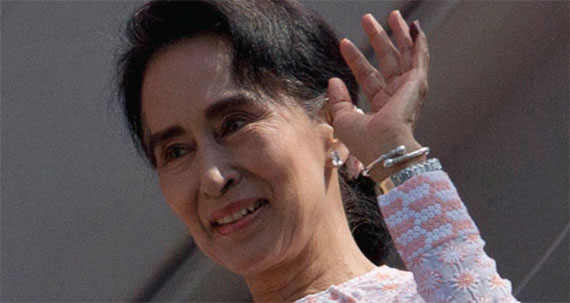
Will a visit from Pope Francis compel Aung San Suu Kyi to act?

For the past three weeks, the world has watched aghast as Myanmar’s military has carried out the latest, most deadly phase of a five-year operation against the Muslim Rohingya people who number about 1.1-1.3 million.

It has been an outrageously outsized reaction by Myanmar’s notorious military, known as the Tatmadaw, to a small attack by what is, thus far, a threadbare insurgency that has taken clearer shape as the Arakan Rohingya Salvation Army. It’s o15f little surprise that the Rohingya, who have suffered waves of persecution and terrorisation by Myanmar’s military, and Burma’s before it, for countless decades, have finally decided to fight back. That is now being used as an excuse for what the UN High Commissioner for Refugees has called a textbook case of ethnic cleansing. In forcing roughly half the Rohingya population from their homes, it’s hard to call it anything else.

At the same time, the world has been bewildered, then dismayed, as arguably the most internationally (and domestically) beloved Nobel Peace Prize Laureate since Nelson Mandela, Myanmar’s state counsellor, foreign minister and de facto leader Aung San Suu Kyi has remained all but silent. When she has opened her mouth, it has only been to put her foot in it by introducing red herrings such as the alleged complicity of NGOs in the insurgency. She remains unable, for largely political reasons, to utter the word Rohingya or even to make comments of any concern about the fate of the latest victims of one of the world’s most murderous militaries.

Francis responds to critics: Morality of ‘Amoris Laetitia’ is Thomist

Pope Francis appears to have responded indirectly to the four cardinals who publicly challenged him last year over his most recent teachings on family life, as contained in the 2016 apostolic exhortation Amoris Laetitia.

In a question and answer session with members of the Jesuit order in Colombia earlier this month, the text of which was made public for the first time Sept. 28, the Pope referenced those who “maintain that there is no Catholic morality underlying Amoris Laetitia, or at least, no sure morality.”

“I want to repeat clearly that the morality of Amoris Laetitia is Thomist, the morality of the great Thomas,” said Francis, referring to 13th century Dominican theologian St Thomas Aquinas.

“I want to say this so that you can help those who believe that morality is purely casuistic,” the Pope told the Jesuits, according to a text of the encounter published Sept. 28 by La Civiltà  Cattolica.” Help them understand that the great Thomas possesses the greatest richness, which is still able to inspire us today.”

Four cardinals wrote to Francis in September 2016 with five yes or no questions about how he understood Church teaching following publication of the apostolic exhortation. After not receiving a response to their letter, the cardi-nals made their letter public in November 2016.

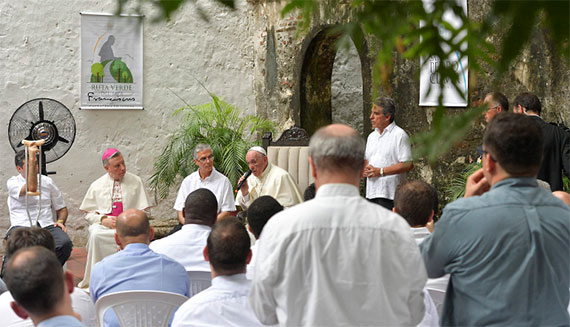
Francis visited Colombia from Sept. 6-11 and met privately with about 65 Jesuits Sept. 10 during his visit to the city of Cartagena. The Pope spoke about Amoris Laetitia in response to a question from a Jesuit about what kind of theological and philosophical questioning he wants the wider Church to undertake.

He said first that he does not want philosophy to be undertaken “in a laboratory, but in life, in dialogue with reality.” He referred to how Pope Benedict XVI had spoken of truth “as an encounter, that is to say no longer as a type of classification, but a path.”