Philippines: Muslim and Christian leaders united against Maute terrorists

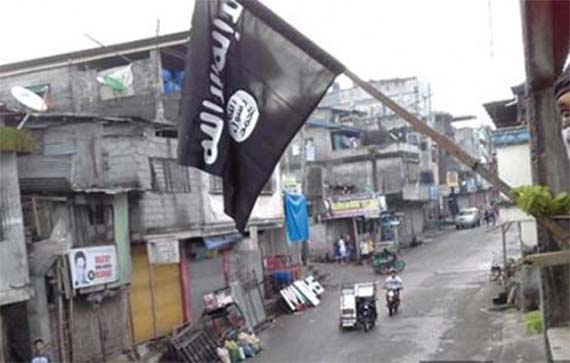
Muslim community leaders in the Philippines have expressed their support for the beleagured Christian community in Marawi. The crisis there has entered its another weeks since 23 May when Maute terrorists occupied the city, torched the cathedral, burning down schools, and forcing the civilian population to flee. They kidnapped about 200 people, including Fr Teresito (Chito) Suganob and 15 parishioners.

With the proclamation of martial law and the massive intervention of the Philippine army to free the city, the terrorists are now confined in a small area and hide themselves in some underground tunnels.

In the last few hours, the army captured Cayamora Maute in Davao, father of the two brothers Abdullah and Omar Maute, founders of the terrorist group.

Although Philippine President Rodrigo Duterte has officially said that “there will be no negotiations with the terrorists,” Fides reports that the arrest of Cayamora Maute could be useful for informal negotiations aimed at the release of hostages who are now being used as human shields.

The Bishop of Marawi, Edwin de la Pena said: “Fighting still continues in Marawi and we fear for the hostages. We have no news about their condition: They were kidnapped, they may need food, water and medicines, and they are surely exhausted. We pray for them.”

The Bishop said he was appalled at the release of a video on social media, showing young armed militants desecrating statues and sacred images and destroying the cathedral.

“It is an immoral act of blasphemy. Terrorists want to instill hatred in Christians and provoke a reaction. Our reaction will only be prayer, brotherhood and interreligious solidarity that many Muslim friends have shown us recently. They have also been helping and defending the Christians of Marawi, “ he said. “Our spirit is the evangelical spirit of love for the enemy,” Bishop Edwin said.

Several Muslim leaders have expressed their grave concern. Alim Abdulmuhmin Mujahid, vice president of the Ulama Council in Basilan condemned the profanation of the cathedral saying it was “non-Islamic.”

The Governor of the autonomous Region of Mindanao, Mujiv Hataman has invited all Muslims in Mindanao to “condemn the action of terrorists linked to the Islamic State” and asked Muslims and Christians “not to fall in Maute’s trap” that want to trigger social and religious conflict.

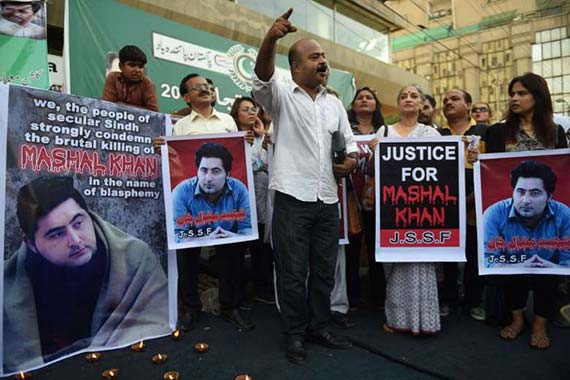
Report shows that lynched student did not blaspheme

Mashal Khan, a student who was lynched for blasphemy, never uttered an offensive word towards the prophet, this according to the official joint report by Pakistani police and intelligence agencies.

The Supreme Court had ordered the probe to shed light on one of the most violent episodes in the history of modern Pakistan.

The report notes that the death of Mardan University student was the result of a plot orchestrated by faculty members and student rivals who wanted to punish him for daring to complain about widespread corruption.

Relieved by the conclusions, Mashal’s father, Muhammad Iqbal, said that the findings had vindicated his son. “This proves my son was not a blasphemer,” he said. On 13 April (Maundy Thursday), the 23-year-old student was stripped, beaten, and killed. After he died, a mob desecrated his body with kicks, punches and sticks. The killing was instigated by members of Khan’s own Pakhtun Students Federation, who felt threatened by his growing prominence as a critic of rising fees and alleged corruption at the university, as well as by the institution’s staff.

“Unfortunately, blasphemy charges have been used all too frequently to settle even smaller scores, [but] So great is the emotional wave around a blasphemy case that it often results in riots, making an honest inquiry next to impossible,” says an editorial in The Dawn, Pakistan’s largest English language daily newspaper.

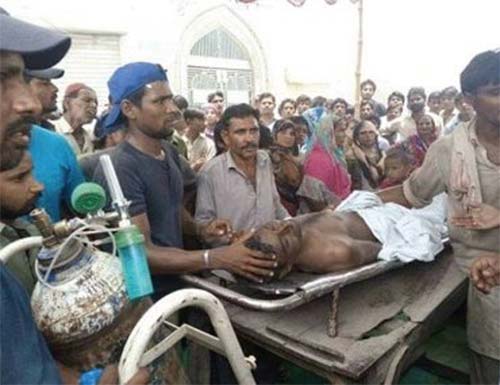
Doctors refuse treatment, Christian sewage worker dies in Pakistan

A Pakistani Christian sewer-age cleaner has died after three doctors refused to treat him until his sludge-covered body had been washed. The physicians said their Ramadan fast would be invalid (“makruh”) because he was “un-clean” and belonged to a low caste. The word for low caste, “chuhra,” especially derogatory, is reserved for sanitary workers and often used in Pakistan synonymously for “Christian.” Irfan Masih died on June 1, in Umar Kot Civil Hospital, Sindh, 300 kilometers from Karachi. Umar Kot has about 75 Christian families; almost all of them work as sanitary workers, a job that many Muslims refuse to do.

Writer Ethan Casey notes: “Most Pakistani Christians today still do the same work as their untouchable ancestors: sweeping the streets and doing other menial jobs formerly deemed ritually or literally unclean by higher-caste.” Unmarried 35-year-old Irfan Masih, who lived with his family, reached his workplace at about 7 a.m. on June 1. Two Christian sanitary workers – Shaukat Masih and Yaqoob Masih – were ordered by their seniors, with Irfan, to unblock sewerage lines. They were not provided with any protective gear, his brother Parvaiz told World Watch Monitor.

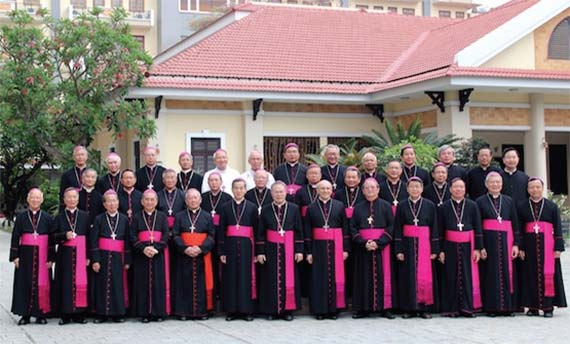
In bold words, Vietnam’s bishops criticize new religion law

Vietnamese bishops have told high ranking communist officials, they are critical of a new religion law that is to take effect next year while also finding fault with the government’s belligerence toward religions. In a formal statement, the bishops criticized the Law on Belief and Religion because it “continues to strengthen asking-and-granting mechanism.” The bishops’ statement said the law replaces words “asking permission” and “giving permission” with “registering, informing, proposing,” which still request “religions to inform government authorities about their activities that authorities may or may not approve.”

“This mechanism shows that religious freedom is really not considered a human right but a grace that needs permission (from the government),” said the statement signed by Archbishop Joseph Nguyen Chi Linh, head of the Catholic Bishops’ Conference of Vietnam and Bishop Peter Nguyen Van Kham, its secretary general. “It is the mechanism itself to legalize the government’s intervention in religions’ internal issues and its tight control over religious activities,” they said. The Catholic Church serves 7 million Catholics in Vietnam. The Vietnamese government currently recognizes 39 religious organizations from 13 religions, with 24 million followers.

To escape abusive marriages, many Christians in Pakistan convert to Islam

For a Pakistani Christian like Shameela Masih, divorcing her abusive husband meant two choices — both nearly as bad as staying in the marriage.

“I have to prove adultery allegations against him,” said Masih, a 34-year-old mother of two. “The other option I have is to convert to Islam.” Masih recently filed for divorce from a husband she said “frequently beats me up” and a mother-in-law who she said burned her leg with coal.

But under the majority-Muslim country’s laws, she must produce a witness who would testify to committing adultery with her husband. As a result, she’s now reluctantly planning to renounce her faith.

“Converting is the easiest way out,” she said. “My family tells me that they will disown me as a Muslim, but I don’t have a choice.”

Masih is one of thousands of Christians in Pakistan who have converted to Islam to divorce their spouses under laws stemming from the British colonial period, when traditional morals held sway.

Now Pakistani officials are considering revising the law to make it easier for couples to part ways.

FRANCIS EXERTS PAPAL AUTHORITY REQUESTING CARDINALS INFORM HIM OF THEIR WHEREABOUTS, REVEALS LEAKED LETTER

Cardinals living in Rome should inform Pope Francis when they leave the city and provide him with their address when they are abroad, a leaked letter reveals.

The request is revealed in a letter sent by Cardinal Angelo Sodano, the Dean of the College of Cardinals, who informs the prelates that it is a “noble tradition” for them to keep both the Pope and the Holy See’s Secretariat of State up to date with their movements.

“Pope Francis has recently requested of the Dean of the Cardinalatial College to fraternally remind each single Cardinal the opportunity of keeping that practice, even more so in the case of an extended absence from Rome,” read the letter dated 31 May but revealed today by Francis Rocca of the Wall Street Journal.

Those living in Rome are in charge of Vatican departments, but many are frequent travellers who fly around the world giving talks and attending major Church summits.

Throughout his papacy, Francis has sought to govern the Church collegially with his fellow cardinals, and to that end set up a cardinal-advisory body – the C9 – which is meeting in Rome.

One of those often on the road is Cardinal Raymond Burke, who is threatening to formally correct Francis for watering down teaching on giving communion to divorced and remarried Catholics.

Sources close to the cardinal say he always tries to accept invitations to speak abroad. In March while speaking in Springfield, Virginia, the cardinal used the opportunity to restate that he will “simply have to correct the situation” regarding allowing the remarried to receive the sacraments.

Last year, another cardinal seen at odds with Francis’ papacy used a trip to London to call for priests to face east when saying Mass. Cardinal Robert Sarah, who is in charge of the Vatican’s liturgy department, was later publicly rebuked by the Pope.

Denmark repealed its blasphemy law. Will other nations follow?

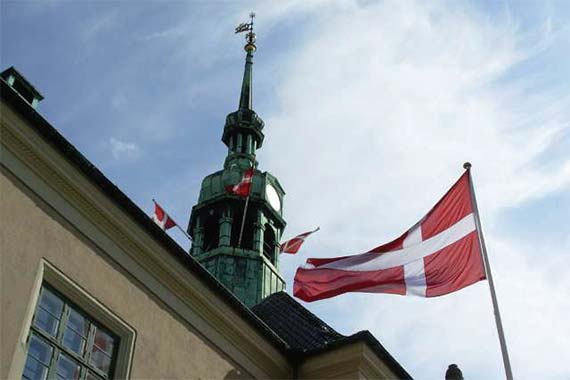
The Danish parliament has repealed an anti-blasphemy law at a time when such laws are still used around the world.

“I am glad they are dropping the law. But the law was almost never used in the last 46 years, so it is only a small step,” Paul Marshall, Wilson Professor of Religious Freedom at Baylor University, told CNA. He thought it significant that it had not been used in recent instances of blasphemy against Christian.

The Danish People’s Party had also supported repealing the law, while the Social Democrats were supportive of the legislation.

In the history of the law, only eight cases were brought under it. Only two sets of convictions have resulted. A 1938 conviction punished four people who hanged up public posters and printed in newspapers mockeries of Jewish belief. In 1946, two people were convicted for mock-baptizing a doll during a masked ball in Copenhagen.

One such law was used in the case against Lars Hedegaard, a Danish Marxist historian and journalist who has made strong criticisms of Islam. In 2011 he was fined on evidence of a recording of his remarks at home which criticized Islamic society, including claims of familial rape. The fine was thrown out in a 2013 decision by the Danish Supreme Court.

“In practice these function as quasi-blasphemy laws, or are ways of silencing unpopular views,” Marshall said.

Mali Church in crisis over Swiss Leaks bank revelations

Until recently the dossier was under the radar of journalists from the International Consortium of Investigative Journalists (ICIJ), who have been making inquiries on the Swiss Leaks scandal, a vast system of tax evasion promoted by the Swiss subsidiary of the British HSBC bank and which was revealed in 2015.

But now Le Monde published an article on its website on Wednesday, May 31 implicating high-ranking leaders of the Catholic Church in Mali. These include Archbishop Jean Zerbo of Bamako, the 73 year old prelate who was named as a cardinal by Pope Francis on May 21.

The accusations concerning Archbishop Zerbo date back to the period when he was the head of the finance commission of the Bishops Conference of Mali (CEM). It was then chaired by Bishop Jean-Gabriel Diarra, 71, currently bishop of San and who was also named in the Le Monde article.

The accusations have stunned the Christian community of Mali, which represents less than 3% of the nation’s 17 million inhabitants.

“At a time when we are celebrating the elevation of Archbishop Zerbo to the cardinalate, we learn that the Church may have bank accounts in Switzerland. Even if we take this with a pinch of salt, it is a shock for many people,” comme-nted Théodore Togo, secretary-general of Caritas Mali.

“Everything decided by the Conference is done transparently and regularly evaluated,” said Fr Edmond Dembélé, current secretary-general of the CEM.

“And to my knowledge, we do not have a bank account in Switzerland.”

“I would like to believe that the Malian bishops have not done anything legally reprehensible,” comments Jean Merckaert, editor in chief of Projets magazine, which is published by a French Jesuit and lay team.

1,600-Year-Old frescoes depicting early church uncovered in catacomb

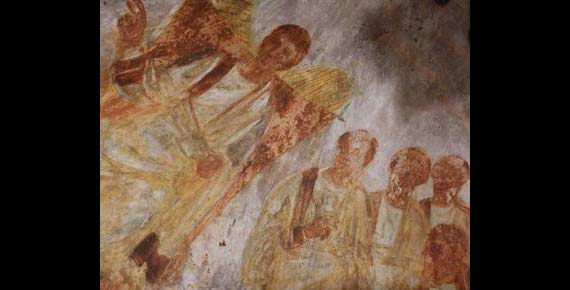
Ancient frescoes depicting the early Christians and some scenes from the Bible were uncovered in Rome’s oldest catacomb located near the Appian Way.

The frescoes, estimated to be 1,600 years old, revealed a “fusion” of pagan symbols and images related to the Christian faith, indicating recent conversion from paganism to Christianity, project head Barbara Mazzei said, according to The Telegraph.

“It’s a fusion of older pagan symbols with new Christian images. The family had only recently converted to Christianity,” project head Barbara Mazzei said. Painted from the catacombs’ ceiling are colourful artworks showing famous biblical scenes, such as Jesus feeding the five thousand, Daniel and the lions and Noah’s Ark.

An image of Jesus Christ, seated on a throne with a man on his right and another on his left, could be seen at the centre. The men were believed to be either the apostles Peter and Paul or St Nerius and St Achilleus.

These images were not always visible, as the catacombs’ ceilings used to be completely black. “When we started work, you couldn’t see anything – it was totally black. Different wavelengths and chromatic sele-ction enabled us to burn away the black disfiguration without touching the colours beneath,” Mazzei said. The frescoes had been covered with algae, smoke stains from oil lamps and calcium deposits for centuries. They were restored through the use of laser technology that effectively peeled off the grime, revealing the fascinating artwork beneath.

Attending Church Is Good for Your Health, Longevity: Study

One of the results of attending church is that you have better health and live longer than those who do not, according to a recent study by Vanderbilt University professor Marino Bruce.

“We found in our study that actually attending church is actually good for your health, particularly for those who are between the ages of 40 and 65,” Bruce, the associate director of Vanderbilt’s Centre for Research on Men’s Health, says in a video posted to YouTube by the university.

Middle aged adults who attend church reduce their mortality by 55 percent, Bruce says, adding, “For those who did not attend church at all, they were twice as likely to die prematurely than those who did who attended church at some point over the last year.”

The professor’s study, “Church Attendance, Allostatic Load and Mortality in Middle Aged Adults,” published in the Plos One journal, used publicly available data from the National Health and Nutrition Examination Survey involving 5,449 participants, both men and women. It looked at participants’ worship attendance, mortality and allostatic load, which is a physiological measurement, and social support.

The study had 89,708 women aged 30 to 55 years from across the United States as participants. It was published in July in JAMA Psychiatry.

In the conclusion, the authors of that wrote: “Our results do not imply that healthcare providers should prescribe attendance at religious services. However, for patients who are already religious, service attendance might be encouraged as a form of meaningful social participation. Religion and spirituality may be an underappreciated resource that psychiatrists and clinicians could explore with their patients, as appropriate.”