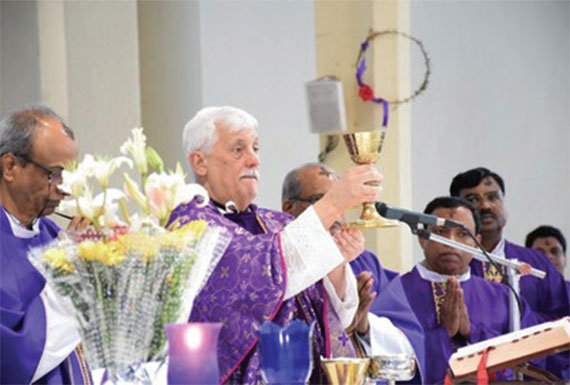
The Catholic who could succeed Angela Merkel

The German Chancellor Angela Merkel, having just formed her fourth government, has established herself as one of Europe’s longest-serving leaders. But she enters her new term of office in a weakened position, and speculation has been turning to her possible successors.

In last year’s general election Merkel’s Christian Democratic Union (CDU) polled the lowest share of the vote in its history, and has remained in power only because its rivals are even weaker and unable to form a majority. Merkel has also come under fire from party colleagues for giving away too much ground on core policies during the months-long coalition talks with the minority Social Democrats (SPD).

Monument to Alexander Solzhenitsyn unveiled in Moscow

At a ceremony on Alexander Solzhenitsyn Street in Moscow, Russian President Vladimir Putin unveiled a new monument of Solzhenitsyn on the 100th anniversary of the writer’s birth on 11 December 2018. The bronze monument sitting on a granite pedestal was designed by National Artist of Russia Andrei Kovalchuk. His project won the architecture and sculpture tender held in 2017 by the Union of Moscow Architects at the initiative of the Alexander Solzhenitsyn House of Russian Expatriate Community, with the support of the Ministry of Culture. President of Russia Vladimir Putin said.

He clearly delineated the true, genuine, people’s Russia and the totalitarian system, which brought suffering and severe trials to millions of people. But even being in exile, Solzhenitsyn would not tolerate anyone to speak evil or scornfully of his homeland, and opposed any manifestations of Russophobia.

A man of integrity, an exceptionally principled person, Solzhenitsyn never wanted to be comfortable. In his writings, in his literary, journalistic and social activity, he openly and consistently defended his views and convictions, and argued the unconditional value of the morals that provide for a healthy society.

Without understanding the country’s past there can be no meaningful movement into the future, Solzhenitsyn believed. Therefore, he directed his efforts toward finding and designating ways to improve Russia, so that the hardest and most dramatic trials that befell our country would never happen again, so that our multi-ethnic people would live in dignity and justice. This is how he saw his mission, his goals and the meaning of his service.”

New survey documents how people deal with grief at Christmas

For most people, Christmas is a joyous time with family and friends; but this joy can turn to grief when those family and friends have died.

How people deal with this sadness was the focus of a survey published Dec. 10 from St Mary’s University, Twickenham, that asked 2000 people across the United Kingdom what they do at Christmas in memory of deceased loved ones.

The survey is part of the University’s project, The Art of Dying Well, which offers practical and spiritual support to those faced with the prospect of death and dying.

“The Art of Dying Well commissioned this survey to try and help the bereaved navigate a way through what can be a very tough season,” said Maggie Doherty, the director of the project. Those taking the survey were given 16 possible ways to remember the deceased, although they were given the opportunity to write in other options.

The most popular option – at 32% – was to simply share memories of the loved one with friends and family.

Other popular activities to remember the dead included lighting a candle (20%), laying a wreath on a grave (20%), saying a prayer (16%), and making a special toast (15%).

“Holidays are a time to get the family together, particularly at Christmas. When a loved one is missing from those get-togethers, the sense of loss can be overwhelming,” Doherty told Crux.

Rodrigo Duterte’s office denies he wants to kill bishops

The office of Rodrigo Duterte, the controversial Philippine president, on December 6 was forced to play down remarks he had made about killing bishops, claiming it was only “hyberbole” and not a genuine threat. In a speech to local government officials on December 5, Mr Duterte, who has a running feud with the influential Catholic Church over its criticisms of his drugs war, lashed out again, calling it “the most hypocritical institution” and denouncing priests as “useless.”

“These bishops, kill them, those fools are good for nothing. All they do is criticise,” he said, according to the Rappler news site.

Salvador Panelo, the presidential spokesman, later clarified to reporters that the president’s provocative statement was borne out of frustration that his efforts to improve the country were being under-appreciated.

“I think that’s only hyberbole on the part of the president. We should be getting used to this president. He makes certain statements for dramatic effect,” he said.

“The president, just like any ordinary human being, is upset when the good things that he does for this country and not even appreciated by people who are supposed to support it, like the Church,” Mr Panelo added.

However, the country’s Commission on Human Rights slammed his statements against religious leaders as “gravely alarming,” warning that they could embolden violence against government critics, reported the Philippine Star.

“Churches and priests… work directly with communities and families who continue to suffer the many forms of human rights violations allegedly stemming from the government’s drug campaign,” said Jacqueline Ann de Guia, the CHR spokesperson.

Catholic bishops show solidarity with embattled youth in Middle East

“In light of the difficulties and challenges you face in the midst of the current situation in the Middle East, and in light of the bleak migration that threatens your future and the Christian presence [in the region] as a whole, we stand by you,” the Conference of the Catholic Patriarchs of the East wrote in a statement capping their Nov. 26-30 annual meeting in Baghdad.

The meeting ran under the theme “Youth is a sign of hope in the Middle East countries.”

“As we share the same present pain, we look forward to a bright future with your presence, and we assure you that we will work together to provide the foundations of your steadfastness and steadfastness in your land,” the patriarchs said, as reported by Catholic News Service.

The last official census in Iraq in 2003 put the Christian population there at between 1.2 million and 2.1 million but their numbers have since dwindled to about a quarter of a million, according to the American NGO Open Doors.

Cardinal Louis Sako, Patriarch of Chaldean Catholics, drew attention to the danger posed by groups like Islamic State (IS), which routinely target Iraqi Christians and other religious minorities for kidnappings and killings.

Filipino Catholics challenge Duterte attacks on church

Filipino Catholics are not letting relentless attacks by President Rodrigo Duterte on the church and its leaders go unchallenged. An influential lay organization has called on Catholics “to stand up for God and defend our faith in Him … [and] renew our commitment to go and fill our churches.”

The Sangguniang Laiko ng Pilipinas, the Council of the Laity, said “more than ever, [Catholics] are called upon to live a life worthy of our Christian vocation.”

Julieta Wasan, its president, called on Catholics to proclaim their faith “courageously” not only through words but especially “by the life that we live as faithful followers of Christ.”

The Catholic Theological Society of the Philippines, mean-while, has expressed its “solidarity” with Bishop Pablo Virgilio David of Kalookan, who has been a major target of Duterte’s vitriolic attacks. The president claimed the prelate stole money from church collections and even insinuated that the bishop may even be involved in illegal drugs, making him a target for extrajudicial killing, according to some observers.

Chengdu, abuse and police violence after the arrest of 100 Protestant Christians

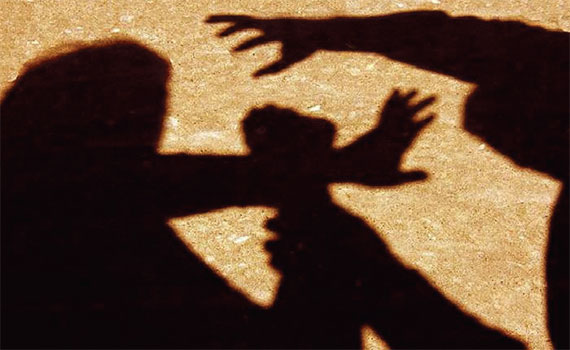
About 100 Protestant Christians and seminary students were arrested in Chengdu (Sichuan) between 9 and 10 December. Some of the faithful, later released claimed they were “raped and abused” by the policemen who kept them in custody.

Among those arrested are Pastor Wang Yi and his wife Jiang Rong , taken away by the police; two others, Guo Hai and his wife, were dragged away from home, leaving their two children alone.

Many were arrested at the community headquarters; others were taken from their homes. The arrests continued even today, when Li Yingqiang, who had hidden himself in the first raid and warned the media, was also arrested.

The community has about 500 members and 300 sympathizers. It is not new to arrests and raids. Last June their headquarters was closed because the community had wanted to remember the people killed in the Tiananmen massacre with a memorial service. Some of his members were arrested two months ago because they were evangelizing in the street near the Chengdu station.

Myanmar women forced into marriage in China

Thousands of impoverished ethnic minority women in Myanmar’s war-torn Kachin and Shan States have been forced into marriages in neighbouring China, say the authors of a new study published by Johns Hopkins University in the United States.

Thousands more disadvantaged women in the country’s mountainous northern most rural hinterland remain at risk of being trafficked across the border to marry local Chinese men against their will and bear children for them, the experts warn.

For the study, which is the most comprehensive research of its kind to date, experts from the American university teamed up with the Kachin Women’s Association Thailand, a rights group, to conduct surveys in 40 communities around three adjacent administrative areas: Kachin State and northern Shan State as well as Yunnan province in China.

All told, researchers say, about 7,500 ethnic minority women in economically disadvantaged communities have in recent years been lured by human traffickers into forced marriages in China on false promises. Three-quarters of the women were found to have borne children in these unions.

“These women are usually undocumented, members of minorities, poor and undereducated, and don’t know how to get legal redress [after being trafficked]. This is known to traffickers who exploit it,” says W. Courtland Robinson, an associate professor at Johns Hopkins University’s Bloomberg School of Public Health who was the study’s lead author.

Christianity as Indian as Indic religions: Mukherjee

Christianity is as Indian a religion as those that originated in the country, says former President Pranab Kumar Mukherjee.

“Indigenization, adaptation and respect of local customs and traditions have made Christianity as Indian a religion as the ones that originated in its ancient geographical boundaries,” Mukherjee asserted on December 13 while addressing Christmas celebrations organized by the Catholic Bishops’ Conference of India (CBCI) in New Delhi.

The former president, who was the chief guest of the program held at the downtown Diocesan Community Centre, noted that the Church’s 2000 years of existence in India has been “more Renaissance and Reformation and rarely about Evangelism.”

For Mukherjee, “the most enduring images of the Catholic Church in India” are millions of Indians, who study in its educational institutions, and hundreds of thousands of patients who get healed in its hospitals.

“The Catholic Clergy in India is personified by the priest or nun in a habit, the very image of whose brings to one’s mind, discipline and dedication. It is the heartening images of Missionaries of Charity led by Mother Teresa, tending to the last person on the margin of society that personifies the Church in India,” he added.

Mukherjee’s assertion comes in the backdrop of calls from some rightwing groups to cleanse India off Christianity by 2021.

“Aberrations of a crusade, a jihad or violent struggles between sects in India, were always defeated in the favour of longer reigning brotherhood, peace and resultant prosperity of mankind,” he added.

Every religion, he noted, “strove to direct human endeavours towards the three basic tenets of Truth, Compassion and Righteousness. It was these tenets that comprised the Ram Rajya of Hinduism, Dharma of Buddhism, the Holy Kingdom of Christianity and many more.”

Mukherjee, who served as India’s 13th president during 2012-2017, agreed that the country was going through troubled time. “Divisive tendencies, intolerance and prejudiced ‘fear of the other’ seem to be defining us.”

Protesters bang drum for Christian Dalits’ rights

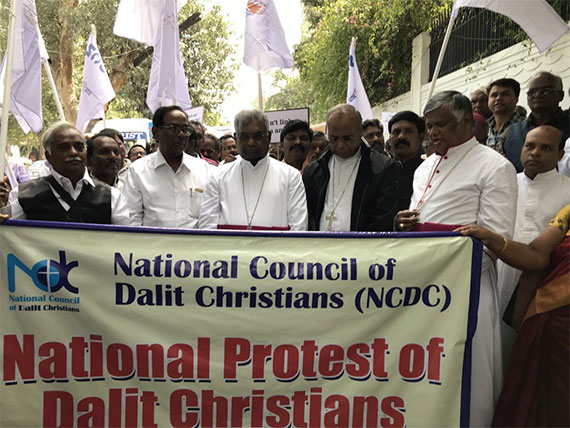
Beating their drums, some 200 socially poor Dalit people marched through the streets of Indian capital New Delhi on Dec. 4 in a novel form of protest to demand that they be given social benefits denied to them because of their Christian faith.

Participants in “the drum, dance, demonstration” played their drums near parliament to demand that the government withdraw a 1950 presidential order that said only Dalits of Hindu religion should be given social security benefits meant for Dalit people’s advancement.

“Government comes and goes, and we get only false promises. Several protest rallies and marches in the past were useless. Now we play our drums to wake up the sleeping government,” said Father A. Arputharaj, a protest organizer from Pondicherry and Cuddalore Archdiocese in Tamil Nadu.

The Indian constitution has special provisions to assist Dalit people’s educational and social advancement with financial aid and reserved seats in jobs and educational institutions.

Official Website

Exit mobile version