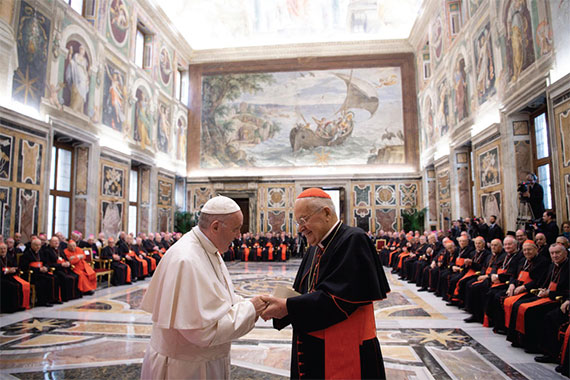
Msgr Machado with Pope Francis in Abu Dhabi: The Church must go everywhere

Msgr Felix Machado is the archbishop of Vasai and president of the Office for Ecumenism and Interfaith Affairs of the Federation of Asian Bishops’ Conferences. For him, “It is not just where Catholics are that the Church must go.” The papal visit is not a waste of time. He was in Abu Dhabi from 3 to 5 February along with the pontiff for an international interfaith meeting called Human Brotherhood. This will be the first visit by a Pope to the Arabian Peninsula. The archbishop’s comments follow.

The visit of the Pope to UAE is very important. There are conservative and politicized voices which criticize Pope’s visit, saying that it is a waste of time to invest Pope’s efforts on a visit to a place where there is no native Catholic. It is not just where Catholics are that the Church must go. We must go to such places where there are no Catholics, precisely to explore the possibilities for the future.

ASIA BIBI: PAKISTANI AUTHORITIES BARRING HER FROM LEAVING, FRIEND SAYS

Pakistani authorities have moved Asia Bibi, a Christian woman recently acquitted of blasphemy charges, to a new “secure area” and are barring her from leaving the country, a close friend and rights campaigner has claimed.

Bibi, who spent eight years on death row, was transferred from a location near the capital to a house in the southern port city of Karachi, her friend Aman Ullah told the Associated Press. She and her husband are locked in a single room in a house where the door opens only “at food times,” he added.

Canada has offered her asylum and she wants to join her daughters there. Pakistani authorities have said she is free to travel, but  Bibi, 54, says she is being prevented from going.

“She has no indication of when she will leave,” said Ullah, who added that Bibi was frightened and frustrated. “They are not telling her why she cannot leave.” He spoke to her by telephone, after the threats from extremists angered by his assistance to Bibi forced him to flee the country.

Ullah has been liaising with diplomats over the case, and he says they were told Bibi’s departure would only come “in the medium-term.”

Publicly, Pakistani authorities insist that Bibi is free both inside Pakistan, and to leave it. “She is living with her family and given requisite security for safety,” the information minister, Fawad Chaudhry, told the AP in an email.

He said the government was responsible for taking “all possible measures” to protect her and her family, adding that “she is a free citizen after her release from jail and can move anywhere in Pakistan or abroad.”

SEVEN CHURCHES AND COMMUNITIES SUPPRESSED IN QIQIHAR DIOCESE

At least seven churches and their communities have been suppressed in recent months in the diocese of Qiqihar, whose bishop, Msgr Giuseppe Wei Jingyi is recognized by the Holy See, but not by the government. Members of the United Front, police, representatives of the Religious Affairs Bureau entered the churches while mass was being celebrated, interrupted the liturgical services, chased the faithful away, threatened them and decreed the closure of the communities. The priests were asked to leave the territory if they did not want to be forcibly expelled. The suppressed communities are all “underground,” that is unregistered. However, until now they had good relations with the local authorities. There are two curious facts: first of all the suppression began at the end of September, shortly after the signing of the agreement between China and the Vatican (22 September) and the lifting of the excommunication of the official bishop of the area, Msgr Giuseppe Yue Fushen of Harbin; secondly, it should be emphasized that Msgr Wei, despite being an underground bishop, also enjoyed good relations with the authorities. The dynamics of the suppressions reflect the implementation of the new regulations for religious activities (launched in February 2018), which provide for the elimination of the underground Church. The implementation has been ongoing since the end of September, as if the China-Vatican agreement had precipitated the times: as a sign of challenge, or of the united front’s certainty towards the Vatican.

CARDINAL FILONI: “HOLY SEE-CHINA PROVISIONAL AGREEMENT OF HISTORICAL SIGNIFICANCE”

Cardinal Fernando Filoni, Prefect of the Congregation for the Evangelization of Peoples, followed the delicate and complex path of the Catholic Church in China since 1992, the year of its arrival in Hong Kong. In those same years the diplomatic detente began between the People’s Republic of China and the Holy See, with the first contacts between members of the Secretariat of State and the Ministry of Foreign Affairs of Beijing. Your Eminence, for several years now you have led the Dicastery of the Holy See responsible for evangelization, with particular reference to the so-called “mission” territories. Cardinal Fernando said the following on  the pastoral significance of the “Provisional Agreement on the Appointment of Bishops” signed by the Holy See and the Chinese Government on 22 September 2018?

“Since the Dicastery that I oversee has a particular responsibility for accompanying the Church in China, I feel particularly called upon to speak about the pastoral significance of the Provisional Agreement. But I think Pope Francis said it best when, in his Message to the Catholics of China last September, he wrote: Furthermore, “The Provisional Agreement signed with the Chinese authorities, while limited to certain aspects of the Church’s life and necessarily capable of improvement, can contribute – for its part – to writing this new chapter of the Catholic Church in China. For the first time, the Agreement sets out stable elements of cooperation between the state authorities and the Apostolic See, in the hope of providing the Catholic community with good shepherds.”

BP. HINDER: THE POPE IN ARABIA WILL BE A BRIDGE FOR DIALOGUE WITH MUSLIMS

Pope Francis’s visit to the United Arab Emirates (UAE), a country where most migrant workers are Catholic from different Asian countries, is an “encouragement and a recognition of their existence and value,” this according to Paul Hinder, Apostolic Vicar of Southern Arabia (United Arab Emirates, Oman and Yemen). Speaking to AsiaNews on the eve of the first papal trip to a Gulf country, the prelate notes that “His presence shows the unity among us, in spite of tensions and differences that characterise a multinational and multicultural Church, which is united under the same sky.”

CHALDEAN PATRIARCH: ONE MILLION IRAQI CHRISTIANS HAVE EMIGRATED IN RECENT YEARS

In recent years, with the migratory flows of the Iraqi population to other countries, about a million indigenous Christians have left Iraq. Chaldean Patriarch Louis Raphael Sako recalls this in a message released on January 31 on the occasion of the sixth anniversary of his patriarchal election. On this occasion, the Patriarch traces a brief account of the events that have marked the years of his patriarchal ministry, outlining problems, difficulties, initiatives and hopes that have marked the path of the Chaldean Church. Among the emergencies, the Primate of the Chaldean Church recalls the flight of Christian populations from Mosul and the Nineveh Plains conquered by the jihadists of the Islamic State (Daesh) and the difficulties encountered in ensuring pastoral and material care for tens of thousands of refugees for more than three years.

VENEZUELAN ARMY BESIEGED HUNDREDS OF PROTESTERS IN MATURIN CATHEDRAL

As opposition marches were held across Venezuela on January 23, at least 700 opposition supporters were trapped in Maturin’s Cathedral of Our Lady of Mount Carmel for several hours, besieged by the Venezuelan Army.

The Jan. 23 marches were convoked by the National Assembly, Venezuela’s democratically elected legislature, which is controlled by the opposition. At one of these marches in Caracas, Juan Guaido, head of the National Assembly, declared himself interim president, calling leader Nicolas Maduro illegitimate.

Tens of thousands of Venezuelans marched in support of the opposition, and security forces met some of the protesters with tear gas. Local NGOs have said 14 people were shot dead during protests Jan. 22-23.

Bishop Enrique Pérez Lavado of Maturin reported that seminarians, priests, and some 700 people participating in the demonstration were besieged in the cathedral, with the military “trying to break their way inside,” according to the Venezuelan bishops’ conference on Twitter.

Soon after, Pérez reported that the soldiers had surrounded the church, with more than a thousand opposition demonstrators inside: “The National Bolivarian Army is guarding the entrances to Our Lady of Mount Carmel Cathedral where there are more than a thousand opposition supporters.”

According to a report on Twitter by Radio Fe y Alegría, government supporters were also inside the cathedral. The station said that Father Samael Gamboa negotiated with the security forces for the people to leave in groups, “to guarantee their human rights.”

The people took refuge in the cathedral due to repression by the regime’s security forces and by pro-government groups. Earlier this month, the bishops called illegitimate Maduro’s swearing in for a second term as president. Maduro won a May 2018 presidential election which was boycotted by the opposition and has been rejected by much of the international community.

HOPE WANES IN CHURCH WOUNDED BY SIN, POPE TELLS PANAMA CLERGY, LAITY

A church wounded by sin can paralyze, confuse and tire the hearts of Catholic clergy and laypeople, causing them to doubt their mission in the modern world, Pope Francis said.

Celebrating Mass at the Cathedral Basilica of Santa Maria La Antigua on Jan. 26 with priests, consecrated men and women and members of lay movements, the Pope warned that the burdens and troubles in the church can lead to a “weariness of hope” that “calls into question the energy, resources and viability of our mission in this changing and challenging world.”

“The weariness of hope comes from seeing a church wounded by sin, which so often failed to hear all those cries that echoed the cry of the Master: ‘My God, why have you forsaken me?’” he said. Thousands of pilgrims and Panamanians waited outside — some camped outside since 4 a.m. — cheering loudly as the bells of the cathedral hailed Pope Francis’ arrival.

Upon entering the 220-yearold church, the Pope was greeted with applause by those present, including President Juan Carlos Varela of Panama and his wife, Lorena Castillo.

The Pope then spent several minutes praying before a statue of Santa Maria La Antigua, patroness of Panama. The original image, which depicts Mary holding baby Jesus in her arms and carrying a rose, was first brought into the country by Spanish conquistadors in 1510.

During the Mass, Pope Francis consecrated the altar of the newly renovated cathedral. Removing his chasuble and rolling up his left sleeve, he poured chrism oil and anointed the altar. According to World Youth Day officials, the Cathedral Basilica of Santa Maria La Antigua is the first cathedral in the Americas to have an altar consecrated by a Pope.

CZECH LAWMAKERS APPROVE TAXATION OF CHURCH RESTITUTION PLAN

The Czech Parliament’s lower house has approved a proposal drafted by Communist lawmakers to tax the compensation that the country’s churches receive for property seized by the former Communist regime.

On January 23, 106-56 vote shows the rising influence of the Communists. The party is not part of the centre-left ruling coalition led by Prime Minister Andrej Babis but helped the minority Cabinet survive a confidence vote.

The nation’s churches, including the Roman Catholic Church and the Jewish community, have had some property held by the state returned, and they are also to receive some $3 billion over 30 years.

FRANCIS EXPRESSES OPENNESS TO MARRIED PRIESTS IN PLACES WITH ‘PASTORAL NECESSITY’

Pope Francis closed the door Jan. 27 on his making celibacy optional for all Catholic priests, but also expressed openness to allowing older married men to be ordained to the priesthood where there is a “pastoral necessity.”

In a press conference aboard the papal flight back to Rome after a five-day visit to Panama, the pontiff first stated firmly: “I am not in agreement with making celibacy optional.”

But the Pope then noted that there are areas of the world where Catholics are deprived of the Eucharist — mentioning specifically the Pacific Islands and the Amazon region — and said “it is a thing to think [about] when there is a pastoral necessity.”

“I believe that the issue must be open in this sense: where there is a pastoral problem because of the lack of priests,” said Francis. “I will not say that it must be done. Because I have not reflected, I have not prayed sufficiently over this. But the theologians must study.”

Francis spoke about priestly celibacy in a 47-minute press conference in which he also sought to downplay expectations for an upcoming February Vatican summit on clergy sexual abuse with the presidents of the world’s Catholic bishops’ conferences.

On celibacy, the pontiff was asked if he could imagine a future in which the Catholic Church would adopt the practice of Orthodox Churches, which allow priest candidates to choose during their formation period whether to marry or remain celibate.

The Pope referred to a phrase he attributed to Pope Paul VI: “I would prefer to give my life before changing the law of celibacy.” He noted that in the Orthodox tradition, priestly candidates must choose whether they will marry before they are ordained deacons.

“My decision is: optional celibacy before the diaconate, no,” said Francis.

“It’s personal, but I will not do it,” he said. “Maybe I am closed-minded, but I do not feel that I can place myself before God with this decision.”

“But where there is not the Eucharist … who will make the Eucharist?” Francis asked.

Official Website

Exit mobile version