
Pope Francis has ruled that new religious orders must receive Vatican approval before being established. It is a significant move that is likely to prevent the hasty establishment of small groups of religious and seeks to put an end to the sexual abuse scandals that have bedevilled such institutes in recent decades.
Francis has amended Canon Law meaning that local bishops will now need written permission from the Holy See before approving the setting up of communities of religious in their diocese. It also signals that bishops will be required to undertake a more credible and rigorous discernment than they have in the past before establishing congregations.
A proliferation of new “institutes of consecrated life or societies of apostolic life” have been established during the latter part of the 20th century, although many of them similar to one another. In an alarming number of cases, the founders of new orders have sexually and spiritually abused their members.
The Vatican has investigated a range of problems inside newly established congregations. These include cults of personality developing around the purportedly orthodox or charismatic founders; how members are formed; an excessive focus on traditionalist liturgies out of sync with the local church; authoritarian leadership styles; psychological manipulation oft those inside the groups and financial mismanagement.
“The faithful have the right to be advised by their pastors about the authenticity of the charisms and about the trustworthiness of those who present themselves as founders,” the Pope explained in the ruling. “It is the responsibility of the Apostolic See to accompany the Pastors in the process of discernment leading to the ecclesial recognition of a new institute or a new society.”
In a sign the Vatican is taking the issue very seriously, Archbishop José Rodríguez Caraballo, the secretary of the Holy See’s congregation for religious, recently wrote the foreword for a new book published this year Risques et dérives de la vie religieu-se (Risks and deviations of Religious Life), which examines sexual and spiritual abuses and how to combat them. The book is written by Dysmas de Lassus, the minister general of the Carthusian Order who is based at the historic Grande Chartreuse monastery in the French Alps. Carthusians, who follow a strict rule of silence, do not normally give their names publicly to what they write but in this case, de Lassus has made an exception.
Tag Archives: Pope
Pope warns Spanish prime minister of rise of nationalism, ideology
The rise of nationalism and the ideological divide that springs from it could create the same circumstances that led to the rise of the Nazi party in Germany and World War II, Pope Francis warned.
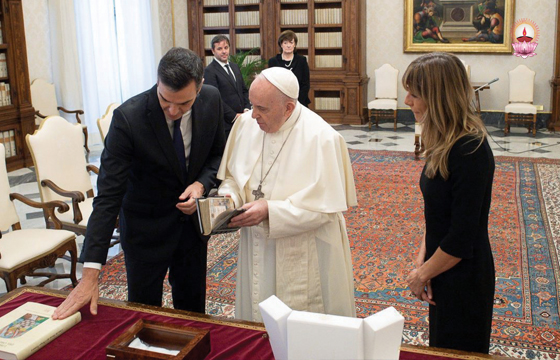
In a rare move, Pope Francis asked for a microphone and gave an off-the-cuff speech to Spanish Prime Minister Pedro Sanchez, who was accompanied by his wife, Maria Begona Gomez, and a delegation of officials on Oct. 24.
Citing a book by Italian philosopher Siegmund Ginzberg titled “Syndrome 1933,” the Pope said he agreed with its assessment that the ideological shift in today’s European political climate risks something similar to what occurred in Germany after the fall of the Weimar Republic, giving rise to the ideology of National Socialism, more commonly known as Nazism.
Ideologies “sectarianize, ideologies deconstruct the homeland, they don’t build it,” he said. And Ginzberg “very delicately, makes a comparison of what is happening in Europe. He says: ‘Be careful, we are repeating a similar path.’”
In his roughly eight-minute address to Sanchez and the Spanish delegation, the Pope recalled St Paul VI’s recognition of politics as “one of the highest forms of charity.” “Politics is not only an art, but for Christians it is an act of charity, it ennobles and often leads to the sacrifice of one’s life, one’s privacy, so many things, for the good of others, and this is because the politician has in his hands a very difficult mission,” he said.
The Pope’s comments came at a time of political division in Spain when lawmakers overwhelmingly rejected a vote of no-confidence on Oct. 22 brought against Sanchez, a member of Spain’s Socialist party, by members of the far-right Vox party.