The National Council of Churches in India has issued a statement condemning the reference to the Bible by Rashtriya Swayam Sevak Sangh chief Mohan Bhagwat, in order to justify the term “mob lynching.” In a statement on October 10, 2019, the NCCI said Bhagwat had misquoted the Bible. The NCCI stated: “We are shocked that such statements which have the potential to divide communities on religious lines are made in public fora.” The NCCI statement said this misrepresentation had “created suspicion among the people” and “humiliated the Christian minority”. It added, “We appeal all people not to be carried away by such misrepresentation or misinterpretation which are often done with political intentions.” At the annual Dussehra celebration at the RSS headquarters in Nagpur on Tuesday, October 8, 2019, Bhagwat had said that the concept of lynching was “alien to Bharat” and was being used to defame the “country and the entire Hindu society.”
Myanmar prelate decries religious leaders’ silence over killings
Cardinal Charles Maung Bo of Yangon says he is dismayed over the silence of religious leaders as civilians were killed and displaced as a result of ongoing fighting in conflicttorn Myanmar.
He said Oct. 1 that there were 500,000 Buddhist monks, 70,000 nuns, nearly 1,200 Christian pastors, more than 2,000 Catholic nuns and countless other religious leaders in the country.
“Some silence can be criminal. The war pursued is unjust and unholy,” Cardinal Bo said, adding that people’s prayers and rituals were being nullified by the blood and tears of innocent people. “Myanmar people are peace-loving and follow the guidelines of their religious leaders,” he said. “There is a huge potential for peace through religious leaders. Kindly raise your voice and speak out against this mutilating war. Innocent suffering will never go away. Their blood and tears will cry out from the grave.”

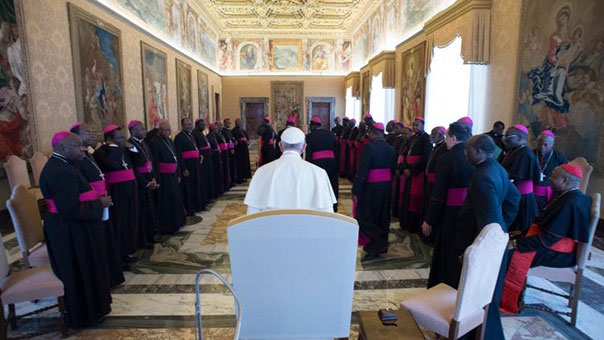
Nigerian Bishops decry attacks on Pope Francis
At the end of their recent meeting, the Catholic Bishops of Nigeria have said that attacks aimed at Pope Francis are ill-advised and describe them as “the proverbial ill wind that blows no one any good, bearing in mind that there are other more legitimate avenues of expressing opinions to the Holy Father.
The Second Plenary Meeting of the Catholic Bishops’ Conference of Nigeria (CBCN) was held at the Divine Mercy Pastoral Centre, Abeokuta, Ogun State from 11 September to 20 September 2019.
In their Communique issued at the end of the plenary, the Bishops particularly criticise those within the Church who are attacking Pope Francis.
“The Holy Father Pope Francis has come under attacks in recent times. Of more serious concern are the attacks coming from some higher levels of the church in some parts of the world. As members of the Episcopal College, of which the Holy Father is the Head, we regard these attacks as the proverbial ill wind that blows no one any good, bearing in mind that there are other more legitimate and traditionally tested avenues of expressing our opinions to the Holy Father,” the Bishops said.


Nepal pastor goes hiding amid social media backlash
Hindu extremist threats have driven a pastor in Nepal into hiding following a leak onto social media of a restricted audience-interview he gave on his journey to Christ, sources said.
Pastor Sukdev Giri of Trinity Fellowship Church in Chitwan District has received death threats, he said. He has changed his phone number, but his family and friends are also receiving threatening calls, he told Morning Star News.
In a sign of how the Himalayan country has become increasingly radicalized, Pastor Giri, 59, has been unable to return home from ministry travels since a video of his comments hit YouTube in mid-August.
“It is the first time a Christian [in Nepal] has been targeted for sharing [on social and other media] about his past religion and introduction into Christianity,” legal advocacy group Alliance Defending Freedom’s allied attorney in Nepal, Ganesh Sreshta, told Morning Star News. “It is turning out to be a high-profile issue, with Hindu fundamentalist groups linked to prominent political leaders taking interest in this video.”
The video shot in March at the International Christian Media Workers Summit in Kathmandu, where Pastor Giri was one of the speakers on a panel, was available only to Christian audiences until a Nepalese Christian woman abroad posted it on YouTube.
During the panel presentation on advice for Christian media workers, Nepalese radio journalist Sunil Raj Lama asked Pastor Giri to talk more about belief systems in Nepal.
“It is not something I would discuss with anybody just anywhere, but his question was very genuine,” Pastor Giri told Morning Star News. “Although I had cautioned Lama to edit the video and not to circulate it outside the Christian circle, the [Christian] persons who were the first to watch it on a private channel insisted that, ‘It is a hard truth – people need to hear it.”’
The unidentified Nepalese woman abroad who had access to the private channel posted the video on YouTube on Aug. 11, and the flood of hostile comments began.


Being elected pope doesn’t wash away one’s sins, pope says
While his responsibilities are greater and his prayer list longer, Pope Francis said he’s basically the same person he was before and he was elected in 2013, so he still goes to confession every two weeks. “The mere fact that I now dress all in white has not made me any less sinful or holier than before,” he told Jesuits in Mozambique on September 5th, according to a transcript of the meeting published on September 26th by La Civilta Cattolica.
Often on trips abroad, Pope Francis spends time with local Jesuit communities and holds a question-and-answer session with them. Weeks later, a transcript of the exchange is published by La Civilta Cattolica, a Jesuit journal in Rome.
In Mozambique, a Jesuit had asked the Pope how his experience of God has changed since he was elected Pope.
“I guess my experience of God hasn’t fundamentally changed,” he responded. “I speak to the Lord as before. I feel God gives me the grace I need for the present time. But the Lord gave it to me before. And I commit the same sins as before.”
“I am and I remain a sinner,” he told his fellow Jesuits. “That’s why I confess every two weeks.”
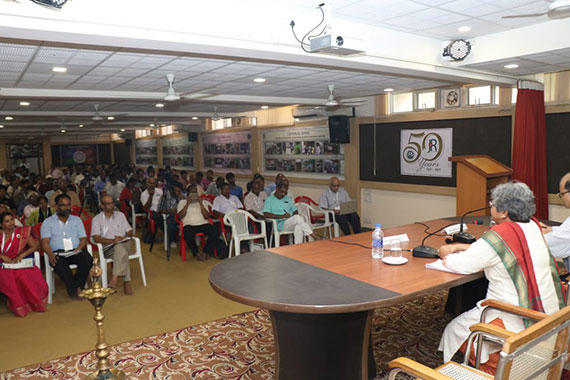
Justice mission claimed 56 Jesuits in 50 years
As many as 56 Jesuits have lost their lives since their congregation made a commitment to promote a “faith that does justice” and foster reconciliation in society 50 years ago, says an official of the Society of Jesus.
“If we want to stand for justice, we have to pay the price. We have sacrificed many Jesuits and their collaborators as our forefathers worked hard to bring justice and reconciliation in the world,” said Father Xavier Jeyaraj, director of Jesuits’ Rome-based Social Justice and Ecology Secretariat.
Father Jeyaraj, a member of the Calcutta Jesuit province, was addressing around 220 conferrers and their associates in South Asia who have gathered in Delhi to celebrate the golden jubilee of their congregation’s commitment to justice.
“If we want to commit for future, be ready to pay the price,” he told the opening session of the September 26-27 program at Navjeevan Renewal Centre in Old Delhi.
Father Jeyaraj, who went to Rome in 2017 after four years of service as the secretary of Jesuits in Social Action in South Asia, said similar celebrations have taken place in various continents and all of them were occasions to review their ways, re-strengthen themselves to recommit to justice.
The bald and mustachioed diminutive Jesuit, who took up social justice seriously after a shock experience of witnessing the demolition of shanties in Mumbai in 1985, pointed out that the golden jubilee celebration takes place at a time when several crises that grip the world hinder the mission of justice and reconciliation.
“There is a crisis of democracy and leadership, a crisis rising from the growth of religious fundamentalism that destroys unity and harmony and a crisis of environment,” he explained.
He said many people in India cutting across religious and ideologies have paid the price for standing for truth and justice.

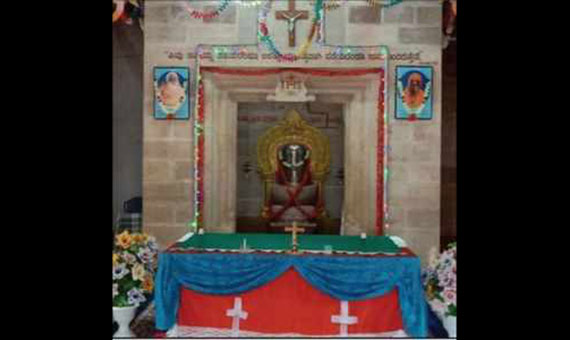
Belagavi: Church-cum-mutt a rare example of religious harmony
On Sunday mornings, when they are not working in the fields that surround Deshnur, around 200 of the village’s 12,000 people go to Snanika Arulappanavara Virakta Mutt, a shrine where they attend mass that a Catholic priest holds in Kannada.
Yet, not a single inhabitant of the village is Christian. Within the imposing building of large stone blocks, also known as the Church of St John the Baptist, is a tabernacle in the form of a Shiva linga – a reminder that it once was a Lingayat mutt.
The Jesuit priest who conducts mass and runs the church, Menino Gonsalves, introduces himself as Sri Menino Swamy. He wears saffron robes and a rudraksha mala as his congregation worships Jesus and Mary in Lingayat style, burning camphor and agarbatties and with vibhuti smeared on their foreheads.
Since its establishment as a church in 1947, five Christian priests have served in the shrine, said Sri Menino. “We all adopted Hindu names,” he said. “Our founding father, Armado Alvares, called him-self Sri Animananda Swamy. Father Sebastien became Swami Arulananda.”
All the Jesuit priests who have served at the church became vegetarians and wore rudrakshamalas, he said. Sri Menino sees no incongruity in the mingling of Hindu and Christian elements in the mutt. It is an experiment in social integration, Sri Menino said. Prelates of the Catholic Church described the shrine as an example of assimilation of local culture.
Sri Menino, who has been in charge of the church for 11 years, dismissed as an “unnecessary controversy” the uproar on social media about alleged conversions at the shrine, triggered by photographs of Belgaum Bishop Derek Fernandes wearing saffron robes and with a tilak on his forehead during a recent visit to the village.

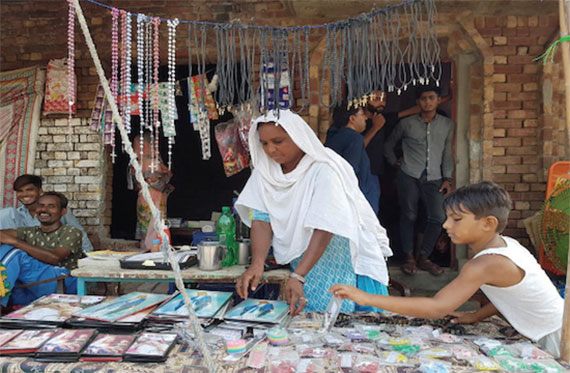
Marian pilgrimage boosts business in Pakistani village
Nasreen was depressed after a stroke left her husband paralyzed on his right side three years ago. Her youngest son took up his father’s job as a mason in the Catholic village of Mariamabad in Pakistan’s Punjab province.
“Suddenly our sole breadwinner became bedridden. The loans kept climbing. I felt helpless as an unskilled housewife,” the 46-year-old mother of five told ucanews.com.
That was until Lahore Arch-diocese announced that the 70th annual pilgrimage to the National Marian Shrine in Mariamabad would be held from Sept. 13-15 under the theme “St Mary: The woman of dialogue.”
More than a million devotees and young people from all over Pakistan travelled to the shrine on foot, by bicycle or in vehicles to pray and intercede with the Blessed Mother for special favours. They lit candles and incense sticks and covered the statue of the Blessed Mother with colourful embroidered dupattas (long scarves).
In keeping with tradition, thousands of Muslims also expressed their personal devotion to Mary, whom the Quran honours as the mother of Jesus, considered a prophet. The non-stop processions head toward a grotto that is a replica of the one in Lourdes, France.
An area in front of the Church of St Mary and St Joseph was allocated for a weekend market. The selection of goods and services included Christian gifts, souvenirs, gospel CDs, toys, clothing, food, beverages and even tattoo parlours.

Populism is pushing democracy to the brink, warns new cardinal
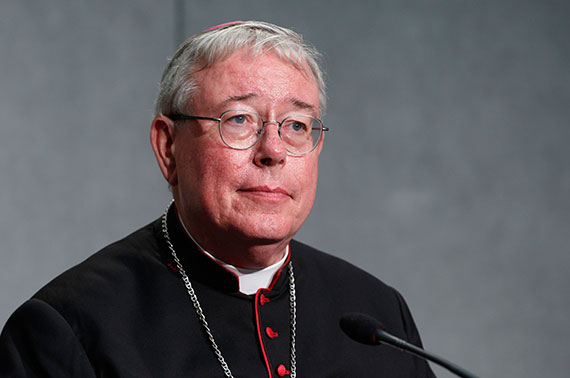
Democracy is under threat due to the rising tide of populism, according to a new Luxembourg cardinal who is urging the church to stand against anti-democratic forces present in politics.
Archbishop Jean-Claude Hollerich, who made a cardinal by Pope Francis on 5th October, said the simple answers offered by populist politics will not solve complex problems and end up leaving people even more disillusioned. “The church has a very clear standpoint. We are against populism, we are in favour of human rights and we are in favour of democracy. And democracy is in danger because civilisation is changing,” he told The Tablet.
The interview is published on the day the Supreme Court ruled that the Prime Minister Boris Johnson’s suspension of parliament was unlawful, although Hollerich spoke to before the ruling was announced by Lady Hale.
Cardinal-designate Hollerich, 61, who is President of Comece (the Commission of Bishops’ Conferences of the European Union), said the pace of change caused by digitisation raises questions about how democracies can function in the future.
“Populism in that sense is very dangerous because the questions are not asked anymore,” he said. “You give a very simple answer – and simple answers are popular nowadays. It’s much more difficult to present a complex situation and find complex solutions. But people will also be disillusioned.” “If the United Kingdom is not a member of the European Union, it is still a European country, and we need to have good relations,” he explains. “So we should do everything to have the best deal, and compromises have to be found, and that is very important for me.”

Indian bishop says Church needs ‘to clean our own house’ on Dalit rights
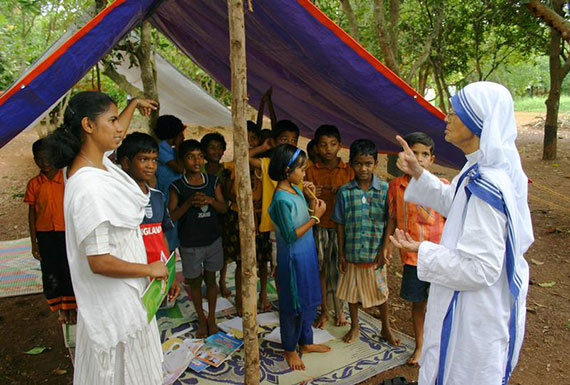
Despite guidelines supporting Dalit Christians – formerly known as “untouchable” – not every church leader is working in their defense, according to one Indian bishop.
“We still have to clean up our own house,” Bishop Sarat Chandra Nayak told Crux. “In some places, sadly, the caste system is still there, in spite of us being Christians, and Dalit Christians suffer because of it still. It’s a very scandalous image of the church, but it’s there.”
“I don’t see so much of a hardship, but a continuation of persecution that we’ve faced. But we also have to trust in our judiciary system: If someone is accused of something, you have to go to the court.
Our challenge is that even in the case of the Khandamal violence, we had to go all the way to the Supreme Court to get permission to help our own people, because the local judges wouldn’t allow us to. We had to fight it out.
That’s still happening today: We have to go all the way to the Supreme Court. This is the case of rights for Dalit Christians, that has been in the Court for over 15 years. They represent some 20 million people, who are suffering exclusion in the name of religion, but nobody seems to be taking it seriously and the government is lingering.
However, the information we have is that in the month of September there will be a hearing.
“At a bishops’ conference level, we released a series of policies on Dalit Christians, but in the end, it’s up to each bishop and each diocese to guarantee that these don’t remain as just a document. And on the bishops doing more at a local level, I believe there’s still much to be done. We still have to clean up our own house. In some places, sadly, the caste system is still there, in spite of us being Christians, and Dalit Christians suffer because of it still. It’s a very scandalous image of the Church, but it’s there.”