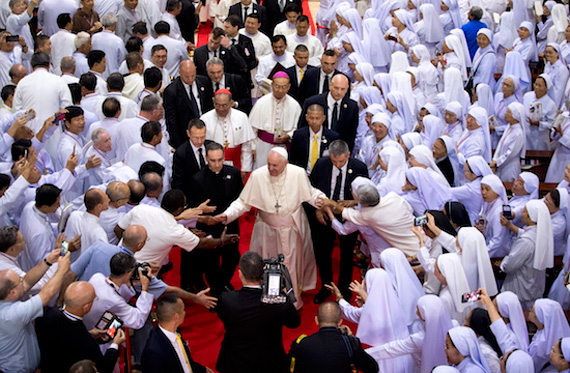
Vatican: German synod plans ‘not ecclesiologically valid’

In a letter sent to German bishops, the Vatican has said that plans for a binding Church Synod in Germany are “not ecclesiologically valid.”
Plans for a “binding synodal process” were first announced by Cardinal Reinhard Marx, head of the German episcopal conference, earlier this year.

CNA reported that draft statues for the planned “Synodal Assembly” were approved in August by the executive committee of the German bishops’ conference, ahead of a final hearing at a full meeting of German bishops, set to be held on Sept. 23-26. CNA also reported that small working groups connected to the Synod have already begun discussing a series of controversial Church topics.

In a Sept. 4 letter addressed to Marx, Cardinal Marc Ouellet, head of the Vatican’s Congregation for Bishops, said that plans for a Synodal Assembly must conform to guidelines issued by Pope Francis in June, especially that a Synod in Germany could not act to change universal Church teaching or discipline.

Ouellet also sent Marx a four-page legal assessment of the German bishops’ draft statues. Both the letter from Cardinal Ouellet and the attached legal assessment were obtained by CNA.

The assessment, signed by the head of the Vatican’s Pontifical Council for Legislative Texts, says that the German bishops’ plans violate canonical norms and do, in fact, set out to alter universal norms and doctrines of the Church.

In his legal review of the draft statutes, Archbishop Filippo Iannone, head of the Pontifical Council for Legislative Texts, noted that the Germans propose to treat four key themes: “authority, participation, and separation of powers,” “sexual morality,” “the form of priestly life,” and “women in Church ministries and offices.”

“It is easy to see that these themes do not only affect the Church in Germany but the universal Church and – with few exceptions – cannot be the object of the deliberations or decisions of a particular Church without contravening what is expressed by the Holy Father in his letter,” Iannone wrote.

Catholic missionaries hit the streets to evangelize

Missionaries from the Institute of the Incarnate Word have been pounding the pavement this September to invite Brooklynites around St Teresa of Avila, Crown Heights, and Co-Cathedral of St Joseph’s, Prospect Heights, to church.

The group of 40 religious brothers and sisters, most of them students, came from the Washington D.C. area. They begin each day in Brooklyn with a Mass and spend most of their days walking the streets around the north end of Prospect Park to invite people to Mass.

Mother Maria Aeiparthenos of the Servants of the Lord and the Virgin of Matará (SSVM), the sisters’ mistress of novices, said the missionaries initially went door to door, but after spending the first few days surveying the area, they decided it was better to encounter people on the streets.

Some sisters form a musical trio with guitar, violin and flute, taking the role of street performers, while others kick soccer balls and throw frisbees with children in the park, and others simply greet locals to engage them in conversation.

Pope celebrates Madagascar’s ‘living saint’, champion of the poor

Pope Francis on Sept. 8 celebrated a former student of his who is now sometimes called Madagascar’s “living saint” for having changed the lives of thousands of poor people who once lived in garbage dumps.

Thousands of former slum dwellers, many of them children, gave the Pope an ecstatic welcome, leaving him seemingly overwhelmed by the experience, who only hours earlier defended the poor in the homily of a huge open-air Mass..

Francis taught Father Pedro Opeka theology at the Colegio Máximo de San Miguel in Buenos Aires in 1968 while Francis was completing his own studies for the priesthood.

Over the last 30 years, an organization founded by Opeka, whose parents emigrated to Argentina from Slovenia, has built homes for 25,000 people, 100 schools, six clinics and two football stadiums across the island nation. Next year, he plans to build a college for paramedics.

The white-bearded, jovial Opeka, 71, has been called a “living saint” along the lines of Mother Teresa of Calcutta by many in Madagascar because of his work in one of Africa’s poorest countries. He has been nominated for the Nobel Peace Prize.

The Pope met families living in Akamasoa, one of the first villages built by Opeka on the hills above Madagascar’s capital Antananarivo to re-house people living on the municipal dump in the valley below.

Church must seek new paths in Amazon, synod secretaries say

The Synod of Bishops for the Amazon will help the Catholic Church make its presence felt and voice heard in a region that is dangerously approaching “a point of no return,” said the special secretaries of the Synod.

“It is a great and continuing challenge for the Catholic Church to make the original Amazonian peoples feel part of it and contribute to it with the light of Christ and the spiritual richness that shines in their cultures,” Cardinal-designate Michael Czerny and Bishop David Martinez De Aguirre Guinea wrote in an article published on Sept. 12 in La Civilta Cattolica, the Jesuit journal.

Cardinal-designate Czerny, undersecretary of the Migrants and Refugee Section of the Vatican Dicastery for Promoting Integral Human Development, and Bishop Martinez, apostolic vicar of Puerto Maldonado, Peru, said the Synod will take place at a time when “both human and natural life are suffering serious and perhaps irreversible destruction.”

The Synod, scheduled for October 6-27, will focus on “Amazonia: New paths for the church and for an integral ecology.”

From inspiration to adoption: A story of working with Mother Teresa

More than 20 years ago, Ann Pollak travelled to Calcutta, hoping to volunteer alongside Mother Teresa. The experience would spark a years-long process that would eventually lead her to adopt a severely handicapped child from one of the care centres run by the Missionaries of Charity.

“It has not been easy, at all, but the blessings have far, far outweighed the sacrifices,” Pollak told CNA. “Oddly, in adopting a blind child, I began seeing the world through my own eyes from a different perspective.”

Nearly 18 years ago, Pollak adopted a child from one of Mother Teresa’s orphanages. But adoption was not initially her intent.

In 1995, Pollak travelled to India in order to meet Mother Teresa. She spent two weeks doing volunteer work and was impressed with Mother Teresa’s constant smile, and the fact that despite winning a Nobel Prize and being globally famous, the religious sister was very approachable.

Pollak would return to do volunteer work numerous times in the years that followed. In 1997, about a month before Mother Teresa’s death, she was working with handicapped children. She was assigned to feed one little girl, Rekha, who was blind, autistic and mentally delayed.

“She had the sweetest smile on her face,” Pollak recalled of Rekha. “I just fell in love with her.” She also believed that the child had potential to develop and grow, if she was able to get the proper care and attention from a family.

A year later, Pollak returned to India to see if the little girl was still there. She was.

But as time went on, she became frustrated with her inability to find anyone to care for the girl. She began praying every day, asking God for a solution. Although she had not previously considered adoption, she began to feel an inner call to adopt Rekha. “I couldn’t find any other solution,” she reflected.

Church spreads education in Arunachal Pradesh

Arunachal Pradesh has a literacy rate of 66.95 percent as per the 2011 census, with 73.69 percent being men and 59.57 percent women.

In 2001, literacy rate in Arunachal Pradesh stood at 54.34 percent of which male and female were 63.83 percent and 43.53 percent literate respectively.

One cannot but notice the sharp increase in the literacy rate in the north-eastern most state, bordering Myanmar and China. What are the contributing components of such a sudden improvement to the dismal situation ten years ago?

According to the education department, of the 11,153 students from 84 government higher secondary schools (GHSS) who appeared for the All India Senior School Certificate Examination (AISSCE) in 2018, only 4944 students had passed. In the All India Secondary School Examination (AISSE), of the 23,829 students registered, only 8270 passed. The government-run schools had a 21.22 pass percentage. The Newman Educational Society (NES) comes as a beacon of hope in this grim context of the dismal educational scenario of the State. NES has taken education to the last, least and the lost villages of Arunachal Pradesh.

Catholic nuns, priests rally against negative media reports

Hundreds of men and women belong to various Catholic religious congregations have come to the streets of Kannur, a major city in Kerala, to protest what they said were biased media reports that tarnish their image.

“Do not belittle the life we have accepted with joy and pride. Religious life is not a matter of pain and distress,” the protesters said at the September 4 rally held outside the local office of the Mathrubhumi (mother-land), a Malayalam newspaper.

Most speakers were heads of several religious congregations for women.

Sister Emestina, superior general of the Dina Sevana Sabha (DSS, Servants of the Poor), deplored attempts by certain section of the media to use isolated incidents as an excuse to despise Catholic asceticism and portray priests and nuns in a derogatory manner. “We serve society with a smiling face forgetting our pain and sorrows. The face of Catholic religious life is contentment,” she asserted.

The DSS leader said Catholic religious men and women serve society with courage whatever the difficulties. “Our religious life is based on our love for God and it will not be affected how-ever much, some try to belittle it,” she added. Sister Mary Noble of the Franciscan Clarist Congregation termed media reports as deliberate attacks on Catholic religious life and urged their detractors not to force priests and nuns to come to the streets again. “We have organized this protest as a last resort as we have no other option left. We feel pity for those attacking us. They should undertake an unbiased study of what is happening around them to know how we live and what we do,” Sister Noble said.

Hindu nationalists accuse Catholic retreat centre of ‘forced conversions’

Catholic officials in India have rejected accusations that a retreat centre in the southern State of Karnataka is promoting the conversion of Hindus.

Sharan Pumpwell, the secretary of the ultranationalist group Vishwa Hindu Parishad, called for the state government to shut down the Divine Call Centre in Mulki, claiming it was seeking converts by “insulting the Hindu religion.”

He also called on local police to press criminal charges against Father Abraham D’Souza, who heads the centre, accusing him of “forcibly converting” a local Hindu.

“Hindus and the Christians are living with mutual respect, love and peace. Some unwanted organizations are trying to destroy the peace and unity between Hindus and Christians by their involvement in conversions,” Pumpwell said.

D’Souza said the person in question came to the retreat centre on his own and was now “being manipulated by communal forces for their agenda.”

“There is absolutely no conversion. No baptism. He wants to come again too. This is false, baseless and motivated allegations,” the priest said.

Kolkata St Xavier’s University VC gets ‘2019 Sankalp Award’

Jesuit Father Felix Raj, vice-chancellor of St Xavier’s University, Kolkata, received the prestigious 2019 Sankalp Award, “Educationist of the Year” from Javed Khan, minister, Government of West Bengal at JW Marriot hotel on September 1, in the presence of Industrialists HP Budhia, Lal Bhatia and others.

The Sankalp Education Forum supported by the David and Goliath and Lions Club selected Father Raj for his contribution in the field of higher education in India particularly in West Bengal.

The Jesuit priest had spent 33 years at St Xavier’s College, Kolkata as vice-principal, rector and principal. He took over as the founder vice-chancellor of the St Xavier’s University, Kolkata. He is credited with setting up the university with the support alumni spread all over the world.

“I am not worthy of this award, but I accept it in all humility in the name of my students who made me a teacher and what I am today,” Father Raj said in his acceptance message.

Church run community radios snatch one sixth awards

At the Community Radio Awards ceremony organized by the Ministry of Information and Broadcasting in collaboration with One World Foundation India, 3 Church run community radio stations bagged 5 out of 30 awards given under five categories for the years 2018 and 2019.

The awards were given in five categories, including Best Thematic category in programs, Best Community Engagement Initiative, Best Program for Promoting Local Culture, Best Innovative and Creative Program and Best Sustainable Model for Community Radio.

Information and Broadcasting Minister Prakash Javadekar on August 28 gave away 30 excellence awards to different community radio stations for their valuable contribution in sensitizing local people about their social, cultural and developmental requirements around the community.

Church run community radio stations snatched five out of 30 awards given for past two years.

Among them, Jesuit run Radio Sarang from Manga-lore got first prize in the Most Creative / Innovative Category for its programme Antarabelaku for year 2019 on visually challenged listeners.

Radio Mattoli of Mananthavady Diocesan Wayanad Social Service Society got first prize for 2018 in the sustainability category for its commendable efforts in achieving technical and financial sustainability.

No third prize was awarded for both years in sustainability category.

Official Website

Exit mobile version