
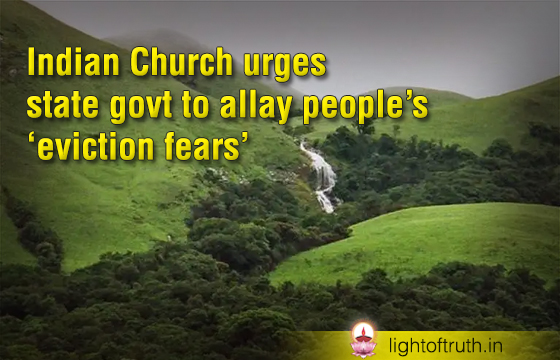
Church leaders have urged the communist-led government in a southern Indian state to clear doubts over the likely evi-ction of people, most of them Christians, in the eco-sensi-tive Western Ghats mountain range. The Kerala government did not take into consideration people’s concerns about the proposed declaration of areas within a kilometre of protected forest areas as eco-sensitive zones (ESZs) in the hilly and forested areas of Idukki and Wayanad districts, they said. Many Catholic dioceses and parishes are located in these districts, which are part of the Western Ghats. Nearly 3 milli-on people, mainly Christians, living in 121 villages fear they may be evicted if they end up being marked as ESZs. ”We are confused and the people are confused. Unless we pre-sent a correct picture, our villa-ges with human habitation will be declared ecologically sensi-tive areas and people will su-ffer,” said Fr Jins Karakkat, director of the media commi-ssion at the Idukki Diocese of the Eastern Rite Syro-Malabar Church. Church leaders alleg-ed that the government did not involve the public in identifying the ESZs as directed by the federal forest ministry in its official notification. Karakkat hinted at launching a public agitation if the government continued to be evasive and did not respond to the people’s concerns. “The government has not yet responded to the demand of the Church,” he told.
More than 50% (approx 20,000 sq km) of the total land area of Kerala, which is India’s most densely populated state, falls in the Western Ghats. The mountain range has witnessed ecological damage and erosion due to increasing human acti-vity over the past few decades.
An expert committee appointed by the Kerala go-vernment had recommended limiting the ESZs to 9,993.7 square kilometres, which included 9,107 sq. km of forest and 886.7 sq. km of non-forest areas.
In recent years, heavy rainfalls and landslides have caused the loss of human life and property in the districts of Idukki and Wayanad.
India’s Supreme Court in its order on June 3, 2022, declared all areas within a kilometre of protected forest areas as ESZs and forbade construction of new permanent structures within them. This left the people living in those areas for generations with no other option but to face eviction from the ecologically sensitive zones.
The federal forest ministry has accepted the suggestion of the expert committee. According to media reports, Kerala is planning to reduce the extent of the ESZs further and may submit a new draft proposal to the federal forest ministry after it sought its suggestions and objection to the proposed ESZs within 60 days through a July 31 notification.
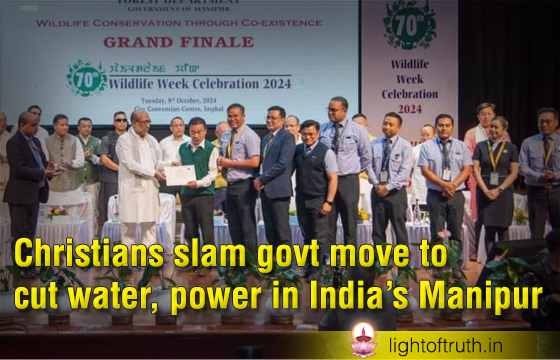
Christians slam govt move to cut water, power in India’s Manipur
Indigenous Chri-stians in India’s strife-torn Manipur say they are worried over the state government’s move to deny power, water, and welfare schemes to “un-registered” villages in the hilly north-eastern state.
Manipur Chief Minister N. Biren Singh on Oct. 8 instructed the authorities not to provide essential services like water and power and benefits of various government welfare schemes to villages in the hilly districts if they are unregistered. Though Singh did not clarify what he meant by “unregistered villages,” media reports said the chief minister was referring to villages that have emerged in the Kuki-dominated areas since 2006. ”This move is yet another attempt to target indigenous Christians who are mostly from the Kuki-Zo community, living in the state’s five hilly districts,” said a Church leader based in the capital, Imphal. He requested that his name not be revealed for security reasons. Another church leader based in a hilly district said that many people lost their houses and businesses during the ongoing sectarian violence and took shelter in other villages. “A few of them have set up temporary houses in other villages. If the government does not recognize them, it will be like adding insult to injury,” he said on the condition of anonymity. Singh, a leader of the Hindu right-wing Bharatiya Janata Party (BJP), has repeatedly blamed “illegal migrants” from neighbouring civil war-hit Myanmar for the ongoing violence in the state and accused the Kuki-Zo communities of giving shelter to them. Singh belongs to the majority Meitei community, which is at loggerheads with the predominantly Christian Kuki-Zo tribal people. ”The government decision to disconnect water or electricity supply will lead to further hostilities between the warring groups,” noted the Church leader. He said the Meiteis and the Kuki-Zo communities cannot co-exist anymore.
Among the 3.2 million people in the state, 41 percent are indigenous Kuki_zo people, mostly Christians, and the influential and wealthy Meiteis Hindus who live in the valleys account for 53 percent. Their feud over granting tribal status to the Meitei Hindus to avail reservation benefits under India’s affirmation action policy has seen the death of nearly 230 people and the uprooting of nearly 60,000, most of them Christians. Christians allege that the official tribal status will allow the influential Meitei community to buy land in Indigenous areas in the districts of Senapati, Tamenglong, Churachandpur, Chandel, and Ukhrul. Christians have been seeking the resignation of Singh over his failure to contain the sectarian violence that started on May 3 last year.

Reprieve for Indian Protestant mission amid land row
The top court in India’s Madhya Pra-desh has temporarily stopped the state government, run by a Hindu right-wing party, from taking over a piece of land from a Protestant mission.The Jabalpur bench of the state High Court on Oct. 7 allowed the mission of the Disciples of Christ Church in Damoh district, 15 days to file a civil suit to settle the land dispute. Navin Lall, the Church’s secretary, said the dispute over 43,560 square feet of prime property in Damoh district has been ongoing for a decade.
The land was under the Church’s control for more than 100 years before a local Hindu man accused the Church people of encroach-ing on it in 2014. He filed a court case, claiming it as government property, Lall said. The Church officials challenged the case in the High Court which suggested an out-of-court settlement between the district autho-rities and Church leaders. But the district officials let the matter drag on and a fresh case was filed against the Church officials this year. On Oct. 4, the authorities issued a notice asking the Church to remove the boundary wall of the disputed property. Later, the Church officials approached the court seeking a stay on the wall’s demolition. Suddenly, on Oct. 7, “the boundary wall was pulled down by district officials like a terrorist operation before the court started working at 10 a.m.,” Lall said. The officials acted in haste, demolishing the 4,570-meter-long wall in the morning before the top court could take up the Church’s petition seeking a stay on its demolition. The case was listed as a priority, Lall said. “The boundary wall was erected 15 years ago” and was sanctioned by local bodies, added Lall. Alok Jacob, a senior Church member, said revenue officials measured the land wrongly to make it appear like a state-owned property. Jacob said that in addition to the disputed land, officials also claimed “another half acre of mission land. “Right-wing “Hindu groups had publicly threatened to pull down the boundary wall if the government failed to do so,” Jacob said. Lall said they plan to file a “complaint before the appropriate authority well before the 15-day deadline ends.” He said “even revenue records were manipulated” to claim the land.
Christian leaders accused the state government of the pro-Hindu Bharatiya Janata Party (BJP) and right-wing Hindu groups of harassing them for their faith. Christian schools, hostels, and orphanages were targets of attacks from government bodies such as child rights panels and police with allegations of religious conversion, which is banned in Madhya Pradesh under a sweeping law, Christian leaders noted. Bishops, priests, nuns, pastors, and people working in Christian institutions are implicated in several cases in Madhya Pradesh, led by Mohan Yadav of the BJP. Christians make up a mere 0.27 percent of the state’s 72 million people, while Hindus make up 80 percent.
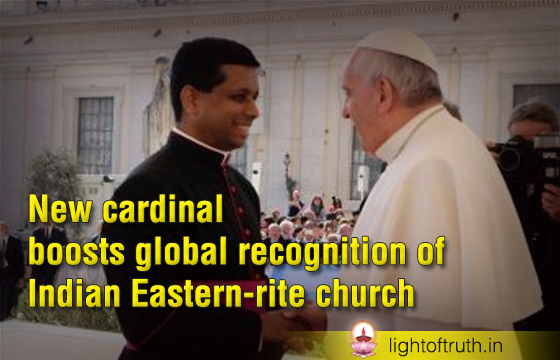
New cardinal boosts global recognition of Indian Eastern-rite church
The elevation of an Indian priest who worked in the Vatican as cardinal adds to the global recognition of the Eastern rite Syro-Malabar Church, says the Church’s spokesperson. Father George Jacob Koovakad, a priest of the Kerala-based Church’s Changanacherry archdiocese, was among the 21 new cardinals named by Pope Francis on Oct. 6. They will be given the red biretta on Dec. 8 at the feast of the Immaculate Conception. “It is a great honour for the Syro-Malabar Church as one of its sons is elevated as cardinal directly, which is first in India,” said Fr Antony Vadakkekara, spokesperson of the Church. Until now, only archbishops were named cardinals in India. He added that the elevation of 51-year-old Koovakad is “a global recognition of the Syro-Malabar Church,” the second largest Eastern rite Church with 35 dioceses in India and abroad. Koovakad is part of the Vatican’s diplomatic corps and is responsible for organizing papal trips. According to Church sources, he is expected to continue with the Holy See. Currently, India has four cardinals, but all of them stay in their home dioceses. Koovakad’s elevation “is a great recognition for the Indian Church to have one more cardinal, especially based in the Vatican,” said Father Robinson Rodrigues, spokesperson of the national bishops’ conference.
Rodrigues told on Oct. 8 that Koovakad can play “a vital role” in protecting the interests of the Indian Church. Koovakad joined the Vatican diplomatic service in 2006 and served in the nunciatures in Algeria, South Korea, Iran, Costa Rica, and Venezuela before being tasked with organizing papal trips.
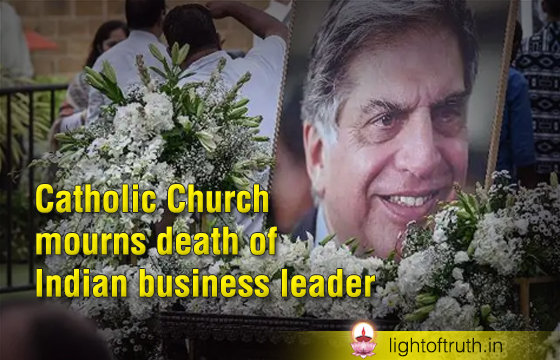
Catholic Church mourns death of Indian business leader
Indian bishops have joined the nation’s top leaders and industry captains in mourning the death of Ratan Tata, an iconic business leader, philanthropist, and visio-nary. Tata, the former chairman of Tata Group died on Oct. 9 at 86 in Mumbai, the state capital of Maharashtra. He is credited with putting the Indian conglo-merate on the global map. The Catholic Bishops’ Conference of India (CBCI) said his life was a testament to an “unwavering commitment to excellence, inte-grity, and compassion.”
“Tata transformed the conglo-merate into a global powerhouse while upholding the values of social responsibility and ethics. His legacy will continue to inspire future generations,” the CBCI said in a statement on Oct 10. The bishops’ body hailed “his philanthropic endeavours, parti-cularly through the Tata Trusts,” which “positively impacted coun-tless lives, fostering education, healthcare, and social welfare initiatives across India.”
India’s Latin-rite Conference of Catholic Bishops of India (CCBI) said: “Ratan Tata was not merely a titan of industry, but a beacon of compassion and generosity.” Through the Tata Trusts and his numerous philan-thropic initiatives, he transformed the lives of millions, championing the cause of the marginalized and playing a pivotal role in India’s development, it said in a state-ment. “Tata’s unwavering commitment to social justice, education, healthcare, and rural development deeply resonated with the core values of the Catholic Church, particularly in its mission to serve the poor and vulnerable,” the statement added.
The CCBI also acknowledged his significant contributions to nation-building and his role in positioning India as a global economic powerhouse while never losing sight of the need to uplift the underprivileged. “His life’s work will continue to serve as a guiding light, inspiring future generations to strive for the betterment of society and to serve others with selflessness and compassion,” it noted. The Catholic Church in India has offered prayers for Tata’s soul and extended condolences to his family, friends, and those touched by his life’s work.
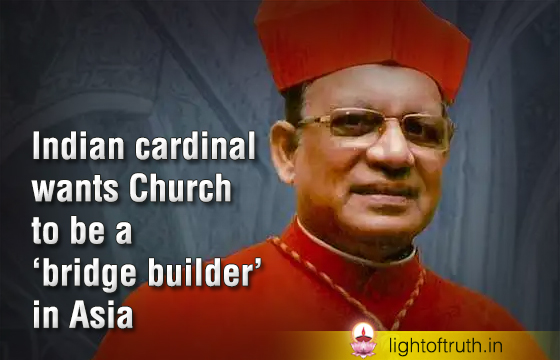
Indian cardinal wants Church to be a ‘bridge builder’ in Asia
An Indian cardinal attending the Synod on Synodality at the Vatican says the Church in Asia emphasizes its role as a “bridge builder” by developing respect for other faiths. “We no longer refer to them as non-Christian religions or other religions,” said Card. Oswald Gracias of Bombay in an Oct. 7 press briefing, the news service of the Catholic Bishops’ Council of the Phili-ppines (CBCP) reported. “We begin to refer to them after the conference as ‘neighbour reli-gions,’” Gracias added. Gracias while referring to the outcome of the 2022 gathering of the Fe-deration of the Asian Bishops’ Conferences (FABC) in Bangkok said that a “certain closeness” has been created among the conference attendees. ”All of us working together, searching for God and feeling a bond among ourselves that has come out,” Gracias said, referring to the conference. Gracias is among the hundreds of other cardinals, bi-shops, priests, and laity attending the 16th Ordinary General Assembly of the Synod of Bi-shops, held from Oct. 2 to 27 in Vatican City. Gracias, who is among the top Asian voices representing the region’s Chri-stian minority, stressed Vatican II’s call for a greater under-standing of other religions and the need to inculturate the faith. “I feel there is a great richness in Asia, in India, in Korea, in Japan, all these countries. The local culture will help us,” Gracias said. “If we try to, not because we’re trying to convert, if we’re trying to build the kingdom of God also in Asia, we’ve got to take the values of Asia,” he emphasized.
Gracias also pointed out the impact of digital media, recalling a message by a youth representative during the 2022 Asian assembly that called upon bishops to come into the digital world. “A very, very powerful message and a challenging message to all of us who are resisting a bit but cannot resist anymore because that’s the world we are in,” he said. Gracias, also a member of Pope Francis’ Council of Cardinals, pointed out that the Asian delegates were comfortable with the synodal process given the experience of the 2022 Asian assembly. “What came out very strongly was we’ve got to work together, respecting lay people, respecting religions, respecting lay movements, respecting the baptismal consecration of each one, which has come out very strongly in the synod,” he said. The prelate also pointed out that the synod gathering displayed the “great fraternity, the great love for the Church, the great passion to do something to revitalize the Church that comes out very strongly.” “I feel that the synod should have an effect not only in transforming the Catholic Church, [but] the Christian churches and also the world,” Gracias emphasized.
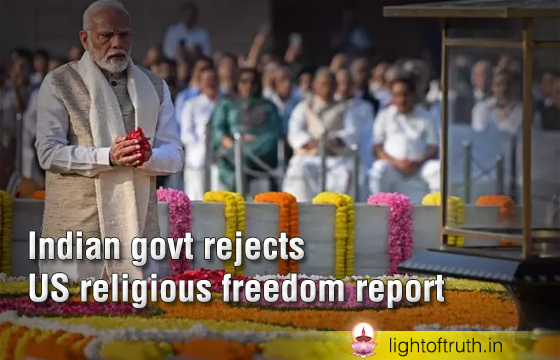
Indian govt rejects US religious freedom report
India’s Hindu right-wing government has rejected a United States Commission on International Religious Freedom (USCIRF) report on India, calling the US agency “biased” and the findings “malicious.” The USCIRF ”is a biased organization with a political agenda,” Indian foreign ministry spokesperson Randhir Jaiswal told reporters in the capital New Delhi. “We reject this malicious report, which only serves to discredit the USCIRF further,” he added on Oct. 3.The US independent bipartisan agency in its Oct. 2 report on India’s religious freedom said, “Individuals have been killed, beaten, and lynched by vigilante groups, religious leaders have been arbitrarily arrested, and homes and places of worship have been demolished.” These events “constitute particularly severe violations of religious freedom,” the commission said and asked the US State Department to designate India as a “Country of Particular Concern.” This is the fifth time the commission has asked the US administration to declare India a “Country of Particular Concern (CPC)” which is the designation for a country responsible for particularly severe violations of religious freedom under the International Religious Freedom Act of 1998. India is ruled by the Bharatiya Janata Party (BJP). The pro-Hindu party is against the missionary activities of the Indian Church.
Since Modi came to power in 2014, violence against Christians has increased, but India’s prime minister enjoys cordial ties with the US administration. The USCIRF annually releases policy recommendations to the State Department on international religious freedom. USCIRF’s report on India said, “The government, led by Bharatiya Janata Party (BJP), reinforced discriminatory nationalist policies, perpetuated hateful rhetoric and failed to address communal violence. “The ministry spokesperson called on the USCIRF to “desist from such agenda-driven efforts” and asked it to focus on addressing human rights issues within the United States. “It is sad that the Indian government is sweeping the report under the carpet, terming it “biased,” said A C Michael, National Coordinator of the United Christian Forum (UCF), an ecumenical body that records persecution against Christians in the country. The government should take necessary steps to protect the religious rights of minorities, Michael, a former member of the Delhi minority commission, told UCA News on Oct. 4.”At least two Christians are attacked every day in the country for their faith.” According to the UCF, India has recorded “447 incidents of violence against Christians this year from January to Aug. 10.” The ecumenical body recorded 731 incidents of violence in the country in 2023, excluding strife-torn Manipur where over 230 people have been killed, 60,000 others displaced and over 360 churches destroyed during 16 months of sectarian strife. According to Church leaders, the Uttar Pradesh government, the most populous state in the country with 200 million people and ruled by the pro-Hindu party, has registered 835 cases against Christians and Muslims under a sweeping anti-conversion law since it was enacted in 2020. Nearly 1,682 people have been arrested on conversion charges as of July 31, 2024. These cases are “closely monitored by senior officials,” said the state’s director general of police Prashant Kumar while briefing the media. Eleven states, most of them ruled by the BJP, have enacted a draconian anti-conversion law. This year’s USCIRF report recommended that 12 nations designated in 2023 by the State Department to be of “particular concern” be named again, including Russia and China.
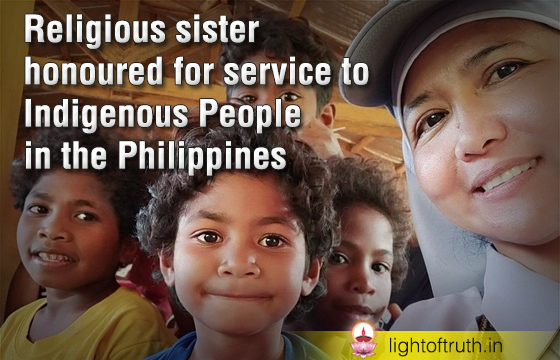
Religious sister honoured for service to Indigenous People in the Philippines
Sr. Minerva Caampued of the Franciscan Apostolic Sisters was recognized for her dedi-cated service to the Indigenous people of Sta. Ana town, where she has worked to preserve their heritage while promoting edu-cation and sustainable liveli-hoods. The award, established in 1983 by the AY Foundation, the philanthropic arm of the Yuchen-gco Group of Companies, and the Manila Jaycees, celebrates outstanding individuals whose selfless service reflects the charitable legacy of Mother Teresa. Sr. Minerva was honoured during a cere-mony on October 4, a significant date as the count-ry marks Indigenous Peoples’ Month.
The awarding organizations praised Sr. Minerva’s comprehensive efforts in uplifting Agta’s quality of life through various initiatives, according to a report by CBCP News. ”She remains a shining example of compassion, inspiring hope, and trans-formation–elevating lives through selfless service,” the organization said. Her programs encompass education, environmental protection, hea-lthcare, and feeding initiatives, with the goal of addressing the marginalization faced by the Indigenous community.
In her message, Sr. Minerva shared her gratitude, dedicating the recognition to the Agta people. “I am not called to be successful, but to be faithful,” she said.
“I dedicate it to the Agta communities, who continue to face the challenges of defending their ancestral domain, asserting their rights, and preserving their rich cultural heritage amidst marginalization,” she said. “Their strength and resilience are a constant source of inspiration to me. This award is not mine alone, but a tribute to their unwavering spirit,” the sister added.
Sr. Minerva emphasized the persistent challenges that indigenous communities in the Philippines encounter, particularly the struggle to protect their ancestral lands from external threats.
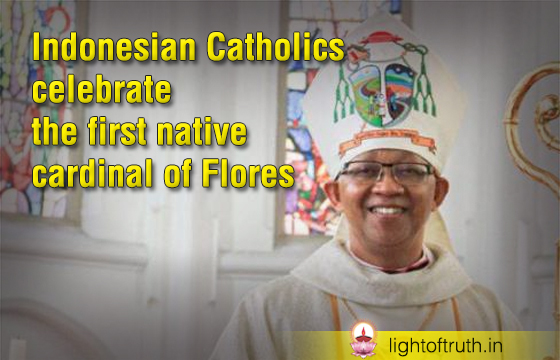
Indonesian Catholics celebrate the first native cardinal of Flores
In the appointment of 21 new cardinals announced by Pope Francis on October 6, there is also an absolute novelty for Indonesia, the world’s most populous Muslim nation, and one that has caused great ‘surprise’ among the faithful and within the local Church: after the three cardinals originally from the province of Central Java and all linked to the diocese of Semarang, in fact, the pontiff has chosen the bishop of the diocese of Bogor (in the province of West Java) Msgr. Paskalis Bruno Syukur (Ofm), a Franciscan from Flores Island, historically the heart of the Catholic presence in Indonesia.
In the aftermath of the appoint-ment, mixed reactions emerged among Indonesian Catholics: surprise and joy for the archipelago’s new cardinal, but also a certain ‘concern’ because there is a strong fear in Bogor that he might be transferred to another post after the purple.
‘I am personally ‘shocked’ to learn the news that our bishop will become a new cardinal next December, as there had not been any ‘hint’ previously,’ an elderly priest from Bogor points out to AsiaNews. ‘I hope that my bishop will not be transferred to another diocese that is still vacant,’ adds a former seminarian from the area.
To date, Indonesia has had four cardinals, three of them from the Central Java province and of Javanese ethnicity, with deep ties to Semarang: they are the late First Cardinal Justinus Darmojuwono, a priest of the Semarang archdiocese; Card. Julius Darmaatmadja, a Jesuit and head of the order’s Indonesian province before being chosen as bishop of Semarang in 1993 and later transferred to Jakarta; a similar story for Card. Ignatius Suharyo Hardjoatmodjo, archbishop of Semarang, later called to lead the archdiocese of Jakarta. Unlike his predecessors, as mentioned above, the new cardinal is originally from the island of Flores and from the local ethnic group.
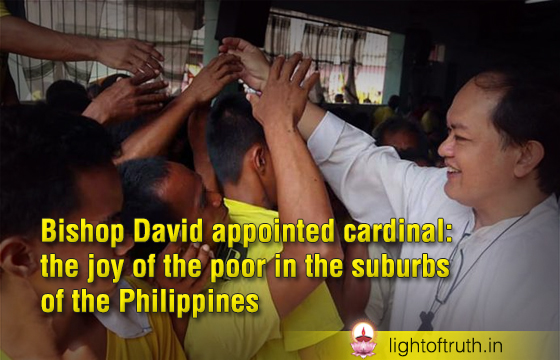
Bishop David appointed cardinal: the joy of the poor in the suburbs of the Philippines
The news of the appointment as Cardinal of Bishop Pablo Virgilio David of Kalookan, one of the smallest dioceses in the Philippines, was greeted with great joy by lay people, priests and bishops. As announced yesterday after the Marian Angelus prayer, Msgr. David – who is 65 years old and has been the president of the Philippine Bishops’ Conference since 2021 – will receive the purple on 8 December, together with 20 other new cardinals.
A priest since 1983 for the diocese of San Fernando, of which he was also auxiliary bishop, and since 2015 at the head of the diocese of Kalookan in the immense metropolitan area of Manila, Msgr David is a highly respected voice in the Philippine Church, for his courageous stance against social injustice, but he is also known outside the country holding the position of vice-president of the Fabc, the Federation of Asian Bishops’ Conferences.
A staunch advocate of human rights, ‘Bishop Ambo’ – as people affectionately call him – has worked tirelessly with the poor and marginalised, particularly in addressing the pressing issues of poverty and inequality in the Philippines. His pastoral leadership has made him a central figure in upholding the dignity of those who are most vulnerable in society.
Agnes Brazal, theologian and lecturer, comments: ‘David is a good theologian and administrator, as well as a courageous voice for the victims of extrajudicial killings during former President Rodrigo Duterte’s war on drugs. Indeed, Kalookan was one of the areas most affected by the Philippine government’s bloody anti-drug campaign. During those years, Bishop David courageously used his position to speak out against acts of violence, upholding the rights of the weak and the sanctity of life. ‘Lord, my life is in your hands,’ Bishop David often repeats in his prayer, and it is the attitude with which he is also preparing to begin this new service to the universal Church. As of 8 December, he will become the tenth cardinal in the history of the Catholic Church in the Philippines, joining two other current Philippine cardinal electors: Pro-Prefect of the Department of Evangelisation Luis Antonio Tagle and Archbishop of Manila Jose Advincula.