“Nutrition: our right,” is the theme of the Lenten campaign of Caritas India for 2019. Caritas India, the charitable arm of the Catholic Church of India, has launched a Lenten campaign against hunger by creating an awareness among people regarding solidarity, food security, medical care and a dignified life for all citizens. The theme of the Lenten campaign 2019, launched “Nutrition: our right.” It aims at fighting the scourge of malnutrition, which it regards as a “painful and shameful for humanity.” According to Caritas India, the nation, with its resources, is be able to feed its inhabitants, yet it continues to be one home to one of the highest numbers of malnourished women and children in the world. According to official data, 38.4% of children in India suffer from rickets and 35.8% from underweight, both of which are liked to malnutrition.

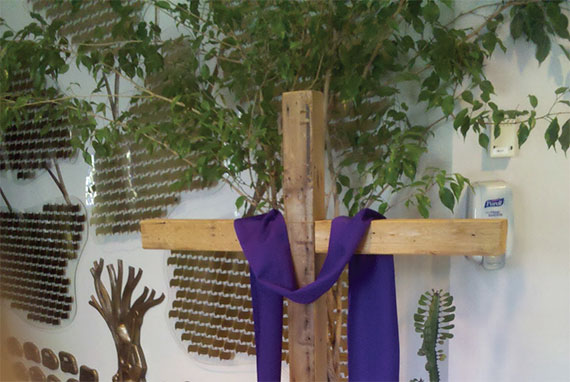
3 German Catholic dioceses to join Lutherans in Lenten fast for climate protection, climate justice
The campaign “Climate Crisis” starts on Ash Wednesday (6th March) for the sixth time. At the initiative called by the Institute for Church and Society of the Evangelical Church of Westphalia (EKvW) under the motto “So much you need …” (Exodus 16), this year a total of eleven Protestant regional churches and three Catholic bishoprics are invited putting climate protection at the centre of our own Lent.
Everyone can take part in thinking about their own actions in everyday life, trying out new things and making changes together. “Limiting to Enough is Urgently Required,” Dr Irmgard Schwaetzer, President of the Synod of the Evangelical Church in Germany, and the Vice-President of the Central Committee of German Catholics, Dr. med. Karin Kortmann, in their joint greeting of the accompanying fasting booklet agree. In view of the “multiple transgressions of ecological boundaries and consequences,” they call for “a mindful and frugal way of life.” With the climate key, you can try out different steps for climate-friendly alternatives in your own everyday life. It is about practicing an ethics of enough, “Volker Rotthauwe, environmental pastor of EKvW and one of the” climate field “initiators, describes the goal of the action.
In a fast-paced booklet, the initiators provide suggestions and ideas for focus topics in the seven days of fasting: After a personal pause and the conscious perception of the self and the fellow creatures at the beginning of Lent, the following weeks are dedicated to concrete actions on the subject of “energy budget” – “mindful cooking and eat “-” fair consumption “-” be different on the way “and – new this year – the” plastic-free life.

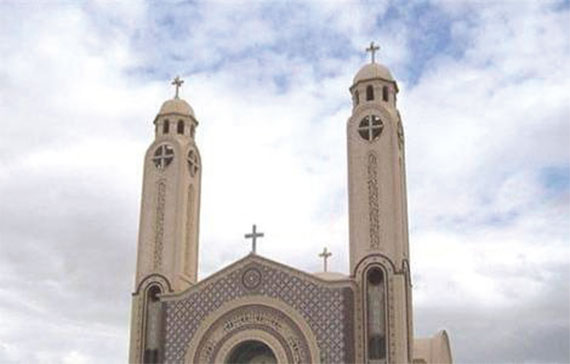
The number of churches “regularized” by the Egyptian government rises to 783
In Egypt the process of “legalization” of Christian places of worship built in the past without the required permits, along with the granting of authorizations for the construction of new churches, continues at a rapid pace. The Egyptian Council of Ministers, chaired by Premier Mostafa Kamal Madbouly, approved last March 5 the report of the Committee for the regularization, restoration and construction of new churches, which formally attested the verification and the subsequent authorization to the legitimate use of 783 Christian places of worship subjected to ministerial controls.
Government and ecclesiastical sources, relaunched by the Egyptian media, expect that at the end of 2020 the controls and the consequent ministerial authorizations will be completed for more than 700 Christian places of worship awaiting regularization.
The churches submitted to the scrutiny of the ad hoc government commission are mainly those built before the new law on the construction of Christian buildings of worship came into force, approved by Parliament at the end of August 2016. The work of the government commission, consists in verifying if thousands of churches and Christian places of prayer built in the past without the required authorizations meet the standards established by the new law.

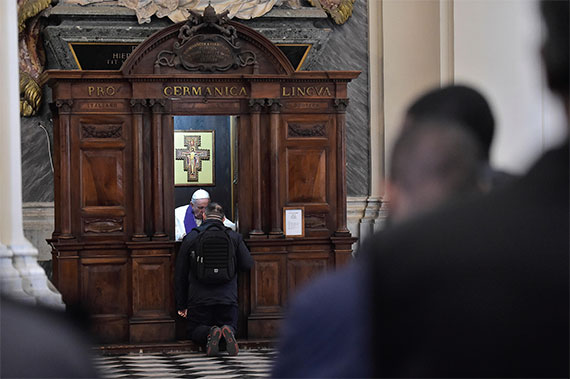
Pope: God is purifying the church with ‘unbearable’ pain of abuse scandal
The clerical abuse scandal has caused everyone in the Catholic Church “pain and unbearable suffering,” Pope Francis said, but it also is a call to repentance and the renewal of the church.
“Our humble repentance, which remains silent between our tears for the monstrosity of sin and the unfathomable greatness of God’s forgiveness, this, this humble repentance is the beginning of our holiness,” the Pope told priests from the Diocese of Rome.
Pope Francis’ annual Lenten meeting with the priests on 7th March began with a penitential prayer service and individual confessions at the Basilica of St John Lateran, the cathedral of the Diocese of Rome.
In a long, impromptu talk on priesthood and forgiveness, the Pope acknowledged the clerical sexual abuse crisis and the particular way it had impacted priests.
“Sin disfigures us,” he said, and it is “humiliating” when “we or one of our brother priests or bishops falls into the bottomless abyss of vice, corruption or, worse still, of a crime that destroys the lives of others,” like the sexual abuse of minors does.
Pope Francis said he is convinced the abuse scandal is ultimately the work of the devil.
God is working “to restore the beauty of his bride, surprised in flagrant adultery,” the Pope said.


Americans’ drinking habits vary by faith
In the United States and many other countries, religiously active people are less likely to drink alcohol than those who are not as religious. That may not be a surprise: Holy texts from the Christian New Testament to the Quran and the Hindu Dharmashastras warn against the dangers of excessive drinking and other potentially harmful “vices.” Many religious leaders, including the late Rev. Billy Graham, have urged followers to abstain from alcohol. Despite these teachings, the relationship between religion and alcohol consumption remains a nuanced one, and not all U.S. religious groups eschew alcohol to the same degree, according to a Pew Research Centre survey conducted in 2015.
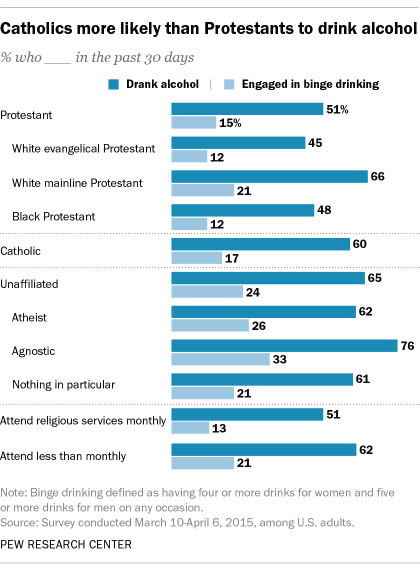

Half of U.S. adults (51%) who say they attend religious services at least once a month report drinking alcohol in the past 30 days, according to the survey. That compares with roughly six-in-ten (62%) among people who attend worship services less often or not at all. Similarly, only 13% of monthly attenders engaged in recent binge drinking – defined as four or more drinks on a single occasion for women and five or more for men – compared with 21% of less frequent attenders.
Christianity played a large role in the U.S. temperance movement. Yet alcohol remains a prominent part of the Christian religion, from the Gospel account of Jesus turning water into wine, to present-day European monks who support themselves by brewing beer, to the use of wine in some contemporary communion services.
Among U.S. Christians, for example, Catholics are more likely than Protestants to say they’ve consumed alcohol in the past 30 days (60% vs. 51%). Adults who don’t belong to any religion, meanwhile, are more likely (24%) than both Catholics (17%) and Protestants (15%) to have engaged in binge drinking in the past month.
(The survey did not include enough Mormon or Muslim respondents to analyze separately, but both of these religious groups teach their followers to abstain from alcohol).

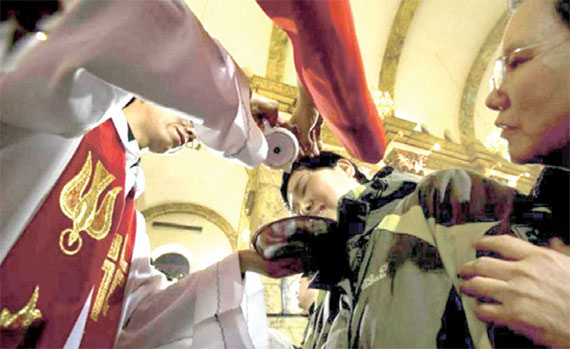
China, nearly 50,000 baptisms in the Catholic Church in 2018
At least 48,365 baptisms were celebrated in churches and Catholic communities in the People’s Republic of China in the year 2018. This is the number reported in the official publication of the Faith Institute for Cultural Studies, based in Shijiazhuang, the capital of the Chinese province of Hebei. The figures bring together data from 104 Catholic dioceses recognized by the Chinese authorities, scattered in more than 30 national provincial divisions. These data appear in substantial continuity with those of the previous year, when the Faith Institute had certified the celebration of 48,556 baptisms in the Chinese Catholic communities.
Also in 2018, as in previous years, the largest number of new Catholics baptized reported by the Faith institute (almost 13,000) was concentrated in the Chinese province of Hebei with other remarkable percentages of new baptisms celebrated in the Catholic communities of the provinces of Shanxi (4124), Sichuan (3707) and Shandong (2914). Faith institute also reported on baptisms celebrated in Catholic communities in the regions where Muslim populations and ethnic minority groups are found, such as Tibet (8 baptisms), Hainan (35), Qinghai (43) and Xinjiang (57).

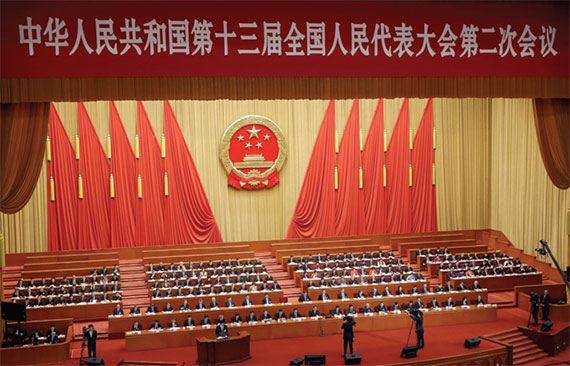
China recommits to sinicisation of religion
“There will be no official or unofficial church when the church is united,” he said. Asked if it meant the so-called underground church would be forced to dis-appear, he said: “Don’t you want the church to be united? A church schism is not the fundamental aspiration of Catholics.”
Bishop Zhan said those Catholics who refused to join the official church were acting in their personal interests, but there was no timetable for the integration of the underground church — those who have refused to register with the government — with Beijing’s hierarchy.
“Everyone works hard and works together,” he said. The push to “Sinicise religion” — make it more culturally Chinese — was introduced by President Xi Jinping in 2015 and written into party orthodoxy in 2017. Experts see it as an attempt by the officially atheist Communist Party to bring religions under its absolute control.
“The agreement is provisional only, and we will improve it in the future,” Cardinal Filoni said after celebrating Mass in Hong Kong March 5.
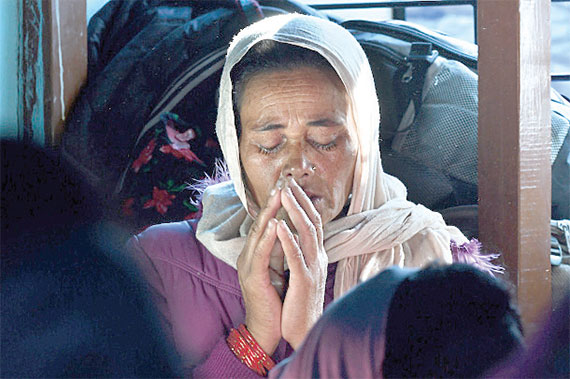
Caste-away: Dalits seek escape through conversion in Nepal
The Christian community in Nepal has not been spared the wrath of society’s caste-based inequality, even though bottom-rung Dalits are increasingly turning to Christianity as a means to escape their fate.
Religious conversions are illegal in Nepal but the numbers suggest many consider it a risk worth taking as the “untouchables” are among the most oppressed by this complex social system, which leaves no sphere untouched. Testament to how legions of Dalits are prepared to gamble on breaking the law in search of a more dignified life, Nepal now harbours one of the fastest-growing Christian populations in the world.
The Federation of National Christians Nepal (FNCN) estimates there are 12,000 churches in the country and millions of Nepalese are believed to have turned to Christianity despite a 2011 census claiming Christians make up just 1.4% of the population, or several hundred thousand people. A whopping 65% of the newly converted are Dalits, according to the FNCN.
There are between 3.6 million and 5 million Dalits in Nepal, which means they could comprise as much as one fifth of the total population.
There are three Dalit sub-groups: those who live in the hilly regions, the mountain dwellers, and the Madeshi Dalits of the Terai, a lowland region in the south that extends to northern India.
The discrepancy in numbers is partly due to so many having legally changed their surname to make it sound like they belong to a more privileged caste as a last-ditch attempt to ease the discrimination they so often face.

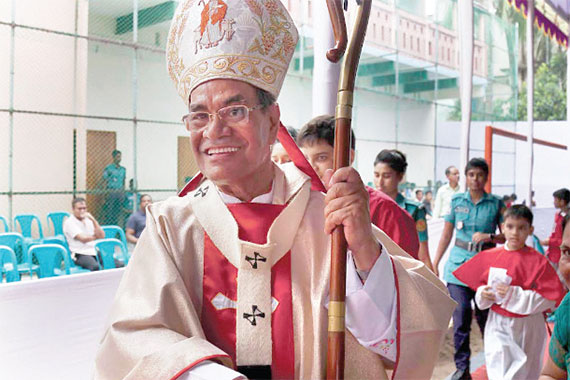
Young Bangladeshi Catholics told to turn off phones
In a Lenten message to young Catholics in Bangladesh, Cardinal Patrick D’Rozario of Dhaka called on them to get closer to Jesus Christ and to refrain from using their mobile phones on every Friday leading to Easter Sunday. “My dear young people, during this Lent I appeal to you for a unique sacrifice. I request you to abstain from using mobile phones from 6 a.m. to 6 p.m. every Friday starting from Ash Wednesday. During this time, you can try to strengthen your relationship with each other and with Jesus Christ,” Cardinal D’Rozario said.
His message resonates with Pope Francis’ call to young Bangladeshis during his visit to the nation in 2017. The cardinal reiterated his appeal during his homily at the Ash Wednesday Mass at Holy Rosary Catholic Church in central Dhaka on March 6 where he was the main celebrant.
“I know, my dear young friends, you love your mobile phone, but it should not be more than your love for each other and for Jesus Christ who saved mankind from sins,” he told more than 3,000 faithful.
“There is a madness in today’s world — we need to grab everything on our way. But remember we came with nothing and nothing will go with us. Only our good deeds will remain, so let’s do good to others as much as we can.”
“I take the cardinal’s message positively, I have serious doubts whether young people, who are seriously addicted to their smartphones, will pay heed to his call. I think the prelate could have asked them to reduce mobile phone use every day,” William Nokrek, a Garo Catholic and former president of Bangladesh Catholic Students’ Movement.

No Church Act in Kerala, Chief Minister assures bishops
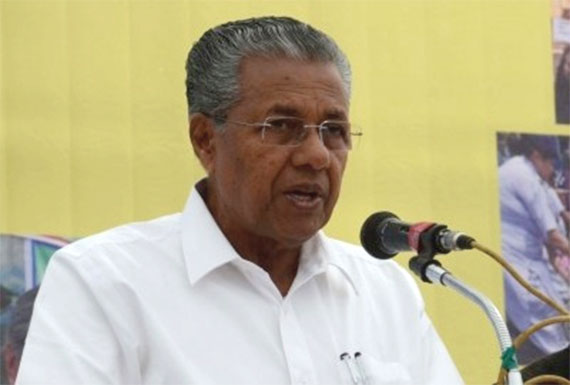
For the second time in a week, Kerala’s ruling CPI-M said that the government has no plans to implement the Church Act, with now Chief Minister Pinarayi Vijayan making the assurance to a group of bishops from various Christian denominations who met him.
The proposed Act aims to put in place a Devasom-like structure of administration over churches in the state and make heads of different churches accountable to the state government.
The draft act was put online by Law Reforms Commission chairman, Justice (retd) K.T. Thomas, a former Supreme Court judge, to solicit public opinion but sparked off protests from various Christian denominations. Vijayan’s office issued a statement to the media which said that his government has no plans at all to implement the Act.
“This Commission before doing this never ever consulted with the Kerala government. We categorically wish to inform all concerned, this government has no plans to implement the Church Act at all,” it read.
During the previous LDF tenure (2006-11), the then Law Reforms Commission had come up with a similar Act but the government never acted upon it, it added.
On March 1, CPI-M state Secretary Kodiyeri Balakrishnan told the media that the Left government was not going forward with the Act, a day after the Inter-Church Council got together near Kottayam to protest the proposed move.