
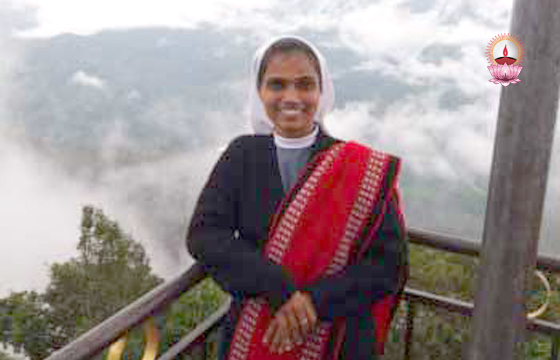
A Catholic nun, who has promoted “Clean India Campaign” in Manipur, was among 42 people who on Sept. 24 were awarded by President Ram Nath Kovind.
The president conferred the National Services Scheme Awards for the year 2018-2019 on Sister William Parmar and others through virtual mode from the Rashtrapati Bhawan.
Federal Minister for Youth Affairs Kiren Reiju attended the ceremony from New Delhi’s Vigyan Bhavan.
The awards were given in three different categories like University and Plus Two, NSS units and their program officers and NSS volunteers.
Sister Parmar, a member of the Carmelite Sisters of Charity, or Vedruna Sisters, was given the prestigious awards in recognition of her exemplary and commendable social service, says a youth ministry press release.
President Kovind congratu-lated the winners and expressed his happiness to honor service-minded people. “Sevice is very much part of our value sys-tem,” he asserted.
Sister Parmar is the pro-gram officer of the NSS unit 1 of Don Bosco College Maram in the Senapati district of Manipur, a northeastern Indian State. She was selected for the award under Program Officer/NSS Unit Category.
The 39-year-old nun cu-rrently serves as assistant pro-fessor at the Salesian college with additional responsibility as NSS program officer.
Church urges Jharkhand government to pass tribal code
The Catholic Church in Jharkhand has asked the state government to pass a bill for a separate code for Adivasis in the eastern Indian State.
Catholic bishops of Jharkhand, led by the Ranchi Archdiocese, on September 19 wrote to the chief minister to remind him that the Indian Constitution has given Advisasis a special status.
“The Articles 25, 29 and 342 talk about their (tribals) fundamental rights, safety and identity. Therefore, they must be provided a separate Sarna code, guaranteeing the rights of the tribal community to their language, religion, culture and a separate identity,” said the letter, signed by Archbishop Felix Toppo of Ranchi.
The Church wants the code passed during the ongoing monsoon session and ahead of the 2021 Census.
Sarna “religion” is followed by tribals in several Indian states, including Jharkhand. It is based on the concept of nature worship. Tribals in Jharkhand have long been demanding a separate Sarna religious code in the Census.
Police remove crosses in India’s Karnataka state
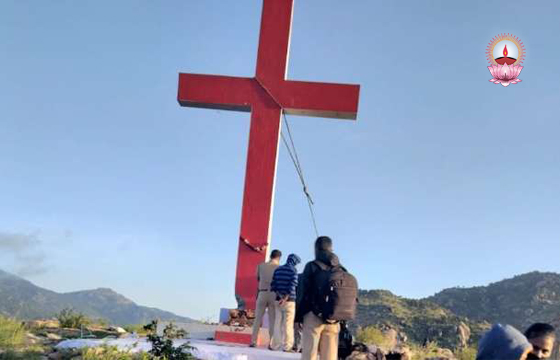
Police in India’s Karnataka State have removed 15 crosses from a hill near a Catholic parish, accusing Christians of encroaching on government land and erecting crosses without permission. It was the second such incident this year in the southern Indian state.
More than 300 police and revenue officials arrived Sept. 23 at St. Joseph’s Church in Susai Palya in Chikkaballapura district and removed the crosses. In a six-hour operation, police removed a 32-meter-long cross from the hilltop and 14 seven-meter-long crosses on the way to the hilltop.
“The government officials acted arbitrarily without any prior notice,” said parish priest Father Antony Britto Rajan.
Videos of persecuted Christians rife in India
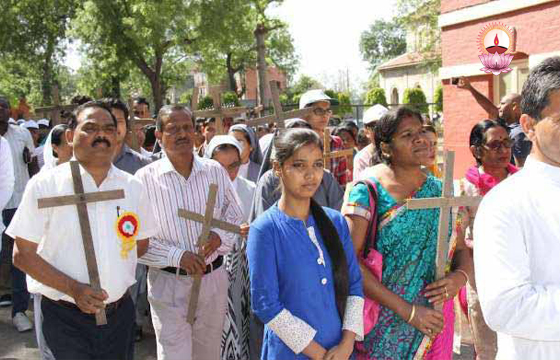
Hindu fanatic groups have been accused of making videos of persecution of Christians across India and circulating them on social media. Shibu Thomas of Persecution Relief said most incidents are recorded in states run by the pro-Hindu Bharatiya Janata Party (BJP) but the highest number has been reported in the northern State of Uttar Pradesh.
He said numerous videos of Christians being persecuted by religious radicals are being widely circulated on social media, with Facebook alone having a network of 33 million users in India.
These videos are especially uploaded on groups run by Hindu fanatics and then spread to other social media platforms like Twitter and WhatsApp.
These videos aim at inciting hatred and defaming the Christian minority by making false allegations against them, mostly involving religious conversion, Thomas said.
The latest incident was reported from Uttar Pradesh, where a video clip shows two Christian men being stopped by fanatics on a street.
Fanatics are seen questioning a Christian who identifies himself as Jung Bahadur and accusing him of converting a woman standing beside him, but the woman immediately denies the accusation.
In 2019 alone, it recorded 527 cases compared with 447 in 2018, 440 in 2017 and 330 in 2016. From January 2016 to June 2020, Persecution Relief recorded 2,067 cases of persecution against Christians.
Veteran artist takes Jesus closer to non-Christians in India
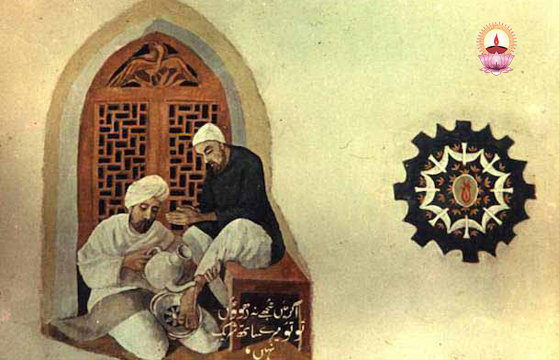
An artist’s attempts to present Jesus Christ and Christian themes in Indian settings are helping convey Christian ideas to thousands of non-Christians in India.
Jyoti Sahi, 76, uses his paintings to blend biblical themes with his native symbols and pieces of folk, tribal and Vedic symbols to take Jesus closer to non-Christians in India.
“I have known Jyoti Sahi personally, and his creative paintings are path-breaking. They introduced a paradigm shift in art, using folk, tribal and Hindu cultural symbols.”
Through his evocative art, Sahi attempted to make Jesus look like an Indian. He aimed to make Jesus accessible to a multicultural and multifaith Indian milieu, said the bishop, a former professor of Indian spirituality and traditions at Jnana-Deepa Vidyapeeth, Papal Athenaeum, in Pune.
Sahi, who once thought of becoming a Benedictine monk, took up a vocation of painting. With some others, he pioneered the Indian Christian Art Movement, encouraging artistic expressions of Christian themes.
Jesuit Fr Roy M. Thottam said Sahi is known as a theologian with the brush. He draws his inspiration from Indian cultures, mythologies and mysticism as well as tribal and folk traditions. “He has depicted Christ variously as ‘the tree of life,’ ‘Lord of Dance’ and ‘Christ the living water.’ He combines Biblical symbols with cultural symbols,” said Fr Thottam, who trained as a painter under Sahi.
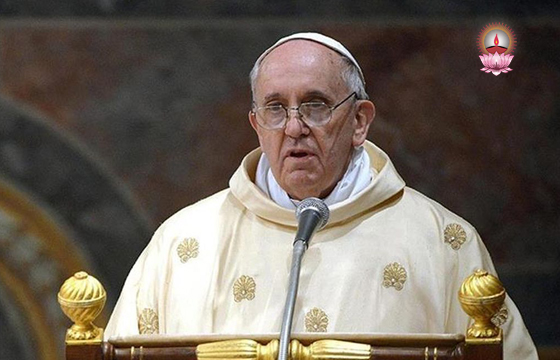
Indian parliamentarian criticizes Pope’s remarks on gossiping
A member of India’s parliament has criticized Pope Francis for comparing gossiping with coronavirus. “I’m not sure about this, Your Holiness… Sometimes it seems like Covid might be a tad bit worse…” tweeted Varun Gandhi, a member of the Lok Sabha (peolple’s house), the lower house of parliament. The 40-year-old politician belonging to the ruling Bharatiya Janata Party was referring to Pope Francis’ remarks on August 6 that gossiping is a “plague worse than Covid” that is seeking to divide the Catholic Church.
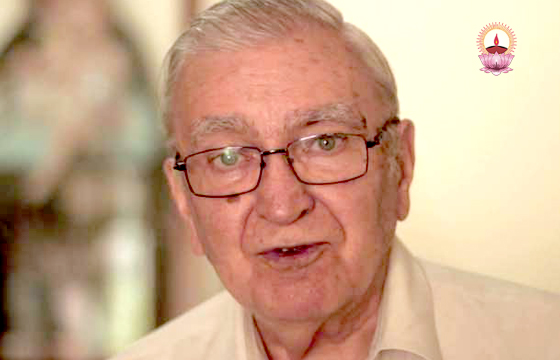
India’s Jesuit film scholar dies at 85
Jesuit Father Gaston Roberge, the French-Canadian founder of Chitrabani media training institute in Kolkata and film and media scholar par excellence, died at St Xavier’s College, Kolkata, on Aug. 26. He was 85. Both Chitrabani and the Xavier Institute of Communications, founded by Francis “Packy” MacFarland, were born within a year of each other, a little over 50 years ago in 1969-70, in two different parts of the country, Calcutta (now Kolkata) and Bombay (now Mumbai).
Pioneering Jesuit missionary in north-eastern India dies
A pioneering Jesuit missionary who had worked for four decades in north-eastern India has died.
Father Jayant Kumar Padival died around 10 pm on September 8 in Father Muller Hospital, Mangaluru, a port town in the southern Indian State of Karnataka. He was 71 and a Jesuit for 54 years.
According to Karnataka Jesuit Provincial Father Dionysius Gerard Leonard Vaz, the burial service was scheduled at 3:30 pm on September 9. Due to the Covid-19 restrictions, only a few people are attending the burial service.

Bishop of first Syro-Malabar diocese in Latin territory dies
Bishop Paul Chittilapilly, the first prelate of a Syro-Malabar diocese Pope Paul II created 33 years ago to resolve the rite rivalry in the Indian Church, died on Sept. 6. He was 86. Bishop Chittilapilly, who had served as the bishop of Kalyan in Maharashtra and Thamarassery in Kerala, died at 6:45 pm in Nirmala Hospital, managed by the Ursulines of Mary Immaculate nuns, in Kozhikode.

Kottayam archdiocese gets new auxiliary bishop
Pope Francis on August 29 appointed Father George Kurisummoottil as the auxiliary bishop of Kottayam Syro-Malabar archdiocese to take care of its Knanaya faithful from Syro-Malankara Church. The new bishop is currently the vicar general for the Syro-Malankara faithful of the archdiocese. Father Kurisummoottil has chosen the name Gheevarghese Mar Aprem.