
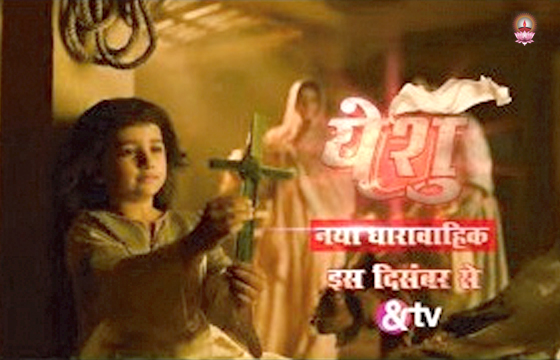
A new television serial on Jesus in Hindi is set to begin next month on TV. The story for the serial entitled “Yeshu” that deals with Jesus’ life story, is done by Utkarsh Naithani, an actor, flute player, and writer based on Divine Word missionary Father John Paul Herman’s research. “First of all, let me tell you that I the research scholar and resource person for this serial in Hindi “Yeshu,” Fr Herman, a media professional, told Matters India. He has been working on it since March 4 as the producer and director called him to Mumbai for the first meeting. “Lockdown was a great opportunity for me to sit down and work on it. Since then I am on it all the time,” said Father Herman, director of media commission, Catholic Diocese of Jaipur, Rajasthan (Western India). TV presents for the first time in Hindi General Entertainment Channels, the untold, unheard story of “Yeshu,” produced by Arvind Babbal Productions Pvt Ltd.
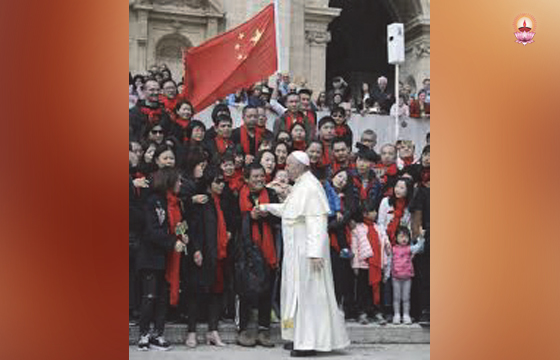
China criticizes pope over comment on Uighur Muslim minority
China criticized Pope Francis on November 24 over a passage in his new book in which he mentions suffering by China’s Uighur Muslim minority group.
Foreign ministry spokesperson Zhao Lijian said Francis’ remarks had “no factual basis at all.”
“People of all ethnic groups enjoy the full rights of survival, development, and freedom of religious belief,” Zhao said at a daily briefing.
Zhao made no mention of the camps in which more than 1 million Uighurs and members of other Chinese Muslim minority groups have been held. The U.S. and other governments, along with human rights groups, say the prison-like facilities are intended to divide Muslims from their religious and cultural heritage, forcing them to declare loyalty to China’s ruling Communist Party and its leader, Xi Jinping.
China, which initially denied the existence of the facilities, now says they are centers intended to provide job training and prevent terrorism and religious extremism on a voluntary basis.
In his new book Let Us Dream, due Dec. 1, Francis listed the “poor Uighurs” among examples of groups persecuted for their faith.
Francis wrote about the need to see the world from the peripheries and the margins of society, “to places of sin and misery, of exclusion and suffering, of illness and solitude.”
In such places of suffering, “I think often of persecuted peoples: the Rohingya, the poor Uighurs, the Yazidi — what ISIS did to them was truly cruel — or Christians in Egypt and Pakistan killed by bombs that went off while they prayed in church,” Francis wrote.
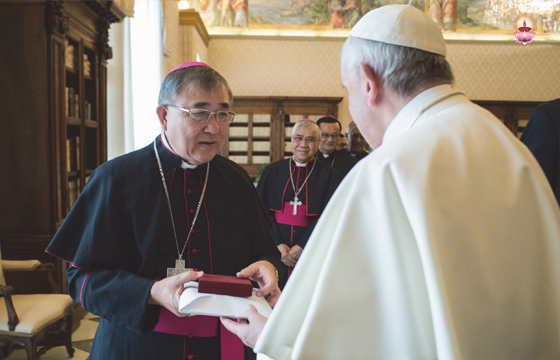
Card. Cornelius Sim: Ours is a ‘hidden’ Church, ‘not noisy’, small but alive
“A hidden Church,” “not noisy;” as small as “a Fiat 500,” but alive, which envisions its apostolate above all through schools and help for migrants. This is the image of the Church of Brunei, depicted by the new cardinal- designate Cornelius Sim speaking with AsiaNews via Zoom. Despite being among the smallest churches in Southeast Asia – indeed, perhaps precisely for this reason – Pope Francis wanted to reserve a Cardinal’s hat for Archbishop Sim during the next consistory on 28 November. Unfortunately, the new cardinal will not be able to be present at the ceremony in Rome, due to the Covid-19 lockdown.
“We are a minority Church and this makes us prudent. Not so much because we are discriminated against… Like in any family gathering, small children should be quiet to let the elders talk. So we are quiet. And we, being small, accept our role: if the dishes have to be washed, we do it; if the floor has to be swept, we do it; we do what is required of us.
As a Church we have three small parishes and a mission station. We also have some schools, linked to the parish. Most of our social apostolate takes place through the school, which was opened in the 1930s. School is where our presence started. And where the Church has been established. The Church was actually present here in the first half of the 1800s, thanks to a PIME father [Fr Antonio Riva, in the Barambang mission; Fr Ignazio Borgazzi in Labuan – ed] but after three or four years, those priests were called to Hong Kong and their attempt did not bear much fruit, until 1920, when the Mill Hill missionaries arrived from Sabah (in present-day Malaysia.) The missionaries started a small school. My grandfather was one of the first to be baptized and he was one of the first Catholics in the nation.
And so the Church has always been involved in school, in education, which is not a partisan education, but an open one: 70 percent and more of the students are non-Catholics. There are Muslims, Buddhists, people of different faiths, or people without any faith. Our schools are renowned for the quality of the education they offer. Our teachers are academically bright and prepared. The teachers are local, but also international: they come from Malaysia, Singapore, the Philippines, …
We are the smallest Church in ASEAN. Perhaps only Laos has a very small Church like ours.
We have about 16 thousand faithful. There were more, but due to the economic crisis, many people left the country. On Sundays, 3-4 thousand people arrive at every mass.”
–AsiaNews
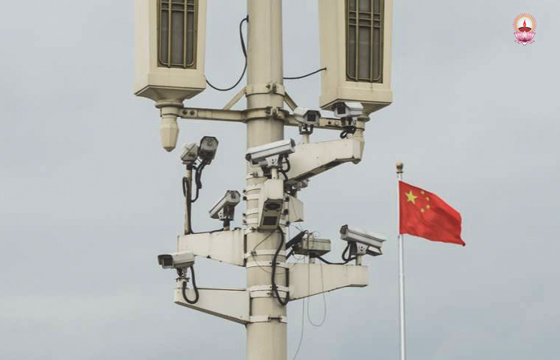
US religious liberty ambassador calls out China for using tech to suppress religion
The U.S. will be working against the use of technology to suppress religious minorities, the religious freedom ambassador announced.
“The United States announced that we will pursue the topic of misuse of technology to oppress religious minorities,” said Sam Brownback, Ambassador-at-Large for International Religious Free-dom, on a Nov. 17 press call about the 2020 Ministerial to Advance Freedom of Religion or Belief.
Brownback cited China’s abuses against Ughurs; it has created a “virtual police state” to track the movements of the population and to engage in predictive policing.
“We’re seeing this graphically done in Xinjiang, where high-tech observation systems using artificial intelligence and facial recognition are oppressing a dominantly Muslim majority from practicing its faith, this along with being locked up in detention facilities – over a million Muslim Uyghurs locked up in detention facilities,” Brownback said.
Poland hosted the third annual ministerial, held virtually on Nov. 16-17 due to the pandemic. The meeting featured leaders from more than 50 countries and international organizations. –CNA
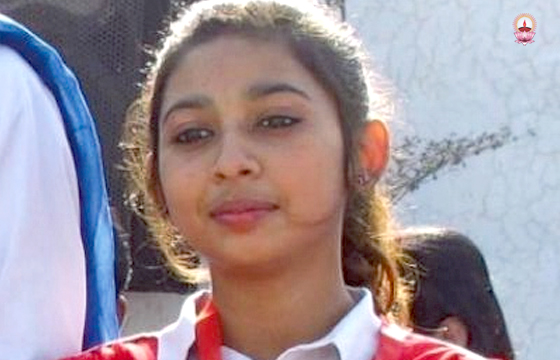
Britain urged to grant asylum to Pakistani girl
A U.K. based charity has called on British Prime Minister Boris Johnson to grant asylum to a 14-year-old Christian girl who was abducted at gunpoint during the Covid-19 lockdown and forcibly married and converted to Islam by a Muslim married man.
The Catholic charity Aid to Church in Need, which supports persecuted Christians around the world, is urging concerned Chri-stians to add their names to an online petition that will be sent to the Prime Minister on behalf of Catholic teenager Maira Shahbaz in Pakistan, who was abducted in April.
In August, Maira fled the home of her alleged husband, Mohamad Nakash, weeks after the Lahore High Court ordered her to return to her abductor and ruled that she was legally married to the Muslim man.
“Regardless of what the court eventually decides, Maira’s life will forever be in danger,” the charity said. “There is the threat of honour killing. Extremists in Pakistan consider her an apostate and will kill her at the first chance. Her lawyer said men have been looking for her, knocking on doors and asking for her whereabouts.”
–MATTERS INDIA
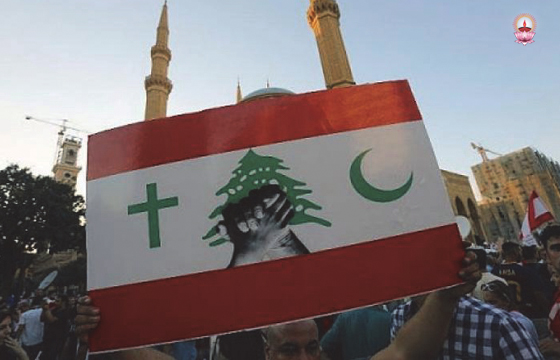
Lebanon’s is a model of coexistence
Lebanon’s “living together,” the historic vocation perceived and conferred by Pope John Paul II to Lebanon, and proposed by him – for our greatest honour and confusion – as “model for East and West,” is once again in the spotlight because of what is happening in a world where multi-religious societies are constantly growing, not without frictions, wars and sometimes horrible massacres.
In his homily on Sunday 15 November, in which he accused those who are delaying the formation of a government by Saad Hariri of trying to “overthrow of the State of Greater Lebanon” established by the Treaty of Versailles (1919), the head of the Maronite Church, Patriarch Bechara al-Rahi, sought to comfort the Armenians of Nagorno-Karabakh that Azerbaijan has just militarily conquered, by offering them as model Lebanon’s “living together,” encouraging them not to flee their homes and their shrines, but to agree to coexist in good harmony with the Muslims of Azerbaijan, in a multicultural and multi-religious state in which the believers of the two great Muslim and Christian religions stand together in an atmosphere of mutual acceptance. –AsiaNews
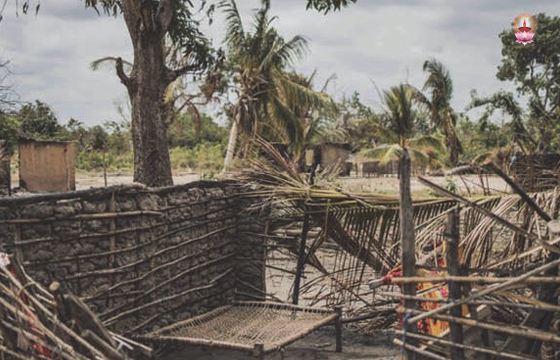
Multiple Beheadings in Mozambique: Is the World Indifferent?
On November 10, Al Jazeera posted a breathtaking headline: “ISIS-linked attackers behead 50 people in northern Mozambique.” The subhead was equally horrifying: “Witnesses say the assailants herded victims onto a football pitch in the village of Muatide where the killings were carried out.”
In the midst of a pandemic, and in the throes of a highly contested US presidential election, it isn’t surprising to encounter dis-concerting news headlines. But the gruesome description of innocent people “herded” to their death on a soccer field, where they were systematically decapitated and dismembered, seems more suitable to a horror film than a present-day news report.
Despite the declaration of an African branch of ISIS taking credit for the killings and its religious tone, there has been discussion about the cause of the violence. For example, the New York Times and Al Jazeera suggest that poverty and inequality led to the attacks. This is similar to the argument that climate change is the primary source of the genocidal Fulani attacks on Christian villages in Nigeria.
Writing about the beheadings, New York Times journalist Declan Walsh quoted Sam Ratner, a contributing editor at Zitamar News. “While the militants claim to be targeting Christians, in practice they make little distinction between their victims. ISIS propaganda says they burned a Christian village or killed Christian soldiers,” Ratner said. “But on the ground, we’re not seeing a lot of differentiation between Christians and Muslims. They do not appear to be targeting churches in particular, for instance.”
It is true that northeastern Mozambique where the attacks took place is rich an oil rich region, and there is wealth to be gained through massacres and the confiscation of property. There have been attacks on oil company convoys and other petroleum-related entities. Perhaps some of the violence is indeed the work of opportunistic criminal enterprises.
In July, CBN News interviewed Bishop Luiz Fernando Lisboa of Mozambique’s Pemba Diocese. He described the world’s response to the atrocities that are taking place in his country and across the world as “indifference.”
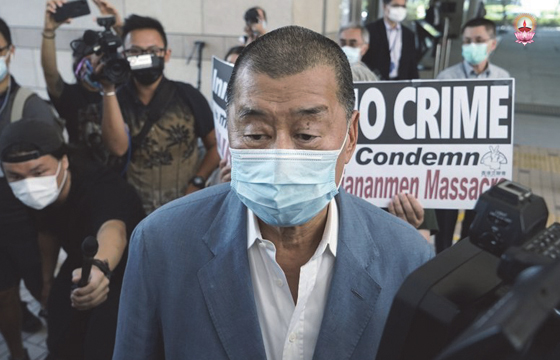
Catholic Hong Kong media mogul: ‘Freedom has a price’
In the words of Jimmy Lai, “freedom has a price.” That’s why the Chinese media mogul and activist is leaning on his Catholic faith for support as he faces potential prison time and continues the fight for freedom and democracy in Hong Kong.
Speaking at the Acton Institute’s 30th anniversary virtual celebration, Lai, who runs the pro-democracy Apple Daily newspaper from the Chinese city, spoke about the opportunities Hong Kong gave him growing up as a reason he continues to fight for freedom.
“I came here with one dollar and the freedom here has given me the opportunity to build up myself. And the value that is underlying this freedom is so precious and that’s exactly what we are fighting for in Hong Kong now,” he said.
Lai was presented the Acton Institute’s 2020 Faith and Freedom Award for his work by the organization’s president Father Robert A. Sirico and chief executive officer Kris Alan Mauren. The Acton Institute is a Michigan-based think tank promoting free market policies undergirded by religious principles.
Sirico offered Lai a message of solidarity in recognizing him for the award. Meanwhile, high-lighting what it shows that he now faces a possible prison sentence.
“When you see a man like this, who is looking at a potential jail sentence in a Chinese cell it prompts in us a certain inspiration but also an awareness that socialism is resilient,” Sirico said. “The collectivism idea, the idea of dominating other people, that politics is the solution to our problems, power to corrupt. These are the challenges we’re facing this day in age.”
Lai was arrested with nine others in August for suspicion of colluding with foreign forces under a new Chinese security law. Police also raided the Apple Daily headquarters.
News reports at the time said he was held for forty hours and shown interviews he did with foreign media outlets as evidence of collusion. He was eventually released on bail.
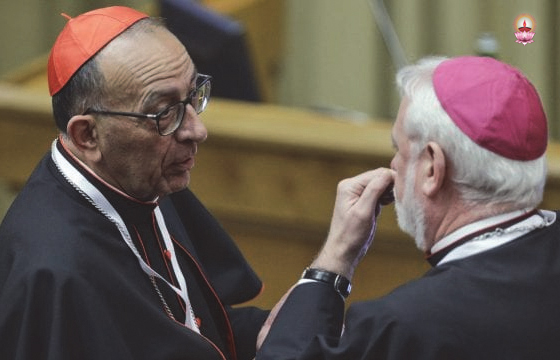
Spain’s bishops meet as religious freedom threatened in the country
With the U.S. Conference of Catholic Bishops holding a virtual fall assembly, the bishops of Spain are also holding their fall gathering.
On the agenda for the Spanish bishops are Europe’s rising populist currents, and a bill in Spain that threatens religious education.
In his opening speech, the conference president, Cardinal Juan Jose Omella of Barcelona, spoke of the “tensions” that society has today, due to stresses caused by the COVID-19 pandemic.
The prelate quoted a recent speech by Pope Francis to the leader of the Spanish government, Pedro Sanchez, during his visit to Rome last month: “It’s necessary for all of us to build our nation, where the delete and start over is not permitted.”
Seeing the rising unemployment and recession in Spain but also in most of Europe, Omella said this is “not the moment for divisions, it’s not the moment to allow the irresponsible and ideological populist sprouts to sneak in. This is the moment for cohesion, for cordiality, working together, of looking to the long term, freeing ourselves from the short-termism of elections or the stock market.”
“As the Pope said, ‘ideologies sectarianize, ideologies deconstruct the homeland, they do not build, it is necessary to learn from history’,” the cardinal continued. “It’s the moment of unity and good politics, that which ensures respect for the human person and works tirelessly for the common good.”
Omella’s speech was divided in 14 points, and several times he insisted on the “urgency” to build spaces and attitudes of encounter in the political class, society as a whole and also within the Church.
The remarks are peppered with references to Francis, including to his historic Urbi et Orbi blessing on March 27.
“The square had never been so empty and perhaps it had never been so full of people following the message from every home,” Omella said. “People of different religions, beliefs and nationalities where more united than ever because of the unusual and hard experience that we are all suffering.”
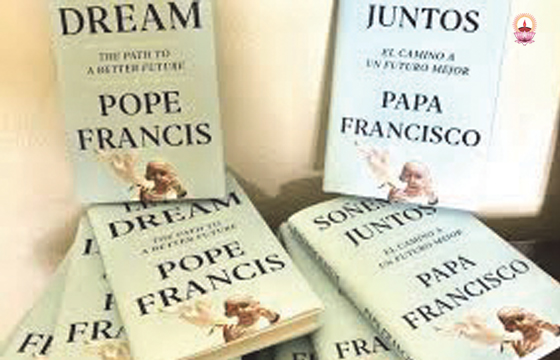
New book sketches Pope’s dream for a post-COVID world
In that brief inter-mezzo over the summer between what turned out to be the first and second great surges of the COVID-19 pandemic, Pope Francis held a series of appropriately socially distanced, “vir-tual” conversations with his premier English-language explicator about what he believes needs to be done for the world to be better than it was before the crisis.
Through conversations held on the phone, through voice recordings and via email, Francis answered questions posed to him by British biographer Austen Ivereigh on a wide range of issues, including the death of George Floyd; clerical sexual abuse; the toppling of statues in an effort to reshape perceptions of history; protests against government coronavirus restrictions; persecuted minorities such as Christians, Yazidi, Rohingya and Uighurs; migrants and refugees; and, though the book notes “many will be irritated to hear a Pope return to the topic,” Francis discussed abortion at length too.
“I cannot stay silent over 30 to 40 million unborn lives cast aside every year through abortion,” the Pope said. “It is painful to behold how in many regions that see themselves as developed the practice is often urged because the children to come are disabled, or unplanned. Human life is never a burden.”
The Pope’s comments are included in an interview book he authored with Ivereigh, titled Let us Dream, which will hit bookstores and online shops on Dec. 1. Crux, along with other news outlets, received an advance copy.
On abuse, both sexual and abuses of power, Francis noted that social distancing has made some potential victims more susceptible to online grooming and other abuses which, as a community, “we should be watching out for and reporting.”
“In these past years, thank God, we have seen a particular awareness of these issues,” he said. “The culture of abuse, whether sexual or of power and conscience, began to be dismantled first by victims and their families, who in spite of their pain, were able to carry through their struggle for justice and help alert and heal society of this perversity.”
Francis added he “will not tire of saying with sorrow and shame, these abuses were also committed by some members of the Church.”
“In these past years we have taken important steps to stamp out abuse and to engender a culture of care to respond swiftly to accusations,” the Pope said. “Creating that culture will take time, but it is an unavoidable commitment which we must make every effort to insist on.”
Society too, Francis argued, has awaken against abuse, either through the #MeToo movement, or the many scandals “around powerful politicians, media moguls and businessmen.”