

When Simone Biles, described as the world’s greatest gymnast, announced July 27 she would not be competing in a team event with the U.S. women’s Olympics gymnastics team and the next day withdrew from the all-around final, many people were shocked, but many supported her decision to prioritize her mental health.
Counsellors and spiritual directors at Catholic colleges and ministries who spoke with Catholic News Service echoed a similar view and also said her action opened up a broader and much-needed discussion about the importance of mental health care.
Biles, the four-time Olympic gold medalist, told reporters she was not in the right state of mind to continue the competition after she completed one fewer than planned mid-air twists in the team’s first event and uncharacteristically stumbled on her landing.
Later, she said she had experienced as a “little bit of the twisties,” an almost quaint term used by gymnasts that belies its meaning of losing control of one’s body while in the air.
That particular sensation is one most Olympics viewers likely can’t even begin to relate to, but the feeling of “fighting all those demons,” which Biles said she had been doing along with a sense of the “weight of the world” on her shoulders, is something non-Olympic stars can grasp on one level.
“Even if we aren’t carrying around the pressure of performing as one of the greatest athletes of all time, we are all susceptible to the undercurrents in our culture that preach grit, grind and pushing through,” wrote Zac Davis, associate editor of America magazine.
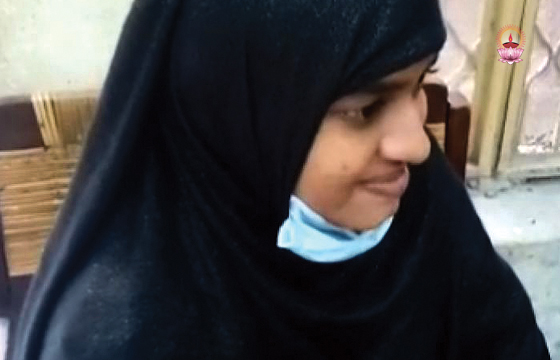
Faisalabad: another Christian girl kidnapped and converted to Islam
Another Christian girl has been kidnapped and converted to Islam in Pakistan.
Speaking to AsiaNews, Chashman’s father, Gulzar Masih, said that on 28 July, he had gone to her school to pick her up; not finding her, he had immediately gone to the police to report the disappearance of the 14-year-old. A few days later, the kidnappers sent the family a video and documents in which the girl claims to have converted of her own free will.
Gulzar, a rickshaw driver by profession, went back to the police station to get some answers, to no avail.
The story came to light only after Lala Robin Daniel, a Faisalabad-based human rights activist, got involved. “Punjab authorities should do their job to free girls who are kidnapped,” he said.
Daniel called for legal action against the kidnappers. “As long as kidnappings continue undisturbed, girls and their families will feel unsafe.”
Muhammad Ijaz Qadri, district president of the Sunni Tehreek organisation, released a letter certifying Chashman’s conversion to Islam, whose “Islamic name from now on will be Aisha Bibi.”
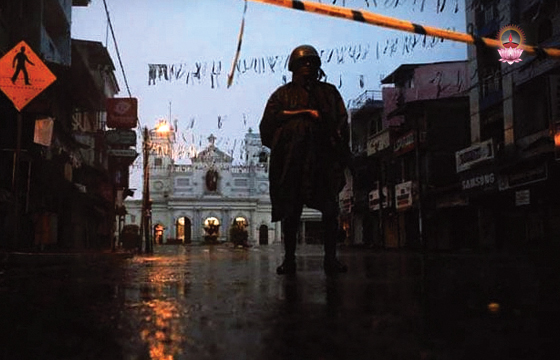
Sri Lanka files charges against 25 Easter bombing suspects
Sri Lanka has filed 23,270 charges against 25 people in connection with the 2019 Easter Sunday suicide bomb attacks on churches and hotels that killed 269 people, the president’s office said Wednesday.
The charges filed Tuesday under the country’s anti-terror law include conspiring to murder, aiding and abetting, collecting arms and ammunition, and attempted murder, it said.
The attorney general also asked the chief justice to appoint a special three-member high court bench to hear the cases speedily, it said in a statement.
Two local Muslim groups that had pledged allegiance to the Islamic State group were blamed for the six near-simultaneous suicide bomb attacks on April 21, 2019. The blasts targeted three churches and three hotels.
Another suicide bomber who had entered a fourth hotel left without setting off his bomb, but later committed suicide by detonating his explosives at a different location.
Friction and a communication breakdown between then-President Maithripala Sirisena and then-Prime Minister Ranil Wickremesinghe were blamed for the government’s failure to act on near-specific foreign intelligence warnings ahead of the attacks. That led to the election of President Gotabaya Rajapaksa later in 2019 on a platform of national security.

Eight-year-old becomes youngest person charged with blasphemy in Pakistan
An eight-year-old Hindu boy is being held in protective police custody in east Pakistan after becoming the youngest person ever to be charged with blasphemy in the country.
The boy’s family is in hiding and many of the Hindu community in the conservative district of Rahim Yar Khan, in Punjab, have fled their homes after a Muslim crowd attacked a Hindu temple after the boy’s release on bail last week. Troops were deployed to the area to quell any further unrest. On Saturday, 20 people were arrested in connection with the temple attack.
The boy is accused of intentionally urinating on a carpet in the library of a madrassa, where religious books were kept, last month. Blasphemy charges can carry the death penalty.
The Guardian knows the name of the boy and family members, but has chosen to protect their identities for their safety.

Inside China’s brutal death row with mobile injection vans & firing squads as Canadian diplomat sentenced to death
A Canadian man is set to join hundreds of shackled inmates on China’s degrading death row as they await agonising lethal injections or firing squads. Robert Schellenberg, believed to be 38, from Abbotsford, British Columbia, was detained by the Chinese authorities for drug smuggling and after a retrial he had been condemned to die. Robert Schellenberg is now on death row in China where doom-ed inmates are caged in humiliating conditions.
Hundreds of Chinese citizens are handed the death penalty each year – more than the rest of the world combinedCredit: AFP A ‘cell trustee’ removes shoes of a prisoner before she is taken away to be killedCredit: chinasmack.com
Schellenberg, who maintains his innocence, has been locked up in China since 2014, when he was accused of attempting to smuggle 225kg of methamphetamine to Australia. In December 2018 he was sentenced to 15 years but after he appealed a retrial was ordered and the Dalian intermediate people’s court instead ordered his execution.
It comes as human rights organisation Amnesty Inter-national has branded China the world’s top executioner.
Schellenberg and others facing death are sent to detention centres where they await their fate on death row in tiny overcrowded cells or in solitary confinement. According to the blog Dui Hua, those on death row wait just two months before being put to death compared to an average of 15 years in the United States.
It says the doomed prisoners are degraded by being shackled at all times by their hands and feet.
Cell trustees help them to eat and go to the toilet and strip them ready for execution after which the chains are removed and cleaned.
Firing squads and lethal injections are two favourite methods of the death penalty used by China.

China arrests leaders of Evangelical church demolished in 2018
Authorities in China have arrested leaders and members of a prominent evangelical church that was destroyed with dynamite about three years ago, sparking a global outcry.
Nine leaders and members of the Golden Lampstand Church, a house church in Linfen in Shanxi province, northern China, were arrested on August 7 in a “well-prepared and coordinated” public security operation, reported Bitter Winter, a magazine on religious liberty and human rights.
Among the detainees were Pastor Wang Xiaoguang and Evangelist Yang Rongli. Both had previously been arrested in 2009. Before it was demolished with explosives by local authorities in January 2018, the Golden Lampstand Church was a mega-church and one of the largest churches in China.
Its congregation was part of a network of 50,000 members and the church was constructed at an estimated cost of US$2.6 million, according to Bitter Winter. It was the second destruction of a church in China in one month after a Catholic church was destroyed in the neighbouring province of Shaanxi, about 20 years after it was opened, The Guardian reported.
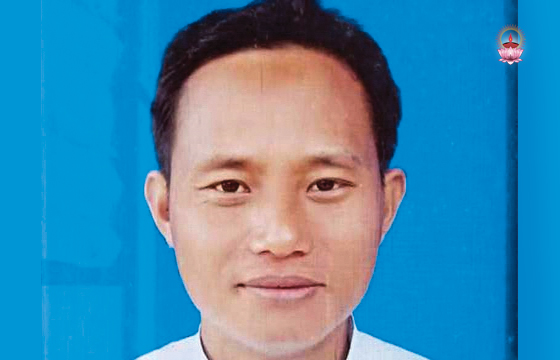
Abducted priest, catechist released in Myanmar’s Chin state
A priest and a catechist from Hakha Diocese in Myanmar’s Chin state who were arrested by a local militia have been released following mediation by Catholic leaders.
Father Noel Hrang Tin Thang and a catechist were arrested by the Chinland Defense Force (CDF) while they were traveling from Surkhua to Hakah on July 26. They are from the Church of Our Lady of the Rosary Parish in Surkhua. They were released on Aug. 4 evening following the intervention of church leaders, according to local sources. “The pair were in good health as they were treated well during nine days of detention. They returned to their parish yesterday evening,” a church social worker from Hakha told. He said the release followed agreeing to the demands of the CDF, which included transferring the priest from Surkhua to Hakha to avoid contact with the military and an agreement not to undertake government projects.
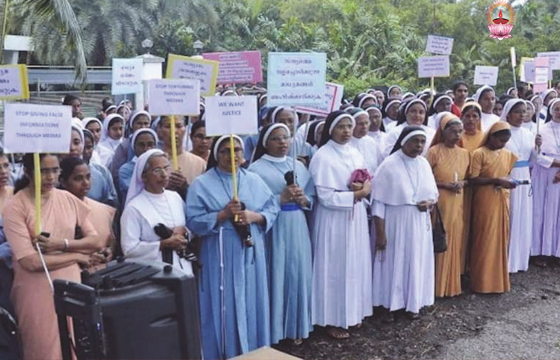
Catholic religious to move India’s Supreme Court over tax order
Catholic religious congregations in Kerala are to challenge a state court’s order which withdrew tax exemption that religious priests and nuns enjoyed as employees of government-aided educational institutions for decades. The court in the southern Indian state refused to accept their argument that they do not take their salaries for their personal use but instead they go to their respective religious societies.
“We have now decided to appeal against the order before the Supreme Court of India,” said Father Jacobi Sebastian, president of the Kerala Conference of Major Superiors.
Father Sebastian, a member of the Oblates of St. Joseph, told on Aug. 9 that they are also planning a larger meeting of church officials, major superiors and financial consultors on August 16 to chart the next steps.
The court quoted the Bible to say “Render unto Caesar the things that are Caesar’s, and unto God the things that are God’s.”
“We are reminded of the above teachings of Jesus Christ … while we consider an engrossing question on the liability of tax deduction at source from the salary paid to teachers who are nuns or priests of the religious congregations,” the court said.
The legal clash began in 2014 after the federal Income Tax Department ordered an end to tax exemption given to the Catholic religious priests and nuns since 1944. It asked the government treasury to deduct tax before paying salaries.
Three priests and a nun challenged the order soon after it was issued. A single bench of Kerala High Court dismissed their demand for exemption and upheld the Income Tax Department’s order.
The petitioners appealed before a higher bench of the court along with 49 others, but the court dismissed their demand on July 13.
The lawyers of the petitioners also quoted from the Church’s canon law to say that people who take “a perpetual vow of poverty” undergo a civil death and thereafter they are not considered persons under the Church’s laws.
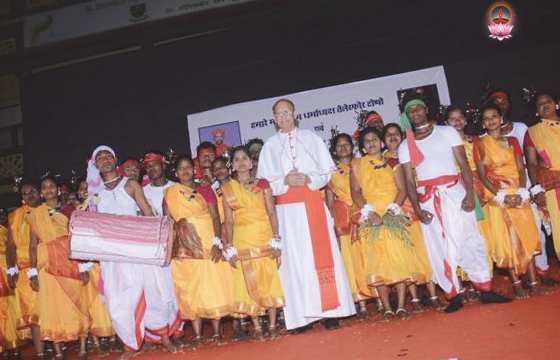
Card Gracias: Tribal groups suffer ‘injustice and exploitation’ around the world
In his morning Mass online, the Archbishop of Bombay (Mumbai) – and is also president of the Catholic Bishops’ Conference of India (CBCI) – spoke about his participation two years ago in the Synod of Bishops for the Pan-Amazon region, enjoined by Pope Francis.
On that occasion, the cardinal realised that “challenges faced by Indigenous people in South America were similar to the challenges faced by Tribals in India.”
Card Gracias also spoke about Fr Stan Swamy, who gave his life for indigenous tribes in India, and mentioned the many men and women religious who work among the Adivasis.
“We are present in Bihar, Chotanagpur and Raighad, to give them hope, education,
dignity and a future,” the prelate said. “But tribes around the world suffer injustice and exploitation.”
For the past three days, the CBCI has been holding webinars to mark the International Day of the World’s Indigenous Peoples, noted Father Nicholas Baria, executive secretary of the CBCI Tribal Affairs Committee.
On paper, the clergyman acknowledges that “The Constitution guarantees the rights of tribal people; in practice, how-ever, their land rights are not recognised” by the authorities.
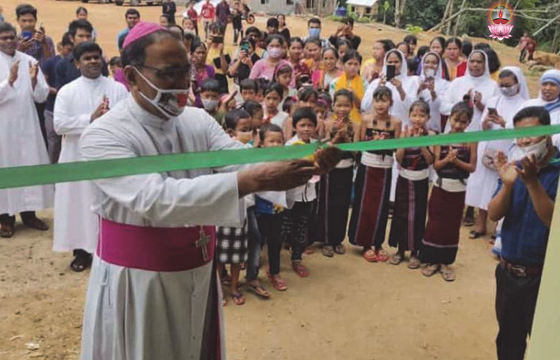
Bishop inaugurates first Jesuit residence in Indian state
Jesuits in India have opened their first residence in the north-eastern state of Tripura.
The Arrupe Inn in Jamtalibari was inaugurated in the presence of faithful by Bishop Lumen Monteiro of Agartala on July 31, the feast day of Jesuit founder Ignatius of Loyola.
“We welcome them to our diocese and wish them our prayers and support as they enter into new ministries. They will be engaged in social, pastoral and education fields in the diocese,” Bishop Monteiro told.
In 2018, two Jesuit missionaries, Babu Paul and James Morias, came to Jamtalibari from the southern state of Kerala.
“As we celebrate the 500th anniversary of the conversion of St. Ignatius, it is an important occasion for Jesuits to refocus on their life and mission,” said Father Irudaya Jyothi, who was part of a Right to Food campaign in West Bengal state before he joined the mission in Tripura.
“The Arrupe Inn is dedicated in a special way to the implementation of the universal apostolic preferences of the Society of Jesus.”