

India’s top court has agreed to hear a dispute between Christians and Muslims over minority scholarships for students after accepting an appeal filed by Kerala’s state government. The Supreme Court bench of Justice L. Nageswara Rao and Justice B.R. Gavai on Oct. 29 ordered to serve notices on all the parties listed in the appeal as respondents. The communist-ruled Kerala government in southern India moved the top court challenging an order by Kerala High Court to quash the 80:20 ratio for distributing scholarships meant for minority communities.
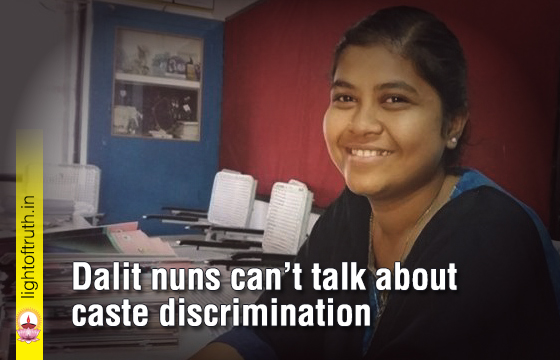
Dalit nuns can’t talk about caste discrimination
Christians of former low caste or Dalit origin face several forms of discrimination within the Catholic Church but they never abandon their faith in Christ, says Sister Robancy Amal Helen, who has been working for the community.
The 33-year-old member of Idente Missionaries (Religious Institute of Christ the Redeemer), a new form of consecrated life of pontifical right, has campaigned and advocated for equality and justice for Dalits in the Catholic Church in India, especially women. As part of her campaign, she coordinated Dalit programs for the community when she worked for the New Delhi-based Catholic Bishops’ Conference of India from 2014 to 2019.
Sister Helen assisted in drafting a policy for Dalit empowerment for the church in India. The policy was published by the bishops’ Office for Scheduled Castes (such as the Dalits) and Backward Classes.
Currently, Sister Helen is an executive editor of the Dalit Christian Digest, a news portal. She also edits and writes for Urimai, (which means “Right” in Tamil), a monthly magazine for Dalit Christians published by the Tamil Nadu Bishops’ Council. “The Indian bishops’ Dalit empowerment policy says, Dalits, although historically the daughters and sons of the soil, are today alienated from society and are silenced. India’s caste system treats Dalits as outcasts. They are robbed of dignity and the basic necessities of life. They are treated as children of a lesser God in Indian society. They are targets of discrimination and have been tortured and killed.
Some Dalits converted to Christianity hoping that they would find dignity and equality in the church. But sadly the caste system is practiced in Christianity, too. The Dalit Christians are deprived of opportunities in church leadership, education and employment. There are separate churches, cemeteries and hearse carts for the Dalits and upper-caste Christians.
But I have observed that the Dalit Christians are deeply rooted in their faith and they never abandon their faith in Christ, whatever the discrimination they face within the church.” She said the Church’s Dalit policy says Dalits account for 12 million among 19 million Catholics in India. But their representation in the hierarchy of the Church is not proportional.
Although Dalits are the majority in the Catholic Church, they are not treated equally. The Dalit Christian children are not allowed to serve the altar or to become lectors. Most so-called upper-caste priests do not visit the houses of Dalit Christians. We see this discrimination even in the appointment of bishops. Among India’s 174 dioceses only 11 bishops are from the Dalit Christian community.
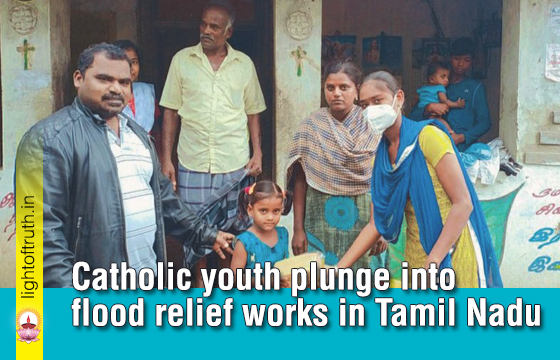
Catholic youth plunge into flood relief works in Tamil Nadu
Young Catholics in Tamil Nadu are in the forefront of rescue and relief operations among the flood victims in the southern Indian state.
Some hundred youth from various parishes of the Archdiocese of Madras-Mylapore “promptly swung into action” as the flooding affected reportedly more than 500 residential areas in Chennai, the state capital, Father Ronald Richard, secretary of the archdiocese’s youth commission told Matters India on November 12.
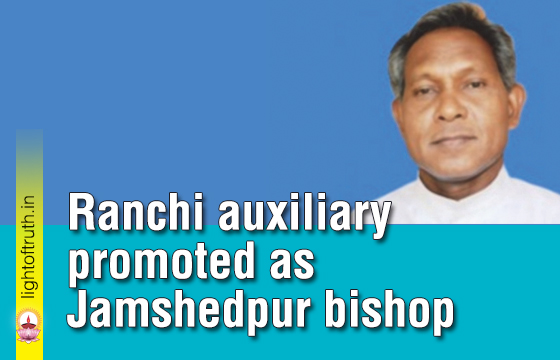
Ranchi auxiliary promoted as Jamshedpur bishop
Pope Francis on November 1 promoted Auxiliary Bishop Telesphore Bilung of Ranchi as the bishop of Jamshedpur.
The appointment was announced at 12 noon Rome time and its corresponding time 3:30 pm in India.
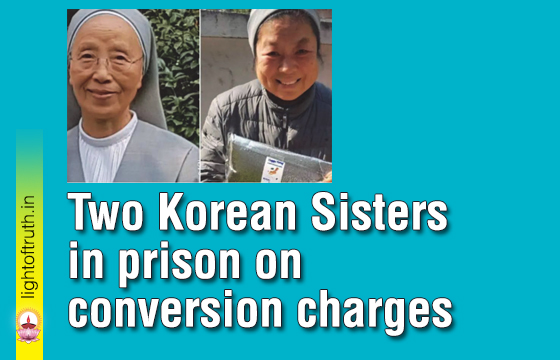
Two Korean Sisters in prison on conversion charges
Two Korean missionary women religious from the Congregation of the Sisters of Saint Paul of Chartres were arrested in Nepal on 14 Septem-ber and are still in detention.
The two, Sisters Gemma Lucia Kim and Martha Park, were charged with proselytising and conversion activities, and arrested at their mission in Pokhara, 200 kilometres from Kathmandu, where they run a facility for poor slum children.
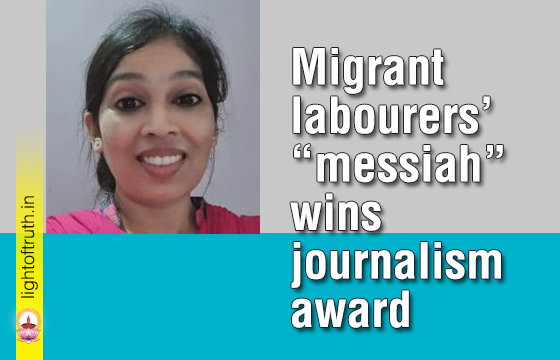
Migrant labourers’ “messiah” wins journalism award
A Catholic nun, who braved coronavirus pandemic and official apathy, to reach out to hundreds of stranded mi-grants labourers during lockdowns has won a prestigious award from the Indian Catholic Press Association.
The national body of Catholic journalists on November 5 chose Sister Sujata Jena for the best reportage on Scheduled Castes and Scheduled Tribes.
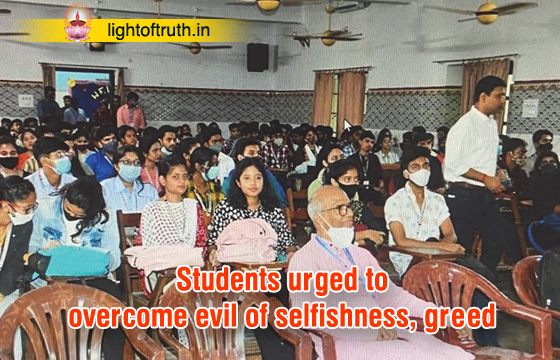
Students urged to overcome evil of selfishness, greed
Swami Sachidananda Bharathi, a peace activist, has urged students to work for an India free of hunger, caste discrimination and corruption by overcoming the evil of selfishness and greed. One should overcome the “evil of selfishness, greed and pride” with love and sharing, caring and giving, focus and progress, trust and entrust, grow and help grow, risk and rise and report and response, said the former Indian Air Force officer who has become a seeker of truth and promoter of peace.
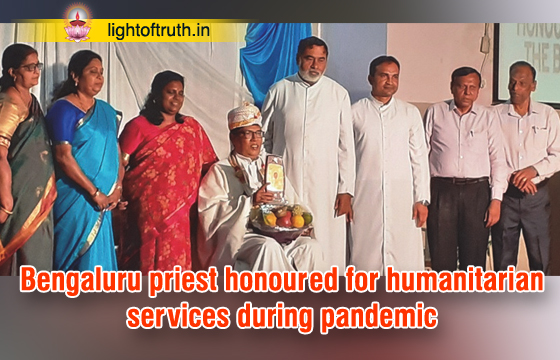
Bengaluru priest honoured for humanitarian services during pandemic
The women of a Catholic parish in Bengaluru have felicitated their parish priest for being the “front line hero” during the pandemic period.
Salesian Father Aloysius Santiago, rector and parish priest of Don Bosco Shrine in Lingarajpuram was honoured October 24 at a function in the parish church.

China forces removal of Bible and Quran apps
American tech giant Apple has removed a Bible app and a Quran app from its App Store in China following requests from officials, triggering conde-mnation from rights groups over a further violation of religious freedom by the communist state.
Apple confirmed to the BBC that the apps, Quran Majeed and Bible App by Olive Tree, have been taken down. Chin-ese officials complained that the apps violated laws by hosting religious texts illegally. “We are required to comply with local laws, and at times there are complex issues about which we may disagree with governments and other stakeholders on the right path forward,” Apple reportedly told BBC, explaining its human rights policy.
Quran Majeed has over 5 million downloads on the Google Play Store, while Bible App by Olive Tree has just over 1 million downloads, according to Business Insider.
Quran Majeed is produced by Pakistan Data Management Services. The company says it has over 35 million users globally including 1 million users in China. It said Apple informed it that “the app has been removed from the China App Store because it includes content that requires additional documentation from Chinese authorities.”
Olive Tree Bible Software, founded in 2000 in Spokane, Washington, creates biblical software and mobile apps. It is an electronic publisher of Bible versions, study tools, Bible study tools and Christian eBooks for mobile, tablet and desktop devices. Another American tech giant, Microsoft, recently announced it was closing its career-focused site LinkedIn in China as Chinese laws pose extreme difficulties. LinkedIn faced criticism recently for closing the accounts of some journalists following complaints from Chinese authorities.
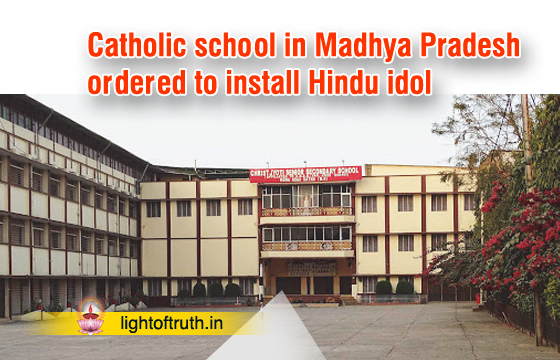
Catholic school in Madhya Pradesh ordered to install Hindu idol
Right-wing Hindu activists on October 25 served a 15-day ultimatum to Catholic school in the central Indian state Madhya Pradesh state to install in the campus an idol of Saraswati, the goddess of know-ledge. A 30-member delega-tion of the Vishwa Hindu Parishad and Bajrang Dal met Father Augustine Chittupara-mbil, manager of Christ Jyoti Senior Secondary School in Satna district headquarters, to make the demand through a memo-randum. The memora-ndum they gave the priest 15 days to comply with their demand or face protests in front of the school.
“The Hindu activists came to our school and wanted us to install an idol of goddess Saraswati in the campus,” Father Chittuparambil told. The radicals forced the priest to give in writing that he had received their memorandum that he accepted at the school’s main gate.
The Hindu activists left the place with a warning to come back in case the school failed to comply with their demand.
“They claim that the school was built at a place where the idol of goddess Saraswati had existed,” the priest explained.
He pointed out that the school was built 49 years ago and no one had made such a claim until now. The Syro-Malabar diocese of Satna manages the school. Satna town is some 455 km northeast of Bhopal, the state capital.