

Indian tribal people, including some who are now Christians, assembled in the national capital New Delhi to press their demand for a separate Sarna religion code in the upcoming census.
The followers of the Sarna religion are predominantly of tribal origin and claim to be nature worshippers. They have been demanding recognition for it as a distinct religion in India for decades. At present, the census has separate codes for only six religions: Hinduism, Islam, Christianity, Sikhism, Buddhism and Jainism. While filling in these columns, a tribal person has to identify as one of these or tick against the column marked as “others” but cannot specify Sarna as a distinct and different religion.
Tribal representatives from the nine states, which are tribal dominated, are now gearing up for a mass agitation to highlight their demand,
On Dec. 7, nearly 500 tribal men and women in traditional attire sat on a fast and staged a sit-in protest at Jantar Mantar in the heart of New Delhi.
They later handed over a memorandum of their demands to the offices of the president, prime minister, federal ministers for home and tribal affairs, besides the registrar general and census commissioner of India.
“States, where tribal people are in majority or have sizable numbers, have been demanding a separate Sarna code but our demand is not been taken seriously,” Karma Oraon, convener of a tribal people’s organization named Rashtriya Adivasi Samaj Sarna Dharma Raksha Abhiyan, told.
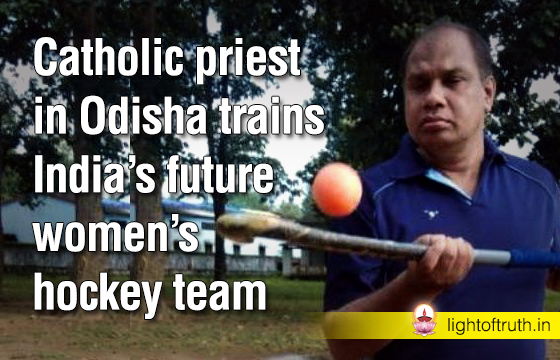
Catholic priest in Odisha trains India’s future women’s hockey team
A Catholic priest in Odisha hopes to achieve his childhood dream of playing hockey for India. He now trains women to become the country’s future hockey team and his main supporter is his bishop.
“I always wanted to become a member of India’s A team, stay in a sport hostel and play for my nation. But God willed otherwise,” Father Rajendra Kumar Kujur of Sambalpur Catholic diocese told Matters India. A documentary film “The Mountain Hockey” made on the priest’s resolves and love for the games was released a few months ago on OTT platforms such as Disney Hotstar, MX Player, Fearless, Amazon Prime Video and DcuBay in more than 170 countries.
The Odia language film, directed by Avinash Pradhan and Debasish Mohapatra, gives a glimpse of the cradle of Indian hockey by focusing Amlikha-man, a small village surrounded by mountains in Odisha’s Sambalpur district.
The inspirational figure in the film is Father Kujur, who is currently the headmaster of Upper Primary Mission School in Amlikhaman, some 90 km northeast of Sambalpur.
Fr Kujur’s dram soared high when hockey and Odisha drew national attention when the Indian women team reached Olympics semi-final. All of them were trained in the eastern Indian state.
Now the 46-year-old priest wants his women to win the gold in future. Fr Kujur training students Along with studies, his school provides hockey training to the students, especially girls with coach Dominic Toppo another hockey enthusiast who could not make it to the top because of lack of guidance and opportunities in childhood.

Religious polarization targets voters in Indian polls
For Indian politicians, it is time again for temple runs as five crucial states, including the largest, Uttar Pradesh in the north, prepare to go to the polls in the first quarter of 2022.
And besides making a public display of offering flowers and milk to a plethora of gods, the usual election talk to polarize the electorate into majority Hindus and minority Muslims will carry on full steam in the coming months.
The Taliban takeover of Afghanistan in August is proving handy for the ruling Bharatiya Janata Party (BJP) and the pro-Hindu outfits aligned with it while warning voters to resist any attempts to Talibanize India.
Such rhetoric and the resulting public mood suit Prime Minister Narendra Modi’s BJP, which has high stakes in these provincial elections. It rules all but one of the five states.
The northern state of Punjab is the only state ruled by Congress, the main opposition party. The repeal of three farm laws in November in the face of sustained agitation by Punjab’s farmers was an unusual retreat by the Modi regime known for its macho-Hindu politics. The BJP could also face some tough challenges in retaining power in Uttar Pradesh, as it may in Uttarakhand in the north, Goa in the west and Manipur in the northeast, where it rules in alliance with regional parties.

Police probe Catholic-run orphanage in central India
A police probe has been initiated into a Catholic-run orphanage in Sagar Diocese in the central Indian state of Madhya Pradesh following allegations that its inmates were given beef and taught the Bible, among other charges.
Church leaders denied the charges and said they were part of a well-orchestrated malicious campaign to defame the Church, especially by those who have an eye on the orphanage’s land.
This is the third such incident targeting a Catholic-run institution in the diocese within a month. A joint team of police and district Child Welfare Committee (CWC) members visited St. Francis Orphanage in Shampura in Sagar district on Dec. 6 following a complaint that the orphanage authorities had supplied beef to the inmates and tried to teach the Bible, among other charges.
“The team interacted with students and took statements of five boys and five girls and also those of officials,” orphanage director Father Sinto Varghese told on Dec. 9.
“The following day another team of CWC members, mostly women, visited the orphanage and took statements from all the girls.” The orphanage is home to 44 children – 21 girls and 23 boys – aged up to 19.
“Local police, judges and CWC members regularly visit it and inspect its running as per the government guidelines and we do not know suddenly where the cow meat and other charges came from,” Father Varghese said.
“Where will we get cow meat?” asked the priest as cow slaughter and consumption of beef are prohibited in the state. “We provide chicken as per the government food menu and those who don’t eat meat are given vegetables and other stuff they require.”
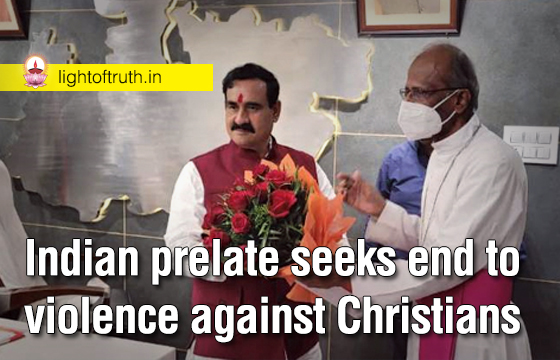
Indian prelate seeks end to violence against Christians
Archbishop Sebastian Durairaj of Bhopal has urged authorities to end the continuing violence against Christians in the central Indian state of Madhya Pradesh.
“A section of our community is feeling insecure. That is why we met Home Minister Narottam Mishra, who has assured us of appropriate act-ion,” the archbishop is reported to have said in a video message released after his meeting with the minister on Dec. 7.
He also appealed for action in the recent attack on St. Joseph School in Vidisha district by a 500-strong mob of Hindutva activists alleging the school management was converting students to Christianity.
The newly appointed arch-bishop, who is based in state capital Bhopal, told that he raised the issue of increasing attacks against Christians and their institutions in the state.
“He asked me ‘Do you convert people?’ and I replied ‘No, we don’t,’” Archbishop Durairaj said about his interaction with Mishra.
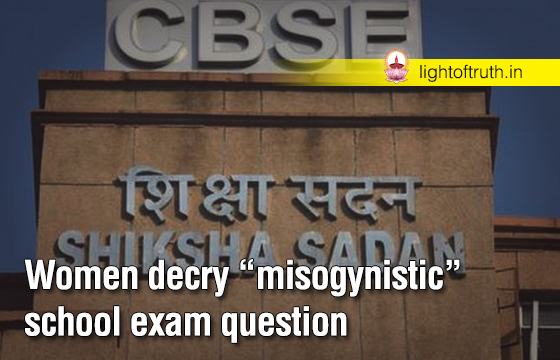
Women decry “misogynistic” school exam question
Women in India on December 13 decried a “blatantly misogynistic” and regressive” question a national school board asked its tenth grade students.
“The education ministry must seriously do an enquiry, and the one made the question/statement should be punished severely,” says Sister Joel Urumpil, a social worker in the eastern Indian state of Jharkhand, reacting to the news about the question set by the Central Board of Secondary Education (CBSE).
The question that appeared in the reading comprehension section held December 10 contained sentences like “women gaining independence is the main reason for a wide variety of social and family problems.”
Sister Urumpil, a member of the Sisters of Charity Nazareth, wants a nationwide out-rage by progressive men, women’s groups, students, Members Parliament of both houses, educational institutions. “Media should be urged to expose the rotten mindset and cry foul,” she told Matters India.
The issue drew national attention December 13 when Congress party’s interim president Sonia Gandhi raised the “blatantly misogynistic” and “shockingly regressive passage” in the parliament.
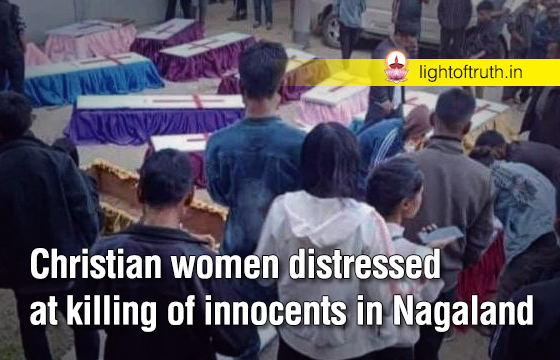
Christian women distressed at killing of innocents in Nagaland
The Indian Catholic Women Movement, an ecumenical forum, has expressed “deep distress and anguish” at the killing of civilians in a messed-up counter-insurgency operation in Nagaland.
“The killing of innocent lives calls for a just probe into the matter, in order to identify why and how the operation went wrong. It is important to end the ambush mentality of armed forces to restore a sense of safety and security to the people of Nagaland,” says a statement from the movement issued on December 9.
The text of the statement:
We the members of ICWM express our deep distress and anger at the killing of unarmed civilians and a soldier in the messed-up counter insurgency operation by the Assam Rifles in the Mon District of Nagaland on 5 December 2021.
The Mon incident needs to be seen against the backdrop of the patiently crafted cease-fire in place and peace negotiations backed by almost all Naga groups, amidst the high tension in the region. In this situation, that calls for joint vigilance and action by political leadership, security forces and civil society, extra caution and sensitivity is needed on the part of security forces towards local communities. In this highly volatile context, the state machinery needs to act with great prudence and care towards civilians so that trust can be re-built and peace restored.
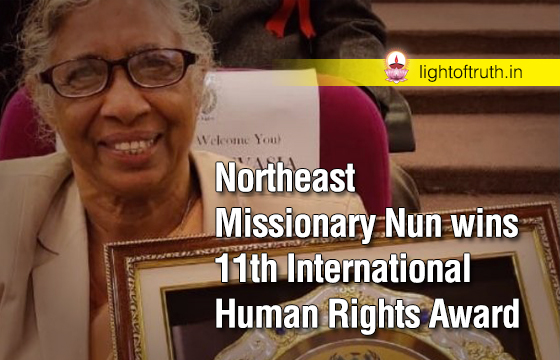
Northeast Missionary Nun wins 11th International Human Rights Award
A missionary Nun, Betsy Devasia, working in Guwahati, Assam, was conferred with 11th International Human Rights Award for her contribution to women development in the region by Delhi-based Inter-national Human Rights Council on 10 December 2021 at the India Islamic Centre Auditorium, New Delhi.
Sister Betsy Devasia, born on July 1, 1947 as the second child, to Mr. Devasia and Rosamma Pulippara in Kerala’s Kottayam district, has been working in Northeast India for the last 30 years.
“I am not sure if I deserve this honour”, said the septuagenarian Holy Cross Nun. “Serving the people of Northeast India in various roles since 1988 and as Director of Women Development Centre (WDC), Guwahati, since 2008, has been the most rewarding experience of my life. That is an award in itself”.
The WDC, established in the year 2000 as a millennium gift to the women in Northeast India by Archbishop Emeritus Thomas Menamparampil, has been catering to the women from rural areas of the region with slew of initiatives to empower them to take their lives forward.
One of the major activities of WDC is educating school dropped out tribal girls to complete their schooling through National Open School. Started with five students in 2005, more than 500 tribal girls from Arunachal Pradesh, Meghalaya, Manipur, Naga-land, Tripura, Mizoram and Assam have completed their secondary education. The current batch has 65 students.
Accepting the award, Sister Devasia said, “My award is to be able to see the lives of these underprivileged children change completely. The underconfident girls who through our educational portals are never the same. They leave our campus with confidence and courage to face the world to make positive contribution to make it a better place to live in.” Many of the girls who completed their secondary education through WDC have gone on to do higher studies including Masters Degree and 20 of them currently working in various Government and private departments in the region, including a motivational speaker, nurses and a radiologist.
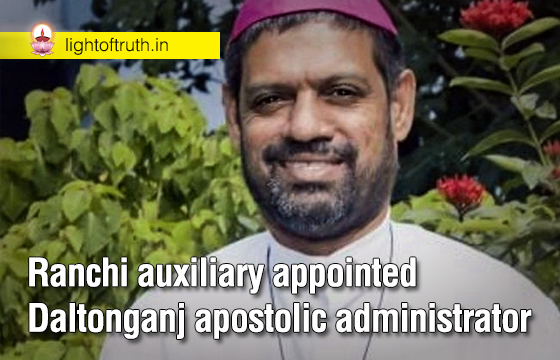
Ranchi auxiliary appointed Daltonganj apostolic administrator
Pope Francis has appointed Auxiliary Bishop Theodore Mascarenhas of Ranchi as the apostolic administrator of the diocese of Daltonganj.
The appointment was announced on December 8 in Rome. “This appointment is an additional to his present office as Auxiliary Bishop of Ranchi,” says a press release from Father Stephen Alathara, deputy secretary general of the Conference of Catholic Bishops of India (Latin rite).
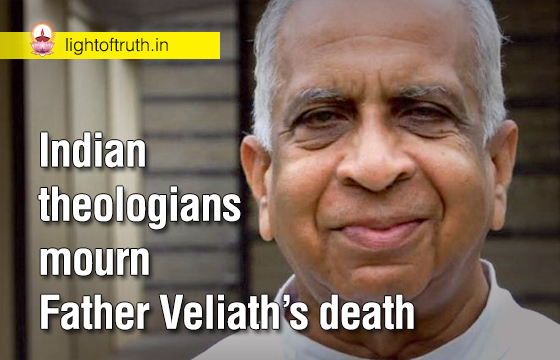
Indian theologians mourn Father Veliath’s death
The national forum of Catholic theologians in India on November 28 mourned the death of Salesian Father Dominic Veliath as a great loss for the Church in the country.
The 79-year-old internationally reputed theologian died November 27 in Bengaluru.
The Church in India has lost “a great theologian who lived Christian faith with deep commitment” in the death of Father Veliath, says a condolence message from the Indian Theological Association. Father Veliath was the executive secretary of the Doctrinal Commission of the Indian bishops that organized annual dialogues between theologians and prelates.
The message also noted with gratitude Father Veliath’s long association with the theologians’ forum. He was its secretary during 1989-1992 and the president from 1992 to 1995. “It is a great loss for the members” of the association, says the message issued by the forum president and executive board members.