
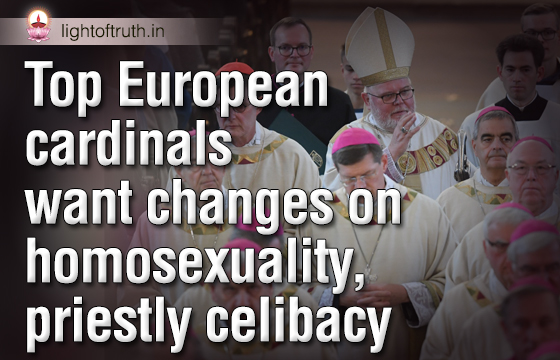
Over the past week, two leading European cardinals, both of whom enjoy broad favour with Pope Francis, have made public statements calling for a change in the Catholic Church’s current position on the issues of homosexuality and priestly celibacy.
In an interview published in Germany’s Catholic News Agency (KNA) earlier this week, Jesuit Cardinal Jean Claude Hollerich, Archbishop of Luxembourg, voiced his belief that the Church’s position viewing homosexual relationships is wrong.
“I believe that the sociological-scientific foundation of this teaching is no longer correct,” he said, saying the time has come to revise this position, and suggesting that Pope Francis’s own rhetoric on homosexuality could open the door for this change to take place.
Since the beginning of his pontificate, Pope Francis, who has also voiced concern over homosexuality in the priesthood, has taken a softer approach to the issue and has urged the Church to be more welcoming to homosexual individuals and to families with homosexual members.
In 2013, he signalled a new approach to the issue with his famous declaration that if a person “is gay and is searching for the Lord and has good will… Who am I to judge?”
In 2018, he said that the Church has to find a way to help the parents of gays and lesbians so that they “stand by” their children, telling parents with LGBT children, “Do not condemn. Dialogue. Understand. Make space for the son or daughter; make space so they express themselves.”
During an interview in 2019, Francis said he does not think it’s rare for parents to have a homosexual child and said that homosexual tendencies “are not a sin,” insisting that tendencies themselves “are not sin. If you have a tendency to anger, it’s not a sin. Now, if you are angry and hurt people, the sin is there.”
Last year, he met with a group of parents of LGBT children, telling them that God loves their children as they are, and that the Church loves them because they are “children of God.”
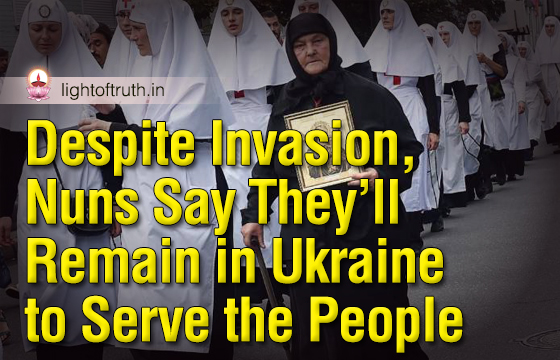
Despite Invasion, Nuns Say They’ll Remain in Ukraine to Serve the People
Women religious in Ukraine are facing Russia’s full-scale invasion of that nation with deter-mined faith and a commitment to service.
Two sisters of the Order of Saint Basil the Great spoke with CatholicPhilly.com directly from Ukraine February 23 and 24 via telephone and the messaging app Viber.
“We understand that this is our new mission, to welcome the refugee,” said Basilian Sister Lucia Murashko, whose convent, the monastery of SS. Peter and Paul in Zaporizhzhia, is located about 125 miles from Donetsk in eastern Ukraine.
Earlier February 24, when Russian airstrikes began to imp-act Ukrainian cities, Sister Murashko and her three fellow women religious welcomed two families, with more expected as residents flee the attacks.
The U.N. High Commissioner for Refugees has estimated more than 100,000 people have already left their homes in Ukraine since Russian forces openly entered that nation Feb. 24. The Ukrainian military reports losing at least 40 troops so far, with an unspecified number of civilian casualties. Nuns from the Order of St. Basil the Great are pictured Feb. 22, 2022, during a pilgrimage in Zaporizhzhia, Ukraine, just hours ahead of a Russian invasion.
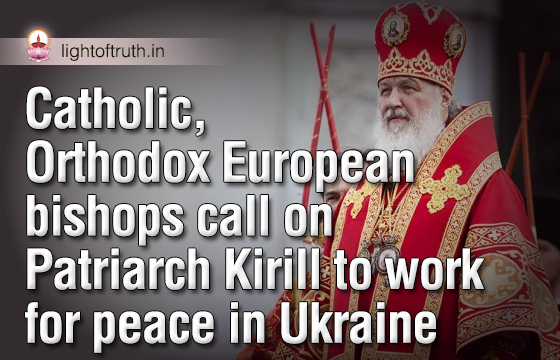
Catholic, Orthodox European bishops call on Patriarch Kirill to work for peace in Ukraine
European bishops, both Catholic and Russian Orthodox, are pleading for the head of the Russian Orthodox Church, Patriarch Kirill, to ask Vladimir Putin to stop the war against Ukraine.
According to the Metropolitan of the Archdiocese of Orthodox Churches of Russian Tradition in Western Europe, “our very unity is threatened” by the situation that arose following Russia’s “military intervention” and “violent attack” on Ukraine.
Meanwhile, the president of the Commission of the Bishops’ Conferences of the European Union (COMECE) said Kirill should take to heart his own remarks: “The Church can be a peace making force.”
Cardinal Jean-Claude Hollerich addressed a letter to Kirill on Tuesday asking him to issue an urgent appeal to Russian authorities to immediately stop the hostilities against the Ukrainian people. The content of the letter was released on Thursday.
“In these dark moments for humanity, accompanied by in-tense feelings of hopelessness and fear, many look to you, Your Holiness, as someone who could bring a sign of hope for a peaceful solution to this conflict,” Hollerich wrote to Kirill.
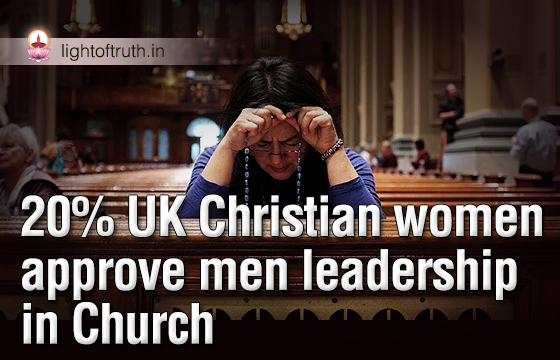
20% UK Christian women approve men leadership in Church
Just one in five Christian women in the United Kingdom claim females should not be in authority over men in Church leadership.
That’s one finding from a new survey conducted by Premier with more than 800 women from across the country.
It also found, four out of five Christian women say their Church is a place where female voices are always listened to and honoured.
The findings are being re-leased on International Women’s Day. To mark the occasion, we’ve been speaking to a variety of women who hold different roles within their church.
Priscilla Reid is a former Church elder from Christian Fellowship Church (CFC), in Belfast, Northern Ireland where she served for 20 years.
She told Premier her experience of becoming a church elder was quite positive, however that was not the case for others: “I think I was in a very smooth, privileged, blessed position com-pared to some of the stories I hear from other women who’ve been in leadership.
“I really didn’t come up against a lot of opposition.
“I did feel affirmed. I did feel the doors open for me. I never felt like I was I was getting a lot of resistance.
“[However] I’ve met a lot of women who’ve been actually very damaged. I met with one just on Friday and she was damaged by the reactions of many male colleagues.
“Perhaps out of their in-securities, things that would be valued in a man are presented as negative in a woman.”
Reid talked about how certain scripture in the Bible – of only men being allowed to become elders in the church – was taken in literal context, by some of their congregation. Something she believed should be challenged.
“It was really important for us that we could say, hand on heart, there is another way to view these difficult passages of scripture, there is another theological proposition that is totally valid and so therefore, we did study it.”
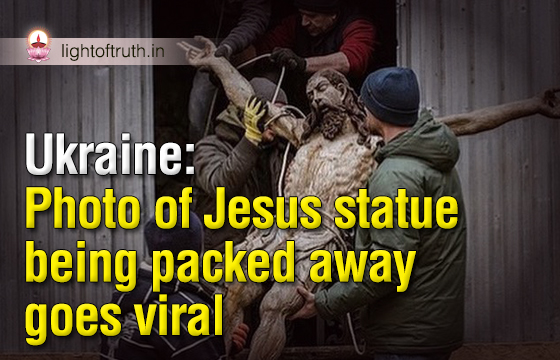
Ukraine: Photo of Jesus statue being packed away goes viral
A photo of a statue of Jesus being removed from a Ukrainian cathedral and put into storage has prompted hundreds of retweets as the world grasps the full implications of the Russian shelling in Ukraine.
The tweet about the statue, from the Armenian Cathedral of Lviv, has prompted reactions from believers and non-believers alike regarding the cultural and spiritual impact of the war on Ukraine’s cityscape and heritage. While some have compared the potential destruction of untold numbers of artifacts to recent conflicts in other countries, others have compared the image to the 17th century painting The Descent from the Cross by Rubens.
The image was posted by cultural protection property officer Tim LeBerre, who claimed that it was the first time the statue had been taken out of the cathedral since World War One.
Tim LeBerre also shared an image of the Ukrainian National Museum being packed away due to concern about the fate of the priceless items. Another image shows the devastation caused by the shelling of a Catholic church in Kharkiv.
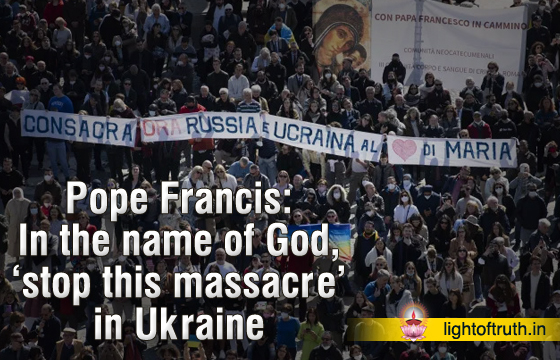
Pope Francis: In the name of God, ‘stop this massacre’ in Ukraine
Pope Francis on March 13 called for an end to the “harrowing war” in Ukraine, condemning in particular the “barbarism” of Russia’s reported attacks last week on civilians— including pregnant women and children— in the eastern city of Mariupol.
“With an aching heart I add my voice to that of the common people, who implore the end of the war,” the Pope said March 13, addressing the crowd gathered in St. Peter’s Square in Rome following the Angelus, a Marian prayer.
“In the name of God, listen to the cry of those who suffer, and put an end to the bombings and the attacks! Let there be real and decisive focus on the negotiations, and let the humanitarian corridors be effective and safe. In the name of God, I ask you: stop this massacre!” The Pope’s words come following numerous reports last week of civilian casualties in Mariupol, amid Russia’s attempt to seize the strategically-located city as part of its ongoing invasion of Ukraine, which began on Feb. 24.
On March 9, a Russian strike on a maternity hospital in Mariupol killed at least three people and injured at least 17, according to local officials. Amid heavy loss of life in the city, there have been reports of civilians being buried in mass graves.
Pope Francis said that Mariupol, a city of 400,000 which was founded and named for the Virgin Mary, “has become a city martyred” amid the assault.
“Faced with the barbarism of the killing of children, and of innocent and defenseless citizens, there are no strategic reasons that hold up: the only thing to be done is to cease the unacceptable armed aggression before the city is reduced to a cemetery,” the Pope said. The Pope’s words echoed those of a prominent Catholic leader in Ukraine, Major Archbishop Sviatoslav Shevchuk, who lamented March 10 what he described as the “mass murder” of Ukrainians following Russia’s full-scale invasion. The following day, March 11, Shevchuk said the assault is “becoming a war primarily against the civilian, peaceful population.”
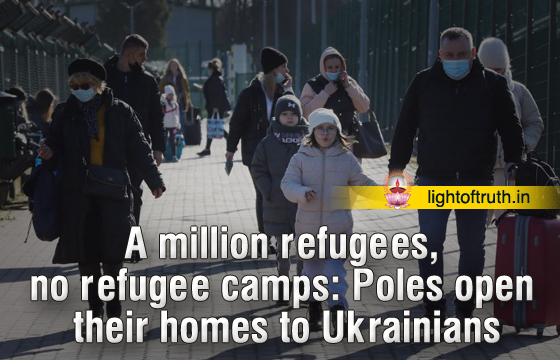
A million refugees, no refugee camps: Poles open their homes to Ukrainians
It was March 5 , three days into the Russian invasion of Ukraine when a friend called Jerzy Donimirski, a hotel owner from Kraków.
“He told me that while half of the country stands in the line at the border to pick up a Ukrainian family, there are people that have nowhere to go, no friends, no relatives,” he told Crux.
So Donimirski decided to open his four-star hotel in the heart of Kraków, by the Floriañska historical gate, to refugees.
“It is war everyone fears. I just had to do it.”
Last Monday, the first 20 people – six adults and 11 children – occupied rooms in his hotel.
“I thought it’s not too much of a burden for our hotel to take 20 more,” so he sent another bus to the border with Ukraine. Today, he has 45 refugees in Hotel Polski.
It is because of people like Donimirski, a Catholic and member of the Order of Malta, that Poland has a million refugees in its territory and not a single refugee camp.
As the Polish Ambassador to the United States, Marek Magierowski, told: “This is probably the first migration crisis in Europe’s history, in which the host country doesn’t need to build refugee camps.”
“Here in Poland, I really felt what fraternity is,” Olga Panivnyk told Polish Television on Sunday. She escaped Ukraine a week ago.
“It was scary – there were planes flying over our heads” she recalled. “Some of our friends had to stop on the way because there was a shooting in the fields.”
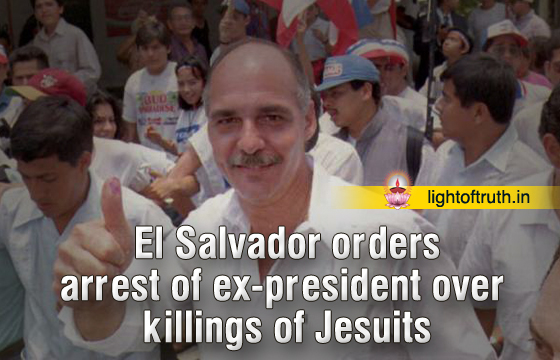
El Salvador orders arrest of ex-president over killings of Jesuits
A judge in El Salvador order-ed the arrest Friday of former president Alfredo Cristiani for alleged links to the murder of six Jesuit priests and two co-workers by the army during the country’s civil war, prosecutors said.
On November 16, 1989, Salvadoran troops from the now-banned Atlacatl battalion shot dead the Jesuits, five of them Spanish, at the Central American University in San Salvador. They also killed a woman who worked as their housekeeper and her 16-year-old daughter.
On February 25, prosecutors filed charges against Cristiani, who was president in 1989-1994, and a group of soldiers for alleged involvement in the murder.
Prosecutors said on Twitter Friday that a judge has ordered Cristiani, who is outside the country, former lawmaker Rodolfo Parker and four colonels to be put “under provisional detention.”
The former president, whose whereabouts are unknown, denied the charges and attacked Attorney General Rodolfo Delgado in a statement.
“The attorney general, in bad faith and with a clear disregard for the truth, has publicly accused me of omission and cover-up,” said Cristiani, who, in his capacity as president, was also commander-in-chief at the time of the killing. “The truth is that I never knew of the plans they had to commit those murders.”
He said that the military “never informed me or asked me for authorization because they knew that I would never have authorized Father Ellacuria or his brothers to be harmed.”
Cristiani also asserted that “at this time there are no procedural guarantees in El Salvador” be-cause most prosecutors and judges are controlled by the president.
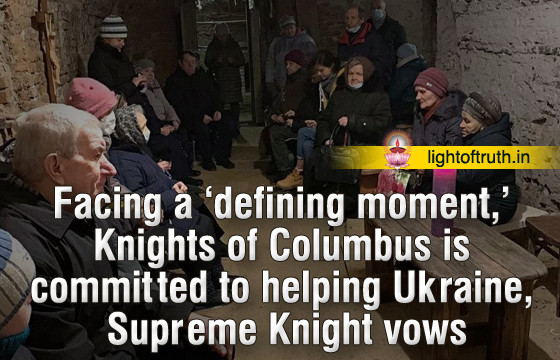
Facing a ‘defining moment,’ Knights of Columbus is committed to helping Ukraine, Supreme Knight vows
Much like 9/11 was a defining moment for the United States, “the brutal invasion of Ukraine will be a defining moment for the world,” and “the Knights of Columbus will have to be here for the long haul,” Supreme Knight Patrick Kelly told in an exclusive interview.
Since Russian forces launch-ed a large-scale military invasion of Ukraine on Feb. 24, members of the Knights of Columbus in Ukraine, Poland, and the United States have launched an unprecedented humanitarian effort to help the growing number of refugees displaced by the largest conventional military attack in Europe since World War II.
“Many Europeans were not ready to believe that a land war could happen again in Europe, so the Russian attack has not only been shocking, but a game-changer that will have long-lasting consequences for Europe and for the world,” Kelly told on March 4.
Kelly has conferred with the Knights of Columbus’ state deputy for Ukraine, Yuriy Malecki, to assess the situation. The Knights of Columbus started in Ukraine in 2012 and now has 40 councils there totaling some 2,000 members. “I can say that I have met those members, and that they are very solid Catholics, very enthusiastic in how they stand for charity, unity and fraternity — the true Knights’ spirit,” Kelly explained.
Kelly sent a video message to all Ukrainian Knights “telling them that I was praying for them, that I was asking God for assistance, and recalling for them that several proud moments in the history of the Knights of Columbus have come in the midst of tremendous challenge, such as the response of the Knights during the First and Second World Wars,” he told.
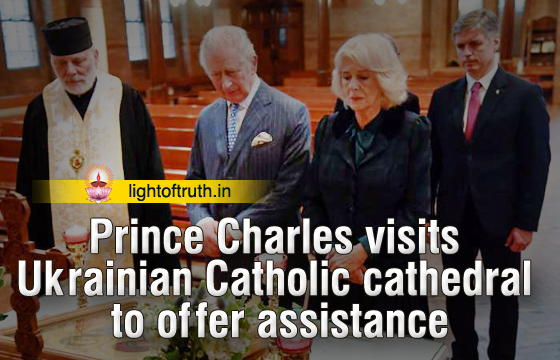
Prince Charles visits Ukrainian Catholic cathedral to offer assistance
Prince Charles, the heir to the British throne, visited the Ukrainian Catholic Cathedral in London to find out how he could assist in the humanitarian crisis emerging from the war in Ukraine. The prince and his wife, Camilla, the Duchess of Cornwall, were welcomed by Bishop Kenneth Nowakowski of the Ukrainian Catholic Eparchy of the Holy Family at the cathedral in London March 2 along with Vadym Prystaiko, the Ukrainian Ambassador to the UK, and his wife, Inna Prystaiko.