
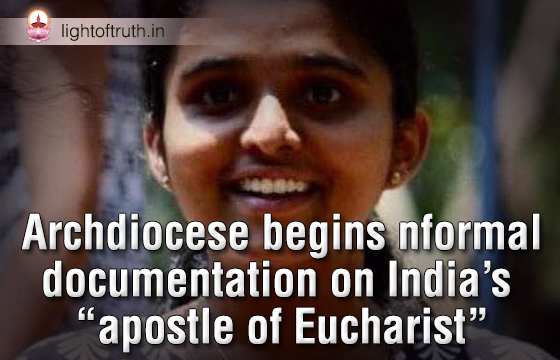
A Catholic archdiocese in the southern Indian state of Kerala has informally begun the documentation on Ajna George, who many now view as an apostle of Eucharist.
Ajna, a member of the Jesus Youth movement and an assistant professor, died January 21 in Kochi, the commercial capital of the southern Indian state of Kerala. She was 27 when she died fighting cancer.

Catholic nun dies in road accident in West Bengal
Sister Paul Vincent, a member of the Daughters of St Anne of Calcutta died in road accident in a remote area in West Bengal state.
Sister Vincent’s funeral Mass was held at 3 pm on March 28 in St. Paul the Apostle Church in Kamarchowki followed by the burial in nearby St. Anne’s Convent compound.
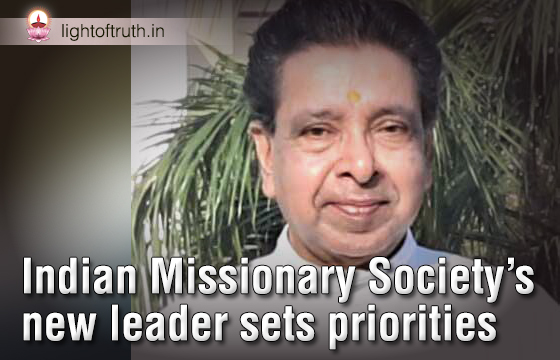
Indian Missionary Society’s new leader sets priorities
The newly elected leader of northern India’s first Catholic religious congregation for men says his priorities include fostering unity and missionary zeal among his people and bringing a movement of indigenized Catholicism to mainstream society.
“Our community life is not perfect. Some members are indifferent. So, my first priority is to bring all the members together under one umbrella through dialogue,” says Father Francis Prasanna Raj, who on February 28 was elected as the superior general of the Indian Missionary Society.
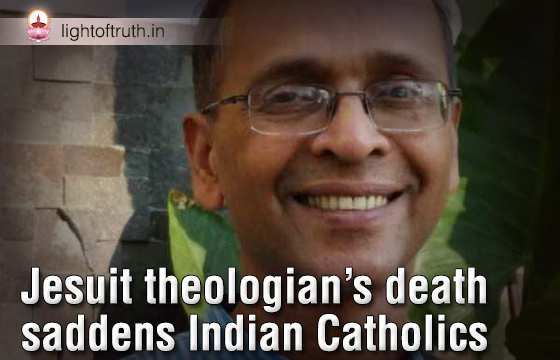
Jesuit theologian’s death saddens Indian Catholics
Father Poulose Mangai, a renow-ned professor of theology who worked among rickshaw pullers of Old Delhi area, died on March 26 after a brief hospitalization.
Father Mangai was a prolific writer and editor of Vidyajyoti Journal of Theological Reflections, Asia’s top theological publication. He was 64.
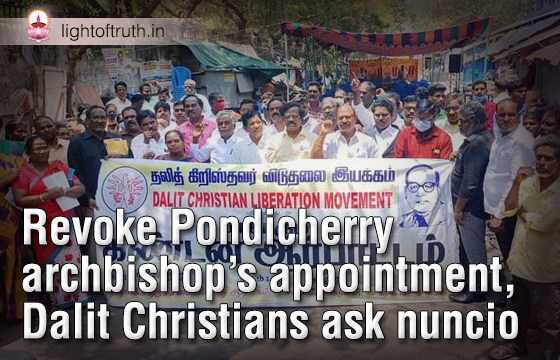
Revoke Pondicherry archbishop’s appointment, Dalit Christians ask nuncio
Dalit Christians on March 29 urged the apostolic nuncio to revoke the appoint-ment of Bishop Francis Kalist of Meerut as the new archbishop of Pondicherry-Cuddalore.
Led by the Dalit Christian Liberation Movement, hundreds of people protested in Chennai, capital of the southern Indian state of Tamil Nadu, against the a non-Dalit’s appointment as the archbishop of Pondicherry-Cuddalore.
They want the nuncio to appoint a Dalit archbishop. “Otherwise Dalit Chri-stians will stop the consecration of Bishop Kalist scheduled for April 29 in Pondiche-rry,” M Mary John, president of Dalit movement, told Matters India March 29.
He said the Dalit Christians plan to hold similar protest demonstrations in other parts of Tamil Nadu and in Pondi-cherry with this demand in coming days.
India MattersIndia Archbishop – elect Francis Kalist. The demonstrators conde-mned the continuing caste domination, caste oppression, and caste atrocity in the Catholic Church.
It noted that no Dalit archbishop has been appointed so far in the Pondicherry-Cuddalore archdiocese. Dalit Christians have protested to end the injustice by demanding the appointment of a Dalit Archbishop. However, the Church has appointed a caste archbishop again, John regretted.
Dalits form 64 percent of the Indian Catholic Church. In Tamil Nadu and Pondicherry they form 75 percent.
“But out of 180 Catholic bishops in India, only 11 are Dalits, and only 2 out of 31 Archbishops are Dalits. Only one of the 17 bishops in Tamil Nadu-Pondicherry is a Dalit,” John explained.
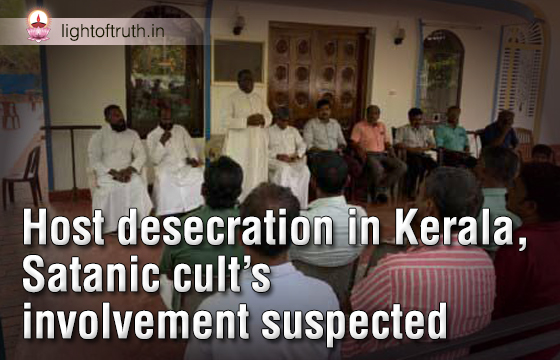
Host desecration in Kerala, Satanic cult’s involvement suspected
A diocese in the southern Indian state of Kerala is out-raged after some miscreants broke into a chapel and dese-crated sacred Hosts kept inside a tabernacle.
While the diocese of Co-chin views the incident as part of hate activities spreading in Kerala, a senior Catholic journalist suspects the involvement of the satanic cult growing in the southern Indian state.
Father Johney Xavier Puthukkattu, the diocesan public relations officer, says the sacristan of St Jacob chapel in Arookutty found the tabernacle broke open on the morning of March 29 and informed the priest, who lives a nearby house.
After a search, they found the Hosts scattered in a marshy land, some 200 meters away. The chapel’s donation box was also found abandoned there.
The chapel is a substation of St Anthony’s Church Padu-vapura at Arookutty, 13 km southeast of Kochi, the commercial capital of Kerala.
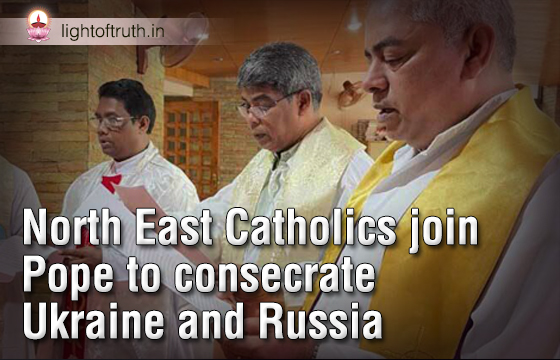
North East Catholics join Pope to consecrate Ukraine and Russia
The Catholic bishops of northeastern India on March 25 responded to the appeal of Pope Francis and spiritually joined him in consecrating Ukraine and Russia to the Immaculate Heart of Mary.
In the wake of the ongoing war between Russia and Uk-raine, the Pope had requested Christians and bishops across the world to join him spiritually in the penitential celebration ’24 Hours for the Lord’ where he consecrated the warring neighboring countries to Mother Mary.
Inviting the people in his archdiocese to pray along with the rest of the world, Arch-bishop John Moolachira of Guwahati said, “We need peace. We are pained by the suffering of people in both these countries. The leaders of these two countries need our prayers that they may have the gift of wisdom and courage to take steps towards peace.”
The archbishop also noted that the prayer of consecration prepared by the Pope has been translated into many tribal languages and made available to the public.
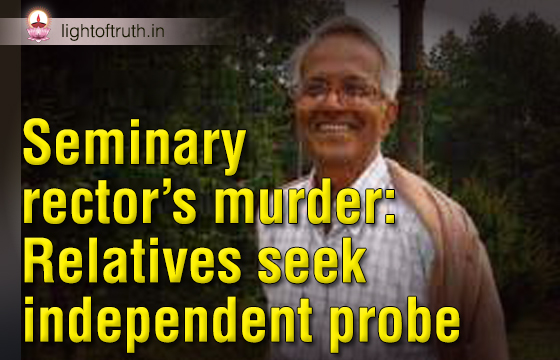
Seminary rector’s murder: Relatives seek independent probe
The relatives of a former rector of Bengaluru’s St Peter’s Pontifical Institute have sought an independent probe nine years after his mysterious death on an Easter Sunday.
Father K J Thomas, who had taught theology in the major seminary for 25 years, was found murdered on April 1, 2013.
“This April 1 it will be nine years since my uncle was phy-sically tortured and murdered in the most inhuman way,” says a letter from Joyson Mathew, one Father Thomas’ nephews, to Archbishop Peter Machado of Bangalore.
“You knew him personally and so you know well that he did not die due to his personal hostility with anyone. My uncle was an innocent victim of the language dispute and the dispute over the ownership of the seminary which was a boiling issue before the murder,” says March 27 letter.
The nephew says the past nine years have been a time of grief and sorrow for the slain priest’s immediate family members. “We still miss him dearly,” he added.
The police had arrested 12 people, including eight Catholic priests, in connection with the murder.
Mathew regrets that the trial of the case has not been begun because of some legal hurdles.
Indian Christians tell govt to avoid exam on Easter Sunday
Christians in the central Indian state of Chhattisgarh have appealed to the provincial government to reschedule a selection exam for postings in the revenue department to be held on Easter Day. The Chhattisgarh Professional Examination Board (CPEB) had earlier decided to hold the examination for the selection of Patwaris – officials entrusted with maintaining land records in villages – on April 10.
The date was subsequently changed as April 10 happened to be Ram Navami, a Hindu spring festival that celebrates the birthday of Lord Ram. The new date announced was April 17, which happened to be Easter Sunday. “We are deeply concerned and pained by the decision of the CPEB to hold the examination on Easter Day,” said Guruvinder Singh Chadda, president of the Akhil Bharati Isai Samudaya Adhikar Sangathan, an organization working for the welfare of Christians in the state.
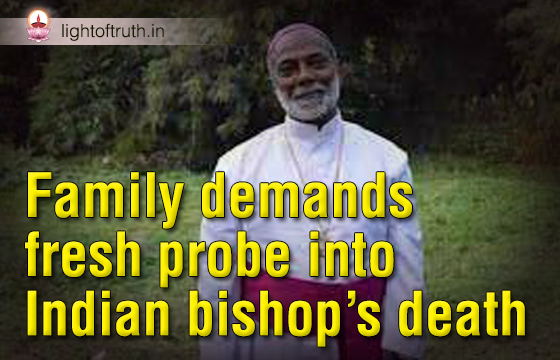
Family demands fresh probe into Indian bishop’s death
Family members of an Indian Bishop who died in a road accident three years ago have demanded an impartial probe into his death amid suspicions of foul play. Bishop Thomas Thennatt, 65, of Gwalior Diocese in the central Indian state of Madhya Pradesh, died in a car crash on Dec. 14, 2018.
“We have serious doubts over his accidental death. We believe he was killed,” said Clara-mma Constatine, a younger sibling of the bishop.
A retired nurse, Constatine, accompanied by her son-in-law, Pastor Lovers Masih, held a press conference in the state capital Bhopal on March 27 to announce the family’s plan to move the high court requesting a probe by the Central Bureau of Investigation (CBI).
Speaking to us, she claimed that diocesan officials had intimidated the family after the accident. “My brother’s body was buried in a hurry, without the mandatory post mortem, and the diocese denied us permission to take his body to our home state Kerala,” she added.
Constatine alluded to the fact that there were three others including the driver traveling in the car at the time of the accident. But none of them suffered even a minor scratch on their bodies and gave contradictory statements about the whole incident, raising suspicions.