
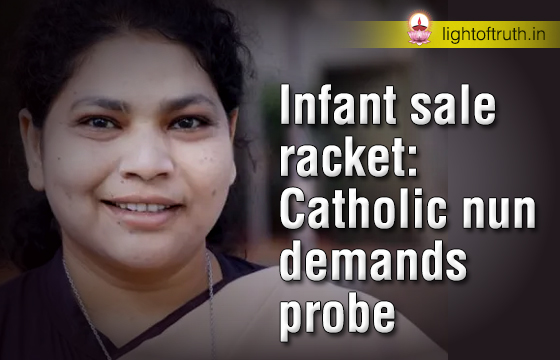
A Catholic nun working among the poor, especially Dalits, has expressed shock at the expo-sure of an infant selling racket in the southern Indian state of Andhra Pradesh.
Poverty alone is not the rea-son for the “rather unfortunate” racket, asserts Sister Manju Devarapalli, secretary of the National Dalit Christian Watch (NDCW).
The Carmelite Missionaries nun was responding to an April 6 report in the Hindu newspaper about poverty-hit mothers selling infants in Andhra Pradesh.
In two cases reported in Eluru and Mangalagiri in the first week of April, women stated that their family members had sold babies unable to care for them.
“Earlier, we have seen cases of childless couples resorting to illegal adoptions and purchasing babies. But now infants are put up for sale in the market by some gangs in the state. This is pathe-tic,” the report quoted a child protection officer as saying.
Sister Devarapalli, who is also a lawyer-activist based in Vijayawada, a major city in Andhra Pradesh, says the government and agencies should study the problem thoroughly and find ways to end it.
The report could only be “the tip of” a rampant malaise prevalent across India, not just in Andhra Pradesh and Telangana states, she told on April 7.

Father Earl Fernandes, son of immigrants from India, named next bishop of Columbus, Ohio
Father Earl K. Fernandes says that when he was growing up in Toledo, Ohio, his mother used to pray that he’d become “a good boy, a tall boy, and a doctor like my dad.” God had other plans for his profession.
On April 2nd, the Vatican announced that Pope Francis has appointed the 49-year-old Cincinnati pastor, the son of Indian immigrants, to be the next bishop of the Diocese of Columbus, Ohio.
The first Indian-American to head a U.S. Roman Catholic diocese, Fernandes succeeds Bishop Robert J. Brennan, who now leads the Diocese of Brooklyn. Fernandes’ episcopal ordination and installation is scheduled for May 31.
In a press conference Saturday morning in Columbus, the bishop-elect spoke at length about the example of his immigrant parents, the experiences he has had being the victim of racial discrimination, and his “synodal” approach to his new role.
“The Pope wants a synodal Church, a Church that walks together. I look forward to walking together with the people, the priests, the deacons, and religious — actually, the whole people of God — in the Diocese of Columbus,” Fernandes said.
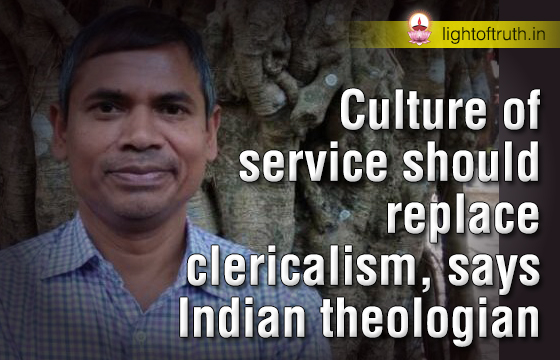
Culture of service should replace clericalism, says Indian theologian
Clericalism, which Pope Francis calls “a perversion of the priesthood,” operates also among some Catholic priests and bishops in India, says a Jesuit moral theologian.
Clericalism is largely center-ed on one’s access to power and wealth in the Church, which in turn gives some priests and bi-shop the taken-for-granted immunity, explains Father Stanislaus Alla, professor of moral theology at Delhi’s Vidyajyoti College of Theology.
The theologian was sharing his reflections at an April 2 webinar on “Clericalism” in the background of the essay titled “Hierarchicalism” by American Jesuit James Keenan, which was published in the latest issue of Theological Studies.
The Secretariat for Service of Faith of the Jesuit Conference of South Asia organized the webinar.
According to Fr Stanislaus, while the importance and impact of the culture of ‘clericalism’ came to light by the expose of child-abuse in the West, it can be noticed equally in many forms in India.
Fr Stanislaus quoted Peter Daly of the Washington who re-gularly contributes to the National Catholic Reporter and discusses clericalism.
Bishops and priests — the clerics — “are often trained to think they are set apart from and set above everyone else in the Church. Their word is not to be questioned. Their behavior is not to be questioned. Their lifestyle is not to be questioned” says Father Daly.
Father Stanislaus says people have lived with and have known “dedicated, simple, holy, humble and service-minded priests and bishops.” But at the same time, they also come across pastors with clericalism-mindset.
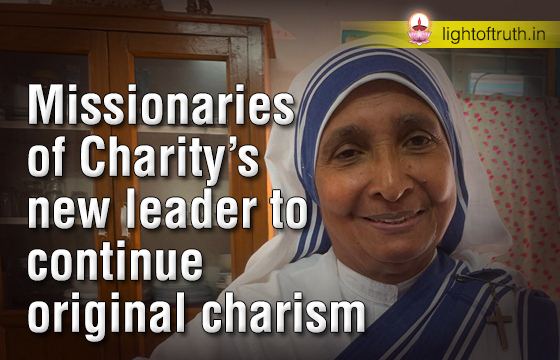
Missionaries of Charity’s new leader to continue original charism
Sister Mary Joseph, the newly elected superior general of the Missionaries of Charity, says her global congregation will continue its original mission of serving the poorest of the poor, despite numerous hurdles.
She also asserts that religious conversion is not their agenda as alleged by some hardliners.
Sister Joseph cannot speak for a long time because of some vocal cord problems. Despite the difficulty, she on April 2 shared with Sunil Rosario, Matters India Special Correspondent in Kolkata, how she will lead the congregation founded by Saint Mother Teresa of Kolkata.
“I experienced fear and deep shock when my name was announced to take up the leadership. It was not easy to digest. I had never dreamt to lead the congregation one day. I felt I was not the one for the task. That night was a nightmare to me. However, I allowed God to speak to me in silence and prayer. In that dark night, I had the assurance of God that He was calling me to take up the position. It was not my choice, but His choice, at this particular time of history. Thus, I accepted the challenge.” Sister Mary Joseph said “We are not social workers. Our charism is to live for Jesus and for the poor. “When I was hungry, did you feed? When I was thirsty, did you give me a drink of water?” This we do in charity. We utterly depend on God’s providence. God takes care of us.” “Conversion is not our agenda in service of the poor and the under privileged. Only God can convert, as Mother would hold.”
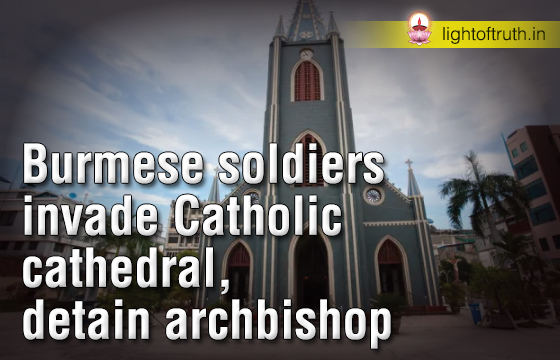
Burmese soldiers invade Catholic cathedral, detain archbishop
Approximately 40 Burmese soldiers forcibly took control of a Catholic cathedral in Mandalay prior to a Lenten prayer service on April 8 and detained an Archbishop and dozens of other worshippers, including a correspondent for CNA.
The soldiers entered Sacred Heart Cathedral at 2:30 p.m. local time April 8 and refused to allow worshipers to leave. Soldiers also occupied other buildings on the compound.
Abp Marco Tin Win and employees of the Archdiocese of Mandalay were similarly herded into the building and forced to sit in the pews along with the worshipers.
A correspondent for CNA was present and was detained for about three hours, then allowed to leave. The others detained were released several hours later.
“I was so afraid,” one elderly Sacred Heart Cathedral parishioner, who did not give her name for safety reasons, told. “The military was always crazy but they never acted like this before. We ran home as soon as we were allowed out of the church.”
“The soldiers kept demanding to know where the gold and money and weapons were hidden,” explained her nephew, who also asked for anonymity. “I told them there was none. Any money collected is for the relief of poor families.”
As soon as the soldiers entered the cathedral, alerts were sent out to the entire Catholic community to stay away from the compound.
Upon hearing of the intrusion, Monsignor Dominic Jyo Du, vicar general of the arch-diocese, confronted the soldiers and their officers inquiring as to their presence. The soldiers rushed him into the cathedral along with the archbishop.
About 30 of the soldiers moved away pews to make room for themselves and slept in the cathedral overnight. They were still inside the cathedral early Saturday morning.
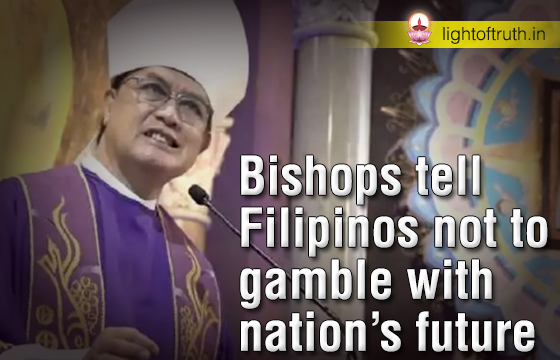
Bishops tell Filipinos not to gamble with nation’s future
Philippine Bishops have urged voters not to gamble with the country’s future in national elections in May by voting for corrupt and incompetent candidates.
Their call came as senior Catholic officials, together with religious congregations and lay-people, gathered in Manila on April 6 for a solidarity Mass on the Catholic Church’s role in the polls.
The “Solidarity Mass for Moral Choice,” held at the National Shrine of the Our Lady of Perpetual Help in Baclaran, Manila, was presided over by Manila Archbishop Cardinal Jose Advincula and members of the Catholic Bishops’ Conference of the Philippines.
The prelates said the aim of the Mass was to have one heart and mind as priests, religious and laypeople on the Catholic Church’s role in politics.
“If faith cannot guide us in our role in politics, then perhaps we have not done enough in our duty. It is easier to just name a candidate to vote for rather than to teach our people how they should vote,” Bishop Pablo Virgilio David, president of the bishops’ conference, said in his homily.
He said that there is no division between faith and politics, especially when issues in politics are moral in nature such as truth and falsehood.
“Truth is like lime pressed on one’s wounds. It hurts but it keeps us awake. But sometimes, if the truth hurts and causes us inconvenience, we choose to be blind and deaf … we choose to be neutral”
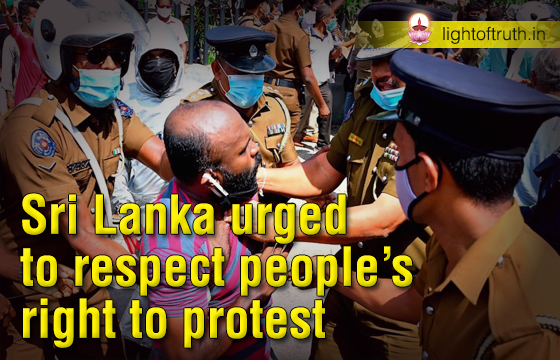
Sri Lanka urged to respect people’s right to protest
A global civil society alliance has expressed serious concern over Sri Lanka’s clampdown on civic space and urged the government to release those detained arbitrarily and investigate and punish abuses by security forces.
“We urge the government to refrain from deploying violence against protesters and instead respect and protect people’s rights to peaceful protest,” said Josef Benedict, Asia Pacific researcher of CIVICUS, in a statement on April 5.
He called the restrictions on access to the internet and social media platforms and the arrest of Thisara Anuruddha Bandara, a youth activist, for promoting the #GoHomeGota social media campaign against the president “a clear violation of the right to freedom of expression and information guaranteed by the constitution and under international human rights law.”
Benedict urged authorities to drop all charges against Bandara immediately.
“CIVICUS has documented how the Gotabaya Rajapaksa administration has led an assault on civic space and fundamental freedoms since the president assumed power more than two years ago,” the statement said.
In March, UN High Commissioner for Human Rights Michelle Bachelet had similarly reported to the Human Rights Council that “the government’s response to criticism has constricted democratic and civic space.”
The protests and escalating economic crisis have led to the resignations of 26 ministers in the current cabinet, leaving only the president and his brother, Mahinda Rajapaksa, the prime minister, to manage affairs.
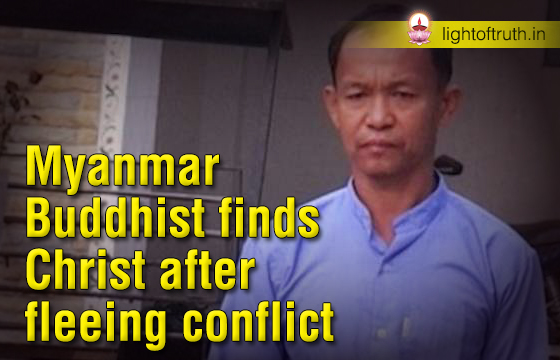
Myanmar Buddhist finds Christ after fleeing conflict
When Buddhist San Shwe Mya’s uncle, a Christian, tried to speak about Jesus Christ, he was annoyed and paid little attention.
“I told my uncle he couldn’t persuade me to convert to Christianity as I had no interest in it,” San Shwe recalled.
Living in a remote village in western Myanmar’s Rakhine state, work was the first priority for the 43-year-old father of three children. “We have to rely on ourselves for our livelihood, so work was the only thing on my mind,” he said.
San Shwe belongs to the ethnic Chin tribe and grew up in a Buddhist neighbourhood in a village in Minbya town. He followed his parents’ Buddhist religion.
His Buddhist-majority village has a few Christians including some Catholics. He could see how the Christians faced daily challenges while practicing their faith. “But I had no idea about Catholicism or Christianity,” he recalled.
San Shwe remembered some radical monks and laypeople warning Christians and not allowing them to use loudspeakers during celebrations such as Christmas.
“I wasn’t involved with the group who opposed Christian celebrations but I witnessed the challenge of being a Christian in a predominantly Buddhist com-munity,” he told.
His native village was remote but it was close to where intense fighting between the military and the Arakan Army had been going on since December 2018.
More than 90,000 people had been displaced due to the conflict in Rakhine that also spilled into neighboring Chin state, home of many Christians, mostly ethnic Chin.
The violence forced even San Shwe to leave for Yangon, Myanmar’s commercial hub, looking for employment and, more importantly, education for his children.
Prevent Sri Lanka becoming failed state: Bishops
As Sri Lanka continues to sink hopelessly into the worst economic crisis in memory, the country’s Catholic Bishops are calling for unity among politicians to save the nation from becoming a failed state. The country of some 22 million is facing its worst economic nightmare since its independence, with foreign exchange reserves falling abysmally by 70% in the past two years. This has left the country struggling to import essential goods, such as food, fuel, cooking gas and medicine, and is causing power cuts of up to 13 hours a day. The devaluation of its currency has sent inflation soaring to 17.5% in February, the highest so far, hitting the already struggling businesses and exporters but especially the people. “All successive governments to date are responsible in varying degrees for the present state of affairs,” the Catholic Bishops’ Conference in Sri Lanka said in a statement, adding that “the present government as well as those in the opposition … must adopt a conciliatory not a confrontational approach” and they should not “play the blame game.”
“The country is fast approaching the precipice of a failed state that will in its wake inflict irreversible injuries on the people,” the bishops warned, calling on their faithful and Church institutions to come to the aid of the most vulnerable and affected groups.
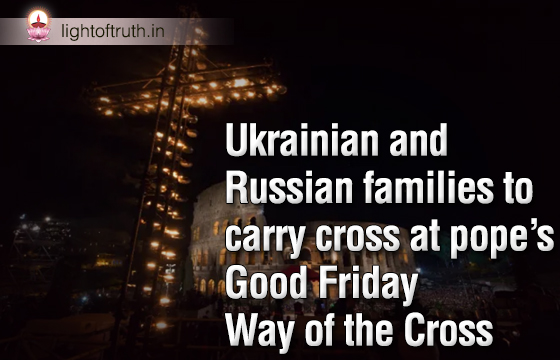
Ukrainian and Russian families to carry cross at pope’s Good Friday Way of the Cross
Ukrainian and Russian families will carry the cross together during the Stations of the Cross led by Pope Francis at Rome’s Colosseum on Good Friday.
The Vatican has published the meditations and prayers for the Pope’s Via Crucis, or Way of the Cross, which will focus this year on the many “crosses” of family life.
The meditations include reflections from a couple without children, a family with a disabled child, a family with an ill grand-parent, a family of migrants, and families suffering due to the Ukraine war.
For the 13th station, “Jesus dies on the Cross,” a Ukrainian family and a Russian family will read a reflection that they wrote together about how their lives were upended by the pain of war. “Why has my land become as dark as Golgotha? We have no tears left. Anger has given way to resignation,” the text of the reflection says.
“Lord, where are you? Speak to us amid the silence of death and division, and teach us to be peacemakers, brothers and sisters, and to rebuild what bombs tried to destroy,” it says. The prayer following the meditation calls Jesus’ pierced side a “wellspring of reconciliation for all peoples” and asks God that “families devastated by tears and blood may believe in the power of forgiveness.”
The two families, whose home countries are at war, will carry a wooden cross together for the 13th station in the Colosseum before passing it to a family of migrants, who will carry the cross for the final station.
On April 15 at 9:15 p.m., Pope Francis will preside over the Stations of the Cross at the Colosseum, a Roman practice dating back to the pontificate of Benedict XIV, who died in 1758.
This is the first time that the pope is returning to the Colosseum on Good Friday since the outbreak of the COVID-19 pandemic. In the past two years, papal liturgies during Holy Week were kept very small due to pandemic restrictions.