
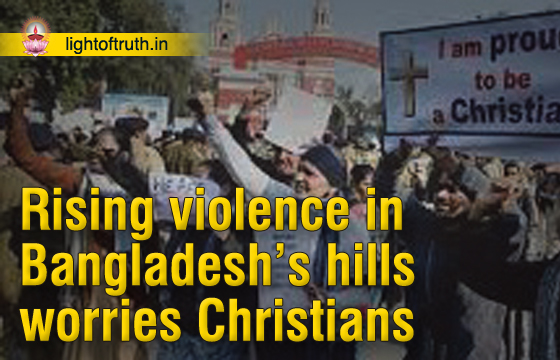
Christians in Bangladesh’s restive Chittagong Hill Tracts (CHT) region say an uptick in violence and deaths has triggered fear in the community.
In the latest violence, a group of Bengali Muslim settlers burned down 40 houses belonging to ethnic Chakma people in Mahalchhari sub-district of Khagrachhari district on July 5. At least five people were injured, locals said.
The attackers allegedly looted the houses before setting them on fire. Church sources confirmed no Christians were among the victims of the attack.
Mohmmad Ashrafuzzaman, officer-in-charge of Mahalchhari police station said that no case has been filed over the arson attack, but law enforcers have been deployed in the area to avert further violence.
“Police and soldiers have stepped up patrols in the area to prevent any deterioration in law and order. Senior security officials have visited the area,” Ashrafuzzaman told.
“There was a clash between two groups. The accusation of looting is totally baseless. We are keen to maintain a friendship with all” Local media, quoting eyewitnesses, have reported that a group of about 120 to 150 Muslims led by local community leader Mohammad Aziz, vandalized and set fire to the houses in the Joysen para (village) area of Mahalchhari.
Aziz denied the allegations.
“The allegation that we attacked them is not true. There was a clash between two groups. The accusation of looting is totally baseless. We are keen to maintain a friendship with all,” Aziz told.
He also dismissed any communal motive behind the clash, adding that it was sparked after tribal people stopped Bengali people from growing crops in local plots.
Earlier, on June 21, an armed insurgent group, the Kuki-Chin National Front, shot dead three ethnic Tripura people and hacked another including one Christian in the Bilachhari area of Rangamati district.
Rights groups say at least 22 members of ethnic minority groups have been killed in violence in the last year and a series of arson attacks targeted tribal houses. While the rise in violence is mostly blamed on a turf war between armed insurgent groups, arson attacks have occurred due to clashes between Muslims and tribals.
“We are the locals, but today we do not have any security, neither at home nor outside. Often, we do not know who is killing whom, when and why”
Makhonlal Tripura, 29, a Tripura Catholic from neighboring Bandarban district, said Christians are living in fear over a surge in violence in the region.
“We are the locals, but today we do not have any security, neither at home nor outside. Often, we do not know who is killing whom, when and why. The CHT has become a turbulent place,” Tripura, a father of two, told.

The Hmong godmother who brought the faith to her Vietnamese village
Catholic Parveen Bibi’s life is an example of how poor Christian mothers contribute to the Church’s growth in Pakistan
For Mary Song Thi May, a 32-year-old mother of two, her deprived childhood and difficult youth are a distant memory since she embraced Catholicism. “I no longer feel wretched about life as Catholicism is the breath of life to me. Since I met God, I am quite determined to bring divine love to other poor people,” she says while adjusting her colorful ethnic attire.
Mary hails from Ho Sen, a village in the impoverished Hua Nhan commune, in north western Vietnam’s remote and mountainous Son La province, some 300 kilometers from Hanoi.
The Hmong woman makes it a point to visit local families in the evenings to tell them about a mighty God, who is better than nature gods, and the priests and lay Catholics from the local Mai Yen Parish, who extend material support to the needy.
“At first they have no clue what I am talking about, but after several visits they fully understand and ask me to take them to the priests,” she said. “I think it is God who opens their minds and shows them how to come to him.”
On weekends, she gathers local Catholic villagers to her home to say prayers in their native language as they speak little Vietnamese. They console one another, make donations to help people in need, send sick people to hospitals, and pray for good weather and crops.
May in traditional costume serves as a godmother at a baptism in Mai Yen Church in March.
Ho Sen village is a mission station with 24 Hmong families, half of whom converted to Catholicism in the past three years.
The Hmong people in Hua Nhan commune are among the poorest people in Vietnam who eke out a living by growing rice, plums, peach, tea, and other crops on the hills. They also raise cattle and poultry but lack food some parts of the year.
The families, with many children, live in wooden houses that often get damaged by hailstorms and floods. The living conditions are bad and they have little access to education and health care.
Whenever someone falls ill, the family borrows money to buy poultry or cattle and approaches a shaman to make offerings to gods in the hope of an often elusive cure.
May recalls her father died from illness when she was only four months old. When her mother remarried, she was forced to drop out of school as a fifth-grader to look after her younger siblings. She also did the housework, herded cattle, and worked on the farm to support the family.
She was barely 15 years old when she was “kidnapped for marriage” by a teenager who was in grade ten. “I was too young to know what love was,” she said.
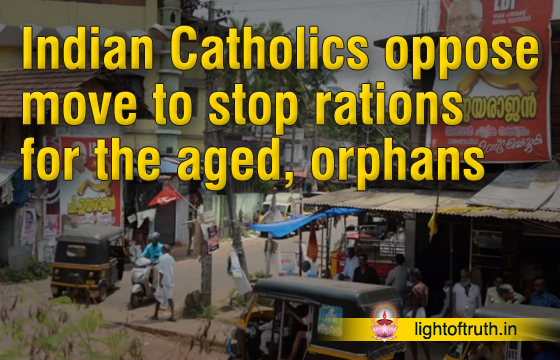
Indian Catholics oppose move to stop rations for the aged, orphans
Catholics in the southern Indian state of Kerala have launched a signature campaign against a reported move by its communist rulers to withdraw a government supply of food items to homes for the elderly and orphanages.
“It is a highly condemnable act,” said P.P. Joseph, president of the Catholic Congress in Changanassery Archdiocese, after launching the campaign at a local old people’s home on July 10.
The signatures with an appeal to not abandon the aged and orphans will be handed to Indian Prime Minister Narendra Modi and Kerala Chief Minister Pinarayi Vijayan, he said.
The signature campaign was initiated in response to an appeal from the Commission for Social Harmony and Vigilance of the Kerala Catholic Bishops’ Council.
“More than 100,000 inmates in 1,800 old people’s homes and orphanages in the state are going to be deprived of food supplied through the public distribution system,” said Father Michael Pulickal, CMI, secretary of the commission.
The Kerala government decided to discontinue the supplies though “verbal instructions to this effect to officials,” the priest alleged.
“The Catholic Church opposed the decision then and will continue to oppose this latest decision too”
The priest claimed to have got the information from reliable sources in the state’s social welfare and public distribution departments. The reason given was that the federal government had withdrawn its support for the free ration scheme in the state.
Government officials remained tight-lipped. A senior official told on July 11 that the government has “enough storage of food grains.”
The official, who did not want to be named, also denied any official information about the alleged move to discontinue food supplies.
Father Pulickal, though, appealed to the provincial government to reverse the decision and reminded of an earlier decision to withdraw the social security pension of residents at old people’s homes in the state in August 2021.
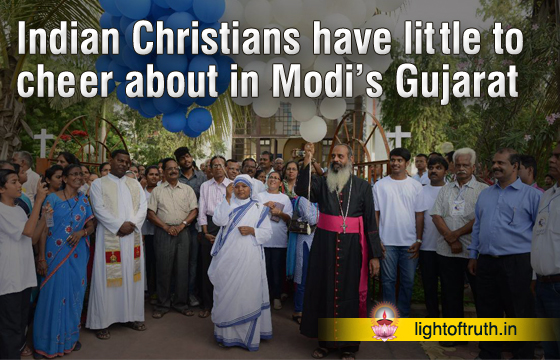
Indian Christians have little to cheer about in Modi’s Gujarat
Abandoned, unwanted, and grossly underrepresented is how religious minorities, including Christians, feel in the western Indian state of Gujarat — Prime Minister Narendra Modi’s home state.
The alienation is so complete that the majority of Christians or Muslims living here are resigned to their fate as second-class citizens in this “model state” that owes much to Modi’s development-oriented governance as its chief minister from 2001 to 2014.
The marginalized communities make no bones about their disillusionment with both the pro-Hindu Bharatiya Janata Party (BJP) and the Congress, which swears by secular-liberal values but practices a softer version of “Hindutva” (Hindu nationalism).
Naturally, the minorities are seething with anger at being sys-tematically reduced to irrelevance — it is as if they do not matter in Gujarat. With the provincial assembly polls round the corner, their political fate hangs in the balance.
There is little hope or assurance of adequate political re-presentation for Christians or Muslims here. And there is little or no other option.
The Aam Aadmi Party, which rose from the ashes of a nationwide anti-corruption crusade in 2012 and rules Delhi and Punjab in the north, has entered the fray and forged an alliance with the Bharatiya Tribal Party (BTS), headed by tribal strong-man Chhotu Vasava, himself a legislator.
“Census figures show Christians barely form 0.50 percent of Gujarat’s 63 million people; but their numbers in about 10 assembly segments, especially in the southern tribal belt”
But Christians, who have sizable numbers in the tribal belt of South Gujarat, are keeping their fingers crossed when it comes to the number of nominations they could expect for their co-religionists.
The BJP never bothered to grant the Christian community adequate representation in the state assembly election, while the Congress indulges in mere tokenism — repeating the nomination of the lone Christian candidate, Punaji Gamit, for the last four terms.
Even Gamit’s nomination stands threatened due to a campaign by pro-Hindu forces, but Congress would still like to ride on his successful run so far.
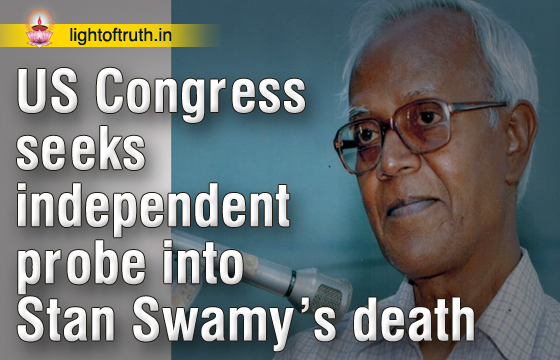
US Congress seeks independent probe into Stan Swamy’s death
A resolution commemorating the life of Indian human rights defender Father Stan Swamy and seeking an independent investigation into the death of the Jesuit priest has been introduced in the US Congress, Congressman Juan Vargas has said.
Vargas, the Representative from the US state of California, recently introduced the resolution in Congress to commemorate Swamy “and to encourage an independent investigation” into his death.
The resolution is co-sponsored by Representatives Andre Carson and James McGovern. Its introduction in the US House of Representatives coincided with the first anniversary of 84-year-old Swamy’s death in judicial custody.
Vargas, a Democratic Party Congressman, was speaking at a webinar titled ‘Persecution of Religious Minorities and their Defenders in India: Commemorating Father Stan’s Death in Custody’ on July 5.
The panelists noted Swamy’s extensive service fighting for the rights of the tribals. “I am appalled by the abuse Father Stan faced while in custody. No one who fights for human rights should face such violence and neglect,” said Vargas.
Swamy was admitted on May 29, 2021, in a Mumbai hospital, a day after he suffered a cardiac arrest and was put on the ventilator. He suffered from Parkinson’s disease and several other ailments. He died July 5, 2021.
Father Swamy was arrested by the NIA from Ranchi, Jharkhand, on October 8, 2020, under the stringent UAPA in connection with the Elgar Parishad case and lodged at the Taloja Central Jail in Navi Mumbai.
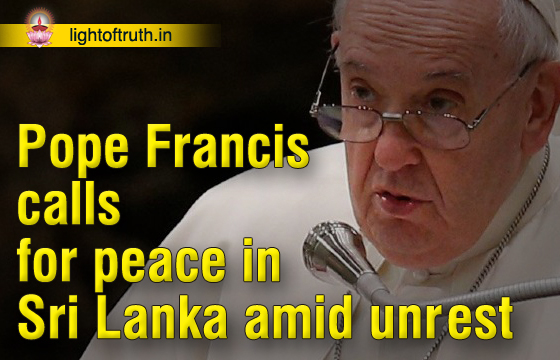
Pope Francis calls for peace in Sri Lanka amid unrest
Pope Francis on July 10 renewed his appeal for peace in Sri Lanka which has been rocked by instability for months over a worsening economic crisis. “I unite myself to the sorrow of the Sri Lankan people, who continue to suffer the effects of political and economic instability,” the Pope said at the Angelus, the traditional mid-day prayer on Sunday.
Following weeks of popular demonstrations, groups of protesters in Sri Lanka on July 9 stormed the presidential palace and other government buildings, demanding the resignation of President Gotabaya Rajapaksa.
The anti-government protesters in Sri Lanka who broke into embattled President Gotabaya Rajapaksa’s official residence have claimed to have recovered millions of rupees inside his mansion, according to a media report.
Sri Lanka, a country of 22 million people, is under the grip of an unprecedented economic turmoil, the worst in seven decades, crippled by an acute shortage of foreign exchange that has left it struggling to pay for essential imports of fuel, and other essentials.
The country, with an acute foreign currency crisis that resulted in foreign debt default, had announced in April that it is suspending nearly US$7 billion foreign debt repayment due for this year out of about US$25 billion due through 2026.
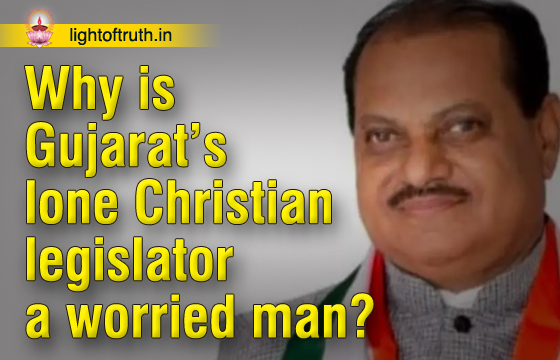
Why is Gujarat’s lone Christian legislator a worried man?
Not many people outside Gujarat and even within this western Indian state itself know that there is a Christian Member of the Legislative Assembly in the Hindutva laboratory – one who has won four terms in a row. And that is perhaps because of his common tribal identity.
Punaji Gamit, 56, a Protestant, represents Vyara, a constituency in the tribal-dominated Tapi district of South Gujarat. He happens to be a convert – like 30% of others in his constituency.
So not many people know that these days Gujarat’s sole Christian assemblyman is losing sleep over an issue — the demand for delisting converts like him from the Scheduled Tribes (ST) list — which has serious ramifications for him and other converts. This demand is being pushed by Janjati Su-raksha Manch (JSM), an outfit backed by the powerful right-wing Hindu group Rashtriya Swayamsevak Sangh.
Despite being the only Christian MLA, Gamit has not emerged as the voice and face of the Christian community. The Dalit community, which accounts for 7.5% of the population, has an iconic figure in the outspoken Jignesh Mevani.
Though about 60 Christian organiza-tions in South Gujarat have come together to form a common plat-form to counter what they des-cribe as Hindu groups’ controversial move, the community so far does not have a prominent face to spearhead the cause.
In fact, the Christian community does not even have a leader of the stature of Chhotu Vasava — an MLA known across the whole tribal belt.
“As a beneficiary of tribal status, Gamit understands that with de-listing he will not be able to contest elections and represent the tribal community”
Interestingly, even this lone Christian MLA, who is a member of the Congress Party, is not part of the Christian group that has been formed to combat the JSM’s campaign which Christians fear is likely to reach its logical conclusion in the Monsoon session of Indian parliament expected to start on July 18.
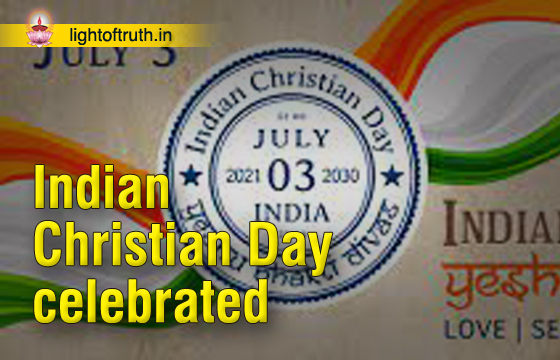
Indian Christian Day celebrated
Christians cutting across denominations came together at various parts of India July 3 to organize special programs to mark the 1950th martyrdom day of Saint Thomas the Apostle.
Saint Thomas, one of the 12 disciples of India, is believed to have come to India in 52 AD and preached the Christian faith in the western and southern regions of the country. He was martyred 20 years later in Chennai, currently the capital of the southern Indian state of Tamil Nadu. Since 2021, the day is being observed as the Indian Christian Day to “love the neighbor, serve society, celebrate Jesus and bless India.”
The ecumenical annual day helps Christians to remember and celebrate “the person and message of Lord Jesus Christ in India.” That also helps them preserve their identity with the Indian cultural heritage and promoting unity. The day, a people’s movement, saw Christians organizing festivities, cultural programs, community service, health and literacy camps, food and clothes drive, environmental cleanup and workshops.
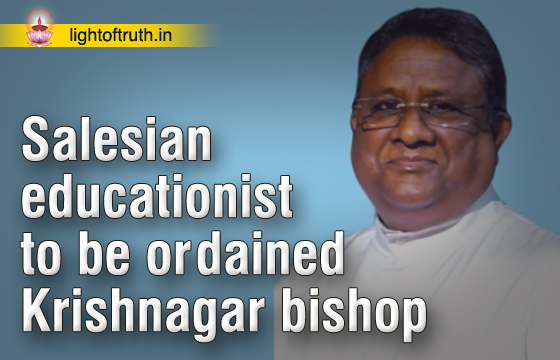
Salesian educationist to be ordained Krishnagar bishop
An educationist for almost four decades, Salesian Fr Nirmol Vincent Gomes will on July 23 be ordained the bishop of Krish-nagar diocese in West Bengal.
The uncle of the bishop-elect, Bishop Emeritus Theotonius Gomes of Dhaka will preside over the episcopal ordination to be held in Cathedral of the Holy Redeemer Krishnagar.
Dignitaries expected at the event include Vatican Nuncio to India and Nepal Archbishop Leopoldo Girelli and president of the Federation of Asian Bishops’ Conferences Salesian Cardinal Charles Bo of Myanmar.
Abp Kalist tests Covid positive in Rome
Archbishop Francis Kalist of Pondicherry-Cuddalore has tested Covid positive and was quarantined in Rome. The archdiocesan office has informed the cancellation of all programs of the archbishop until further information and urged people to pray for the prelate’s speedy recovery. Archbishop Kalist went to Rome on invitation from Pope Francis to receive the pallium on June 29, the feast of Saints Peter and Paul.