

The words “I am sorry” are powerful.
For Tammy Ward of the Samson First Nation, those words from Pope Francis brought tears as she listened on the Muskwa, or Bear Park, Powwow Grounds.
“It’s just very powerful,” Ward told The Catholic Register, Toronto-based newspaper, after Pope Francis finished delivering his historic apology on Indigenous land for the Catholic Church’s role in residential schools and other wrongs done on the church’s behalf. “For me, it’s the healing.”
Ward leaned into her 21-year-old daughter, Aleea Foureyes, for comfort as Pope Francis confessed the sins Catholics committed against Indigenous Canadians in residential schools.
“In the face of this deplorable evil, the church kneels before God and implores His forgiveness for the sins of her children,” Pope Francis said, invoking St. John Paul II’s 1998 bull, “Incarnationis Mysterium.” “I myself wish to reaffirm this, with shame and unambiguously. I humbly beg forgiveness for the evil committed by so many Christians against the Indigenous peoples.”
Pope Francis delivered his apology on the treaty land of the Ermineskin and Samson Cree Nations, the Louis Bull Tribe and the Montana First Nation, as part of his “penitential pilgrimage” to Canada. The site was near one of Canada’s largest residential schools. For 49-year-old Ward, it brought memories of her relationship with her parents.
“I always thought my parents didn’t love me. I was always wondering why they were silent,” she said. Years later she understood how a childhood spent institutionalized in residential schools had left her parents unprepared for family life.
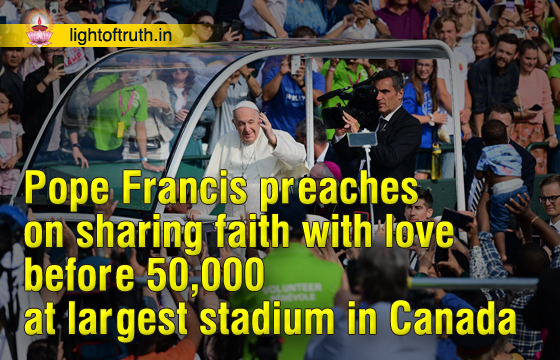
Pope Francis preaches on sharing faith with love before 50,000 at largest stadium in Canada
Preaching at a Mass celebrated in Canada’s largest stadium, Pope Francis reflected on the elderly, who he said should be honoured, and who serve as an example to the Church on how to pass on faith in a loving way.
“In addition to being children of a history that needs to be preserved, we are authors of a history yet to be written,” the Holy Father said.
“The grandparents who went before, the elderly who had dreams and hopes for us, and made great sacrifices for us, ask us an essential question: what kind of a society do you want to build?”
Developing a theme he introduced Monday in his speech at Sacred Heart parish, the pope reflected on the importance of presenting the faith to others in a loving way, rather than with proselytism.
“From our grandparents we learned that love is never forced; it never deprives others of their interior freedom. That is the way Joachim and Anne loved Mary; and that is how Mary loved Jesus, with a love that never smothered him or held him back, but accompanied him in embracing the mission for which he had come into the world,” Pope Francis said.
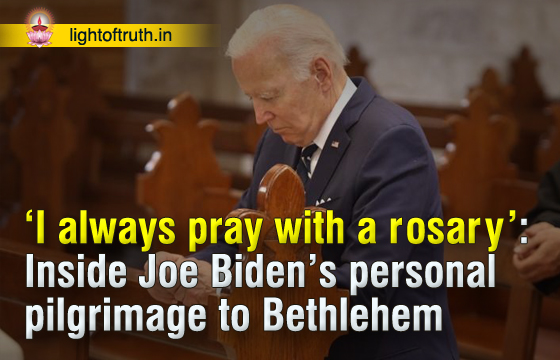
‘I always pray with a rosary’: Inside Joe Biden’s personal pilgrimage to Bethlehem
One part of President Joe Biden’s ultra-publicized trip to the Middle East took place in private, away from the eyes of any of the journalists who accompanied him on the five-day visit.
The president was accompanied only by a single Secret Service agent when, after meeting with Palestinian President Mahmoud Abbas in Bethlehem on July 15, he went on a personal pilgrimage to the complex containing the Basilica of the Nativity and the Church of Saint Catherine to pray.
Ibrahim Faltas, a Franciscan priest with the Custody of the Holy Land, first met Him, at the Jerusalem ceremony in which Israeli President Isaac Herzog awarded the U.S. president Israel’s highest civilian distinction, the Presidential Medal of Honour. Saint Catherine’s, adjacent to the basilica, is where the Latin Patriarch of Jerusalem traditionally holds the crowded midnight Mass on Christmas Eve. Last Friday, anticipating Mr. Biden’s visit, it was empty.
“After going to the grotto he came to Saint Catherine’s Church, where I received him,” Father Faltas said, in an exclusive interview with America. “He arrived with the Custos and only one Secret Service agent.”
“He took a rosary out of his pocket, saying, ‘I always pray with a rosary,’ and remembered his son Beau. He cried. He was very emotional,” Father Faltas said, about the moment in which Mr. Biden kneeled alone in a wooden pew, the rosary in his hands, and prayed.
Who are the women appointed to the Vatican’s Dicastery for Bishops?
Pope Francis named three women as members of the Vatican’s Dicastery for Bishops on July 13.
The appointments, which the pope previewed in an interview last week, mark the first time that women have served as members of the Vatican department responsible for the world’s episcopal appointments.
Who are the pioneering trio? María Lía Zervino is the Argentine president general of the World Union of Catholic Women’s Organizations (WUCWO). The umbrella body representing almost 100 groups worldwide was founded in 1910 and represents an estimated eight million Catholic women.
She is a member of an Argentine institute of consecrated life, the Servidoras, founded by Fr. Luis María Boneo.
She wrote: “I dream of a Church that has suitable women as judges in all the courts in which matrimonial cases are processed, in the formation teams of each seminary, and for exer-cising ministries such as listening, spiritual direction, pastoral health care, care for the planet, defence of human rights, etc., for which, by our nature, women are equally or sometimes better prepared than men. Not only consecrated women, but how many lay women in all regions of the globe are ready to serve!”
Sister Raffaella Petrini was born in Rome on Jan. 15, 1969, Petrini studied political science at the Luiss Guido Carli, a prestigious private university in the Italian capital, before pursuing a doctorate in social sciences at the Pontifical University of St. Thomas Aquinas (Angelicum). She earned a master’s degree in organizational behavior from the University of Hartford in Conn-ecticut in 2001.
Sister Yvonne Reungoat is T 77-year-old Salesian Sister of Don Bosco has been a member of the Congregation for Institutes of Consecrated Life and Societies of Apostolic Life since 2019, when she became one of the first women appointed to the body.
In 1990, she began serving as delegate of the institute’s provinces of Spain and France for West Africa. In 1991, she was elected superior of the African province of Mother of God, based in Lomé, Togo. In a 2012 interview, she said: “My time as a missionary in Africa enriched my vocation, which then developed in a surprising way with my election as visiting councillor, vicar general, and finally superior general.”
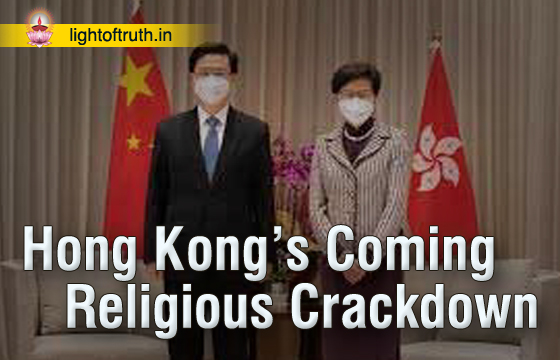
Hong Kong’s Coming Religious Crackdown
Freedom of speech, assembly and the press are gone in Hong Kong, and there’s good reason to fear religious liberty will be the next target.
That was the warning from Monsignor Javier Herrera-Corona, the Vatican’s unofficial envoy in Hong Kong, as he prepared to leave the city this spring after six years. Reuters reports that in four private meetings he encouraged some 50 Catholic missions in the city to safeguard their property, files and funds in anticipation of more mainland Chinese control.
“Change is coming, and you’d better be prepared,” Monsignor Herrera-Corona warned the missionaries, according to Reuters, which quoted an attendee as summarizing the monsignor’s message: “Hong Kong is not the great Catholic beachhead it was.”
Hong Kong’s Basic Law guarantees freedom of religion, and diverse faiths have flourished there. The city has also long been a haven for mainland Christians, who traveled to Hong Kong to study. Father Laszlo Ladany, a Hungarian Jesuit based in Hong Kong, famously reported on Chinese political and legal developments during the Mao Zedong era. Yet China has violated other liberties it swore to respect under the Sino-British Joint Declaration, and there’s no reason to believe religious freedom will be an exception.

Pope names three women to Vatican’s Dicastery for Bishops
Pope Francis on Wednesday named three women to the Dicastery for Bishops, the first time women have been appointed to the Dicastery responsible for identifying future bishops globally.
The Holy See Press Office published the Pope’s latest appointments to the Dicastery in a statement on Wednesday.
The female members are Sister Raffaella Petrini, F.S.E., Secretary General of the Governorate of the Vatican City State; Sister Yvonne Reungoat, F.M.A, former Superior General of the Daughters of Mary Help of Christians; and, Dr. Maria Lia Zervino, President of the World Union of Catholic Women’s Organizations.
The nomination of Dr. Zervino also marks the first appointment ever of a laywoman to the Vatican Dicastery.
Described as a ”close friend of the Pope,” she wrote an open letter to Francis in 2021, praising him “for being the Francis of the 21st century,” but saying that “not enough progress has been made in taking advantage of the wealth of women who make up a large part of the People of God.”
She wrote:
“I dream of a Church that has suitable women as judges in all the courts in which matrimonial cases are processed, in the formation teams of each seminary, and for exercising ministries such as listening, spiritual direction, pastoral health care, care for the planet, defense of human rights, etc., for which, by our nature, women are equally or sometimes better prepared than men. Not only consecrated women, but how many lay women in all regions of the globe are ready to serve!”
“And I dream that, during your pontificate, you will inaugurate, together with the Synods of Bishops, a different synod: the synod of the People of God, with proportional representation of the clergy, consecrated men and women, and lay men and women.”
“We will no longer be happy just because a woman votes for the first time but because many prepared lay women, in communion with all the other members of such synod, will have given their contribution and their vote that will add to the conclusions that will be placed in your hands.”
“Probably, Holy Father, you already have this ‘card in your deck’ to put synodality into practice and wait for the right moment to play it,” Zervino said at the time.
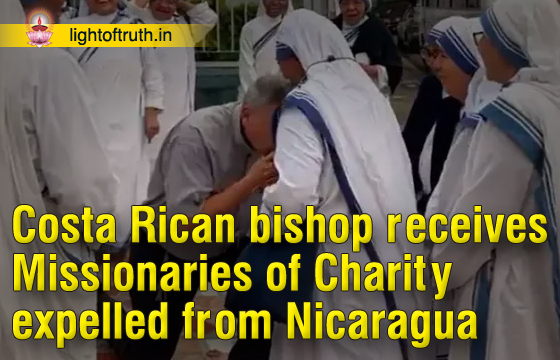
Costa Rican bishop receives Missionaries of Charity expelled from Nicaragua
The bishop of Tilarán-Liberia in Costa Rica, Eugenio Salazar Mora, on July 6 knelt as he greeted the superior of the Missionaries of Charity, who were expelled from Nicaragua by the government of President Daniel Ortega.
The sisters of the order founded by St. Teresa of Calcutta were welcomed to Costa Rica at a parish in the town of Cañas.
A video posted by the bishop on Facebook shows him greeting the nuns one by one, who in turn kiss his episcopal ring. When he came to the superior, Salazar knelt down and it was he who kissed the sister’s hand.
The Diocese of Tilarán-Liberia explained that “the sign of reverence that [the bishop] makes toward the mother provincial is a sign of being at her disposal and of service toward this community.” ‘In receiving you we have received Jesus Christ.’
In another video, posted July 7, the bishop said he didn’t know the reasons for the expulsion of the nuns, who “remain silent be-cause they are religious, because of their spirituality of not seeking recognition, not getting involved in controversies, and they offer their pain for the Costa Rican people.”
“They have had difficult ti-mes, fearful for their personal safety, knowing that they are of several different nationalities and some of them are older. They were very worried until they arrived on Costa Rican territory,” the prelate continued.
“If it had been up to them, they would stay in Nicaragua; they love Nicaragua, the Nicaraguan people, especially those most in need,” the bishop noted.
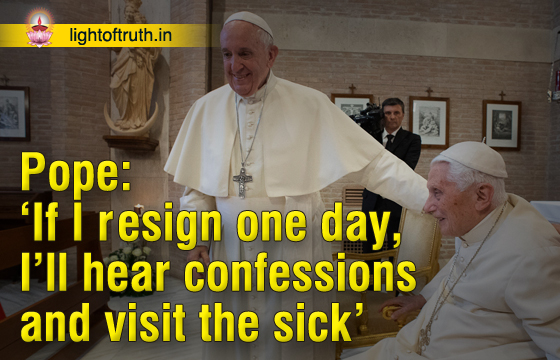
Pope: ‘If I resign one day, I’ll hear confessions and visit the sick’
In yet another wide-ranging interview, Pope Francis said Monday that he doesn’t plan to step down anytime soon, though he prays for the strength to do so when the time is right.
If the day comes when he does resign, the pontiff said he would prefer to be considered the “Bishop emeritus of Rome rather than pope emeritus” and to dedicate his time to the confession of the faithful, the practice of charity, and visiting the sick in some Italian parish.
“If I survive after resignation, I would like to do one thing: confess and go to see the sick,” he said.
On other fronts, the pope said pro-choice Catholic politicians should “talk to their pastor” about their “incoherence” with church teaching, and he repeated a familiar warning about the risks of a third world war.
Francis also answered – and, to some extent, dodged – questions about Ukraine, the COVID-19 pandemic, the clerical sexual abuse scandals, abortion, his resignation, and why he doesn’t go back to his home country, Argentina.
The Pope’s remarks came in a July 11 interview with Mexican journalists Valentina Alazraki and Maria Antonieta Collins, published on the Vix streaming channel of Noticias Univision 24/7.
On the subject of war, Francis noted he changed the Catechism of the Catholic Church to say that both the use and possession of nuclear weapons is immoral, because an accident could lead to the killing of half of humanity: “We cannot play with death in our hands like that. We were playing with death.”
Do findings of two new polls show the path where America is headed?
With the issuance of two re-cent Gallup polls on Americans’ belief in God and their views on morality, one could come to the conclusion that the United States could be in a heap of trouble.
One poll, issued June 15, found a record rating: Fully half of the survey’s respondents said they believe the country’s moral values are “poor.” And if that’s not enough, another 37% rated America’s moral values as “only fair,” and 78% said the nation’s morality is getting worse.
The other poll, released June 17, found that 81% of Americans believe in God. That’s an impressive number, until you realize that the percentage is the lowest ever recorded by Gallup when it has asked this question.
It’s down six percentage points from 2017. And according to Gallup, more than 90% of Americans believed in God between 1944 — when Gallup “first asked this question” — and 2011.
There are not a lot of polling organizations in the United States that focus on faith, religion and related matters. And one of the biggest, the Pew Research Cent-re, takes a hands-off policy when it comes to others’ findings.
“Pew Research Centre does not comment on research conducted/published by other pollsters or polling organizations,” said a June 23 email to Catholic News Service by Anna Schiller, senior communications manager for Pew’s research on religion and public life.
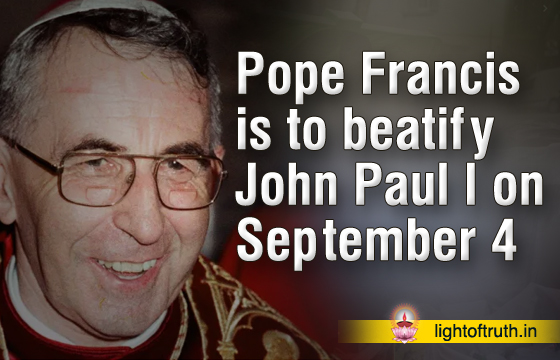
Pope Francis is to beatify John Paul I on September 4
Pope Francis will beatify Pope John Paul 1 September 4 during a Mass at St. Peter’s Square, the Vatican Press Office has announced. Bishop Renato Marangoni will read the Rite of Beatification at the Mass, together with the Cardinal Beniamino Stella, po-stulator for the Cause of Canonization, and Stefania Falasca, the deputy postulator, the press office said.
Pope John Paul I was born as Albino Luciani in the northern Italian town of Forno di Canale (now Canale d’Agordo) on October 17, 1912.
“During the beatification, the team of postulators will gift the Holy Father with a reliquary containing the relics of the new Blessed,” according to the July 11 statement from the Press Office.
Ahead of the beatification, Cardinal Angelo De Donatis will preside over a prayer vigil in the Basilica of St. John Lateran on the evening of September 3.
The Pope’s Vicar General for the Diocese of Rome will celebrate the vigil in the Basilica which houses the Chair of the Bishop of Rome, of which John Paul I took possession on September 23, 1978.