

Four Nuns who were kidnapped in Nigeria’s southern Imo State on Sunday, Aug. 21, have been returned to their community.
Sisters Johannes Nwodo, Christabel Echemazu, Liberata Mbamalu and Benita Agu were freed unconditionally – meaning without the payment of a ransom – according to a statement issued Aug. 23 by members of the Sisters of Jesus the Savior (the Saviourite Sisters, or SJS) to which the nuns belong.
“With hearts full of joy, the Sisters of Jesus the Savior wish to announce the unconditional and safe release of four of our sisters who were abducted around Okigwe-Umulolo on the 21 of August 2022,” reads the statement signed by the director of the order, Sister Zita Ihedoro.
“Today is a memorable day for us, therefore we wish to share this joy with all men and women of goodwill who, in one way or the other, have contributed to the quick and safe release of our dear sisters,” the statement adds.
“We sincerely appreciate and thank you for your prayers and moral support during this difficult moment,” Ihedoro said, before imploring Jesus “to bless, protect and provide for you, especially in times of difficulty.”
The four nuns were kidnapped along a local highway on Sun-day morning on their way to a thanksgiving Mass.
It’s still not known who kidnapped them or why, but it is increasingly becoming clear that Nigeria’s Christians in recent years have become targets for attacks, kidnappings and even killings.
Catholic Church in Argentina opposes legalization of euthanasia
The Committee for Life, the Laity, and the Family of the Argentine Bishops’ Conference ex-pressed its opposition to four bills introduced in Congress to legalize euthanasia. The committee said the country is facing “a new manifestation of the culture of death and the throwaway culture.”
In an Aug. 18 statement, the committee said that “the Gospel commits us not to be indifferent in the face of discussions on the beginning and end of life.”
There are currently four bills to legalize euthanasia: two introduced last year and two this year.
In its statement, the Church in Argentina warned that “we are facing a new manifestation of the culture of death and the throwaway culture” and at the same time, “we are a people that wants such important needs as health, work, housing, and land” to be taken care of.
“Although a society cannot eliminate suffering, it can always commit itself with all its energies to the lives of those who suffer,” the committee said, noting that Argentina “has a rich history of doing so” with multiple alternatives “to accompany physical and spiritual pain with science and humanity.”
“In the hospices and in the cottolengos (homes for the physically and mentally disabled), we see a great example of this,” the committee said.
In its statement, the Committee for Life, the Laity, and the Family pointed out that “even in cases of diseases that have no cure, all patients must be cared for and accompanied so that their lives are respected until natural death. We are not the masters of life and therefore we place our-selves at its service.”
The bishops’ committee call-ed for valuing “palliative and comprehensive care, which relieves pain in serious illness and helps those who suffer and bears much fruit in the human person and in their family.”
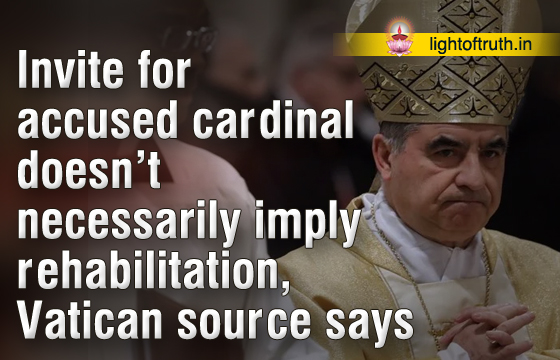
Invite for accused cardinal doesn’t necessarily imply rehabilitation, Vatican source says
Speaking on background, a Vatican source has said Italian Cardinal Angelo Becciu’s apparent invitation to participate in a high-profile meeting of cardinals next week represents a personal gesture on the part of Pope Francis, but that it does not necessarily mean Becciu’s rights as a cardinal, stripped by the pope two years ago, are being restored. Over the weekend Becciu made headlines for telling attendees of a small, private Mass, which he celebrated Sunday, that he is being “reinstated” by Pope Francis. According to Italian media outlets, Becciu told congregants at Italy’s Golfo Aranci that, “On Saturday, the Pope phoned me to tell me that I will be reinstated in my cardinal duties and to ask me to participate in a meeting with all the cardinals that will be held in the coming days in Rome.”

Pope urges new cardinals to be meek, close to their flocks and tender
Calling for the gathered prelates to be meek, faithful, close to their flocks and tender, and to pay attention to both the big and small events of life so people can “savour the presence of Jesus alive in our midst,” Pope Francis created 20 new cardinals Saturday, including 16 eligible to vote for the next pontiff.
“To us, who in the church have been chosen from among the people for a ministry of particular service, it is as if Jesus is handing us a lighted torch and telling us: ‘take this; as the Father has sent me so I now send you’,” Francis told the cardinals. “In this way, the Lord wants to bestow on us his own apostolic courage, his zeal for the salvation of every human being, without exception.”
Francis spoke to the prelates of the “fire” that Jesus “came to bring the earth, a fire that the Holy Spirit kindles in the hearts, hands and feet of all those who follow him.” God himself, Francis said, is a “powerful flame” that “purifies, regenerates, and transfigures all things.”
But there is also a slow-burning fire, the pope said, that of the “charcoal,” which makes God’s presence warm and nourishing for everyday life.
The “fire” that comes from “presence,” he said, was once experimented and shared by Saint Charles de Foucauld, a poor hermit Francis declared a saint earlier this year. He “lived for years in a non-Christian environment, in the solitude of the desert, staking everything on presence: the presence of the living Jesus, in the word and in the Eucharist, and his own presence, fraternal, amicable and charitable,” the Pope said.
Francis listed several examples of that charcoal fire that is present in the “small” things, such as the consecrated who live in the “quiet and enduring fire in their work-place, in interpersonal relationships, in small acts of fraternity. It is also in the unassuming ministry of a parish priest, in the Christian married couples and their “homemade” prayers, and in the elderly, representing “the hearth of memory, both in the family and the life of the community.”
“How important is the fire of the elderly!” he said. “Around it families unite and learn to interpret the present in the light of past experiences and to make wise decisions.”

By the numbers: Consistory keeps expanding variety in College of Cardinals
Pope Francis led a number of major events at the end of August, starting with the creation of 20 new cardinals in St. Peter’s Basilica.
Inducting the appointees into the College of Cardinals at an ordinary public consistory Aug. 27, the Pope will give each new cardinal: a scarlet biretta — the “red hat” — whose colour signifies a cardinal’s willingness to shed his blood for the faith; a gold ring, a sign of their special bond with the church of Rome; and a scroll testifying to his new office and containing the name of his titular church in Rome.
On Aug. 28, the Pope will leave Rome for L’Aquila, 55 miles east of the capital, where he is scheduled to open a seven-centuries-old celebration of forgiveness and meet with the families of those who died in a 2009 earth-quake.
Back in Rome, the Pope then hold an important closed-door assembly with the College of Cardinals Aug. 29-30.
All the world’s cardinals have been invited to attend the consultative session to reflect on the apostolic constitution “Praedicate evangelium” (Preach the Gospel) on the reform of the Roman Curia — a project that has been an important focus of this pontificate.
The Pope will then end the day Aug. 30 with Mass with all the new cardinals and the College of Cardinals in St. Peter’s Basilica.
The Pope convening the world’s cardinals in Rome offers a rare chance for the College of Cardinals to get to know each other and to serve as a consultative body for the Pope.
With 20 new members inducted into the College of Cardinals Aug. 27, Pope Francis will bring up to 132 the number of cardinal electors, and the college as a whole will have 226 members.
Some of the significant characteristics of the college after the Aug. 27 consistory can be seen in numbers:
— The college is elderly. The average age of cardinals today is 78, and the average age among the cardinal electors is 72. Even though nine electors are under the age of 60 and one is 48 years old, nearly three-quarters of the electors are 70 and older. Almost 41% of the entire college is over the age of 80.
— The college is international. Today there are more than 90 countries represented in the entire college and 71 countries among the electors. That’s a notable increase from 2005, when all 117 eligible cardinal electors came from 53 countries.
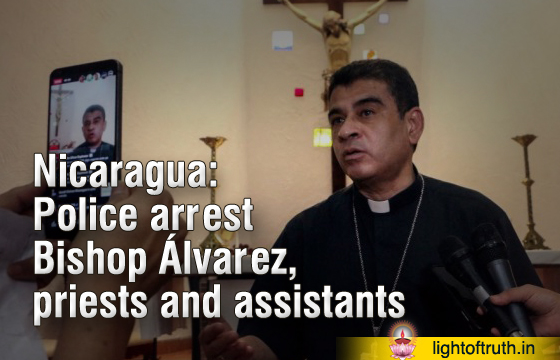
Nicaragua: Police arrest Bishop Álvarez, priests and assistants
Bishop Rolando Álvarez is under house arrest in Nicaragua’s capital Managua after being detained by police August 19 in a pre-dawn raid.
Bishop Álvarez had been confined to his residence for two weeks along with five priests, a seminarian, and a cameraman of a religious television channel. The priests and cameraman have reportedly been put in prison in the capital now, while the Bishop is under house arrest. A police statement said authorities had been waiting for several days for what they called a “positive communication” from the Diocese of Matagalpa, which had not been forthcoming. No formal charges have been announced.

Shia LaBeouf embraces the Catholic faith: Here’s what we know
Shia LaBeouf, an actor known for his roles in such movies as “Transformers” and “Fury,” made headlines this week for the personal details he shared about how his on-screen portrayal of Padre Pio led him to a newfound love of the Catholic faith.
In an 80-minute-long inter-view with Bishop Robert Barron of the Diocese of Winona-Rochester and Word on Fire ministries, LaBeouf spoke at length about his appreciation of the works of St. Augustine and Thomas Merton, his devotion to the Traditional Latin Mass, the peace he feels when he prays the rosary, and his experience receiving the Holy Eucharist for the very first time. “I start feeling a physical effect from it,” he said of going to Communion. “I start feeling a reprieve and it starts feeling, like, regenerative, and [I] start enjoying it to such a degree I don’t want to miss it, ever.”
Though revelatory — and perhaps surprising, coming from a major Hollywood star — the interview didn’t conclusively answer a question many of his Catholic fans are asking: Has Shia LaBeouf formally “converted to Catholicism,”
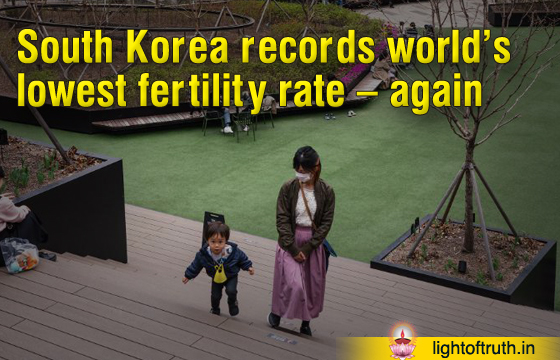
South Korea records world’s lowest fertility rate – again
South Korea has broken its own record for the world’s lowest fertility rate, according to official figures released Wednesday, as the country struggles to reverse its years-long trend of declining births.
The country’s fertility rate, which indicates the average number of children a woman will have in her lifetime, sunk to 0.81 in 2021 — 0.03% lower than the previous year, according to government-run Statistics Korea.
To put that into perspective, the 2021 fertility rate was 1.6 in the United States and 1.3 in Japan, which also saw its lowest rate on record last year. In some African countries, where fertility rates are the highest in the world, the figure is 5 or 6.
South Korea’s birth rate has been dropping since 2015, and in 2020 the country recorded more deaths than births for the first time — meaning the number of inhabitants shrank, in what’s called a “population death cross.”
And as fertility rates drop, South Korean women are also having babies later in life. The average age of women that gave birth in 2021 was 33.4 — 0.2 years older than the previous year, according to the statistics agency.

Hong Kong’s Cardinal Joseph Zen to stand trial
The trial for the 90-year-old cardinal and four others detained under China’s national security law will take place Sept. 19-23
At a pre-trial hearing in Hong Kong, a judge set a five-day trial for Cardinal Joseph Zen Ze-kiun and four other defendants who face charges of failing to properly register a now-defunct fund to help anti-government protesters.
According to an Aug. 9 report by the Hong Kong Free Press news agency, Magi-strate Ada Yim announced that the trial will take place Sept. 19-23 after asking prosecutors and the defendants’ lawyers if five days would be sufficient for the court to hear the case. Both sides agreed.
The 90-year-old cardinal was detained May 11 under China’s national security law. However, he and the four others were charged with failing to properly register the 612 Humanitarian Relief Fund, set up to offer financial assistance to those involved in anti-government protests in 2019. It was disbanded last year after coming under scrutiny by authorities.
Lawyers for both sides will argue whether the 612 Humanitarian Relief Fund fell under Hong Kong’s Societies Ordinance, which regulates registered and exempted associations.
The Hong Kong Free Press reported that prosecutors and defines lawyers also will argue whether the defendants held any positions of authority within the relief fund.
The national security law made participating in or supporting the pro-democracy movement crimes of subversion and collusion with foreign organizations and allowed for those remanded to be extradited to mainland China. Punishment ranges between a minimum of three years and a maximum of life imprisonment.
All five defendants pleaded not guilty. If convicted of the improper registration, each defendant could incur a fine of about $1,300.

Police hunt for Sri Lankan priest deplored
Rights defenders and church officials in Sri Lanka have deplored the police raid on a remote parish church allegedly to search for a Catholic priest who has been a key figure in anti-government protests in the crisis-hit nation.
Police raided the church at Ratnapura in Sabaragamuwa Province of south-central Sri Lanka on July 27 and searched for Father Amila Jeewantha Peiris, media reports said.
The raid came two days after a Sri Lanka court slapped a travel ban on the 45-year-old priest and five others for their alleged participation in “unlawful assembly and damage to public property” during a protest rally in June.
Father Peiris has been at the forefront of the months-long anti-government pro-test at Galle Face Green in the capital Colombo that effectively ousted the long-reigning Rajapaksa family dynasty blamed for the nation’s worst economic crisis.
The huge protests forced President Gotabaya Rajapaksa to flee the country and resign. Last week, parliament elected former prime minister Ranil Wickreme-singhe as the new president. However, protests have continued demanding the resignation of Wickremesinghe, who is known as a loyalist of the Rajapaksa dynasty.
Prominent rights activist Ruki Fernando said police actions against Father Peiris are absolutely unacceptable, noting that he is among the few Sinhalese Catholic priests who have spent years serving communities in minority Tamil-dominant North and East that were ravaged by decades of civil war in the ethnically-divided Sri Lanka.
The priest is loved by the Tamil clergy, religious and laity, said Fernando, a consultant to the Justice, Peace and Integrity of Creation Commission of the Conference of Major Religious Superiors.
“He faces reprisals for his unwavering commitment to the struggle of people. I hope church leaders and all others will come forward to support and protect him, as he had done for others,” he told.