Filipino Catholic bishops led by the Archbishop of Manila have urged church-goers not to forget the atrocities during the martial law era. But will the people heed their advice?
The Catholic Church’s hierarchy had gone silent after the presidential election results in May. It was perhaps a painful realization for them that very few Catholics listened to their call to support opposition candidate and for-mer Vice President Leonor Robredo.
The Catholic Church had not involved itself in national politics since the Church-supported 1986 People Power Revolution, which removed Dictator Ferdinand Marcos from power.
During the presidential election, clergy-men wore pink masks and shirts — the color adopted by Robredo supporters. Pastoral letters were issued against martial law and election frontrunner Ferdinand Marcos Jr’s purported effort to revise Philippine history.
Despite accusations of electioneering by conservatives, priests formed associations to support Robredo. The Canon law’s provision for the Church’s non-partisanship was stretched to the limit. But still, Robredo lost. Marcos, Jr. won by an overwhelming majority with 31 million votes.
What happened to the Catholic consci-ence? Do Catholics in the Philippines still listen to their bishops and priests? Or have they pushed them aside while they themselves decide on matters that directly affect the nation?
On the 50th anniversary of martial law, the Catholic prelates spoke.
Perceived to be a clergyman who doesn’t engage in politics, Archbishop Cardinal Jose Fuerte Advincula broke his silence on martial law. Now the stance of the Archbishop of Manila is clear. His statement should silence any critics. He’s not an archbishop sitting in an ivory tower while looking at his flock in the old walled city of Intramuros in the capital.
Cardinal Advincula is still a pastor who does not want to erase the atrocities of martial law from Philippine history, and I suppose, from the history of the Catholic Church in the Philippines.
Karnataka governor urged not to sign anti-conversion law

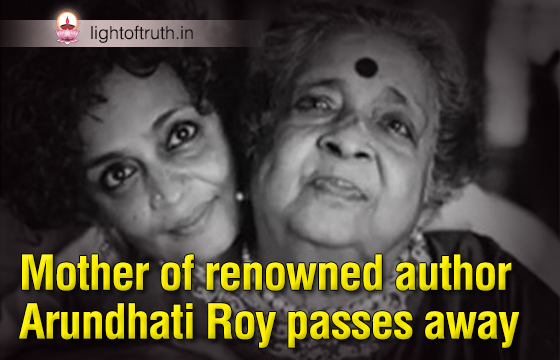
Mother of renowned author Arundhati Roy passes away
Mary Roy, an educator and a women’s rights activist, died September 1 after a brief ill-ness in Kottayam, a town in the southern Indian state of Kerala. She was 89.
She was survived by two children, son Lalit Roy and daughter Arundhati Roy, renowned writer and activist who won the 1997 Man Booker prize for her novel “God of Small Things.”
Roy was known for winning a landmark Supreme Court case in 1986 that ensured equal rights in family property for women belonging to the Syrian Christian community in Kerala. She fought a 39-year-long legal battle to gain equal access to the property of her deceased father that led to the Supreme Court judgment against the archaic Travancore Christian Succession Act of 1916.
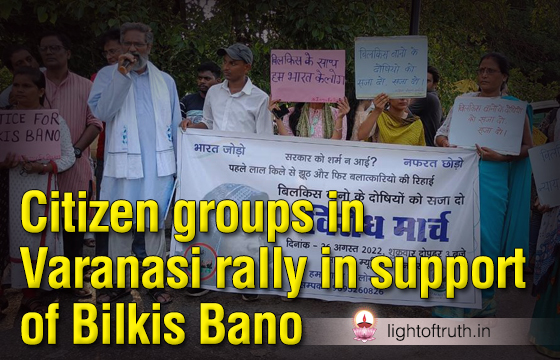
Citizen groups in Varanasi rally in support of Bilkis Bano
A powerful citizen’s movement in Varanasi has come to the streets demanding justice to Bilkis Bano, a rape survivor of the 2002 communal riots in the western Indian state of Gujarat.
The Sajha Sanskriti Manch (SSM, United Forum for Cultural Diversity), network of various social and human rights organization, has organized a series of public protests, rallies and signature campaign in various parts of the northern Indian holy city to demand repeal of the mercy given by the Gujarat High Court to the 11 rapists and murderers.
SSM, in collaboration with Joint Action Council, an organization of the Students of Ba-naras Hindu University and Dakhal (Initiative), a young women’s organization for the rights of women and transgenders through cultural and political interventions, organized its third public meeting August 26 at Sarnath, 10 km northeast of Varanasi.
SSM convenor Father Ana-nd Mathew of the Indian Missionary Society, while addressing the gathering said: “We are standing in front of the Sarnath museum where the Ashoka pillar, symbol of peace and dharma is preserved. The place is significant because it is here Buddha preached his first sermon, denoting the four noble truths of dharma. And from here we appeal to the judiciary not to perpetuate in-justice.”
He condemned the court verdict which he says certi-fies the exploi-tation of wo-men and mino-rity communities. He indicated the communal angle and appeasement of the majority community in the unjust court verdict and expressed the hope that the Supreme Court will give justice to Bilkis Bano and other suffering women and minority communities.
He also appealed for justice to Teesta Setalvad, Himanshu Kumar, Sanjeev Bhat and R.B. Sree Kumar who are jailed for their voice of dissent and standing for truth. Jagriti Rahi, a prominent woman activist of Varanasi, explained in detail the repercussions of this cruel verdict in favor of people who gang raped Bilkis Bano, murdered her three year daughter and seven members of her family in front of her eyes during the Gujarat riots.
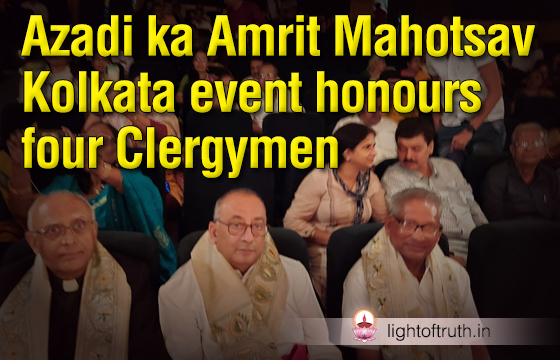
Azadi ka Amrit Mahotsav Kolkata event honours four Clergymen
At an event marking Azadi ka Amrit Mahotsav – 75 years of India’s in-dependence – and Literacy Day, Church Art Kolkata honoured four clergy men for outstanding contribution to society along with several other eminent citizens. The program was held at Indian Council for Cultural Relations Kolkata Satyajit Ray auditorium, September 8, 2022.
Church Art based out of Kolkata is a pan-India initiative with global linkages engaged in promoting education, art and Indian culture for the past 25 years under Shri Subrata Ganguly.
Besides achievers from different walks of life felicitated at the event, there were four clergy men and six high ranking officials of Eastern Rail-way Sealdah like Principal Chief Engineer, Divisional Railway Manager, Additional Divisional Railway Manager and Divisional Engineer Coordinator.
Speaking at the occasion, one of the achievers, President of the Press Club Kolkata Mr Snehasish Sur said, “September 8 is Mother Mary’s birthday and Literacy Day in which several priests and Railway officials are honoured, indicates education is carried forward through mothers, priests and technology.”

Priest who inspired Dalit movements in southern India dies
Father P Antonisamy, who was an inspiration to scores of Dalit priests, religious and lay faithful, died on Sept. 6 in Pondicherry. He was 82.
He was a resident of Emmaus house in Pondicherry, a house of the retired clergy of the Archdiocese, for the past five years.

Protesting Indian fishermen hit with restraining order
An Indian court has issued a re-straining order against Catholic fisher-men protesting against a multi-billion dollar seaport in the southern Indian state of Kerala and ordered the stepping up of security at the project site.
The Kerala High Court issued the order on September 1 in response to a petition by Adani Vizhinjam Port and its contractors seeking police protection from alleged disruption to their work by the protesting fishermen and their families led by the Latin Archdiocese of Trivandrum (Thiruvananthapuram).
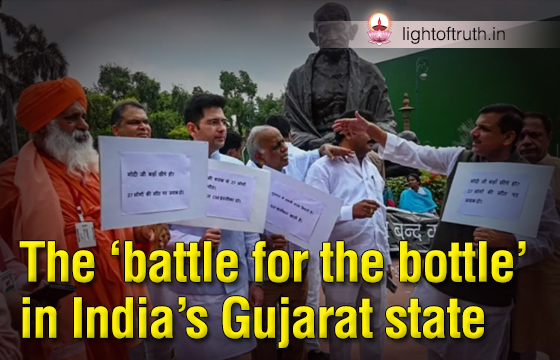
The ‘battle for the bottle’ in India’s Gujarat state
India’s apostle of peace, Mahatma Gandhi, would turn in his grave if he were to witness the “battle for the bottle” in his home province Gujarat ahead of crucial state polls later this year. Prime Minister Narendra Modi’s bête noire and old war horse, Shankarsinh Vaghela, has once again thrown his hat in the electoral ring.

Statue vandalized, parish priest’s vehicle burnt in Punjab
Some unidentified miscreants on August 31 vandalized a Marian statue kept in front of a church in Patti, an old town in the northern Indian state of Punjab. They also set ablaze the car of the parish priest.
According to a message from Father Thomas Poochalil, the parish priest of Infant Jesus Catholic Church in Patti, the “shocking incident” took place around 12:45 am.
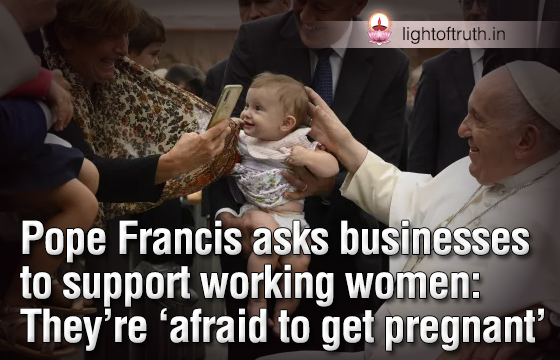
Pope Francis asks businesses to support working women: They’re ‘afraid to get pregnant’
Pope Francis is stressing the importance of accommodating pregnant women as employees — and calling on the business world to find a solution.
“Please, this is a problem for working women: Study it, see how to make sure that a pregnant woman can go on, both with the child she is expecting and with her job,” he said on Monday in the Vatican’s Paul VI Hall.
The 85-year-old pontiff addressed a group of entrepreneurs — the General Confederation of Italian Industry — and the world of business in general during his remarks. He sounded the alarm on low birth rates and encouraged companies to support pregnant employees.
“Still on the subject of the birth rate: Sometimes, a woman who is employed here or works there is afraid to get pregnant be-cause there is a reality — I am not saying among you — but there is a reality that as soon as the belly begins to show, you get booted out: ‘No, no, you can’t get pregnant,’” he cautioned. Countries depend on families for prosperity and a future, he said.
“There is an urgent need for concrete action to support families and the birth rate,” Pope Francis said. “This is what we need to work on, to get out of the demographic winter in which Italy and other countries are living, as soon as possible. It is a bad demographic winter, which goes against us and prevents us from the possibility of growth.”