No Mass for Sri Lanka’s Catholics; no veils for Muslim women, Card. Ranjith: the first Masses on May 5th

The effects of Sri Lanka’s Easter suicide bombings reverberated across two faiths. Catholics shut out of their churches for fear of new attacks, left with only a televised Mass, and Muslim women ordered to stop wearing veils in public.

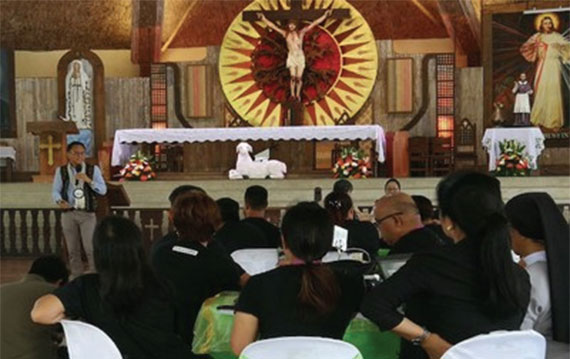
Many across the nation knelt before their televisions as Cardinal Malcolm Ranjith, the Archbishop of Colombo, delivered a homily before members of the clergy and the country’s leaders in a small chapel at his residence in the capital. Meanwhile the tension remains high for the Christian community. Card. Malcolm Ranjith, Archbishop of Colombo, after refusing the armoured car made available by the government, announced the reopening of the churches from May 5, with the celebration of Mass.

‘We will rebuild’: Macron vows to restore Notre-Dame within five years

President Emmanuel Macron has vowed to rebuild Notre-Dame “even more beautifully” within five years, as all of France’s cathedrals prepared to ring their bells on Wednesday to mark 48 hours since the colossal fire began.

The blaze on 15th April gutted the great Paris landmark, destroying the roof, causing the steeple to collapse and leaving France reeling with shock.

Macron announced the fast timescale for restoration — a process some experts said would take decades — in an address to the nation where he hailed how the disaster had shown the capacity of France to mobilise and unite. Pledges worth around 700 million euros ($790 million) have already been made from French billionaires and businesses to restore the Gothic masterpiece.

An unknown number of artefacts and paintings have been lost and the main organ, which had close to 8,000 pipes, has also suffered damage. But the cathedral’s walls, bell towers and the most famous circular stained-glass windows at France’s most vi-sited tourist attraction remain intact.

Macron’s defiant comm-ents indicated he wants the reconstruction of the cathedral to be completed by the time Paris hosts the Olympic Games in 2024.

“We will rebuild the cathedral even more beautifully and I want it to be finished within five years,” Macron said from the Elysee Palace. “And we can do it.”

Macron said that the dramatic fire had brought out the best in a country driven by divisions and since last November shaken by some-times violent protests against his rule.

“Our history never stops and that we will always have trials to overcome,” he added. The bells of all cathedrals in France will sound at 6:50 pm (1650 GMT) on Wednesday, 48 hours after the fire started.

Arab nations, Al-Azhar condemn Sri Lanka blasts

A number of Arab nations and Al- Azhar Islamic institution in Cairo condemned the Easter Sunday bombings in Sri Lanka that killed more than 350 people. Bahrain and the United Arab Emirates issued statements on April 21 via their foreign ministries over the attack.

The UAE called upon “the international community to close ranks and uproot the scourge of terrorism in order to ensure international peace and security.”

Bahrain said “these acts of terrorism are incompatible with religious principles and human and moral values.”

Saudi Arabia also denounced the “terrorist explosions” and extended the kingdom’s condolences to the families of the victims and the people of Sri Lanka.

The series of blasts at three churches and three luxury hotels killed at least 350 people. It is the worst spout of violence in Sri Lanka since the South Asian country’s bloody civil war ended a decade ago.

In Cairo, Al-Azhar, the Sunni Muslim world’s foremost religious institution, also condemned the “terrorist” attacks.

“I cannot imagine a human being could target the peaceful on their celebration day,” said Sheikh Ahmed al-Tayeb, the institution’s grand imam.

“Those terrorists’ perverted disposition goes against the teachings of all religions,” he said in comments published on Al-Azhar’s Twitter account.

“I pray that God may grant patience to the families of the casualties and recovery to the injured,” added Sheikh Tayeb.

Al-Azhar frequently denounces jihadist movements and regularly reaches out to the Christian faith.

Two Muslim groups in Sri Lanka and the secretary general of the world’s largest organisation of Muslim nations also issued statements condemning the attacks.

The Organisation of Islamic Cooperation’s chief Yousef al-Othaimeen described them as “cowardly attacks” that targeted innocent worshippers and civilians. Some 57 nations are part of the OIC, which is headquartered in Saudi Arabia’s Red Sea city of Jeddah.

Survey: Catholics want church to invest funds in line with its values

More than 90% of Catholics said, they believe that Catholic organizations should invest church funds in ways that are consistent with church teaching and values, according to results of a new survey.

In addition, about 31% of respondents to the survey conducted by Boston-based Catholic Investment Services said that news of clergy sexual abuse and the church’s handling of such allegations has caused them to give less to their parish. Still, 7% of respondents said they have given more to their parish.

However, 41% of respondents said, they either plan to donate less to their parish or are considering giving less in the future. Peter Jeton, the firm’s CEO, said the findings would help Catholic Institutions under-stand the thinking of individual donors in planning future investments to fund church-based operations. The survey results were released on April 24.

“My sense is that this (awareness of socially responsible investing) increasingly is a personal issue that people in the pews feel,” Jeton told Catholic News Service.

“There is increasing talk of the notion of donating financial resources and to what kind of causes and there is an implied stewardship that needs to be played there,” he explained. “If you are a parish or a diocese receiving this kind of funding, what kind of obligation is there to invest in a way that could be considered, consistent with the church in a whole group of things.”

Nearly nine in 10 respondents — 87% — also said they believed socially responsible investing can be done without sacrificing financial gains. Meanwhile, 13% of respondents disagreed with that standard.

Pope proposes radical shakeup of the Roman Curia

Pope Francis’ reforms of the Roman Curia will see the creation of a new “super ministry” dedicated to evangelisation that will take precedence over the once-powerful Vatican doctrinal body. The Congregation for the Doctrine of the Faith, formerly the Holy Office of the Inquisition, is the oldest institution in the Curia and known as “La Suprema.” For years, it policed theologians, set out the red lines of Catholic Doctrine and gave its rubber stamp to all major Vatican documents.

But according to Vida Nueva, the respected Spanish Catholic publication, the congregation will no longer hold the number one spot in the curia. Under Francis the CDF has already lost significant influence, and the new constitution formally sets out that it now comes under the new mission statement of spreading the Gospel.

The changes are contained in the new Apostolic Constitution on the Roman Curia, Praedicate Evangelium (“Preach the Gospel”) drafted by the Pope and his council of cardinal advisers over the last five years, and which could be published on 29 June, the Feast of Sts Peter and Paul.

The whole thrust of the constitution puts evangelisation at the heart of the Roman Curia’s mission, meaning that every aspect of Catholicism’s civil service, must flow from this.

“Pope Francis always emphasises that the Church is missionary. That is why it is logical that in the first place we have put the Dicastery for Evangelisation and not the Doctrine of the Faith,” Cardinal Oscar Rodriguez Maradiaga, the co-ordinator of the council of cardinals, told.

“In this way the Holy Father has sent a significant message of reform to the People of God.”

Decades of Neglect Threatened Notre-Dame, Well Before It Burned

Years before flames ravaged Notre-Dame Cathedral, the landmark’s custodians realized they had a problem.

In 2013, the cathedral hired Didier Dupuy and his son to scale the building and install lightning rods at different points, including its central spire. Gaping holes and cracks they discovered in the lead roofing shocked them. Just below was a dry and dusty space of timber beams, known as “the forest,” that had supported Notre-Dame’s roof for centuries. A job that was supposed to last a couple of weeks took three months as the duo performed emergency repairs before quitting in frustration.

“We told them, you need professionals for this. We can weld, but it’s not pretty,” said Mr Dupuy, who removed 110 pounds of rust from the cross atop the spire. “The cross was in very bad shape.” Notre-Dame’s forest caught fire, incinerating the central spire and most of the cathedral’s roof in a disaster that dismayed the world.

Pope awards top job to Nobel Prize winning physicist

Pope Francis appointed Steven Chu, a Nobel Prize winning physicist from the United States, to the Pontifical Academy of Sciences.

Chu, who served as secretary of energy under US President Barack Obama, was appointed to the papal think tank, the Vatican announced on 20 October.

Born in St Louis, Chu is the co-recipient of the 1997 Nobel Prize in Physics “for development of methods to cool and trap atoms with laser light.”

The Nobel Prize winning professor of physics and molecular and cellular physiology taught at Stanford University in California before serving as energy secretary from 2009 to 2013; in that post, he was the first scientist to hold a cabinet position, according to the Stanford physics department website.

According to the papal academy’s website, the members are “eighty women and men from many countries who have made outstanding contributions in their fields of scientific endeavour. They are nominated by the Holy Father after being elected by the body of the academicians.”

Colombo Cardinal condemns bombs attacks in Sri Lanka

The Archbishop of Colombo, Cardinal Albert Malcolm Ranjith, condemned the deadly attacks on churches and luxury hotels on Easter Sunday (April 21) in a series of bomb blasts that claimed at least 290 lives and leaving more than 500 people injured.

The police said that it was the worst violence to hit the island since its devastating civil war ended a decade ago in 2009.

Cardinal Ranjit urged Sri Lankans not to “take the law into their own hands” after a series of explosions targeting churches and people hotels.

“I condemn, to the utmost of my capacity, this act which has caused so much death and suffering,” he told Fides.

He also urged people to donate blood to help the injured and pray for their speedy recovery. It is so sad, so tragic and shocking. The dastardly attack was mainly on Christians in churches and others in hotels.

“We are saddened for all those who loved lives in this violence. Our prayers are for each of them,” the Cardinal said. One of the explosions was at St Anthony’s Shrine, a Catholic Church in Kochcikade, Colombo, a tourist landmark.

A second blast hit at St Sebastian’s Church during Easter Mass, killing dozens. Pictures from the site showed bodies on the ground, blood on the church pews and a destroyed roof. Soon after the first two church blasts, police confirmed that the Zion Church in the east coast town of Batticaloa had been hit, along with three high-end hotels in the capital the Cinnamon Grand, the Shangri-La and the Kingsbury.

Mass funeral held for Sri Lanka blasts victims

The first mass funeral was held in Sri Lanka on 23rd April as the country marks a day of mourning for the victims of the Easter Sunday bombings that killed 350 people.

The mass funeral was held at the St Sebastian’s Church in Negombo, north of Colombo, which was one of the places targeted in Sunday’s blasts, reports the BBC.

Earlier, a moment of silence was observed at 8.30 a.m., reflecting the time the first of six bombs detonated.

Flags were lowered to half-mast and people bowed their heads in silence in respect to the victims as well as the 500 people injured in the attacks, BBC said.

The funeral comes amid a state of emergency which was imposed on Monday 22nd April.

The police have so far detained 40 suspects in connection with the attacks, a spokesman said.

Easter a holiday in Bangladesh this year

In Bangladesh, where Sunday is not a holiday, Easter was celebrated as a holiday for the first time in 30 years.

This was largely the effort of Gloria Jharna Sarker, the first Catholic woman parliamentarian chosen in the last elections who fought to have the rights of the Christian Community recognized at the national level, reports.

On Easter Sunday, April 21, all schools in the country remain-ed closed. Welcoming the good news, local Christians said it was a positive sign of good relations between religions.

A Dhaka merchant explained to AsiaNews that since independence gained in 1971, Sunday was a holiday, including Easter Sunday.  However, Sunday ceased to be a holiday since the mid 1980s, when former president Hussain Muhammad Ershad introduced the Islamic tradition making Friday the weekly holiday.

“In this way, the celebration of the Resurrection of Christ was excluded from the nationally recognized festivities.”

Official Website

Exit mobile version