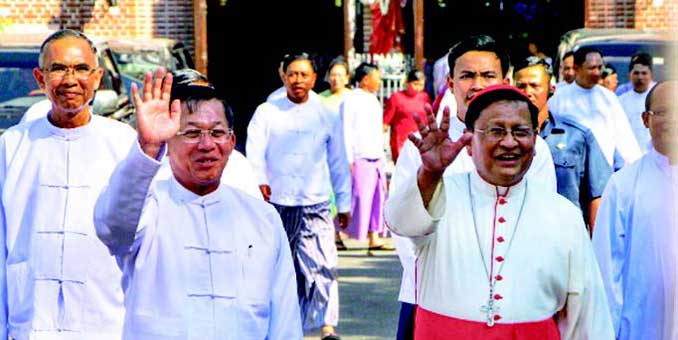
Pope praises Thailand’s commitment to peace

Pope Francis has praised Thailand for promoting harmony and peace in a video message ahead of his visit to the kingdom that begined on Nov. 20.

“In this world that too frequently experiences discord, division and exclusion,” Thailand has shown commitment to work hard “to promote harmony and a peaceful coexistence,” he says.

This commitment, he says, “can serve as an inspiration” for all the people around the world who are working to “promote a great, true development of our human family in solidarity, in justice and in living in peace,” Vatican News reported.

Pope Francis visited Thailand on his 32nd Apostolic Journey from Nov. 20-23 before heading to Japan.

In his message, he said he will have the opportunity to meet and “encourage” the Catholic community of Thailand “in their faith and in the contribution they make to the whole of society.”

He is hoping to “strengthen the bonds of friendship that we share with many Buddhist brothers and sisters.”

“I trust that my visit will help to highlight the importance of interreligious dialogue, mutual understanding and fraternal coope-ration,” says the Pope.

He thanked the people of Thailand “from the bottom of” his heart for all the preparation that is being made for his visit.

This is the first papal visit to Thailand in nearly four decades following the journey made by Pope John Paul II in 1984.

Pope’s Asia visit ‘shows concern for marginalized’

Pope Francis’ visits to Thai-land and Japan show his love for marginalized communities, says Cardinal Charles Bo of Yangon, president of the Federation of Asian Bishops’ Conferences. In his fourth visit to Asia, Pope Francis is scheduled to arrive in Bangkok on Nov. 20. Three days later, he leaves for Tokyo and nuclear-bombed Hiroshima and Nagasaki before returning to Rome on Nov. 26.

Pope Francis has “chosen countries where the Catholic community is a minority. His concern for communities on the margins has amplified their presence,” Cardinal Bo said in a statement.

Two years ago, “he chose to visit two countries where the Christian presence is so small. Christianity was in Myanmar for 500 years. His visit made this small flock to be known to the world,” said the cardinal.

In his 2017 Asia visit, Pope Francis covered Muslim-dominated Bangladesh and Buddhist-majority Myanmar, the base of 71-year-old Cardinal Bo.

Pope Francis became the first Pope to visit Myanmar, where Christians form just 6 percent of a population of some 54 million people. Catholics make up about one percent or some 750,000.

Myanmar cardinal praises inter-faith harmony at Kolkata meet

On a stopover in Kolkata on the last leg of his first visit to north-eastern India, Cardinal Charles Maung Bo of Yangon, Myanmar, met with leaders of various religions in Kolkata.

The cardinal expressed happiness over interfaith unity, harmony and brotherhood he witnessed among the leaders on November 13.
“I am deeply touched by the religious brotherhood and respect shown by the minority delegation of Muslim and Buddhist leaders who spent fellowship time,” said the cardinal who is known for his leadership among the Religions for Peace movement.

Pope’s cousin, missionary in Thailand, will serve as his translator

Pope Francis’s translator in Thailand will be someone familiar with the nuances and colloquialisms of his Argentine Spanish because she grew up speaking it with him.

Salesian Sister Ana Rosa Sivori, the Pope’s second cousin and a missionary in Thailand for more than 50 years, will translate for Francis during his stay on Nov. 20-23 in Thailand, said Matteo Bruni, director of the Vatican press office.

Christian journalist persecuted, resigns in Pakistan

In yet another incident of religious intolerance in Pakistan, a Christian journalist quit Dunya News after she was allegedly persecuted for her faith by co-workers and insulted for not converting to Islam after marrying a Muslim, media reports said.

Gonila Gill (38), married to Husnain Jamil, was the only Christian journalist registered with the Lahore Press Club, reported AsiaNews.

“People talk rubbish about my faith. But I will not lose hope and remain steadfast in my religion,” Gill was quoted as saying by the news website.

In Pakistan, several incidents of violation of religious freedom have come to fore recently.

According to a recent US Commission on International Religious Freedom (USCIRF) report, “Extremist groups and societal actors in Pakistan continued to discriminate against and attack religious minorities, including Hindus, Christians, Sikhs, Ahmadis and Shia Muslims.”

Pakistan had failed to “adequately protect these groups and it perpetrated systematic, egregious religious freedom violations,” it said.

Theology in ‘dialogue with cultures’ renews humanity, Pope Francis says

When theology and philosophy engage with cultures in creative ways, they become a powerful tool for renewing humanity with the Word of God, Pope Francis said Saturday, during the awarding of the Ratzinger Prize on 9th November 2019.

“This is true for all cultures: access to redemption for humanity in all of its dimensions should be sought with creativity and imagination,” the Pope said.

He quoted St Paul VI’s apostolic exhortation Evangelii Nuntiandi, which says, “Evangelizing means bringing the Good News into all the strata of humanity, and through its influence transforming humanity from within and making it new.”

“It is a duty for theology to be and remain in active dialogue with cultures, even as they change over time and evolve differently in various parts of the world,” he said. “It is a condition necessary for the vitality of Christian faith, for the Church’s mission of evangelization.”

“All the arts and disciplines,” Francis said, “thus cooperate in contributing to the full growth of the human person, which is to be found ultimately in the encounter with the living person of Jesus Christ, the incarnate Logos, the revelation of the God who is love.”

Pope Francis addressed members of the Joseph Ratzinger-Benedict XVI Foundation in the Vatican’s apostolic palace during the award ceremony for the 2019 edition of the prestigious Ratzinger Prize.

The Ratzinger Prize was begun in 2011 to recognize scholars whose work demonstrates a meaningful contribution to theology or philosophy in the spirit of Cardinal Joseph Ratzinger, the Bavarian theologian who became Benedict XVI.

The winners of the 2019 prize are Catholic intellectual Charles Taylor and Jesuit priest and theologian, Fr Paul Béré.

Béré is the first African to win the prestigious Ratzinger Prize. A lecturer at the Pontifical Biblical Institute, he received the prize for his work on the figure of the prophet Joshua.

Cameroon cardinal: Christians called to be ‘rebels against evil’

Every Christian is a “rebel against evil,” according to Cameroon’s lone cardinal.

Speaking during a program on Cameroonian state television, Cardinal Christian Tumi also called on Christians to become more involved in politics.

“Every Christian is a rebel against all that is not good-that is morally evil. A Christian is a rebel against lies,” Tumi said.

“Politics is part of the world and Christ has told us: Go into the whole world and proclaim the Gospel message. Wherever there is man acting; the Church has to be present,” he said.

“We are therefore called to evangelize the politicians and politics, because their activity also is preparing them for the Kingdom of God. There is no activity that is out of the region of the church,” Tumi continued.

The program brought together Christian leaders from different denominations to discuss relations between Church and State in the West African country, which is currently experiencing a number of crises, including a rebellion in the country’s two English-speaking provinces.

Music, art are a gateway to discover God’s greatness, Pope says

Liturgical musicians have the unique calling to interpret God’s will and love through song and praise, Pope Francis said.

“Every Christian, in fact, is an interpreter of the will of God in his or her own life, and by his or her life sings a joyful hymn of praise and thanksgiving to God,” the Pope said on Nov. 9 during a meeting with participants at a Vatican conference on interpreting sacred music.

The conference, titled “Church, Music, Interpreters: A Necessary Dialogue,” was sponsored by the Pontifical Council for Culture, the Pontifical Institute for Sacred Music and the Pontifical Athenaeum of St Anselm.

Reflecting on the conference theme, the Pope said most people think of interpreters as a kind of translator who conveys what “he or she has received in such a way that another person can understand it.”

Although good interpreters in the field of music essentially “translate” what a composer has written, they also should feel “great humility before a work of art that is not their property,” and to “bring out the beauty of the music.”

European bishops mark 30th anniversary of fall of Berlin Wall

Catholic bishops from the European Union marked 30 years since the breaching of the Berlin Wall with tributes to those who worked for peaceful change, as well as warnings against resurgent “ideologies behind the building of walls.”

“The fall of the Berlin Wall was one of the most important events in European history of the last decades, a moment full of emotion,” the Commission of the Bishops’ Conferences of the European Union, or COMECE, said in a Nov. 6 statement. “But not all the expectations that the fall of the wall brought forth have been fulfilled.”

The statement said the Berlin Wall had symbolized “the ideological division of Europe and the whole world,” adding that its breaching during mass protests on Nov. 9, 1989, had “opened the way for regaining freedom” after communist rule in Central and Eastern Europe.

“Having been separated by a concrete wall for more than 28 years, people — relatives, friends and neighbours — living in the same city were able to meet each other, celebrate and express their joy and hopes. From this moment the world looked different,” said the document, signed by representatives of 26 bishops’ conferences.

Ukrainian Catholic Church faces new struggles, archbishop says

Addressing an audience at Georgetown University on Oct. 25, the leader of the Ukrainian Catholic Church in the United States said the world news in Washington is as “Ukrainian as it ever has been.”

But although he made reference to the current political interest in Ukraine, he also said “no one in Washington would give (the country) the time of day had there not been a July phone conversation,” referring to President Donald Trump’s conversation, now under congressional investigation, with Volodymyr Zelenskiy, Ukraine’s president.

Official Website

Exit mobile version