HENAN, JIANGXI, ZHEJIANG, SINICIZATION ADVANCES: CROSSES BURNT, PARTY FLAGS AND SLOGANS ON CHURCHES

In the name of the sinicization, to create a Christianity with “Chinese characteristics,” the government authorities are burning crosses on the bell towers, replacing them with the red flags of China; slogans praising the Party and the values of socialism are exposed on religious buildings, erasing sacred images, that are considered too Western.

In recent days in Henan, the cross of a Protestant Church was burned in Anyang, Shuiyi County; another was demolished in Hebei; another one in Luoyang has been replaced with the red flag. Even a Catholic centre in Anyang had to display the flag.

In a church in the province, the authorities demanded the removal of the cross, paintings with calligraphy of verses from the Bible and a painting of the Last Supper.

Similar events also take place in Jiangxi. Testimonies gathered by Chinaaid in Xinyu County say that churches are forced to wave the national flag, to display a picture of President Xi Jinping and slogans praising socialism. Many crosses have been destroyed, including that of the evangelical church of Jieken.

At least 40 churches in Shangrao have been forced to display banners that prohibit the preaching of non-Chinese people and prohibit entry to young people under the age of 18.

In Zhejiang, in Leqin, the authorities have forced the churches to exalt the Chinese Communist Party, by singing patriotic anthems at a flag-raising ceremony and pushing for con- certs with nationalist programs. In the Pudong region of Shanghai, the Xuanqiao’s Church of Jesus Christ had to display the slogan on the “basic values of socialism.”

INDIAN BISHOP SEEKS FEDERAL HELP FOR FRAUGHT CHRISTIANS

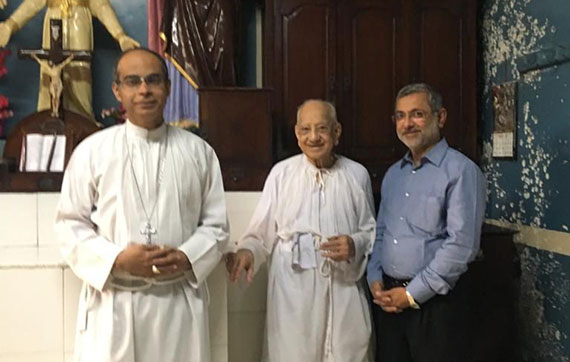
Indian Bishop Theodore Mascarenhas has personally asked federal Home Affairs Minister Rajnath Singh to intervene over the mistreatment of Christians and their organizations in eastern Jharkhand State. Bishop Mascarenhas, secretary general of the Indian Bishops’ Conference, met Singh at his New Delhi office on September 3.

The minister was briefed about difficulties being faced by the Christian minority.

Also present at the meeting was Conard K.Sangma, the Catholic chief minister of Me- ghalaya, a Christian majority state in north-eastern India.

Many Jharkhand Christians believe they are being unfairly targeted by a state government investigation of 88 Christian agencies over foreign donations.

The probes centre on India’s Foreign Contribution Regulation Act requiring that donations be received through a designated bank and spent only for specific social service undertakings.

THE CHRISTIAN FEDERATION OF MALAYSIA: IT IS URGENT TO ERADICATE CORRUPTION AND POVERTY


The Government of Malaysia must commit itself to formulating laws and implementing policies to eradicate corruption and poverty from society: this is what is asked, in an appeal sent to Fides, in preparation for the “Malaysia Day” of September 16, which commemorates the birth of the nation, the Christian Federation of Malaysia (CFM) that, in harmony with Christian values, works to make the country “a nation of harmony, peace, equal opportunity, equality and prosperity for all.”

“Malaysian citizens strive to build a united nation as imagined by the founding fathers. There is a palpable expectation that Malaysia is truly a nation where people can live together and prosper,” says the Federation in a note sent to Fides, reaffirming its message of coexistence, harmony, peace, equality.

The CFM is an ecumenical body that in Malaysia includes the Council of Churches of Malaysia, the Christian Evangelical Fellowship and the Catholic Episcopal Conference of Malaysia. Currently the president of the Federation is Catholic Archbishop Julian Leow, at the head of the Catholic diocese of Kuala Lumpur.

POPE FRANCIS TO VISIT JAPAN NEXT YEAR

In a meeting in Rome with a visiting Japanese delegation on Sept. 12, Pope Francis announced plans to visit Japan next year.

“Since you are here, I would like to announce my intention to visit Japan next year. I hope I am able to fulfil this wish,” Pope Francis told members of the Tensho Kenoh Shisetsu Kenshoukai Association.

“Thanks again for your visit,”

the Pope said, telling the visitors to “take back to your wonderful people and your great country the friendship of the Pope of Rome and the esteem of the whole Catholic Church.”

Members of the association were there with Fathers Renzo De Luca and Shinzo Kawamura. Father De Luca is the Argentine- an-born Jesuit provincial of Japan and was a novice when Pope Francis was his novice master in his native Argentina.

It is well known that Pope Francis had hoped to be a missionary in Japan after joining the Society of Jesus and becoming a priest. But his superiors believed he did not have the required good health to do so.

BANGLADESH CHURCH SETS PRIORITIES FOR THE NEXT DECADE

The Catholic Church in Bangladesh plans to treat the welfare of families and poverty, as well as environmental protection and migrant welfare, as pastoral priorities in the next decade. New guidelines state that such an approach would “give witness” to the Church in the low-lying nation.

A 12-point ‘mission statement’ was issued at the end of a national pastoral workshop of the Catholic Church held on August 28-31 at the Catholic Bishops’ Conference of Bangladesh secretariat in the capital, Dhaka. It was themed ‘Communion: Witness of the Church in Bangladesh.’ Pastoral priorities are to include spirituality of communion in individual, family and social life as well as the formation of faith, evangelization and pastoral services. Also cited was educational opportunities and values formation together with family life and pastoral services to marginalized communities and the poor. Further, priority would be afforded to socio-economic development and self-reliance, inter-religious harmony and Christian unity as well as enhancing religious vocations and services.

BURMA CARDINAL: THE ‘WAR’ ON THE KACHIN IS BEING OVERLOOKED

Cardinal Charles Bo, Burma’s most senior churchman, has said the military are continuing to persecute ethnic Kachin, a predominantly Christian group in a conflict- torn part of the country.

Speaking on September 1 at a peace forum in South Korea, Cardinal Bo said the suffering the Rohingya have endured has captured the world’s attention. He described their plight as an “appalling scar on the conscience of my country,” ucanews.com reported.

Yet, he continued, other targeted groups are being overlooked as ethnic fighting rages on in northern Burma, with thousands of ethnic minorities having been injured, killed and displaced.

“Villages bombed and burned, women raped, churches destroyed, villagers used as human minesweepers and human shields,” Cardinal Bo told peace experts at the Catholic University of Korea in Seoul.
The cardinal elaborated on military air strikes in Kachin in February and a major offensive in April that led to more than 7,000 people being displaced.

He said a series of “wars” were being waged in Burma against those who espouse religious freedom by forces preaching religious intolerance and hatred.

Cardinal Bo also lamented a several violent conflicts stemming from land ownership disputes and other concerns including human trafficking, environmental degradation, drug abuse by young people, poverty and a lack of protection of basic rights.

“These ‘wars’ continue even though Burma has moved over the past eight years through reforms and made a fragile transition from a military dictatorship to a fragile democracy,” he said.

Sporadic fighting has occurred in the Christian stronghold of Kachin State since the country then known as Burma broke free of its colonial shackles in 1948 by gaining independence from British rule. The situation deteriorated in 2011 when some 100,000 people were displaced. Most of the state’s 1.7 million Kachins are Christians, including 116,000 Catholics.

AUSTRALIAN BISHOPS, RELIGIOUS SAY SEAL OF CONFESSION IS SACRED

Australia’s Catholic bishops and religious orders, responding to recommendations from the Royal Commission Into Institutional Responses to Child Sexual Abuse, accepted 98 percentage of its suggestions, but said they could not accept recommendations that would violate the seal of confession.

Support independent Catholic journalism. Become an NCR For- ward member for $5 a month.

“We are committed to the safe-
guarding of children and vulnerable
people while maintaining the seal.
We do not see safeguarding and the
seal as mutually exclusive,” said the preamble to a 57-response to dozens of recommendations concerning child safety, formation of priest and religious workers, on-going training in child safety and even out-of-home care service providers.

The response, published Aug. 31, came eight- and-a-half months after the Royal Commission released its 17-volume report on child sexual abuse. The report was based on five years of hearings, nearly 26,000 emails, and more than 42,000 phone calls from concerned Australians. In February 2017,

Australian Church leaders spent three weeks testifying before the commission.

In a statement published with their response, Josephite Sister Monica Cavanagh, president of Catholic Religious Australia, and Archbishop Mark Coleridge of Brisbane, president of the Australia Catholic Bishops’ Conference, ex- pressed “their deep sorrow that vulnerable children were abused, weren’t believed and weren’t supported when seeking justice.”

Cavanagh said, “The process is already underway to reform the church’s practices to ensure that safeguarding is integral in all that we do as part of our ministry and outreach in the community.”
The statement said Coleridge acknowledge that the church’s response to the abuse scandal had been “too slow and too timid.”

“Many bishops failed to listen, failed to believe, and failed to act,” he was quoted as saying. “Those failures allowed some abusers to offend again and again, with tragic and sometimes fatal consequences.”

GERMAN CHURCH LEADERS CONDEMN RACISM AND ‘MIGRANT-BASHING’ IN CHEMNITZ

The clashes between right- wing demonstrators and antifascist protesters in the eastern German city of Chemnitz in Saxony, where a German with Cuban roots was stabbed to death by an Iraqi and a Syrian on 27 August, have been sharply condemned by church leaders in Germany.

The Catholic Church would always “clearly reject” racism and “migrant bashing,” Father Karl Jüsten, head of the “Katholisches Büro” in Berlin, the German bishops’ conference’s liaison office with the German government, underlined in an interview with ‘domradio.de.’

“It really is terribly depressing to see that many people have obviously rejected the democratic consensus and no longer allow the constitutional state to do its work,” Jursten said. “This time, the police were very quick to act but for a certain group of people that was not enough. It is simply not acceptable that such a group should think they are above the law, should take the law into their own hands and even to declare how the state should behave. I am not accusing all those who joined in the rioting of being Nazis. In Berlin, we have similar problems with left-wing protesters. As a church we must ask ourselves how we can reach those who have rejected the democratic consensus.”

WORLD LEADERS, FAITH GROUPS GATHER FOR GLOBAL CLIMATE ACTION SUMMIT

In an effort to move beyond promises and pledges, leaders from around the world have joined the faith community and others in San Francisco to put on display actions under way to address the global threat of climate change, and to mobilize even more.

The three-day Global Climate Action Summit officially opened Sept. 12, and is expected to draw more than 4,000 delegates to the Bay Area. Its primary focus is show- casing the steps taken so far toward fulfilling the goals of the 2015 Paris Agreement. Under that accord, 195 nations committed to limit average global temperature rise “well below” 2 degrees Celsius (3.6 degrees Fahrenheit), and as low as 1.5 C (2.7 F).

While the summit, hosted by California Gov. Jerry Brown, will highlight achievements to date in implementing the Paris Agreement — announcements of progress and new commitments to reduce greenhouse gas emissions by cities, regions, organizations and companies are expected throughout the three days — it also aims to push the global community to “take ambition to the next level,” the gathering’s theme. Scientists have estimated the planet has already warmed 1 C since the late 19th century and that the initial national pledges under the Paris accord will yield an overall temperature rise of 3 C by the end of the century. In addition, few countries are on track to meet their commitments, and funding for the Green Climate Fund, to assist developing nations in implementing climate mitigation efforts, has been slow to materialize.

The next round of United Nations climate talks, in Katowice, Poland, in December, will serve as the first official stock take of global progress. “Climate change is the defining issue of our time, and we are at a defining moment,” António Guterres, U.N. Secretary General, said in a speech at U.N. headquarters in New York. He added that if the world doesn’t change course by 2020, “we risk missing the point where we can avoid runaway climate change.”

“God has made the earth green and beautiful. And there is no greater threat to our ‘green and beautiful’ earth than the more frequent and intense droughts, floods, storms and wildfire brought by climate change, which knows no barrier,” said Nana Firman, co-founder of the Global Muslim Climate Network.

SPOKESMAN OF THE EPISCOPATE: EVERY FIFTH DIOCESAN PRIEST IN POLAND MURDERED DURING WORLD WAR II

Every fifth diocesan priest
was murdered in Poland occupied by the Germans and Russians.
Four Polish bishops were killed
in the concentration camps, and
nearly half of the Roman Catholic dioceses were deprived of
diocesan bishops. It was also a
war with religion – said the spokesman of the Polish Bishops’ Conference, Fr Pawe B Rytel- Andrianik, on the 79th anniversary of the outbreak of World War II. The spokesman of the Episcopate reminded that during the World War II in Poland there was massive persecution of the clergy. “Priests, monks, nuns were shot, sent to concentration camps, imprisoned and tortured. The Germans confiscated the Church’s goods and closed the churches. Nevertheless, the faith of the Church in Poland survived this dark period of German Nazi terror” – he added.

Fr. Rytel-Andrianik pointed to the tragic data from World War II. “According to scientific research, for about 10,000 diocesan priests (in 1939) German Nazis murdered about 2,000 priests, that is every fifth priest. Among about 8,000 monks (in 1939), 370 were murdered. Among about 17,000 nuns, the Nazis murdered about 280 sisters. Additionally, during World War II about 4,000 priests and monks and about 1,100 nuns were imprisoned in German concentration camps. Those who were at large were also repressed” – said the spokesman of the Polish Episcopate. During the World War II, almost half of the Polish dioceses were deprived of diocesan bishops. In twenty-one Roman Catholic dioceses in Poland, nine were without bishops who were interned or forced to emigrate, and one of the diocesan bishops was murdered.

Official Website

Exit mobile version