
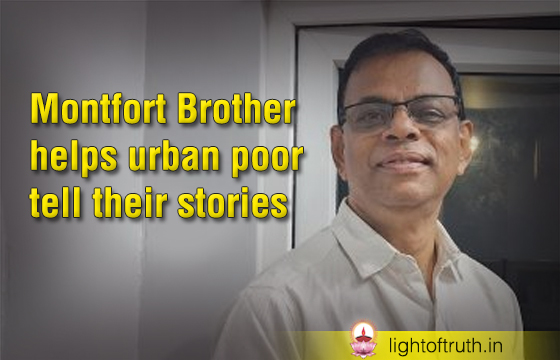
Montfort Brother Varghese Theckanath is on a journey to make the voice of the voice-less heard in the main stream socie-ty. “Many interest-ing things happen among them, but only when a misfortune happens, their stories are reported,” bemoans Brother Theckanath, a grassroots activist promoting the rights of the urban poor. As a solution, the 67-year-old Brother has set up a sound and visual studio at Montfort Social Institute (MSI) at Ramanathapuram, Secunderabad, the twin city of Hyderabad. The institute, affiliated to the Earth Charter Initiative, is a resource and training centre for the promotion of Human Rights Edu-cation and Sustainable Development Education. “I want to train about 100 youth from the families of migrants, domestic workers, street dwellers so that they can express their achieve-ments and grievances first hand,” Brother Theckanath, who had served as the Central India provincial of the Montfort Brothers of St Gabriel for six years, told.
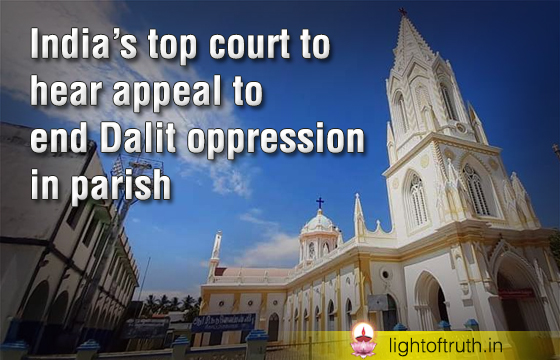
India’s top court to hear appeal to end Dalit oppression in parish
In what is billed as a first in history, India’s Supreme Court has agreed to hear an appeal seeking to end discrimination against socially poor Dalit Catholics in a parish in southern India. The case came to the nation’s top court after the High Court of the Tamil Nadu state dismissed a petition of some Catholics of Kottapalayam parish in Kumbakonam diocese seeking its intervention to end the alleged caste-based discrimination in the parish. The Madurai bench of the state High Court dismissed the petition, saying the appeal was “not only superfluous” but also the court had no “jurisdiction” over the issue. The petition wanted the court to order to end discriminatory practices in the parish, which included maintaining two cemeteries in the parish – one for the upper caste people and the other for Dalit people – among several other such practices. The petitioners challenged the state court’s dismissal in the Supreme Court, which, following a preliminary hearing on Feb. 21, accepted the case for hearing and ordered to seek responses from the respondents. The respondents include 17 individuals and offices, which include heads of regional and national bishops’ forums, the local bishop, the archbishop, and district and state officials of departments meant to protect the interests of people of lower caste origin. Lawyer Franklin Caesar Thomas, who appeared for petitioners, said the Supreme Court’s accepting a petition of Dalit Catholics against discrimination within the Church “is first in the history of India.” Thomas said Dalit Catholics in Kumbakonam diocese face inhuman caste-based discrimination, including “untouchability and aggression” from the high caste community. The petitioners in the appeal said they had sought the help of district and state authorities to end the practice but “no proper or complete action was taken by any of the authorities.” Thomas told that the parish has 150 Dalit Catholic families, but the parish does not take their contributions nor involve them in church activities and celebrations. Thomas said the upper caste believe Dalit Catholics’ contributions could “pollute them and their entire celebrations.”
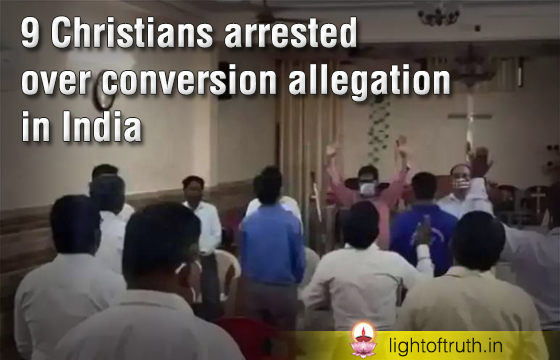
9 Christians arrested over conversion allegation in India
Police have arrested nine Christians in the northern Indian state of Uttar Pradesh for holding Sunday prayer meetings, which Hindu groups alleged were meant to convert local Hindus. The arrests were made in identical cases reported from two places on Feb. 23. Five people, including a pastor and three women, were arrested in Sitapur district while four others including a pastor were arrested in Raebareli district, said local media reports. The arrested Christians had gathered for regular Sunday prayers insides houses when Hindu mobs barged in and alleged they were defaming the Hindu religion and its deities and offering inducements to convert people.
The police seized religious materials including copies of the Holy Bible as evidence of conversion activities, media reports said. “They were later remanded in judicial custody,” said a Church leader who is assisting the arrested Christians. The leader who did not want to be named for fear of reprisals said the police action was based on “mere allegations from right-wing Hindu activists and without any evidence.” “It has now become very dangerous for Christians to hold prayer gatherings in their homes,” he told on Feb. 24. The arrested Christians were charged under the strict provisions of the Uttar Pradesh Prohibition of Unlawful Conversion of Religion Act 2021.
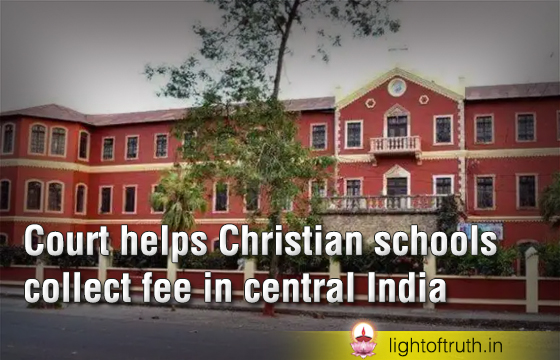
Court helps Christian schools collect fee in central India
Several schools in central India, some of them Church-managed, averted a crisis when students began to pay tuition fees, which they had stopped on allegations that these schools collected excessive fees in the past.
“We have been struggling to pay the salary to our teachers as many parents refused to pay the fees of their children this year,” said Father Thankachan Jose, who is dealing with the court cases of his Jabalpur diocese in Madhya Pradesh state.
The parents had stopped paying school fees to their children in 11 schools, most of them Christian-run, accusing them of collecting excess fees in the previous six academic years. The parents also filed 20 petitions seeking the inter-vention of the High Court, the top court in the state, to get the alleged excess money collected refunded to them.
Christian leaders say the allegation stems from an anti-Christian atmosphere in the state, where the pro-Hindu Bharatiya Janata Party runs the government. “We are relieved now after parents began to pay the tuition fees after court, through its interim order, took a clear stand, Jose told.
He told on Feb. 20 that the differing parents began to pay fees following a Feb. 13 High Court order that asked parents to clear all fee dues to the respective schools within one month.
The court said if the parents fail to pay fees, schools are allowed to withhold the annual results of the students.
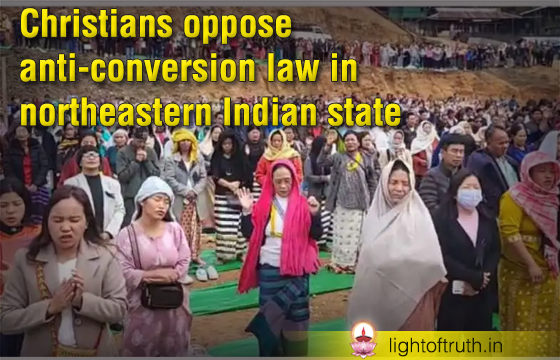
Christians oppose anti-conversion law in northeastern Indian state
Christians in a northeastern Indian state staged a day-long hunger strike on Feb. 17 against the government’s move to impose an anti-conversion law, which they say is unconstitu-tional and anti-Christian.
The Arunachal Pradesh Freedom of Religion Act (APFRA) was introduced in 1978 to protect the traditional religious practices of indigenous communities from external influence or coercion. But it remained dormant for over 45 years as successive governments failed to frame the rules.
On Sept. 30 last year, the Gauhati High Court’s perma-nent bench in Arunachal Pra-desh’s capital Itanagar asked the state government to finalize the rules within six months. The directive came after a public interest litigation by a citizen against the government’s failure to enforce the law. Chief Mini-ster Pema Khandu on Feb. 15 said the rules being framed as per the court directive were not against any religion, but “to give some more protection to indigenous faiths.”
The Arunachal Christian Forum (ACF) said that “the draconian law is against the secular constitution of our country and is anti-Christian.” “It violates the right to freely profess, practice and propagate religion,” ACF President Tara Miri told on Feb. 18.The ACF, a multi-denominational body that organized the hunger strike in Itanagar, said Christians also held protests, across the state’s 29 districts throughout the week. “There are 46 Christian denominations in the state and their members organized their own protest marches, prayers and fasting programs at their respective places,” Miri said.
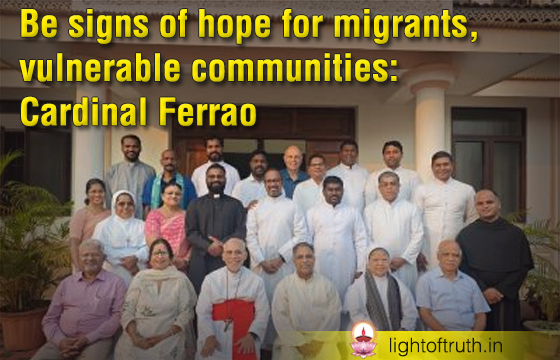
Be signs of hope for migrants, vulnerable communities: Cardinal Ferrao
A two-day meeting in Goa has reaffirmed the Church’s commitment to migrant care and advocacy, urging dioceses and religious congregations to become protagonists of change in fostering a more inclusive and compassionate society. “The members of the Church must become signs of hope for migrants, the elderly, the sick, and all those in need, especially those in vulnerable situations and on the peri-pheries,” said Cardinal Philip Neri Ferrao, Archbishop of Goa and Daman and presi-dent of both the Federation of Asian Bishops’ Conferences and the Conference of Catholic Bishops of India (CCBI).The cardinal was speaking at the February 20-21 gathering of diocesan secretaries of the Commission for Migrants from Tamil Nadu and Kerala, organized by the CCBI Commission for Migrants at Shanti Sadan Pastoral Centre, Old Goa. He reminded the Church of its mission, especially in this Jubilee Year, to be a source of hope. He referenced Pope Francis’ Bull of Indiction for the Jubilee Year, emphasizing the Church’s call to accompany and uplift those in distress. Highlighting the lives of Saints Francis Xavier and Joseph Vaz, Cardinal Ferrao described them as models of relationship-building, which he called the foundation of pastoral care for migrants and other vulnerable groups. “Caring and empowerment happen through relation-ships,” he stressed.
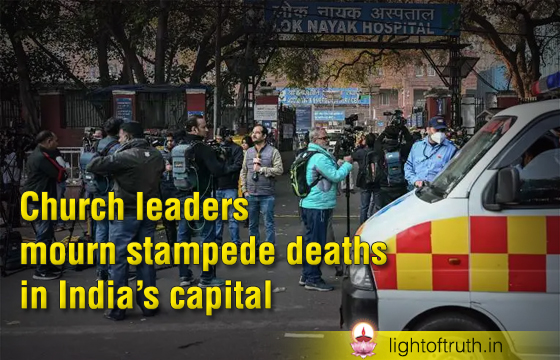
Church leaders mourn stampede deaths in India’s capital
Church leaders have mourned the death of Hindu pilgrims in the latest stampede at the overcrowded New Delhi Railway Station in India’s capital. The deadly crush on Feb. 15 night reportedly killed 18 people and left several injured. Railway officials said the surging crowds scrambled to catch trains to Prayagraj, a city in northern Uttar Pradesh state, for the Maha Kumbh, the world’s biggest religious gathering of humanity. This is the second such tragedy related to the Maha Kumbh festival in recent weeks. On Jan. 29, at least 30 people lost their lives in a stampede at the festival in Prayagraj. Two trains had been delayed at the station, while a third heading to Prayagraj was waiting to depart. “People pushed against each other to get into them and the crush occurred after some passengers slipped and fell on the stairs” leading to the platforms, a spokesperson for Indian Railways said. Opposition leaders criticized the Indian Railways and the pro-Hindu Bharatiya Janata Party (BJP) led federal government in Delhi, for failing to manage crowds. “Very unfortunate and sad that we have lost precious lives of Hindu pilgrims,” Father Savarimuthu Sankar, spokesperson of the Archdiocese of Delhi told on Feb.17. He said the administration “learned nothing from the deadly stampede just 15 days ago.” Father Isidore D’Souza, chancellor of Allahabad diocese told that “in both the incidents, the authorities did not expect that such huge crowds would turn out.” Allahabad is the former name of the Prayagraj. People suspect that the exact number of causalities in the stampedes is not made known. “It’s also not clear what exactly led to the tragedies,” D’Souza added.

Indian Church hails Saint Teresa of Kolkata Church calendar move
Church leaders in India have welcomed the Vatican’s decision to add the feast of St. Teresa of Kolkata to the universal liturgical calendar, saying it will help Catholics across the globe emulate the nun’s sense of service to the poor.” This is a great recognition and appreciation of her work for the poorest of the poor and the abandoned men, women and children,” Archbishop Thomas D’Souza of Calcutta told UCA News on Feb.19. The archbishop was responding to the Feb. 11 Vatican decree that said Pope Francis had added the saintly nun to the liturgical calendar, making the feast day Sept. 5, the day of her death in 1997. The Vatican decision “would also provide a tremendous boost to the work of her congregation — the Missionaries of Charity — in all corners of the world,” D’Souza said. The Vatican decree said the decision follows requests from “bishops, religious and associations of the faithful” and also considers “the influence of the spirituality of Saint Teresa of Calcutta throughout the world.”
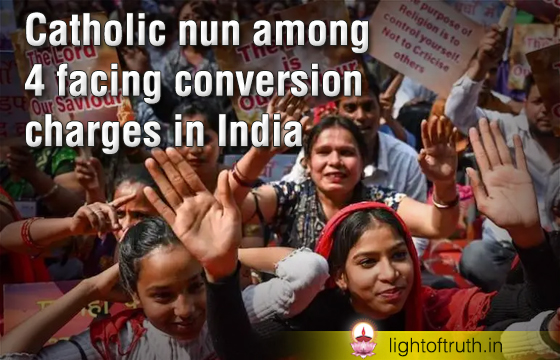
Catholic nun among 4 facing conversion charges in India
Police in central Indian Madhya Pradesh state filed a criminal case against a Catholic nun and three others on Feb. 16 for violating the state’s anti-conversion law. Indore city police filed the case against Holy Spirit Sister Sheela Savari Muthu and her three colleagues – two women and a man – after they organized a program for the children of domestic workers. The case is based on the demand of some right-wing Hindu activists. The Hindus wanted action against Christians for allegedly trying to convert some 120 children who attended the health and hygiene awareness camp conducted in a public garden. The police detained the accused for close to nine hours but released them at nine at night despite some 600 Hindu activists shouting slogans against their release and missionary activities. The Hindu mob also tried to instigate the children and women brought to the police station to give testimonies against the nun but failed. They also unsuccessfully attempted to get the nun’s female colleagues to give statements against her inside the police station, eyewitnesses told. “Neither the children nor the women succumbed to their pressure, but still the police, under pressure from the Hindu activists, registered the case,” says an eye witness to the incident, who did not want to be named. Sister Muthu said it was “totally a false case.” “We organized a health and hygiene camp for the domestic workers’ children. We did it in the open public garden with permission from the local government officials,” she told. Within a few hours of the program, people gathered and started shouting slogans against missionaries and religious conversions. “Soon, we sought police help,” she said.” The police took us to the police station.
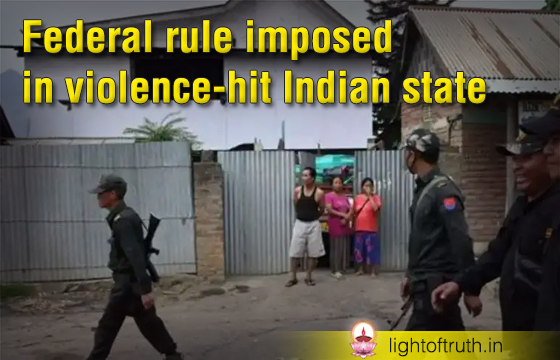
Federal rule imposed in violence-hit Indian state
A Church leader from India’s Manipur expressed optimism after the strife-torn state in north-east region was brought under direct federal rule days after its chief minister resigned.
Chief Minister N Biren Singh from the pro-Hindu Bharatiya Janata Party (BJP) quit on Feb. 9 after facing pressure to step down for failing to stop the continuing violence in the state for nearly two years. The ethnic clashes bet-ween the state’s majority Meitei and minority Kuki communities broke out in May 2023 over economic benefits, land rights and job quotas.
More than 250 people have been killed and over 60,000 displaced, most of them indigenous Christians from the Kuki-Zo group. The office of President Droupadi Murmu on Feb. 13 announced President’s rule, which allows the Delhi-appointed gover-nor to administer the state on behalf of the federal government. Murmu’s office said in a state-ment that the federal rule was imposed because of the situation in which the governance of that state could “not be carried on in accordance with the provisions of the Constitution of India.”
A Church leader in the troubl-ed state told that “the federal government can work towards healing wounds and restoring peace, provided it is sincere.” Christians have been demanding the chief minister’s dismissal since the violence began almost two years ago.
“The chaos cannot continue indefinitely. There should be an end [to violence],” added the Church leader who did not want to be named, fearing retribution. He said the discriminatory atti-tude towards indigenous commu-nities adopted by Singh, a Meitei, has “divided both the communities to such an extent that they do not like to see each other or share the same space.”