
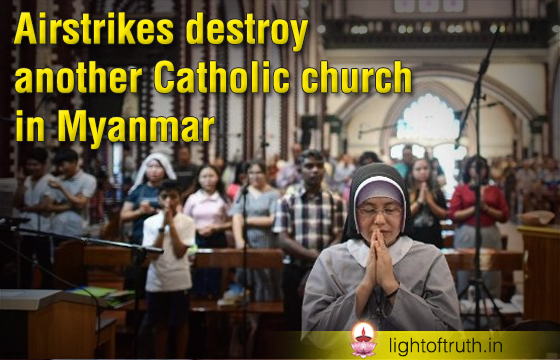
As fighting between the military junta and resistance forces continues despite the recent earthquake, the regular army bombs the Church of Christ the King in the town of Falam, Chin State. Airstrikes by the regular army have destroyed another Catholic church in Chin, Myanmar’s only Christian-majority state, marking yet another tragic chapter in country’s ongoing civil war between the military junta and resistance forces that continues to severely impact Christians and their places of worship.
The Church of Christ the King in the town of Falam, part of the Diocese of Hakha, was hit on April 8. According to Fides local sources the church’s roof and interior have been devastated, but the building’s walls are still standing. The church had only been recently built with great sacrifice to meet the needs of the local Catholic community of around one thousand faithful. It had been consecrated and opened for worship in November 2023, replacing a small chapel that had existed for 75 years. “There is great sadness now in the community, but also the desire and determination to rebuild,” the source told Fides.
Southeast Asia: Traffickers pose as Christian missionaries, pilgrims to exploit victims
Investigations have revealed that Human traffickers in Southeast Asia are increasingly posing as missionaries or pilgrims to deceive authorities and avoid detection at international borders. According to a report by the Vatican’s Fides News Agency, this emerging tactic involves victims and traffickers disguising themselves as Christian missionaries or volunteers engaged in religious activities abroad.
Police operations, supported by wiretaps and coordinated investigations, have uncovered several cases using this “religious cover.” Police described a method where “a regular traveler, acting as a smuggler, accompanies groups of passengers under false pretenses, who become victims of trafficking.” Law enforcement agencies across Southeast Asia–including the Philippines, Indonesia, Malaysia, Thailand, and Cambodia–have intensified joint operations to combat these networks.
In the Philippines, the Catholic Foundation PREDA (People’s Recovery, Empowerment, and Development Assistance), founded by Irish missionary Fr Shay Cullen, has long denounced trafficking schemes that exploit young women. Fr Bryand Restituto, Assistant to the Secretary General of the Catholic Bishops’ Conference of the Philippines, strongly condemned these deceptive practices. ”We strongly condemn individuals and trafficking networks that exploit vulnerable populations and use language, clothing, and presumed religious practices to commit criminal acts,” he said. In Thailand, Sister Marie Agnes Buasap of the Hospitaller Sisters of Saint Paul of Chartres and coordinator of the Talitha Kum Thailand network, is among those leading anti-trafficking efforts. Talitha Kum promotes awareness among youth, families, and educators, and supports the reintegration of survivors.
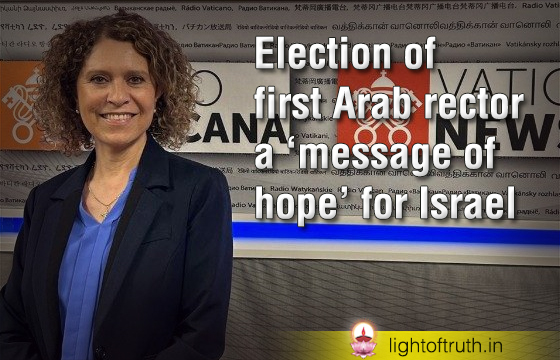
Election of first Arab rector a ‘message of hope’ for Israel
Mouna Maroun was appointed Rector of the University of Haifa, becoming the first member of Israel’s Arab minority – an underprivileged group that, according to rights organisations, continues to face structural discrimination – ever to hold the role at an Israeli university.
Maroun is also a Christian, hailing from a small Maronite Catholic village on the slopes of Mount Carmel. Christians make up only around 7% of the total Israeli Arab population, which in turn represents about one fifth of Israel’s total, and Maroun’s tale of success – as a woman, an Arab, and a Christian – is therefore a noteworthy one.
Her election was “a miracle”, Maroun tells Vatican News, coming as it did only a few months after Hamas’ 7th October attacks and rising tensions between Arabs and Jews within Israel. In April 2024, she had been appointed the University of Haifa’s Rector, or chief academic officer, a role second only to the President in the university hierarchy.
Speaking recently to the Vatican News Maroun describes her appointment as a “message of hope” and a sign that “things can be different in Israel”, that Jews and Arabs “can succeed together and can live together”.
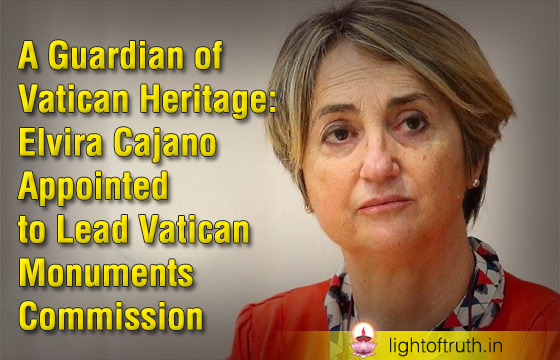
A Guardian of Vatican Heritage: Elvira Cajano Appointed to Lead Vatican Monuments Commission
Professor Elvira Cajano has been appointed President of the Permanent Commission for the Protection of Historical and Arti-stic Monuments of the Holy See. The announcement was made on April 10 by Cardinal Secretary of State Pietro Parolin, marking a new chapter for the century-old institution charged with safe-guarding some of the most trea-sured sites and artworks in Chri-stendom.
Cajano, an esteemed archi-tectural historian born in Parma in 1955, brings decades of expertise to her new role. With an academic background that bridges architecture, history, and conservation–earned at the Uni-versity of Rome “La Sapienza”–she has long stood at the inter-section of scholarship and public service. Her leadership roles within the Superintendency of Archaeology, Fine Arts, and Heritage of Umbria, coupled with her tenure as a visiting professor at the Pontifical Gregorian University, position her uniquely to take on the complex responsi-bilities of the Commission.
More than an administrative role, the presidency of the Co-mmission represents a stewardship of memory and meaning. Cajano succeeds Francesco Buranelli, a former director of the Vatican Museums and a leading figure in art conservation. Under Cajano’s direction, the Commission will continue to serve not only as a regulatory body but also as a cultural conscience for the Vatican–evaluating restoration projects, overseeing architectural developments, and shaping the ways sacred art is preserved and presented both within Vatican City and in extraterritorial sites under its jurisdiction.
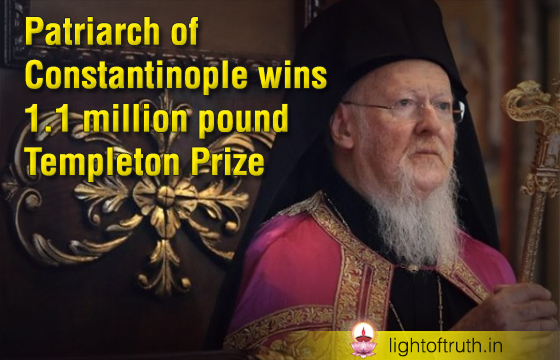
Patriarch of Constantinople wins 1.1 million pound Templeton Prize
The 2025 Templeton Prize has been awarded to Ecumenical Patriarch Bartholomew of Constantinople, the spiritual leader of Eastern Orthodoxy and a visionary voice in the global movement for ecological justice. The £1.1 million prize honours a lifetime of prophetic leadership that has redefined the moral dimensions of environmental stewardship and challenged both faith communities and secular institutions to see the Earth not merely as a resource, but as a sacred inheritance. Often referred to as the “Green Patriarch,” Bartholomew is not only the first among equals in the hierarchy of Orthodox Christian leaders, but also one of the first major religious figures to consistently frame environmental degradation as a spiritual crisis. Decades before climate change entered mainstream conversation, he had already begun weaving together theology and ecology in a call for moral responsibility toward creation.
The John Templeton Foundation, which announced the award on April 9, praised Bartholomew for “pioneering efforts to bridge scientific insight and spiritual wisdom in our relationship to the natural world.” The foundation highlighted how his tireless engagement with scientists, theologians, and policymakers has helped reframe environmental harm not simply as a technical or political issue, but as a profound ethical and spiritual failure.
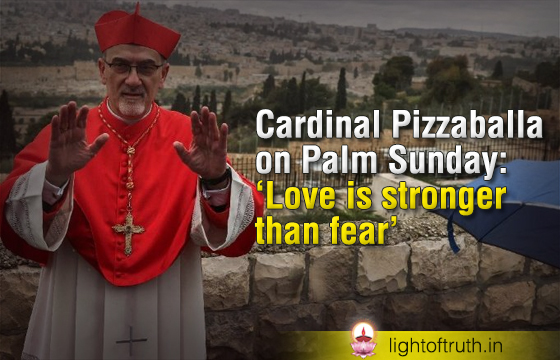
Cardinal Pizzaballa on Palm Sunday: ‘Love is stronger than fear’
As pilgrims and faithful gathered at the gates of the Holy City to commemorate the trium-phal entry of Jesus into Jerusalem, Cardinal Pierbattista Pizzaballa, Latin Patriarch of Jerusalem, delivered a Palm Sunday message calling for hope, unity, and perseverance in the face of ad-versity. Offering greetings to those present and to all united in prayer across the region – from Gaza to Nazareth, from Bethle-hem to Jenin, including the faithful in Jordan and Cyprus, Cardinal Pizzaballa’s words especially ho-noured the Christian community of Jerusalem, whom he described as the custodians of the flame of faith in the city of the Resu-rrection.
“We know we are living through difficult times,” the Cardinal acknowledged. “But we are not here today to speak only of hardship. We are here to proclaim with strength that we are not afraid. We are children of light, of resurrection, of life. We believe in a love that conquers all.” As the Church enters Holy Week, the Patriarch reflected on the Passion of Christ, reminding the faithful that suffering is not the final word. “The Passion is not God’s last word to the world. The Risen One is. And we are here to affirm it once more – with strength, with love, and with unshakable faith.”
Addressing all Christians, he appealed for a response of peace to hatred, unity to division, and welcome to rejection. “This is our vocation: to build, to unite, to tear down walls, and to hope against all hope.” Concluding his message, the Patriarch called on the faithful not to lose heart. “Let us not be discouraged. Let us not lose hope. Let us lift our eyes with trust and renew our concrete and sincere commitment to peace and unity, grounded in the power of Christ’s love.”
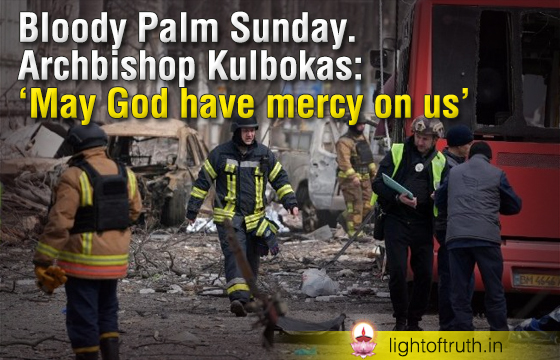
Bloody Palm Sunday. Archbishop Kulbokas: ‘May God have mercy on us’
Palm Sunday, 13 April, marked yet another horrific chapter in the ongoing war in Ukraine. On what should have been a sacred and peaceful day of worship, tragedy struck the city of Sumy in northeastern Ukraine, turning Palm Sunday into a day of mourning and devastation. Just 50 kilometres from the Russian border, Sumy became the site of a deadly missile strike, as two Russian ballistic missiles landed in the city centre around 10 a.m., right as the faithful were making their way to church. The attack reportedly killed at least 34 people, including children, and injured over 100. The victims, many of whom were preparing to celebrate the beginning of Holy Week, instead found themselves caught in a carnage.
In a brief statement to Vatican News, the Apostolic Nuncio to Ukraine, Archbishop Visvaldas Kulbokas, conveyed a sense of helplessness in the face of such senseless violence. ”There’s nothing left but to turn to the Lord to defend us, because it seems that no other force is capable of protecting peace and life,” he said. The Vatican Nuncio noted that in this moment of shared Christian observance–this year, Easter, according to both main calendars Gregorian and Julian falls on the same date,–the attack becomes even more symbolic, cutting into the heart of a nation already under siege.
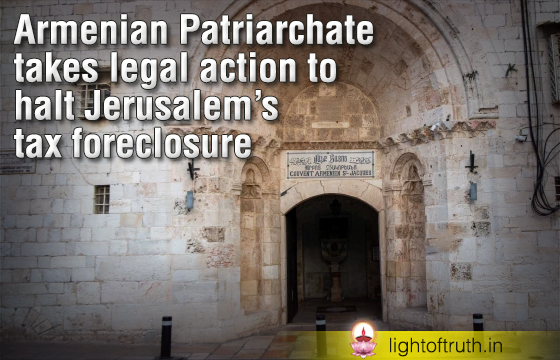
Armenian Patriarchate takes legal action to halt Jerusalem’s tax foreclosure
Tensions have continued to escalate between the Armenian Patriarchate of Jerusalem and the Jerusalem municipality with the latest skirmish over a demand for significant property tax payments called the “Arnona tax” – a levy imposed on property owners in the municipality.
The dispute began two years ago and reignited in February, when a hearing session was scheduled before a district court about an alleged debt of 21 millions shekels (about $5.7 million) and with the threat of foreclosure on patriarchate properties.
CNA spoke with Bishop Koryoun Baghdasaryan, the director of the real estate department of the Armenian Patriarchate who, since Jan. 11, 2023, has been in charge of all the real estate properties in the Holy Land – Israel, the Palestinian Authority, and Jordan. “We received tax bills 12 days after I was appointed, in January 2023, together with the noti-fication that the execution bureau was instructed to be-gin foreclosure proceedings due to the alleged Arnona de-bt,” Baghdasaryan explained.
The Patriarchs and Heads of the Churches in Jerusalem have issued a statement expressing “great concern” over the incident and voicing their solidarity with the Armenian Patriarchate. “This reckless move,” they wrote, “jeopardizes the Orthodox Armenian Patriarchate and sets a perilous precedent that could imperil Christian institutions throughout the Holy Land.” Thanks to public pressure as well as adverse weather forecasts, the hearing was once again postponed until further notice. “At the moment, the situation is on hold,” Baghdasaryan explained, but the situation remains tense, since “it could rise again at any time.”
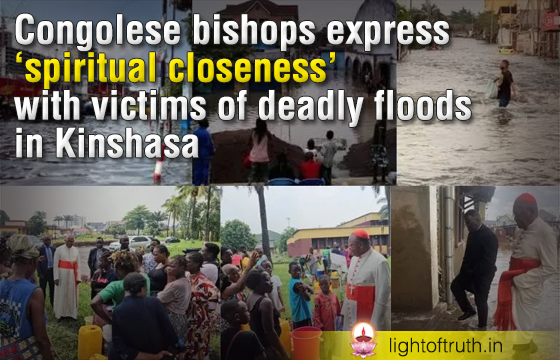
Congolese bishops express ‘spiritual closeness’ with victims of deadly floods in Kinshasa
Catholic bishops in the Democratic Republic of Congo (DRC) have expressed their “spiritual closeness and solidarity” with victims of the recent floods and landslides that struck the capital city of Kinshasa and surrounding areas, leaving scores dead and causing widespread destruction. At least 33 people were reported dead and thousands displaced following the April 5-6 flooding that cut access to over half of the capital. The floods reportedly occurred when the N’Djili River, which runs through the city of an estimated popu-lation of 17.8 million, burst its banks and submerged major roads.
In a statement shared with ACI Africa, CNA’s news partner in Africa, on April 9, members of the National Episcopal Confe-rence of Congo (CENCO) con-veyed their compassion and assured their prayers for those affected by the devastating natural disaster, which followed torrential rains during the night of April 4-5. “We are deeply saddened by the tragic events caused by the torrential rains … resulting in the loss of human lives and significant material damage,” CENCO members said in their statement.
They expressed their “spi-ritual closeness and solidarity” with Cardinal Fridolin Ambongo, archbishop of Kinshasa, and Bishop Jean-Crispin Kimbeni of Kisantu. “With them, we share in the suffering of all those in the heavily affected areas,” they said. “As shepherds of the people, we welcome the measures taken by the Congolese government and the arrangements put in place to assist and shelter those living in the flooded zones,” the statement said. They also appealed to “humanitarian organizations and to the solidarity of all people of goodwill to support the victims of these disasters.”
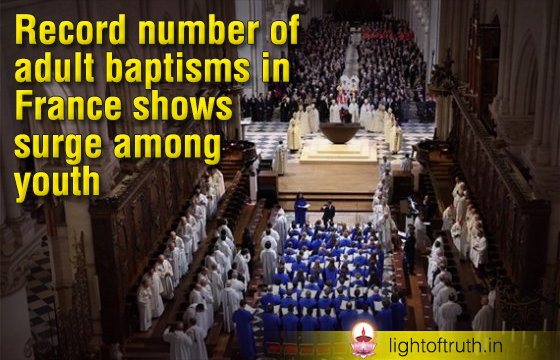
Record number of adult baptisms in France shows surge among youth
France’s Catholic Church will welcome more than 10,384 adult catechumens at Easter this year, marking a 45% increase from 2024 figures, according to data released by the French Bishops’ Conference. The French report reveals the highest numbers ever recorded since the survey began over twenty years ago. Even more striking is the demographic shift – young adults now constitute the largest segment of converts. “The great challenge that presents itself to us now is to make disciples,” wrote Archbishop Olivier de Germay of Lyon in his assessment of the findings. ”We must not simply imagine some procedures for ‘after’ baptism, but our entire parish communities must become aware of their collective mission.”
The 18-25 age group, composed of students and young professionals, now represents 42% of adult catechumens, surpassing the 26-40 demographic that had historically dominated conversion statistics. This youth-driven spiritual awakening represents a significant shift in the Church’s evangelization landscape. Addi-tionally, adolescent baptisms have surged, with more than 7,400 teenagers between 11 and 17 years old preparing to receive the sa-crament. Dioceses across France report a 33% increase in adole-scent catechumens compared to last year. The French Bishops’ Conference intentionally conne-cted this year’s data to the Jubilee of Young People in Rome, des-cribing the event as “a meeting place for young catechumens from around the world.”